
The latest Windows Weekly episode — “Selectively Transparent” — landed as a compact, wide‑ranging briefing that tied together three running threads in the Microsoft era: hardware‑first Windows updates, the ballooning cost of AI at scale, and the operational friction that follows when features are selectively enabled by device, license, or server flag.
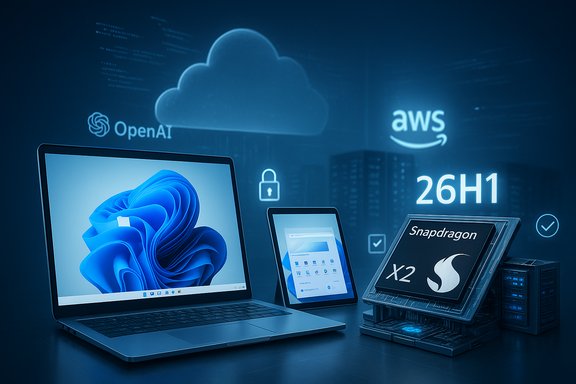
Windows Weekly 957 picked up where recent Insider flights and Microsoft filings left off: Microsoft is experimenting with device‑targeted Windows builds to accelerate support for new Arm silicon, corporate filings reveal sizeable, visible financial exposure to OpenAI in the recent quarter, and the broader industry is reacting in real time — OpenAI is diversifying compute partners even as Microsoft continues to invest heavily in cloud infrastructure. The episode draws direct lines between these developments: a hardware‑gated Windows release (commonly referred to in leaks as 26H1) appears aimed at Qualcomm’s Snapdragon X2 family, Microsoft’s public filings disclose billions of dollars of OpenAI‑related losses in the quarter, and OpenAI’s compute strategy has rapidly moved beyond a single cloud supplier.
This feature unpacks the claims, verifies the largest factual points against primary documents and mainstream reporting, and assesses the implications for consumers, enterprises, and the Windows ecosystem. Where claims are speculative or unverifiable, those will be flagged and explained.
Why this is credible:
That blend of technical pragmatism and financial tension will define the short term for Windows, Azure, and the wider AI ecosystem: a period of rapid capability expansion, meaningful cost volatility, and increasing complexity for admins, developers, and customers. The right response for organizations is pragmatic: validate device behavior before procurement, plan capacity for large update payloads, and demand transparent, machine‑level documentation from OEMs and cloud partners before committing at scale.
Source: Thurrott.com Windows Weekly 957: Selectively Transparent
 Background / Overview
Windows Weekly 957 picked up where recent Insider flights and Microsoft filings left off: Microsoft is experimenting with device‑targeted Windows builds to accelerate support for new Arm silicon, corporate filings reveal sizeable, visible financial exposure to OpenAI in the recent quarter, and the broader industry is reacting in real time — OpenAI is diversifying compute partners even as Microsoft continues to invest heavily in cloud infrastructure. The episode draws direct lines between these developments: a hardware‑gated Windows release (commonly referred to in leaks as 26H1) appears aimed at Qualcomm’s Snapdragon X2 family, Microsoft’s public filings disclose billions of dollars of OpenAI‑related losses in the quarter, and OpenAI’s compute strategy has rapidly moved beyond a single cloud supplier.This feature unpacks the claims, verifies the largest factual points against primary documents and mainstream reporting, and assesses the implications for consumers, enterprises, and the Windows ecosystem. Where claims are speculative or unverifiable, those will be flagged and explained.
What Windows Weekly reported (summary)
- Microsoft is expected to ship an interim Windows 11 release labeled 26H1 that will arrive first on devices built around Qualcomm’s Snapdragon X2 family; this mirrors the 24H2 early rollout for earlier Snapdragon hardware and appears designed to permit platform‑specific driver, NPU, and firmware work to ship with retail systems.
- The Dev and Beta Insider rings are being remapped to support this cadence (Dev → 26H1 testing; Beta moving to 25H2 from 24H2). Functionality is expected to be largely identical across eventual H2 releases except for a handful of Copilot+ PC features that may initially be exclusive to X2 hardware.
- Microsoft’s October/quarterly filings and updates exposed two financial themes: robust top‑line growth driven by cloud and AI but rapidly rising AI infrastructure and partner costs that are materially affecting financial results. The episode highlighted Microsoft’s revenue and capex numbers reported for the quarter and noted an item in regulatory filings that quantified net losses tied to Microsoft’s investment in OpenAI.
- The Insider channel build notes include Ask Copilot in the taskbar, shared audio over Bluetooth LE in preview, improvements to the WOA Prism emulator, and other incremental features and polish for 25H2/26H1 test builds.
- Broader context: OpenAI’s compute relationships are diversifying — recent reports confirm a large multi‑year compute partnership with AWS — and Microsoft’s financial disclosures show a specific, nontrivial accounting impact from the OpenAI equity interest. The hosts discuss how that reality complicates the narrative of Microsoft’s AI investments and Wall Street’s interpretation.
Verification: what’s confirmed and where
1) 26H1 and Snapdragon X2 — credible engineering signal, not a formal product promise
Independent reporting and community analyses align: a device‑targeted interim Windows release timed to Snapdragon X2 hardware is plausible and consistent with Microsoft’s recent pattern of staging heavier features on Copilot+ devices first. Multiple Insider traces show OS and servicing mechanics that make this approach feasible and that Microsoft uses server‑side gating to control exposure. These signals are present in community leak analysis and Insider build notes.Why this is credible:
- Qualcomm’s Snapdragon X2 generation introduces significantly different NPU, CPU core, and driver requirements that often require coordinated OS‑level integration.
- Microsoft has precedent for shipping platform‑specific builds or gating heavy features to new silicon first to protect quality and privacy guarantees (e.g., early 24H2 Copilot+ exposures).
2) Microsoft’s quarterly results and AI infrastructure spending — primary filings and mainstream coverage
Microsoft’s public filings and earnings materials for the quarter ended September 30, 2025, make the following points clear and verifiable:- Revenue for the quarter was reported at approximately $77.7 billion, representing roughly an 18% year‑over‑year increase. This is corroborated by Microsoft’s investor release and market coverage.
- Capital expenditures for the period surged materially (reported figures indicate capex on the order of $34.9 billion for the period as part of AI infrastructure build‑out reporting in market coverage of the earnings). Mainstream tech press covered the unusually high, AI‑driven capital outlay.
- Microsoft’s SEC Form 10‑Q and related disclosures explicitly state that net losses from investments in OpenAI were recognized in the period — the 10‑Q text documents $4.1 billion of net losses from investments in OpenAI that were included in other income (expense), net. That amount reduced GAAP net income and was excluded from Microsoft’s non‑GAAP presentation. The 10‑Q is the primary source for that accounting entry.
3) OpenAI’s multi‑cloud compute expansion — AWS partnership reporting
After Microsoft’s quarter closed, coverage from multiple outlets confirmed that OpenAI agreed to a large, multi‑year infrastructure partnership with Amazon Web Services (AWS). Multiple news agencies reported the headline figure in the range of $38 billion for a long‑term supply agreement for GPU/CPU capacity and related services, with immediate utilisation and a multi‑year deployment ramp targeted through 2026. This diversification is consistent with OpenAI’s strategic need to scale compute beyond a single supplier. Cross‑check: the AWS deal reporting appears in mainstream wires and reputable outlets; while headline numbers vary by outlet and framing, the underlying fact — a very large multi‑year compute agreement between OpenAI and AWS — is confirmed by multiple independent news sources.What the Windows Weekly analysis gets right (strengths)
- Engineering and rollout logic. The podcast correctly framed a 26H1 targeted release as a platform engineering decision rather than a marketing stunt. Shipping on‑device models and NPU runtimes inside a servicing payload but enabling features by device/tenant is Microsoft’s practical pattern for delivering hardware‑dependent AI features without breaking the broader install base.
- Financial transparency concerns. The show’s critique of Wall Street/analyst behavior and the opacity around non‑GAAP adjustments is well founded. Microsoft’s earnings presentation layers non‑GAAP reconciliation that isolates the OpenAI impact; yet the presence of a $4.1 billion charge in the 10‑Q that gets glossed over in some headline narratives merits scrutiny. The hosts called attention to the risk that investors and the public may underappreciate the scale and trajectory of AI infrastructure costs.
- Practical guidance for IT and buyers. The discussion around SKU mapping, servicing metadata, and the need for OEM/Intune/WSUS alignment if devices ship with targeted images is proper operational advice — enterprises must specifically validate images, entitlements, and update chains before committing to device fleets that may host early AI features.
Risks and open questions (critical analysis)
1) Fragmentation and admin friction from hardware‑gated experiences
Gating modern OS features by hardware capability creates a new axis of fragmentation: identical Windows versions may behave differently because of device‑specific flags, local NPUs, or entitlements. That helps deliver high‑quality local AI experiences but complicates:- Imaging and lifecycle management for enterprises (how do you test a repeatable image when features appear/disappear based on device telemetry?.
- Support and helpdesk triage: a support script that assumes a uniform feature surface may fail when Copilot+ actions are present on some machines and absent on others.
- Procurement consistency: buying “Windows 11” no longer guarantees the same experience unless OEM shipping images and SKU metadata are explicitly documented.
2) The economics of AI: big upside, bigger bill
Microsoft’s business is capturing the upside of AI‑driven platform adoption, but the bill for raw compute and datacenter footprint is now visible. Record capex and large equity‑method losses related to a highly speculative partner create several risks:- Investors will demand clearer economic models tying compute investment to revenue uplift or contracted Azure spend. Microsoft’s own guidance and investor materials suggest sustained capex through fiscal 2026 and beyond.
- Non‑GAAP adjustments are necessary for comparability, but they can also obscure year‑over‑year operating economics when third‑party equity investments are material and volatile.
- If OpenAI’s own economics (model training costs, inference operating costs, contracting) don’t scale to profitable margins, the downstream risk for suppliers and investors rises — Microsoft’s $4.1 billion recognized loss in the quarter is a concrete example.
3) Antitrust and platform dependence
The episode highlighted antitrust developments and settlements (for example, Epic v. Google moves) that underscore how regulatory action is reshaping platform dynamics. The OpenAI/AWS diversification after renegotiation with Microsoft illustrates how shifting legal and contractual frameworks can rapidly alter vendor lock‑in and commercial leverage. This produces positive competition in compute markets but raises new questions:- How will the entitlements and intellectual property clauses between cloud providers and AI model developers be standardized (or not)?
- Will regulators examine large long‑term compute partnerships for anti‑competitive effects given the acute barrier to entry that GPU scale creates?
Practical takeaways for different audiences
For IT administrators and procurement teams
- Validate OEM shipping images and ask for explicit SKU/servicing metadata that lets you target updates via WSUS/Intune. Don’t assume feature parity between Copilot+ devices and older hardware.
- Plan for larger update downloads if your fleet will receive on‑device model payloads; prepare bandwidth and storage strategies for any devices that will receive model payloads via Windows Update.
- Review privacy, DLP, and semantic indexing controls: new Settings pages for Text and Image Generation and per‑app toggles mean administrators should audit which apps can access on‑device models and whether any actions fallback to cloud services.
For developers and ISVs
- Test on both Copilot+ hardware profiles and standard devices to avoid feature creep in product expectations. Where possible, avoid bake‑in dependencies on on‑device NPU features unless your deployment is explicitly targeted.
- Embrace multi‑cloud deployments: OpenAI’s AWS partnership underscores the reality that any single cloud assumption for frontier AI compute is fragile. Architect apps to be cloud‑agnostic where possible and validate data‑sovereignty models.
For investors and analysts
- Focus on the drivers behind capex: how much is ordinary datacenter expansion versus specialized GPU/accelerator purchases? Microsoft’s filings and conference commentary indicate a heavy skew toward AI‑specific hardware; that changes depreciation, utilization, and ROI dynamics.
- Treat headline non‑GAAP metrics with caution: reconcile GAAP results to understand the economic impact of large equity investments or one‑time items, especially when these involve transformative partners with their own volatility.
Longer‑term outlook and strategic implications
- Microsoft is executing a dual play: scale Azure and lock in enterprise AI customers while experimenting with on‑device AI to protect privacy and latency. This bifurcated strategy is sensible but operationally complex; the market will judge winners by both cloud economics and device ecosystem coherence.
- OpenAI’s multi‑cloud compute agreements (including the reported AWS deal) mark a strategic pivot away from exclusive dependence on a single cloud partner. That lowers operational concentration risk for OpenAI but changes the partner economics and IP negotiations that originally favored Microsoft. Expect more non‑exclusive, scale‑securing compute arrangements across the industry.
- Enterprises must build governance models for AI that assume heterogeneous deployment topologies (on‑device models, private cloud, multi‑cloud inference). The era of one‑size‑fits‑all controls is ending; compliance, DLP, and SLA thinking must evolve accordingly.
Recommendations and final verdict
- For buyers evaluating Copilot+ or X2‑class devices: insist on OEM documentation that explicitly states which OS image ships, how updates are delivered, and which Copilot+ features are pre‑enabled. Run pilot fleets under controlled telemetry to capture real‑world behavior before wide procurement.
- For IT leaders planning rollouts: include bandwidth planning for model payloads and ensure policies and per‑app generative AI controls are configured ahead of feature exposure. Test assistive tech and accessibility paths early — new UI changes can affect screen readers and workflows.
- For anyone following the economics of AI: treat Microsoft’s 10‑Q disclosure of $4.1 billion in OpenAI‑related net losses as an important datapoint; it demonstrates that strategic investments in frontier AI come with near‑term headline costs that can be large and volatile. Watch contracted Azure purchases and OpenAI’s own financial disclosures for further clarity.
Conclusion
Windows Weekly 957 captured a moment when product engineering, platform economics, and competitive strategy converge. The prospect of a hardware‑first Windows release for Snapdragon X2 machines reflects sensible, risk‑averse engineering: ship platform plumbing where silicon is new, then broaden features when the stack stabilizes. Microsoft’s public filings, however, show the cost side of the AI race in unambiguous terms — not just in capex line items but in equity‑method accounting that produces large, visible losses tied to partners like OpenAI. And OpenAI’s swift pivot to additional compute partners underscores how fast commercial realities can force re‑calibration of strategic bets.That blend of technical pragmatism and financial tension will define the short term for Windows, Azure, and the wider AI ecosystem: a period of rapid capability expansion, meaningful cost volatility, and increasing complexity for admins, developers, and customers. The right response for organizations is pragmatic: validate device behavior before procurement, plan capacity for large update payloads, and demand transparent, machine‑level documentation from OEMs and cloud partners before committing at scale.
Source: Thurrott.com Windows Weekly 957: Selectively Transparent
