

Microsoft's decision to ship a device‑specific Windows 11 release in early 2026 has reshaped the update conversation:
Microsoft’s public release notes make the central fact unambiguous:
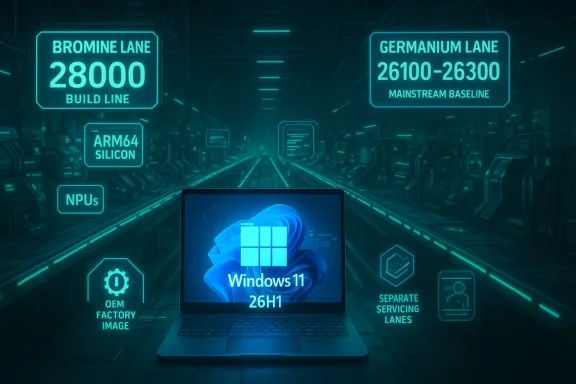
This is not merely a naming quirk. Microsoft’s release tables and Insider artifacts show that 26H1 arrives on a distinct build series (the 28000 series) and is tied to an internal platform snapshot widely discussed under the community codename Bromine. That platform branch diverges from the current mainstream foundation (often described as Germanium, the basis for 24H2 and 25H2), which explains why 26H1 systems follow a different lifecycle and update path.
The move echoes Microsoft’s earlier pattern of producing narrowly scoped platform releases for ARM hardware (recall the 24H2 factory images tied to early Copilot+ ARM machines), but 26H1 is notable because Microsoft has signaled that devices shipping with this Bromine baseline will not be upgraded to the expected 26H2 mainstream feature update later in 2026. Instead, Microsoft promises “a path to update in a future Windows release,” without committing to that particular fall release.
Microsoft faced a choice: delay the OEM and silicon ecosystem, or produce a targeted, validated factory image that OEMs can flash for day‑one compatibility. The company chose the latter. That approach reduces launch risk for partners and users of bleeding‑edge devices, while preserving the broader H2 feature cadence for the larger Windows install base.
Key technical drivers behind the split:
That said, parallel platform tracks are costly to maintain and raise questions about the eventual convergence strategy. If Bromine’s innovations are ultimately valuable across the Windows ecosystem, Microsoft will need to accelerate a convergence plan — either by moving Germanium forward to include Bromine changes or by providing an explicit, timely migration mechanism from 26H1 to the mainstream lane. The longer the two lanes diverge, the greater the friction for ISVs, security tooling vendors, and enterprise management tooling.
A plausible optimistic path: Bromine’s platform work is absorbed into a consolidated mainstream baseline within 12–18 months, minimizing long‑term fragmentation. A pessimistic timeline — slow convergence — would saddle enterprises with an awkward multi‑lane reality for several years.
The tradeoff is clear: faster hardware enablement and better day‑one AI integration at the cost of short‑term fragmentation and upgrade ambiguity. The crucial next steps that will determine whether this becomes a brief engineering necessity or a persistent headache are straightforward: transparent OEM labeling, clear migration timelines from Microsoft, and rapid convergence of Bromine improvements into the mainstream Windows baseline. Until those pieces fall into place, buyers and administrators should treat Bromine devices as a specialized lane — desirable for early access to Arm‑first features, but requiring extra diligence in procurement and rollout.
Source: ekhbary.com Microsoft Confirms Windows 11 26H1 Exclusively for Arm Devices at Launch — Snapdragon X2-Powered Systems Lead the Way
Windows 11, version 26H1 will be distributed exclusively as a preinstalled, OEM‑flashed image on select Arm64 PCs — notably systems built around Qualcomm’s Snapdragon X2 family — and it will run on a different platform baseline than the mainstream Windows 11 releases.
 Background / Overview
Microsoft’s public release notes make the central fact unambiguous: Windows 11, version 26H1 is a hardware‑optimized, device‑scoped release intended to enable “next‑generation silicon” and will not be offered as an in‑place update through Windows Update to existing Windows 11 machines. Instead, qualifying new devices will ship from the factory with 26H1 installed, and those devices will receive monthly security and quality servicing on their own lane.This is not merely a naming quirk. Microsoft’s release tables and Insider artifacts show that 26H1 arrives on a distinct build series (the 28000 series) and is tied to an internal platform snapshot widely discussed under the community codename Bromine. That platform branch diverges from the current mainstream foundation (often described as Germanium, the basis for 24H2 and 25H2), which explains why 26H1 systems follow a different lifecycle and update path.
The move echoes Microsoft’s earlier pattern of producing narrowly scoped platform releases for ARM hardware (recall the 24H2 factory images tied to early Copilot+ ARM machines), but 26H1 is notable because Microsoft has signaled that devices shipping with this Bromine baseline will not be upgraded to the expected 26H2 mainstream feature update later in 2026. Instead, Microsoft promises “a path to update in a future Windows release,” without committing to that particular fall release.
What 26H1 actually is — the technical picture
Bromine vs Germanium: two platform cores
Under the hood, Microsoft is running two platform cores in parallel.- Germanium: the current baseline for the broad Windows 11 install base (24H2 / 25H2 / upcoming 26H2 work), with build families in the 26100–26300 series.
- Bromine: the newer platform baseline for 26H1, surfaced in Canary as build numbers in the 28000 series and engineered to carry low‑level changes required by new Arm silicon.
Build numbers and Canary traces
Insiders and industry trackers foundBuild 28000.x artifacts and winver strings showing version 26H1. Microsoft’s release pages list 28000.1575 as the latest 26H1 build at the time of the release‑notes snapshot, confirming the 28k series as the Bromine lineage. This numeric divergence is a concrete technical marker that separates the Bromine servicing lane from Germanium‑based updates.Why Microsoft did this: timing, NPUs, and OEM constraints
Chip vendors and OEMs often ship silicon on cadences that don’t match Microsoft’s fall feature cycle. Qualcomm’s Snapdragon X2 family — which includes multiple performance tiers geared at on‑device AI, with integrated NPUs and novel power/thermal profiles — required OS level support that the then‑current Germanium baseline couldn’t provide without delaying device launches.Microsoft faced a choice: delay the OEM and silicon ecosystem, or produce a targeted, validated factory image that OEMs can flash for day‑one compatibility. The company chose the latter. That approach reduces launch risk for partners and users of bleeding‑edge devices, while preserving the broader H2 feature cadence for the larger Windows install base.
Key technical drivers behind the split:
- NPUs with new attestation and runtime expectations (on‑device AI pipelines need kernel/user‑mode integration).
- Vendor‑specific driver stacks and DCH packaging that must be validated together with firmware.
- Scheduler and thermal tuning for heterogeneous core clusters at the heart of modern Arm SoCs.
What Microsoft has confirmed (and what it has not)
- Confirmed:
Windows 11, version 26H1is a preinstalled, hardware‑scoped release for select Arm‑based devices (first wave: Snapdragon X2 family). It will receive monthly security and quality servicing on its own lane. - Confirmed: 26H1 runs on a newer platform branch (Bromine) with
Build 28000artifacts. - Confirmed: Devices shipped with 26H1 will not be upgraded to the mainstream 26H2 release later in 2026, though Microsoft promises a future migration path.
- Not fully detailed: the exact mechanism or timeline of the promised “path to update” remains unspecified in Microsoft’s public support notes; the company has not tied the migration to a specific future release or date. Administrators and buyers should treat that gap as a real planning unknown.
Support windows and servicing obligations
Microsoft’s published release information lists precise end‑of‑updates dates for 26H1:- Home, Pro, Pro for Workstations, Pro Education: support through 2028‑03‑14.
- Enterprise, Education, IoT Enterprise, Enterprise multi‑session: support through 2029‑03‑13.
Who gets 26H1 — and who doesn’t
- You will get 26H1 if you buy a qualifying new Arm64 PC that is factory‑flashed with the Bromine image (first wave: Snapdragon X2 systems). OEM and SKU differences will determine which SKUs ship with Bromine. Industry reporting has pointed to specific vendor models as first adopters, but buyers should verify image/OS information at the point of sale.
- If you already own a Windows 11 machine running 24H2 or 25H2 on Intel, AMD, or earlier Arm silicon, Microsoft has stated you will not be offered 26H1 through Windows Update; your primary upgrade target for feature work remains the mainstream H2 release later in the year.
Practical implications for users, IT admins, and developers
Consumers and buyers
- If you want the earliest and most polished on‑device AI experiences available on Snapdragon X2 hardware, a device shipping with 26H1 will deliver OEM‑validated drivers, NPU runtimes, and tuned power/thermal profiles out of the box.
- If you prefer a single, broadly supported OS servicing lane or run a mixed‑silicon environment at home, you should not feel compelled to buy into the Bromine lane; Intel/AMD systems and earlier Arm models will continue to follow the normal H2 feature cadence and maintain mainstream compatibility.
IT administrators and procurement leads
- Treat Bromine devices as separate image SKUs. Before large‑scale deployment:
- Run pilot deployments to validate management tooling, driver/agent compatibility, and security posture.
- Obtain written OEM commitments for driver and firmware servicing aligned to Microsoft’s lifecycle dates.
- Verify how vendor update channels will deliver device firmware, NPU runtime updates, and signed drivers.
- Keep mixed fleets segregated in test rings until Bromine and Germanium codebases converge in a future release; expect additional validation overhead and possible policy exceptions in your endpoint management tooling.
Developers and ISVs
- Prioritize Arm64 CI and automated tests against both Bromine (X2 hardware) and Germanium (mainstream) builds where customers may run either environment.
- Assume NPU acceleration paths and hardware attestation will be available on X2 devices — design graceful fallbacks for systems without equivalent hardware to avoid functional regressions.
- Coordinate with OEM and driver teams on kernel‑mode components: Bromine’s low‑level changes may expose different behavior in drivers and syscall timing assumptions.
Strengths of Microsoft’s approach
- Faster time to market for new silicon: OEMs can ship validated devices for spring windows instead of waiting for the fall feature update, which benefits consumers and partners aiming to showcase on‑device AI capabilities.
- Reduced blast radius: By scoping deep kernel-level changes to an OEM image, Microsoft limits potential regressions from affecting the entire installed base.
- Better day‑one experience for advanced features: When hardware and OS are co‑validated (drivers, runtime, firmware), features that rely on tight hardware/OS integration — especially on‑device AI — are likelier to work reliably from first boot.
Risks, tradeoffs, and the areas to watch closely
- Servicing complexity and user confusion: Running two platform cores in parallel creates a new class of compatibility complexity. Users may be uncertain which update lane a given device will follow, and IT teams must track two servicing branches with distinct lifecycles. Microsoft’s public messaging mitigates some risk, but the burden shifts to OEMs and partners to provide clear SKU‑level information.
- Upgrade uncertainty: Microsoft’s commitment to a future update path is welcome, but its absence of a specific timeline or mechanism forces enterprises to make purchasing decisions without full clarity on long‑term upgrade mechanics. That matters for sensitive, long‑lifecycle deployments.
- Driver and ecosystem fragmentation: Independent software vendors and driver authors must test against two diverging baselines for some period. Kernel‑mode or low‑level components that haven’t been retested on Bromine could reveal regressions only when scaled to retail devices.
- Retail and warranty transparency: OEMs must label exactly which image ships with which SKU. Ambiguity at retail could lead to warranty support mismatches and frustrated buyers who intended to purchase either a Bromine or Germanium device for specific workflows. Reports linking specific models to 26H1 exist, but not all OEM product pages are explicit — buyers should check the box.
Strategic analysis — long term consequences for Windows on Arm
This split is an engineeringly practical response to the reality that next‑gen Arm SoCs bring fundamentally new integration requirements. Microsoft’s Bromine lane preserves the company’s relationship with silicon and OEM partners: enable device launches, validate end‑to‑end stacks, and avoid delaying hardware innovations.That said, parallel platform tracks are costly to maintain and raise questions about the eventual convergence strategy. If Bromine’s innovations are ultimately valuable across the Windows ecosystem, Microsoft will need to accelerate a convergence plan — either by moving Germanium forward to include Bromine changes or by providing an explicit, timely migration mechanism from 26H1 to the mainstream lane. The longer the two lanes diverge, the greater the friction for ISVs, security tooling vendors, and enterprise management tooling.
A plausible optimistic path: Bromine’s platform work is absorbed into a consolidated mainstream baseline within 12–18 months, minimizing long‑term fragmentation. A pessimistic timeline — slow convergence — would saddle enterprises with an awkward multi‑lane reality for several years.
Recommendations — what buyers and admins should do now
- For consumers shopping for an X2 laptop: confirm the OS image at purchase. If you want on‑device AI day‑one, buy the Bromine/26H1 device. If you prefer consistent servicing and single‑lane support, consider Intel/AMD or wait for the mainstream 26H2 rollout.
- For IT and procurement:
- Require explicit OEM documentation mapping SKUs to the factory image and service commitments.
- Run Bromine devices through a managed pilot ring before broad deployment.
- Validate management agents, security tooling, and AV/EDR behavior on Bromine hardware prior to production onboarding.
- For developers and testers: expand CI matrices to include Arm64/Bromine images and test NPU/offload paths with realistic data sets. Prioritize graceful degradation for devices that lack identical hardware features.
- For OEMs and silicon partners: publish clear, public SKU‑level guidance and driver lifecycle commitments to avoid downstream surprises for customers and enterprises.
Conclusion
Microsoft’sWindows 11, version 26H1 marks a pragmatic, engineering‑driven pivot: a factory‑flashed, hardware‑scoped release built to enable the first wave of Snapdragon X2 systems and the deeper on‑device AI scenarios they promise. The Bromine platform baseline reduces day‑one risk for OEMs and users of those devices but creates a temporary branching of the Windows servicing model that adds complexity for enterprises, ISVs, and consumers who prize uniform update behavior.The tradeoff is clear: faster hardware enablement and better day‑one AI integration at the cost of short‑term fragmentation and upgrade ambiguity. The crucial next steps that will determine whether this becomes a brief engineering necessity or a persistent headache are straightforward: transparent OEM labeling, clear migration timelines from Microsoft, and rapid convergence of Bromine improvements into the mainstream Windows baseline. Until those pieces fall into place, buyers and administrators should treat Bromine devices as a specialized lane — desirable for early access to Arm‑first features, but requiring extra diligence in procurement and rollout.
Source: ekhbary.com Microsoft Confirms Windows 11 26H1 Exclusively for Arm Devices at Launch — Snapdragon X2-Powered Systems Lead the Way
