

Microsoft’s bet on turning Windows from an operating system into an agentic platform is the company’s boldest strategic pivot in decades: it reframes Windows as the orchestration layer for persistent AI agents that plan, act, and autonomously execute multi‑step workflows on behalf of users and organizations. The vision — promoted through 2025 previews, Insider builds, and enterprise briefings — couples new OS primitives (Agent Launchers, Agent Workspaces, an On‑Device Registry) with cloud control planes (Agent 365, Foundry Control Plane), developer tooling (Copilot Studio, Azure AI Foundry), and hardware incentives (Copilot+ device tiers). If successful, the move could re‑seed Windows as the default locus of productivity in a world that has increasingly shifted toward browsers and mobile apps; if mishandled, it risks privacy, security, regulatory headaches, and fractured developer interest.
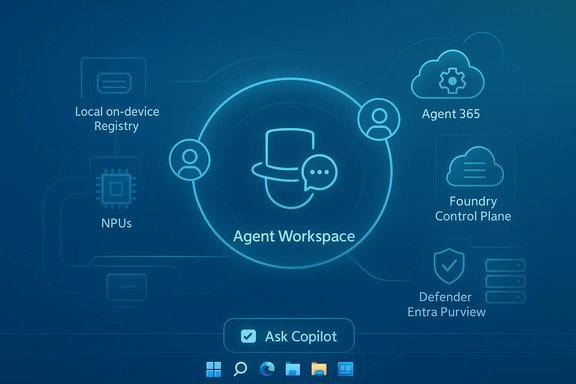
Microsoft’s announcements across 2025 reframed the company’s long‑running Copilot initiative into a broader platform strategy: embed agents — autonomous, goal‑driven AI programs with memory and tool‑use — as first‑class citizens of Windows and Microsoft 365. These agents are not mere chatbots; they are intended to persist across sessions, access contextual data, call apps and web services, and execute multi‑step plans such as compiling meeting briefings, reconciling spreadsheets, or triaging email. The company has introduced a set of interlocking components to realize that idea:
Why this matters: by standardizing discovery, Microsoft reduces the friction for developers to make agents available across system surfaces and increases the chance users find and reuse agents without hunting through individual apps.
Why this matters: containment and explicit agent identities are a pragmatic attempt to make autonomy auditable and governable — a necessary step when software can click, type, and transmit on users’ behalf.
For enterprises and developers, the prudent path is cautious experimentation: treat agents as a new class of privileged automation, insist on auditable controls, and focus pilots on bounded, high‑ROI workloads. For Microsoft, the challenge is to deliver tangible value while minimizing surprise — ensuring agents feel like trusted teammates, not opaque, uncontrollable actors.
The next 12–24 months will tell whether the industry embraces an agentic desktop anchored by Windows, or whether agentic experiences instead fragment across cloud, browser, and device boundaries. Either way, Microsoft’s move has already reshaped the conversation about what an operating system can — and should — do in an AI‑native era.
Source: WebProNews Microsoft Bets on Windows as AI Agent Hub to Revive Dominance
 Background / Overview
Microsoft’s announcements across 2025 reframed the company’s long‑running Copilot initiative into a broader platform strategy: embed agents — autonomous, goal‑driven AI programs with memory and tool‑use — as first‑class citizens of Windows and Microsoft 365. These agents are not mere chatbots; they are intended to persist across sessions, access contextual data, call apps and web services, and execute multi‑step plans such as compiling meeting briefings, reconciling spreadsheets, or triaging email. The company has introduced a set of interlocking components to realize that idea:- Agent Launchers and an On‑Device Registry to declare and discover agents system‑wide.
- An Agent Workspace runtime and agent accounts to contain runtime actions and separate privileges from the main user session.
- Copilot Actions and UI surfaces such as the taskbar Ask Copilot box to make agent invocation low friction.
- A cloud control plane, Agent 365, and Foundry Control Plane to govern, monitor, secure, and orchestrate fleets of agents in enterprise tenants.
What Microsoft has announced — the pieces that matter
Agent Launchers: discoverability at the OS level
Agent Launchers are a declarative registration model that lets apps publish interactive agents to a system registry so Windows can present available agents in system UI (Ask Copilot, Start, Search, taskbar). The mechanism relies on App Actions, a small JSON agent manifest, and an on‑device registry tool (odr.exe) for dynamic registration. The behavioral contract Microsoft enforces is explicit: an Agent Launcher must produce an interactive surface rather than silently performing hidden actions. This design aims to make agents discoverable, consistent, and auditable across the OS.Why this matters: by standardizing discovery, Microsoft reduces the friction for developers to make agents available across system surfaces and increases the chance users find and reuse agents without hunting through individual apps.
Agent Workspace and agent identities: containment and auditability
Agents run in a sandboxed Agent Workspace under distinct, non‑administrator accounts with scoped file access (known folders by default). The workspace is lighter than a VM but stronger than simple in‑process automation, presenting progress indicators, pause/stop controls, and telemetry hooks. The model treats agents as principals with identities, enabling Entra integration, conditional access, and Defender‑style protections.Why this matters: containment and explicit agent identities are a pragmatic attempt to make autonomy auditable and governable — a necessary step when software can click, type, and transmit on users’ behalf.
Copilot, Ask Copilot, and taskbar integration
Windows 11 preview builds introduced an opt‑in Ask Copilot taskbar box and tighter Copilot integrations in File Explorer and app contexts. The taskbar box is optional, controlled by feature flags and staged rollouts, but signals Microsoft’s intent to surface conversational and agentic experiences as part of the OS shell. Reported Insider builds place these features behind opt‑in toggles and staged rollouts to manage rollout risk.Agent 365 and Foundry Control Plane: enterprise control planes
Agent 365 is Microsoft’s enterprise control plane for agents — a unified console to register, govern, visualize, access‑control and analyze agent fleets. It integrates with the Microsoft 365 admin center, Microsoft Entra, Defender, and Purview, and is being offered initially via early‑access Frontier programs. The Foundry Control Plane extends this capability into Azure, centralizing lifecycle governance, policy management, and observability for agents across cloud and on‑device runtimes. These control planes are Microsoft’s acknowledgement that agent sprawl — thousands of autonomous actors acting on behalf of users — requires enterprise‑grade governance.Why Microsoft thinks Windows is the right canvas
Microsoft’s argument rests on four durable advantages:- Scale of endpoints and enterprise reach: Microsoft has repeatedly cited a billion‑plus Windows devices as a distribution on‑ramp for new experiences, and Windows remains deeply embedded in corporate fleets. The 1.4 billion devices figure has been used publicly by Microsoft in earnings and investor commentary as the metric for “monthly active Windows devices.” That number has been repeated in corporate statements and industry reporting, though the precise reporting period and mix of device types (Xbox, HoloLens, Surface, desktops) should be noted when interpreting it.
- End‑to‑end stack: Windows (OS), Microsoft 365 (productivity), Azure (cloud), and Entra/Defender (security) allow Microsoft to offer integrated developer tooling, governance, and monetization paths that are difficult for competitors to match at the same scale.
- Developer reach and enterprise procurement: Microsoft’s enterprise sales motion, OEM partnerships, and long developer relationships create distribution channels for agent‑enabled experiences.
- Hybrid compute architecture: Microsoft’s approach pairs local on‑device inference (for latency and privacy) with cloud compute (for scaling, memory, and model updates), which is attractive in regulated industries. The company has shipped experimental on‑device models (e.g., Fara‑7B) and positions NPUs/Copilot+ hardware tiers as performance enablers.
Cross‑checked facts and verified claims
- Agent 365 is a Microsoft product/initiative unveiled at Ignite 2025 and described as a control plane for deploying, organizing, and governing agents at scale; Microsoft documentation and major press reports confirm its existence and enterprise focus.
- Windows Insider builds in late 2025 introduced an opt‑in Ask Copilot box for the taskbar; multiple outlets and Microsoft Q&A posts corroborate the rollout is optional and staged.
- Windows-level primitives for agents — Agent Launchers, Agent Workspace, and an On‑Device Registry — appear in Microsoft previews and developer documentation and have been described in Windows Insider coverage and community previews. These primitives are present in Insider cumulative packages and are documented in developer guidance for App Actions and agent registries.
- Gartner forecasts that up to 40% of enterprise applications will embed task‑specific AI agents by 2026; this prediction is published by Gartner and widely reported. Use this projection as a directional market indicator — Gartner frames it as a high‑adoption scenario that underlines the enterprise opportunity.
- Microsoft has emphasized persistent memory and continuous planning as core capabilities for next‑generation Copilot agents; Microsoft AI leadership (Mustafa Suleyman) has publicly discussed memory and the three‑stage agent progression (see Wired and GeekWire interviews), though exact timelines for maturity are predictive rather than guaranteed. Where specific timelines are quoted, they reflect company forecasts and should be treated as aspirational.
The upside: what Microsoft can win
- Productivity gains at scale. Agents that can gather, synthesize, and act across apps could materially reduce repetitive cognitive overhead for knowledge workers (meeting prep, report drafting, data reconciliation). Microsoft’s integrated stack gives it a plausible path to monetize and measure these gains inside enterprise contracts.
- A revived platform moat. If developers and ISVs embrace Agent Launchers and ship agentic experiences tied to Windows primitives, Microsoft could rebuild the historical lock‑in cycle: more agent experiences on Windows attract users, which in turn attracts developers.
- Enterprise governance advantage. For regulated industries, the presence of Agent 365, Entra identity integration, Defender protections, and Purview auditing can be a credible differentiator against cloud‑only agent platforms.
The risk stack: where the plan could fail
- Privacy and data‑access friction. Agents need context to be useful; that context often requires access to files, calendars, emails, or corporate data. Even with scoped access and opt‑in defaults, the perceived invasion of privacy or confusing consent flows could prompt resistance from users and regulators. This risk is amplified when agents persist memory across sessions. Microsoft has introduced dashboards and retention controls, but the tradeoffs remain material.
- Security and attack surface. Agents that can act (click buttons, send messages, call APIs) expand the attack surface dramatically. Threat scenarios include prompt‑injection attacks, compromised agents acting with elevated access, or malicious agent publishers seeking privilege escalation. Containment (Agent Workspace) helps, but attackers adapt quickly; enterprises will require independent assurance and continuous testing.
- Fragmentation and developer ambition. Many agent experiences can be delivered cross‑platform (browsers, cloud services, mobile). Convincing developers to prioritize Windows‑native agent integration may require compelling UX or monetization incentives; otherwise, agent development could drift to cloud SDKs and browser extensions that offer broader reach. Microsoft’s Agent Launchers lower integration friction, but network effects will determine adoption.
- Regulatory and liability exposure. The EU AI Act and other emerging frameworks will impose logging, transparency, and human‑oversight obligations — especially when agents operate in high‑risk domains (hiring, finance, healthcare). Non‑compliance can mean steep fines and reputational damage, particularly for agentic features that automate decision‑making. Legal guidance urges early conformity assessments and design‑time logging.
- Licensing and economic ambiguity. There are open questions about how agents will be licensed (per‑agent, per‑tenant, or bundled)—a withdrawn Microsoft admin announcement created confusion about whether agents require full human Microsoft 365 licenses or can operate under specialized agent licenses. That uncertainty matters because wide agent deployment at human‑scale would be cost‑prohibitive if each agent required expensive human licenses. This is an area to watch for formal clarification. (Treat the withdrawn admin note as unverified until Microsoft reissues official guidance.
Practical advice for enterprise IT and developers
For IT leaders (priorities and a short checklist)
- Treat agents as service accounts: apply the same lifecycle, least‑privilege, and audit controls you use for privileged automation.
- Pilot in low‑risk workflows: begin with repetitive, non‑safety‑critical tasks that deliver measurable ROI (e.g., report assembly, inbox triage).
- Require runtime logs and human‑in‑the‑loop checkpoints for any action that crosses approval thresholds. Ensure Agent 365 telemetry is connected to your SIEM.
- Maintain strict DLP and data‑scoping rules; default to minimal access and seek explicit escalation for additional scopes.
For developers (practical steps)
- Use the Agent Launcher manifest contract and App Actions to make agents discoverable and consistent across system surfaces.
- Design agents to be interruptible and transparent: surface step lists, progress, and checkpoints so users can pause or take over.
- Instrument agents with robust telemetry, input sanitization, and prompt‑injection defenses. Treat tool calls as untrusted until verified.
Competitive landscape and standards
Microsoft’s agentic push sits alongside rival strategies: Google favors cloud‑centric agent frameworks tethered to Gemini and Workspace; Anthropic and AWS offer agent SDKs and tooling aimed at enterprise orchestration; open standards like the Model Context Protocol (MCP) and industry efforts on runtime governance are emergent. Interoperability and standards (MCP, Policy Cards ideas, and Model/tool interface standards) will influence whether agents remain platform‑specific or form a cross‑platform ecosystem. Gartner’s forecast (40% embedding by 2026) makes clear that enterprise software vendors are planning agentic futures — not necessarily Microsoft‑only ones.Ethical, workforce, and societal implications
The proliferation of agentic AI raises ethical and workforce questions beyond compliance:- Job evolution, not immediate elimination: many roles will shift from execution to orchestration, compliance, and exception handling; Gartner and industry analysts project skills changes where humans govern agent fleets. Still, redistribution of work carries short‑term disruption risks.
- Concentration of power and vendor lock‑in: deep OS integration can create strong vendor pull; interoperability and open standards are vital to avoid new vendor lock‑in dynamics.
- Transparency and consent: persistent memory, personalization, and continuous planning improve effectiveness but must be opt‑in with clear UI affordances to view, edit, and delete remembered facts. Microsoft’s Copilot memory features include dashboards and controls, but ambiguity remains around default settings and enterprise policies.
Weighing the odds: what success and failure would look like
Success indicators (12–24 months)- Broad adoption by enterprise ISVs and internal teams using Agent 365 for governance.
- Meaningful ROI measurements (time saved, error reduction) from agent pilots documented as case studies.
- Mature, auditable runtime controls and independent security validations that mitigate major incident risk.
- Widespread user opt‑outs and opt‑ins limited to power users due to privacy or trust issues.
- A major security incident involving agent compromise that forces regulatory scrutiny or emergency rollbacks.
- Developer apathy: agents primarily built as cloud/browser integrations, bypassing Windows primitives and undercutting Microsoft’s platform rationale.
Conclusion
Microsoft’s wager to make Windows the nerve center for AI agents is a high‑stakes, high‑reward strategic pivot that revives the classic platform playbook — but in a radically different regulatory, hardware, and trust environment. The architecture Microsoft is shipping (Agent Launchers, Agent Workspace, Agent 365, Foundry Control Plane, Copilot integrations) is coherent and addresses many operational needs for enterprises. Yet the move amplifies privacy, security, licensing, and regulatory risks that will determine adoption speed.For enterprises and developers, the prudent path is cautious experimentation: treat agents as a new class of privileged automation, insist on auditable controls, and focus pilots on bounded, high‑ROI workloads. For Microsoft, the challenge is to deliver tangible value while minimizing surprise — ensuring agents feel like trusted teammates, not opaque, uncontrollable actors.
The next 12–24 months will tell whether the industry embraces an agentic desktop anchored by Windows, or whether agentic experiences instead fragment across cloud, browser, and device boundaries. Either way, Microsoft’s move has already reshaped the conversation about what an operating system can — and should — do in an AI‑native era.
Source: WebProNews Microsoft Bets on Windows as AI Agent Hub to Revive Dominance
