

Avanade has launched an Agentic AI Platform — a Microsoft-aligned, midmarket-focused stack of pre-built industry agents, no-code/pro-code authoring tools, an operational cockpit, and a partner marketplace — explicitly designed to plug into Microsoft’s newly announced Agent 365 control plane to shorten the path from PoC to production for companies that already run Microsoft stacks.
Avanade unveiled the Agentic Platform at Microsoft Ignite, positioning it as a packaged, “opinionated” set of agent templates and delivery patterns for midmarket organizations — which Avanade defines as companies with annual revenues between US$300 million and US$5 billion. The product launch ties directly into Microsoft’s broader agent ecosystem (Copilot Studio, Azure AI Foundry / Foundry Agent Service, and Agent 365), and Avanade frames this as a way to accelerate measurable business outcomes from generative AI investments. Microsoft’s Agent 365 is described by Microsoft as a tenant-level control plane for AI agents: a registry, access-control surface, telemetry/visualization layer, interoperability glue and security integrations (Entra identities, Defender, Purview). Agent 365 is intended to make agents manageable like human users or service principals, and it is being surfaced through Microsoft’s Frontier preview channels. Independent coverage confirms Agent 365’s control-plane role and early-access rollout.
At the same time, prospective buyers should balance optimism with discipline: demand measurable PoC results, insist on strong identity-and-policy controls, budget for operational governance, and evaluate the long-term implications of vendor and platform concentration. Agent fleets can deliver tangible productivity and automation benefits, but they also introduce new classes of operational risk and recurring cost. The prudent path for midmarket IT leaders is to pilot carefully, instrument everything, and only scale once auditability, remediation, and cost controls are proven in production.
Avanade’s platform is available now and backed by the company’s Microsoft partnership and delivery capacity; the integration with Microsoft Agent 365 and Copilot tooling gives it practical momentum for organizations committed to the Microsoft cloud. For buyers, the immediate questions are operational: How will agents be managed day-to-day? Who owns AgentOps? And can the promised business outcomes be measured, replicated and governed at scale? The answers to those questions will determine whether Avanade’s Agentic Platform is a rapid route to production-grade AI or another vendor stack that needs a disciplined operational runway to succeed.
Source: Cloud Wars Avanade Agentic AI Platform Features Pre-Built Agents, Integration With Microsoft Agent 365
 Background / Overview
Avanade unveiled the Agentic Platform at Microsoft Ignite, positioning it as a packaged, “opinionated” set of agent templates and delivery patterns for midmarket organizations — which Avanade defines as companies with annual revenues between US$300 million and US$5 billion. The product launch ties directly into Microsoft’s broader agent ecosystem (Copilot Studio, Azure AI Foundry / Foundry Agent Service, and Agent 365), and Avanade frames this as a way to accelerate measurable business outcomes from generative AI investments. Microsoft’s Agent 365 is described by Microsoft as a tenant-level control plane for AI agents: a registry, access-control surface, telemetry/visualization layer, interoperability glue and security integrations (Entra identities, Defender, Purview). Agent 365 is intended to make agents manageable like human users or service principals, and it is being surfaced through Microsoft’s Frontier preview channels. Independent coverage confirms Agent 365’s control-plane role and early-access rollout. What Avanade Announced — The Essentials
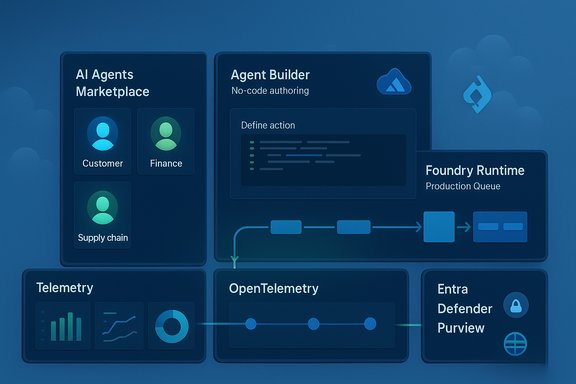
Avanade’s public materials and media coverage make the same core claims about the Agentic Platform’s structure and purpose:- A library of pre-built, industry-specific agents and templates designed to automate repeatable workflows (contact centers, finance reconciliation, supply‑chain tasks and similar vertical scenarios).
- Agent authoring via a no-code/low-code Agent Builder and the ability to refine pre-built agents, plus a pro-code path that integrates with Microsoft’s Azure AI Foundry (previously called Azure AI Foundry / Foundry Agent Service).
- Discoverability through Microsoft Copilot Studio (low-code) and Azure Foundry (pro-code), with agents managed and governed via Microsoft Agent 365.
- Agent Cockpit for orchestration, monitoring, performance tuning and real‑time governance controls.
- An Agent Solutions Marketplace (Agent Solutions Marketplace) intended to surface leading agents — including third‑party and startup-built agents — with Avanade managing integrations so those agents operate seamlessly on the platform.
How the Platform Integrates With Microsoft’s Agent Ecosystem
Agent 365: The control plane alignment
Avanade’s platform is explicitly designed to interoperate with Microsoft Agent 365 so that agents created or delivered via Avanade can be registered, governed and observed within the same tenant control plane Microsoft is promoting. That integration is central to Avanade’s pitch: midmarket customers often already run Microsoft 365, Dynamics 365 and Azure, so aligning to Microsoft governance primitives reduces integration friction. Microsoft materials confirm that Agent 365 provides a registry, access controls (Entra-based identities), visualization and security integrations that are used to treat agents as governed, auditable entities.Copilot Studio and Azure AI Foundry (authoring to runtime)
- Copilot Studio is the low-code authoring surface for building and publishing Copilot/agent experiences.
- Azure AI Foundry / Foundry Agent Service is Microsoft's pro-dev runtime and orchestration environment for production agents.
Key Features and Technical Anatomy
Pre-built, vertical agents and templates
- Pre-packaged agents cover common midmarket use cases: customer service triage, invoice processing, sales development assistants, HR/people agents and supply‑chain orchestration.
- Templates provide connectors and preconfigured flows, reducing the engineering lift to deploy agents for routine enterprise tasks.
Avanade claims these are "easy to deploy and manage" and purpose-built to work within existing Microsoft-centric stacks.
Agent Builder (no-code) and pro-code refinement
- A no-code Agent Builder lets business users or citizen developers configure agent behaviors and guardrails.
- A pro-code path enables developers to extend and harden agents using Azure AI Foundry/SDKs, implement custom connectors, and perform multi-agent orchestration.
This two-track strategy is designed to balance speed for business teams and rigor for production engineering.
Agent Cockpit: orchestration, monitoring, governance
- Orchestration for multi-agent choreography and long-running durable workflows.
- Monitoring/observability with telemetry, lineage and OpenTelemetry-style tracing to support audits and forensic reconstruction.
- Governance hooks to enforce approval flows, conditional access, and human-in-the-loop gating for high-risk actions.
Avanade emphasizes the Cockpit as a central place to manage operational risk while scaling agents.
Agent Solutions Marketplace
- A curated marketplace where Avanade and third parties can publish agents organized by industry and function.
- Avanade said it will manage integrations so third-party agents operate seamlessly on its platform, reducing vendor integration work for customers.
Analytics and Performance Measurement
- Built-in analytics to track agent impact (hours saved, ticket volumes, response times) and identify optimization opportunities.
- Avanade positions this as a business-centric layer that ties technical telemetry to measurable KPIs.
Who the Platform Is For
- Primary target: midmarket enterprises (annual revenue bracket defined by Avanade as US$300M–US$5B).
- These customers commonly have enough data and process complexity to benefit from automation but lack the internal scale to industrialize AI projects.
- The offering is intended for organizations already invested in Microsoft clouds and productivity suites to leverage the integration and reduce bespoke engineering overhead.
Verified Claims and Cross-References
- Avanade’s definition of the midmarket (US$300M–US$5B) appears consistently in Avanade’s media materials and media coverage. Independent press covering the launch repeats that definition, confirming the company’s stated target segment.
- Integration points with Microsoft’s Agent 365, Copilot Studio, and Azure AI Foundry are corroborated by Microsoft documentation and Ignite announcements describing Agent 365 as a control plane and Foundry as the agent runtime. These platform-level integrations are confirmed across Microsoft’s official posts and independent news coverage.
- Avanade’s business-impact examples (vendor-cited case metrics such as “7,000 hours saved at PageGroup” and “90% faster customer response times at Japan Airlines”) are presented in Avanade’s press materials as customer outcomes. Those figures are vendor-reported and should be validated during procurement and PoC stages.
Strengths — Why This Will Appeal to Midmarket Buyers
- Speed to value through productized IP: Pre-built agents and templates reduce time and cost to deliver immediate workflows, which matters for organizations that need quick ROI from AI.
- Microsoft alignment reduces integration friction: For organizations that already use Microsoft 365, Dynamics 365 and Azure, Avanade’s tight interoperability with Copilot Studio, Foundry and Agent 365 simplifies identity, policy and data grounding.
- Operational tooling and governance: The Agent Cockpit, marketplace, and Agent 365 integration give a practical governance surface that treats agents as auditable, lifecycle-managed assets — a meaningful differentiator versus ad hoc bot deployments.
- Delivery capacity and co‑innovation support: Avanade’s regional hubs and staffed delivery teams (for example, the APAC hub in Kuala Lumpur) provide customers with hands-on help to move pilots into production.
Risks, Limits and Practical Concerns
Vendor dependency and lock-in
Tight coupling to Microsoft’s agent stack yields integration ease but also increases dependency on Microsoft identity, runtime and service choices. Buyers should negotiate portability and data‑portability clauses, and require clear modeling of what happens if models or runtimes change.Security and attack surface
Agents that possess permissions to read mail, files and systems create a substantial new attack surface. Microsoft’s Agent 365 addresses identity and visibility, but operational security still depends on sound tenant configuration (conditional access, least‑privilege connectors), DLP labeling and active monitoring. Recent research and operational experience show token misuse and misconfigured connectors are realistic threats; implementation must include hardened consent, short-lived tokens, and detection/response playbooks.Model correctness, hallucination and auditability
Agents combine retrieval, reasoning and tool execution. Incorrect or confident-sounding but wrong outputs can have business consequences if agents are allowed to act autonomously on high-impact tasks. The safe path is staged autonomy: start with suggestion-only modes, require human approvals for actions with financial or legal impact, and instrument validation tests for all production flows.Operational cost and governance overhead
Scaling fleets of agents will surface recurrent costs: model inference, hosting, storage for logs and telemetry, and engineering to maintain connectors. Midmarket firms must budget for an AgentOps function that owns SLAs, incident response, and cost controls. Microsoft’s tooling provides telemetry but does not remove the need for governance staffing and FinOps.Practical Procurement and Implementation Checklist
- Confirm compatibility and residency
- Verify Azure region parity and required VM/GPU SKUs for your intended workloads; new regions often roll out capabilities in phases.
- Define measurable PoC outcomes
- Require vendor-run PoCs with concrete KPIs (ticket volume, resolution time, FTE hours saved) and acceptance criteria before moving to production.
- Treat agents as identity-bearing assets
- Insist on Entra Agent IDs for every agent and require lifecycle processes (provisioning, access review, deprovisioning) to be contractually described.
- Lock down permissions and approvals
- Implement least privilege connectors, short-lived tokens and human-in-the-loop gating for high-risk operations.
- Instrument telemetry and cost controls
- Require integration with monitoring stacks and cost dashboards; set consumption caps and alarms for inference spend.
- Validate third‑party agents on the marketplace
- Demand integration tests and security attestations for any third-party agent you intend to deploy from an Agent Solutions Marketplace.
- Define contractual SLAs for remediation and rollbacks
- Ensure vendor responsibilities for agent-caused incidents, including rollback semantics and forensics support, are clearly defined in the contract.
Vendor Claims to Verify During Procurement
- Customer outcome metrics (hours saved, response time reductions) — request reconciled logs from PoCs.
- Data residency and model hosting options — confirm where tenant data and RAG indices will be stored and which model providers will be used.
- Detailed governance flows — proof of Entra Agent ID provisioning, conditional access enforcement, Purview label enforcement and Defender/Sentinel integration.
Strategic Takeaway and Conclusion
Avanade’s Agentic Platform is a pragmatic, partner-driven attempt to productize agentized workflows for midmarket firms that already live in the Microsoft ecosystem. Its biggest selling points are pre-built vertical IP, integration with Microsoft’s emerging agent control plane (Agent 365), and a delivery model that bundles co‑innovation, templates, and marketplace distribution to accelerate production deployments. These elements directly address the common midmarket failure mode — many pilots that never scale — by offering repeatable templates, staffed delivery, and an operational cockpit for governance.At the same time, prospective buyers should balance optimism with discipline: demand measurable PoC results, insist on strong identity-and-policy controls, budget for operational governance, and evaluate the long-term implications of vendor and platform concentration. Agent fleets can deliver tangible productivity and automation benefits, but they also introduce new classes of operational risk and recurring cost. The prudent path for midmarket IT leaders is to pilot carefully, instrument everything, and only scale once auditability, remediation, and cost controls are proven in production.
Avanade’s platform is available now and backed by the company’s Microsoft partnership and delivery capacity; the integration with Microsoft Agent 365 and Copilot tooling gives it practical momentum for organizations committed to the Microsoft cloud. For buyers, the immediate questions are operational: How will agents be managed day-to-day? Who owns AgentOps? And can the promised business outcomes be measured, replicated and governed at scale? The answers to those questions will determine whether Avanade’s Agentic Platform is a rapid route to production-grade AI or another vendor stack that needs a disciplined operational runway to succeed.
Source: Cloud Wars Avanade Agentic AI Platform Features Pre-Built Agents, Integration With Microsoft Agent 365
