

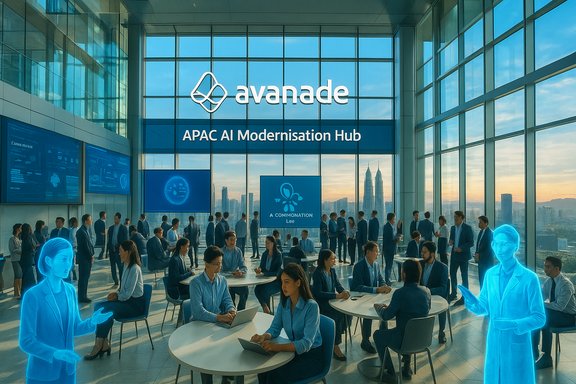
Avanade’s launch of an APAC AI Modernisation Hub in Kuala Lumpur and the simultaneous unveiling of its Avanade Agentic Platform mark a deliberate push to move Asia Pacific mid‑market firms from pilots to production‑grade AI — pairing pre‑built, Microsoft‑centric agent templates with a staffed co‑innovation facility at The Exchange 106 in Tun Razak Exchange.
Avanade’s announcement bundles two tightly‑coupled moves: a regional delivery hub in Malaysia and a packaged, agentic platform built to plug into Microsoft’s Copilot and Foundry ecosystem. The company positions these investments specifically at mid‑market organisations that already use Microsoft products but lack the in‑house scale to industrialise AI across business processes. The Kuala Lumpur hub is sited at The Exchange 106 @ TRX and is described as housing more than 100 AI and Microsoft specialists, with an on‑site AI Co‑Innovation Lab for rapid prototyping, sector‑specific accelerators, and end‑to‑end modernisation services (data, cloud and security). Avanade’s public materials underline that the companion Avanade Agentic Platform contains pre‑built industry agents and templates designed to integrate with Microsoft Copilot Studio and Microsoft Foundry (Azure AI Foundry). Microsoft’s regional channel leadership publicly endorsed the approach, framing it as an example of platform + partner collaboration to accelerate practical AI adoption across SMEs and mid‑sized companies. Avanade executives emphasised speed‑to‑value and repeatability as the primary selling points.
Avanade’s press messaging and regional coverage make a persuasive case for Malaysia as a delivery hub and for agentic templates as a route to scale; the next six to twelve months of customer PoCs and published case studies will be the clearest test of whether the approach moves more mid‑market projects from pilot to production at real scale.
Source: NST Online KL chosen as Avanade's AI modernisation hub in Asia Pacific | New Straits Times
 Background / Overview
Avanade’s announcement bundles two tightly‑coupled moves: a regional delivery hub in Malaysia and a packaged, agentic platform built to plug into Microsoft’s Copilot and Foundry ecosystem. The company positions these investments specifically at mid‑market organisations that already use Microsoft products but lack the in‑house scale to industrialise AI across business processes. The Kuala Lumpur hub is sited at The Exchange 106 @ TRX and is described as housing more than 100 AI and Microsoft specialists, with an on‑site AI Co‑Innovation Lab for rapid prototyping, sector‑specific accelerators, and end‑to‑end modernisation services (data, cloud and security). Avanade’s public materials underline that the companion Avanade Agentic Platform contains pre‑built industry agents and templates designed to integrate with Microsoft Copilot Studio and Microsoft Foundry (Azure AI Foundry). Microsoft’s regional channel leadership publicly endorsed the approach, framing it as an example of platform + partner collaboration to accelerate practical AI adoption across SMEs and mid‑sized companies. Avanade executives emphasised speed‑to‑value and repeatability as the primary selling points. What Avanade announced — the essentials
Avanade Agentic Platform: productised agents, templates and governance
- A library of pre‑built, industry‑specific agents and deployment templates that aim to automate routine workflows (contact centre tasks, finance processes, supply‑chain orchestration).
- Designed to integrate with Microsoft Copilot Studio and Microsoft Foundry — enabling agents to access models, tools, and enterprise data stores while applying governance controls.
- Built‑in governance and human‑in‑the‑loop patterns are emphasised in Avanade’s messaging as a way to retain oversight while scaling automation.
APAC AI Modernisation Hub (Kuala Lumpur)
- Located at The Exchange 106 in TRX, Kuala Lumpur; described as a regional centre with >100 AI and Microsoft specialists, plus an AI Co‑Innovation Lab for customer prototyping and testing.
- Sector focus called out: financial services, manufacturing, healthcare, retail and consumer goods — with end‑to‑end modernisation services spanning data, cloud migration, security and responsible AI practices.
Strategic positioning
- The combined offering targets the common mid‑market pain point: experimentation without scale. Avanade’s thesis: package repeatable IP, plug it into Microsoft stacks most mid‑market customers already use, and provide a staffed hub to accelerate proofs‑of‑value into production.
Technical anatomy: how the platform plugs into Microsoft technology
Microsoft Foundry (Azure AI Foundry) and Copilot Studio
Microsoft Foundry (formerly Azure AI Foundry) is positioned as an end‑to‑end platform to build, govern and operate AI apps and agentic workflows at scale. It includes model catalogs, agent services, memory, knowledge integrations, and tooling for observability and governance — features that enterprise agents need to operate reliably. Avanade’s Agentic Platform is explicitly designed to interoperate with Foundry’s agent and model services. Copilot Studio is Microsoft’s enterprise tooling to design Copilot experiences and agent behaviours that can act across apps and services. Integration points between Avanade’s agent templates and Copilot Studio aim to enable faster deployment of copilots that perform real tasks (data entry, summarisation, ticket routing) while maintaining tenant security and identity boundaries.What “agentic” means in practice
- Agents are modular automation units that can plan, act and coordinate across applications; the platform approach packages common agents so customers avoid building from scratch.
- Agents can be configured to run in shadow (monitoring) mode before escalation to full autonomy, and must be governed with audit logs, explainability and human approval gates for sensitive actions. Avanade highlights governance as a differentiator in its messaging.
Practical integration concerns
- Customers must validate exact Foundry/Foundry Models availability and region‑specific SKUs where workload residency or GPU acceleration is a requirement.
- Foundry provides model routing and deployment controls, but actual GPU SKUs, latency and cost vary by Azure region; customers should confirm availability for specific inference/training needs.
Why Kuala Lumpur (TRX) makes strategic sense
Talent and regional access
Kuala Lumpur offers a deepening pool of cloud and AI talent in Southeast Asia, and Avanade already operated a Generative AI Lab and delivery teams in Malaysia prior to this hub — giving it a local operational foothold. The Exchange 106 at TRX is a visible, premium address that signals long‑term commitment.Infrastructure and cloud parity
Microsoft and other hyperscalers are expanding cloud capacity and services in Malaysia, which reduces latency and simplifies data‑residency compliance for regulated industries. Local cloud region availability and the broader Azure network make Malaysia a logical place to host a regional modernisation centre that relies on Azure Foundry and Copilot integrations. That said, new cloud regions tend to reach full feature parity over time, so early adopters must validate SKU and service availability before committing production workloads.Ecosystem multiplier
A staffed hub with co‑innovation lab capabilities creates a place for regional customers to test agents against real data, allowing Avanade and Microsoft to iterate quickly. For the mid‑market, an on‑shore co‑innovation space reduces procurement friction, shortens PoC cycles and increases confidence in readiness for production.What this means for mid‑market organisations (opportunity)
- Faster, lower‑risk adoption path: pre‑built agents and templates shorten proof‑of‑value cycles compared with bespoke builds.
- Leverages existing Microsoft investments: organisations already using Microsoft 365, Dynamics 365 and Azure get tighter integration and reduced integration risk.
- Access to delivery capacity: the hub promises a staffed delivery model that helps companies without large AI teams to operationalise projects faster.
- Sector accelerators: industry templates can reduce customisation overhead — particularly important for verticals with heavy regulatory or compliance needs.
Critical analysis — strengths, practical limits and systemic risks
Notable strengths
- Productised IP meets platform plumbing: Packaging repeatable agents and templates that integrate with Microsoft Foundry and Copilot Studio can materially reduce time‑to‑value for many mid‑market customers who already use Microsoft tools.
- Staffed regional capability: A >100‑person hub focused on co‑innovation, prototyping and delivery reduces vendor switching friction and increases immediate capacity to run PoCs to production.
- Responsible AI framing: Avanade emphasises human oversight, governance and measurable outcomes — valuable guardrails in agentic deployments where autonomous actions can impact customers or finances.
Practical limitations and caveats
- Vendor‑reported outcomes should be treated as directional, not guaranteed. Case examples cited by vendors (hours saved, response time improvements) are real signals but typically rely on ideal conditions and close vendor support; buyers should demand reconciled PoC metrics.
- Azure region parity and GPU availability: The Foundry/agent model story assumes underlying region support for necessary VM SKUs and GPU families. New regions often roll out SKUs in phases; enterprises must confirm availability and reservation options for large inference or training workloads.
- Vendor concentration risk: Tight coupling to Microsoft tooling reduces integration friction for Microsoft shops but increases dependency on a single platform for models, identity and observability. Architecture and contract design should preserve portability where possible.
Security and operational risk — concrete concerns to watch
- Recent security research has flagged novel attack vectors involving Copilot Studio agents (for example, token‑theft abuses) that demonstrate the need for strict application consent controls, token lifetimes, and monitoring of third‑party agent sharing. Organisations must harden consent grants, enforce conditional access, and monitor for anomalous activity. These are not theoretical — they have been observed in the wild.
- Automation without rigorous human‑in‑the‑loop controls can produce operationally significant errors. For workflows that touch financial transactions, customer complaints, or regulated outcomes, staged autonomy and explainable audit trails are essential. Avanade’s messaging includes governance constructs, but implementation details must be contractually specified.
How to evaluate Avanade’s hub and Agentic Platform (practical checklist)
- Confirm technical compatibility
- Validate connectors for Copilot Studio, Foundry, Dynamics 365 and your specific Azure tenancy; ask for a connectivity and identity diagram.
- Require measurable PoC deliverables
- Define KPIs (time saved, transaction throughput, cost per transaction) and measurement methods up front. Demand reconciliation runs on your production telemetry.
- Validate infrastructure and resilience
- Request explicit SKU lists, regional availability windows and reservation/commitment options for GPU SKUs if you plan inference or training at scale.
- Contract for governance and audit rights
- Insist on audit logs, model cards, change‑management protocols, red‑team testing outcomes and documented rollback plans.
- Test for portability and exit mechanics
- Define data export, model artifacts, and agent configuration export paths so you can migrate agents or models if needed. Preserve the ability to run in hybrid / sovereign cloud where compliance requires.
Vendor claims to verify independently (flagged items)
- “More than 100 AI and Microsoft specialists” at the Kuala Lumpur hub is a corporate staffing claim; it is supported in company materials but should be treated as a headcount target rather than a performance guarantee. Request a capabilities matrix and delivery SLAs before relying on vendor capacity.
- Savings percentages quoted in some vendor materials (e.g., cloud optimisation average reductions) are typical of marketing narratives; they are worth benchmarking in an audited PoC but are not guarantees. Ask for customer references and bill reconciliation reports.
Competitive context and market dynamics
Avanade’s move is part of a broader industry trend: global consultancies and systems integrators are productising AI delivery IP to capture mid‑market customers who value predictable scope and speed. The Microsoft partner ecosystem (including Accenture/Avanade combinations and other SIs) is racing to provide packaged agent solutions, and hyperscalers are building Foundry‑style platforms to enable multi‑agent orchestration. Customers will see multiple competing offerings, and differentiation will hinge on vertical depth, expansion economics, and demonstrable governance practices.Strategic recommendation for CIOs and procurement teams
- Treat Avanade’s Agentic Platform and KL hub as a valuable option in the supplier shortlist if your organisation already has significant Microsoft investment and needs speed. Prioritise short, measurable PoCs tied to production KPIs and insist on contractual guarantees around data portability, auditability and service inventories.
- Invest in organisational readiness: create agent‑ops roles, a governance playbook, and a staged autonomy roadmap (shadow → assisted → autonomous) to avoid operational surprises when agents act across systems.
- Preserve architectural choice: negotiate terms that protect you from long‑term vendor lock‑in, and require documented export paths for models, agent configs and data.
Conclusion
Avanade’s APAC AI Modernisation Hub in Kuala Lumpur and the Avanade Agentic Platform represent a pragmatic, Microsoft‑aligned route for mid‑market organisations in Asia Pacific to accelerate AI adoption. The offering’s real value will depend on disciplined PoCs, transparent governance, and proof that the Foundry/Copilot integrations can be delivered reliably within regional Azure constraints. The hub’s staffed delivery model and pre‑built agents lower the barrier to operationalisation, but buyers must demand auditable results, clear governance, and explicit infrastructure assurances to convert vendor promises into durable business outcomes.Avanade’s press messaging and regional coverage make a persuasive case for Malaysia as a delivery hub and for agentic templates as a route to scale; the next six to twelve months of customer PoCs and published case studies will be the clearest test of whether the approach moves more mid‑market projects from pilot to production at real scale.
Source: NST Online KL chosen as Avanade's AI modernisation hub in Asia Pacific | New Straits Times
