

TeamCentral, a Cincinnati AI software company, is positioning its Central AI Hub and governed data infrastructure strategy around MCP-aligned enterprise agents in June 2026, arguing that manufacturers, distributors, and logistics firms need normalized, secured operational data before copilots can deliver production value. That is a sharper claim than another startup saying it has “AI-ready” software. TeamCentral is betting that the next durable enterprise AI company may not own the best model, the flashiest chatbot, or the biggest app marketplace, but the canonical data layer that makes agents useful inside messy companies. The bet is plausible, but it also puts the company in the path of giants that already know how to turn standards into distribution.
For the past two years, the enterprise AI story has been told from the top of the stack. The demos were conversational, the product names were copilots, and the buyer pitch was productivity: ask a question, draft a memo, summarize a meeting, generate a workflow. But production deployment has a way of dragging attention away from the interface and toward the machinery underneath it.
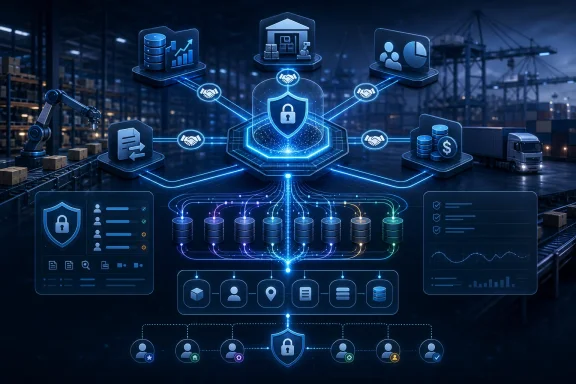
That is where TeamCentral is trying to insert itself. The company’s pitch is that the useful enterprise agent is not merely a model with a chat window, but a governed execution layer attached to ERP, warehouse, CRM, e-commerce, finance, and supply-chain systems. In that framing, the chatbot is the least interesting part of the architecture.
This matters because mid-market industrial companies do not usually fail at AI because they lack curiosity. They fail because their data is fragmented across aging ERP instances, warehouse management systems, spreadsheets, custom databases, EDI flows, and SaaS tools acquired department by department. A model can be brilliant in the abstract and still be useless if it cannot tell whether “customer,” “ship-to,” “item,” and “available inventory” mean the same thing across systems.
TeamCentral’s recent messaging leans directly into that bottleneck. It says the value is in normalizing, governing, and activating operational data so agents can do more than retrieve documents or produce plausible prose. In other words, the company is not trying to sell magic. It is trying to sell the unglamorous precondition for magic.
But a standard is not a moat by itself. If MCP succeeds, it lowers the cost of integration for everyone. That helps TeamCentral sell into customers who no longer need to be convinced that agent-to-system connectivity matters, but it also invites every integration platform, automation vendor, cloud provider, and enterprise software incumbent to claim the same territory.
The strategic question is therefore not whether TeamCentral can say “MCP.” It is whether TeamCentral can make MCP useful inside the kinds of operational environments where generic connectors break down. The company’s answer is experience: years spent wiring together enterprise systems, building partner relationships, and understanding the awkward reality of mid-market business data.
That is a sensible argument because data infrastructure is rarely won on protocol purity alone. It is won in exceptions, mappings, permissions, retries, audit logs, schema drift, and the terrifying moment when an agent is allowed to update a purchase order rather than merely summarize one. MCP can define the handshake, but it cannot automatically decide what a warehouse supervisor in Ohio should be allowed to approve at 2:17 p.m. on a Tuesday.
This is also where the WindowsForum audience should recognize the pattern. Standards matter, but operational control matters more. In enterprise IT, the winner is often not the cleanest architecture diagram; it is the platform that survives identity, governance, support tickets, compliance audits, and the brittle systems nobody has budget to replace.
That channel detail is important. Manufacturers and distributors do not usually buy core operational software the way consumers download apps. They buy through trusted implementers, resellers, ERP specialists, and systems integrators who already understand which workflows are fragile and which data problems are politically impossible.
TeamCentral’s claim that partner dynamics are shifting is also credible in the broader market context. As Claude, Microsoft Copilot, ChatGPT-based tools, and other agent frameworks move from experiments to production pilots, integrators need an answer for the plumbing. They can demo agents quickly, but they cannot responsibly deploy agents into live operational workflows without governed context, identity-aware permissions, and predictable data access.
The company’s existing site and public positioning emphasize no-code integration, prebuilt connectors, semantic context, data governance, and hybrid infrastructure. That is not a coincidence. It is the vocabulary of companies trying to turn AI from a knowledge-worker assistant into an operational system that can search, decide, and act across business applications.
The hard part is that this market will not reward slogans for long. “AI-ready data” is already becoming one of those phrases that can mean everything from a cleaned-up warehouse to a loosely governed API wrapper. TeamCentral’s challenge will be proving that its version has enough product depth, enough implementation repeatability, and enough partner confidence to become infrastructure rather than a consulting artifact.
The reason is straightforward: most businesses do not run on documents alone. They run on transactions, exceptions, approvals, inventory movements, invoices, customer records, supplier commitments, and production constraints. These live in systems that were not designed for conversational access and often do not agree with one another.
A warehouse manager does not need an agent that can poetically describe inventory planning. She needs one that knows which inventory is committed, which stock is physically available, which supplier delay matters, which substitute item is approved, and which customer order has priority. That requires normalized operational data, not just a language model with confidence.
The same is true in procurement and sourcing. An agent that can compare suppliers is only useful if it can see purchase history, contract terms, lead times, quality events, compliance constraints, and current demand. If those inputs are scattered across ERP, WMS, CRM, spreadsheets, and email, the model becomes a fancy interface to a partial truth.
This is why TeamCentral’s focus on manufacturers, distributors, and logistics firms makes sense. These sectors are full of repetitive, high-value workflows where better context could reduce friction, but they are also full of heterogeneous systems and local process variations. The opportunity is large precisely because the environment is messy.
That creates a tailwind for TeamCentral because customers and integrators can now discuss agents in a Microsoft-native procurement and governance context. If an organization is already evaluating Copilot Studio or extending Microsoft 365 Copilot, an MCP-aligned infrastructure layer sounds less exotic than it would have a year ago.
But the same ecosystem can also compress margins and strategic space. Microsoft has a long history of absorbing adjacent infrastructure categories once they become essential to platform adoption. Identity, endpoint management, collaboration, security information and event management, low-code automation, and developer tooling have all seen this dynamic in one form or another.
TeamCentral’s best defense is specialization. Microsoft can provide broad platform primitives, but it may not solve every mid-market operational data problem across ERP, WMS, TMS, CRM, EDI, e-commerce, and legacy on-premise systems with the specificity customers need. If TeamCentral can become the company that makes Copilot-style agents actually work in industrial workflows, it can ride Microsoft’s distribution without being swallowed by Microsoft’s abstraction.
That is a narrow path. It requires complementing the platform without becoming a replaceable connector catalog. It also requires proving that TeamCentral’s governance and normalization layer is not just middleware with AI branding, but a durable system of record for context.
Every enterprise data project eventually collides with semantics. What counts as a customer? Is a customer a billing account, a ship-to location, a legal entity, a contact, a sales territory, or all of the above? Which system wins when records conflict? Who owns the mapping? Who gets to change it?
AI raises the stakes because ambiguity that once caused reporting headaches can now cause automated action. If an agent is allowed to create a purchase order, adjust inventory, initiate a return, or notify a customer, the canonical layer becomes part of the control plane. Bad context no longer produces merely bad dashboards; it can produce bad operations.
This is where governance has to mean more than access control. It has to include lineage, observability, policy enforcement, role-aware context, approval boundaries, and a clear distinction between what an agent can read, recommend, and execute. The more useful the agent becomes, the more dangerous weak governance becomes.
TeamCentral’s positioning recognizes this, at least at the message level. The company is not presenting AI as a standalone assistant, but as a governed operational fabric. That is the right framing. Whether the product can consistently deliver it across real customer environments is the question that will define the company’s next phase.
That does not mean MCP is doomed. It means MCP belongs in the same governance conversation as identity, endpoint management, API security, data loss prevention, and privileged access management. Treating it as a developer convenience rather than an enterprise control plane would be a category error.
For TeamCentral, this is both opportunity and burden. The company can argue that governed infrastructure is safer than improvised agent integrations stitched together by departments under pressure to show AI progress. But once it makes that claim, it inherits the expectations of security-minded buyers.
The practical concerns are familiar. Who authenticates the agent? Which user’s permissions does it inherit? Can the agent call destructive tools? Are actions logged in a way auditors can understand? Can an administrator revoke access quickly? Can the system prevent prompt-driven tool misuse, data exfiltration, or privilege escalation?
Windows admins and Microsoft-oriented IT teams will be especially sensitive to this. They have lived through decades of integration shortcuts becoming security incidents. An AI agent with tool access is not just a smarter macro; it is a new actor in the enterprise environment, and it needs to be governed accordingly.
That allocation tells us something about where TeamCentral thinks the risk sits. The company is not primarily trying to out-research frontier labs. It is trying to scale a commercialization motion around a product and integration thesis it believes is already validated enough to sell.
This is a rational posture for an infrastructure startup in 2026. The model layer is expensive, crowded, and dominated by companies with capital requirements far beyond most regional software firms. The implementation layer, by contrast, rewards domain specificity, customer intimacy, and partner leverage.
But go-to-market execution is not a soft problem. Selling infrastructure into manufacturing and supply-chain firms can be slow, consultative, and dependent on trust. Buyers want proof that a platform can integrate with their systems, respect their controls, and improve measurable workflows without creating another brittle dependency.
The risk is that TeamCentral lands between categories. If buyers see it as an integration platform, it competes with iPaaS vendors. If they see it as an AI agent platform, it competes with larger AI and automation stacks. If they see it as data governance software, it competes with data catalogs, master data management, and cloud data platforms. The company’s job is to make the combined category feel necessary rather than confusing.
This kind of know-how is hard to package but powerful when embedded in a product. A generic connector can move data from one application to another. A stronger platform understands that a sales order, inventory reservation, shipment, invoice, and return are not isolated events but parts of a business process with dependencies and constraints.
That is where TeamCentral wants to live. Its public language about embedded data models, metadata, semantic layers, and governed execution suggests a move away from simple integration and toward context management. In the AI era, context management may become as important as workflow automation was in the SaaS era.
The challenge is that operational memory must become software, not just services. If each deployment requires bespoke mapping and heroic implementation work, the business will scale like a consultancy. If the product can encode repeatable patterns for manufacturers, distributors, and logistics firms, the margin profile and strategic value change.
This is the difference between being a clever implementation partner and becoming infrastructure. TeamCentral’s messaging says it wants the latter. The next 12 to 18 months will show whether its partner channel can turn that ambition into repeatable deployments.
This is why governed infrastructure is becoming a strategic layer. Enterprises do not merely want more agents. They want agents that behave like accountable participants in business processes. That requires identity, permissions, context, workflow state, exception handling, and a way to reconcile model output with business truth.
TeamCentral’s argument is that this layer will become a primary battleground for value creation. That is not unreasonable. If AI agents become the interface through which employees interact with enterprise systems, the company controlling the trusted context layer will influence what agents know, what they do, and how safely they operate.
The danger is that everyone else sees the same prize. Salesforce will frame customer data as the agent control layer. Microsoft will frame Graph, Dynamics, Fabric, Copilot Studio, and Entra as the enterprise control fabric. ServiceNow will frame workflows as the system of action. Snowflake, Databricks, Workato, Boomi, MuleSoft, SAP, Oracle, and a long list of automation vendors will each claim part of the same territory.
TeamCentral’s opening is that mid-market operational complexity often falls between the cracks of giant platforms. A regional manufacturer running a mix of legacy ERP, warehouse software, e-commerce, spreadsheets, and Microsoft tools may not find a clean end-to-end answer from any single incumbent. If TeamCentral can be that answer, its size becomes less of a weakness and more of a focus advantage.
That means the familiar enterprise questions return in new form. How do we manage identity? How do we prevent data leakage? How do we approve automation? How do we monitor actions? How do we support users when the system behaves unexpectedly? How do we retire or replace integrations without breaking business processes?
TeamCentral’s strategy intersects with those questions because it aims to sit between model providers and traditional enterprise applications. That is the space where many of the most consequential IT decisions will happen. It is also the space where vague AI enthusiasm turns into tickets, policies, exceptions, and procurement reviews.
The lesson is not that every organization needs TeamCentral. The lesson is that every organization pursuing enterprise AI agents needs some answer to the same problem. A model without governed operational context is a clever assistant. A model with governed operational context can become a business actor. That difference is enormous.
And once AI becomes a business actor, Windows and Microsoft ecosystem administrators will be asked to manage it like one. The agent will need permissions, observability, lifecycle management, security controls, and probably a place in the change-management process. The infrastructure layer will decide whether that is manageable or chaotic.
 The AI Stack Is Moving Downward Into the Plumbing
For the past two years, the enterprise AI story has been told from the top of the stack. The demos were conversational, the product names were copilots, and the buyer pitch was productivity: ask a question, draft a memo, summarize a meeting, generate a workflow. But production deployment has a way of dragging attention away from the interface and toward the machinery underneath it.That is where TeamCentral is trying to insert itself. The company’s pitch is that the useful enterprise agent is not merely a model with a chat window, but a governed execution layer attached to ERP, warehouse, CRM, e-commerce, finance, and supply-chain systems. In that framing, the chatbot is the least interesting part of the architecture.
This matters because mid-market industrial companies do not usually fail at AI because they lack curiosity. They fail because their data is fragmented across aging ERP instances, warehouse management systems, spreadsheets, custom databases, EDI flows, and SaaS tools acquired department by department. A model can be brilliant in the abstract and still be useless if it cannot tell whether “customer,” “ship-to,” “item,” and “available inventory” mean the same thing across systems.
TeamCentral’s recent messaging leans directly into that bottleneck. It says the value is in normalizing, governing, and activating operational data so agents can do more than retrieve documents or produce plausible prose. In other words, the company is not trying to sell magic. It is trying to sell the unglamorous precondition for magic.
MCP Gives the Pitch a Standard, but Not Yet a Moat
The Model Context Protocol has become the shorthand for a larger shift in AI architecture: models need a common way to connect to tools, databases, and enterprise systems. Anthropic introduced MCP in late 2024, and Microsoft has since pushed support across parts of its own developer and Copilot ecosystem. That gives companies like TeamCentral a useful vocabulary for explaining what they do.But a standard is not a moat by itself. If MCP succeeds, it lowers the cost of integration for everyone. That helps TeamCentral sell into customers who no longer need to be convinced that agent-to-system connectivity matters, but it also invites every integration platform, automation vendor, cloud provider, and enterprise software incumbent to claim the same territory.
The strategic question is therefore not whether TeamCentral can say “MCP.” It is whether TeamCentral can make MCP useful inside the kinds of operational environments where generic connectors break down. The company’s answer is experience: years spent wiring together enterprise systems, building partner relationships, and understanding the awkward reality of mid-market business data.
That is a sensible argument because data infrastructure is rarely won on protocol purity alone. It is won in exceptions, mappings, permissions, retries, audit logs, schema drift, and the terrifying moment when an agent is allowed to update a purchase order rather than merely summarize one. MCP can define the handshake, but it cannot automatically decide what a warehouse supervisor in Ohio should be allowed to approve at 2:17 p.m. on a Tuesday.
This is also where the WindowsForum audience should recognize the pattern. Standards matter, but operational control matters more. In enterprise IT, the winner is often not the cleanest architecture diagram; it is the platform that survives identity, governance, support tickets, compliance audits, and the brittle systems nobody has budget to replace.
TeamCentral Is Selling the Boring Layer at Exactly the Right Time
The company says its Central AI Hub has reached roughly $1.2 million in annual recurring revenue, with traction coming largely through a channel-led model built over about two and a half years with Microsoft systems integrators and independent software vendors. For a private company in a crowded AI infrastructure market, that is not a hyperscale number. It is, however, a signal that the company is trying to build distribution through the same consulting and implementation networks that already touch its target customers.That channel detail is important. Manufacturers and distributors do not usually buy core operational software the way consumers download apps. They buy through trusted implementers, resellers, ERP specialists, and systems integrators who already understand which workflows are fragile and which data problems are politically impossible.
TeamCentral’s claim that partner dynamics are shifting is also credible in the broader market context. As Claude, Microsoft Copilot, ChatGPT-based tools, and other agent frameworks move from experiments to production pilots, integrators need an answer for the plumbing. They can demo agents quickly, but they cannot responsibly deploy agents into live operational workflows without governed context, identity-aware permissions, and predictable data access.
The company’s existing site and public positioning emphasize no-code integration, prebuilt connectors, semantic context, data governance, and hybrid infrastructure. That is not a coincidence. It is the vocabulary of companies trying to turn AI from a knowledge-worker assistant into an operational system that can search, decide, and act across business applications.
The hard part is that this market will not reward slogans for long. “AI-ready data” is already becoming one of those phrases that can mean everything from a cleaned-up warehouse to a loosely governed API wrapper. TeamCentral’s challenge will be proving that its version has enough product depth, enough implementation repeatability, and enough partner confidence to become infrastructure rather than a consulting artifact.
The Mid-Market Copilot Problem Is Really a Data Problem
TeamCentral’s most persuasive argument is that low utilization of mid-market copilot tools is not simply a model-quality problem. Microsoft, Anthropic, OpenAI, Google, and others are all improving model capability at a pace that few corporate IT departments can fully absorb. Yet many organizations still struggle to find daily, durable value beyond summarization, drafting, and search.The reason is straightforward: most businesses do not run on documents alone. They run on transactions, exceptions, approvals, inventory movements, invoices, customer records, supplier commitments, and production constraints. These live in systems that were not designed for conversational access and often do not agree with one another.
A warehouse manager does not need an agent that can poetically describe inventory planning. She needs one that knows which inventory is committed, which stock is physically available, which supplier delay matters, which substitute item is approved, and which customer order has priority. That requires normalized operational data, not just a language model with confidence.
The same is true in procurement and sourcing. An agent that can compare suppliers is only useful if it can see purchase history, contract terms, lead times, quality events, compliance constraints, and current demand. If those inputs are scattered across ERP, WMS, CRM, spreadsheets, and email, the model becomes a fancy interface to a partial truth.
This is why TeamCentral’s focus on manufacturers, distributors, and logistics firms makes sense. These sectors are full of repetitive, high-value workflows where better context could reduce friction, but they are also full of heterogeneous systems and local process variations. The opportunity is large precisely because the environment is messy.
Microsoft’s Ecosystem Is Both Tailwind and Threat
For TeamCentral, Microsoft is not just another name in the partner slide. It is the gravitational field around much of the mid-market enterprise AI conversation. Microsoft 365 Copilot, Copilot Studio, Dynamics 365, Azure AI Foundry, GitHub Copilot, and Windows itself create a massive surface area for agentic workflows, and Microsoft has been moving MCP support into that world.That creates a tailwind for TeamCentral because customers and integrators can now discuss agents in a Microsoft-native procurement and governance context. If an organization is already evaluating Copilot Studio or extending Microsoft 365 Copilot, an MCP-aligned infrastructure layer sounds less exotic than it would have a year ago.
But the same ecosystem can also compress margins and strategic space. Microsoft has a long history of absorbing adjacent infrastructure categories once they become essential to platform adoption. Identity, endpoint management, collaboration, security information and event management, low-code automation, and developer tooling have all seen this dynamic in one form or another.
TeamCentral’s best defense is specialization. Microsoft can provide broad platform primitives, but it may not solve every mid-market operational data problem across ERP, WMS, TMS, CRM, EDI, e-commerce, and legacy on-premise systems with the specificity customers need. If TeamCentral can become the company that makes Copilot-style agents actually work in industrial workflows, it can ride Microsoft’s distribution without being swallowed by Microsoft’s abstraction.
That is a narrow path. It requires complementing the platform without becoming a replaceable connector catalog. It also requires proving that TeamCentral’s governance and normalization layer is not just middleware with AI branding, but a durable system of record for context.
The Canonical Data Layer Is a Powerful Idea With Dangerous Edges
TeamCentral’s thesis rests on the idea of a canonical enterprise data layer. In plain English, that means creating a trusted representation of business entities and relationships across systems so agents are not forced to reason from disconnected fragments. It is the kind of concept that sounds obvious once stated and becomes brutally difficult once implemented.Every enterprise data project eventually collides with semantics. What counts as a customer? Is a customer a billing account, a ship-to location, a legal entity, a contact, a sales territory, or all of the above? Which system wins when records conflict? Who owns the mapping? Who gets to change it?
AI raises the stakes because ambiguity that once caused reporting headaches can now cause automated action. If an agent is allowed to create a purchase order, adjust inventory, initiate a return, or notify a customer, the canonical layer becomes part of the control plane. Bad context no longer produces merely bad dashboards; it can produce bad operations.
This is where governance has to mean more than access control. It has to include lineage, observability, policy enforcement, role-aware context, approval boundaries, and a clear distinction between what an agent can read, recommend, and execute. The more useful the agent becomes, the more dangerous weak governance becomes.
TeamCentral’s positioning recognizes this, at least at the message level. The company is not presenting AI as a standalone assistant, but as a governed operational fabric. That is the right framing. Whether the product can consistently deliver it across real customer environments is the question that will define the company’s next phase.
Security Turns MCP From Integration Story to Risk Surface
The rise of MCP also introduces a security problem that enterprise IT cannot treat as theoretical. A protocol designed to let models access tools and data is, by definition, a protocol that expands the blast radius of compromised agents, misconfigured servers, vulnerable connectors, and over-permissive workflows. The more useful MCP becomes, the more attractive it becomes as an attack surface.That does not mean MCP is doomed. It means MCP belongs in the same governance conversation as identity, endpoint management, API security, data loss prevention, and privileged access management. Treating it as a developer convenience rather than an enterprise control plane would be a category error.
For TeamCentral, this is both opportunity and burden. The company can argue that governed infrastructure is safer than improvised agent integrations stitched together by departments under pressure to show AI progress. But once it makes that claim, it inherits the expectations of security-minded buyers.
The practical concerns are familiar. Who authenticates the agent? Which user’s permissions does it inherit? Can the agent call destructive tools? Are actions logged in a way auditors can understand? Can an administrator revoke access quickly? Can the system prevent prompt-driven tool misuse, data exfiltration, or privilege escalation?
Windows admins and Microsoft-oriented IT teams will be especially sensitive to this. They have lived through decades of integration shortcuts becoming security incidents. An AI agent with tool access is not just a smarter macro; it is a new actor in the enterprise environment, and it needs to be governed accordingly.
Funding Execution Matters More Than AI Theater
TeamCentral has opened a limited investment opportunity for accredited investors, with existing backing from Queen City Ventures, CincyTech, and angel investors. The company says new capital is expected to support expansion and go-to-market execution in supply chain and manufacturing verticals rather than being heavily directed toward core research and development.That allocation tells us something about where TeamCentral thinks the risk sits. The company is not primarily trying to out-research frontier labs. It is trying to scale a commercialization motion around a product and integration thesis it believes is already validated enough to sell.
This is a rational posture for an infrastructure startup in 2026. The model layer is expensive, crowded, and dominated by companies with capital requirements far beyond most regional software firms. The implementation layer, by contrast, rewards domain specificity, customer intimacy, and partner leverage.
But go-to-market execution is not a soft problem. Selling infrastructure into manufacturing and supply-chain firms can be slow, consultative, and dependent on trust. Buyers want proof that a platform can integrate with their systems, respect their controls, and improve measurable workflows without creating another brittle dependency.
The risk is that TeamCentral lands between categories. If buyers see it as an integration platform, it competes with iPaaS vendors. If they see it as an AI agent platform, it competes with larger AI and automation stacks. If they see it as data governance software, it competes with data catalogs, master data management, and cloud data platforms. The company’s job is to make the combined category feel necessary rather than confusing.
The Moat Is Not the Connector, It Is the Operational Memory
TeamCentral’s most interesting moat claim is not that it has connectors. Connectors are useful, but they are also replicable, especially when standards like MCP reduce integration friction. The more defensible asset is what might be called operational memory: accumulated knowledge about how real companies structure data, resolve exceptions, and automate workflows across systems.This kind of know-how is hard to package but powerful when embedded in a product. A generic connector can move data from one application to another. A stronger platform understands that a sales order, inventory reservation, shipment, invoice, and return are not isolated events but parts of a business process with dependencies and constraints.
That is where TeamCentral wants to live. Its public language about embedded data models, metadata, semantic layers, and governed execution suggests a move away from simple integration and toward context management. In the AI era, context management may become as important as workflow automation was in the SaaS era.
The challenge is that operational memory must become software, not just services. If each deployment requires bespoke mapping and heroic implementation work, the business will scale like a consultancy. If the product can encode repeatable patterns for manufacturers, distributors, and logistics firms, the margin profile and strategic value change.
This is the difference between being a clever implementation partner and becoming infrastructure. TeamCentral’s messaging says it wants the latter. The next 12 to 18 months will show whether its partner channel can turn that ambition into repeatable deployments.
The Agent Economy Will Reward Control, Not Just Capability
The broader enterprise AI market is entering a phase where capability alone is no longer enough. Models can write, summarize, classify, reason, and increasingly call tools. The differentiator is shifting toward control: which data they can see, which actions they can take, which policies bind them, and how confidently the organization can audit the result.This is why governed infrastructure is becoming a strategic layer. Enterprises do not merely want more agents. They want agents that behave like accountable participants in business processes. That requires identity, permissions, context, workflow state, exception handling, and a way to reconcile model output with business truth.
TeamCentral’s argument is that this layer will become a primary battleground for value creation. That is not unreasonable. If AI agents become the interface through which employees interact with enterprise systems, the company controlling the trusted context layer will influence what agents know, what they do, and how safely they operate.
The danger is that everyone else sees the same prize. Salesforce will frame customer data as the agent control layer. Microsoft will frame Graph, Dynamics, Fabric, Copilot Studio, and Entra as the enterprise control fabric. ServiceNow will frame workflows as the system of action. Snowflake, Databricks, Workato, Boomi, MuleSoft, SAP, Oracle, and a long list of automation vendors will each claim part of the same territory.
TeamCentral’s opening is that mid-market operational complexity often falls between the cracks of giant platforms. A regional manufacturer running a mix of legacy ERP, warehouse software, e-commerce, spreadsheets, and Microsoft tools may not find a clean end-to-end answer from any single incumbent. If TeamCentral can be that answer, its size becomes less of a weakness and more of a focus advantage.
The Windows Angle Is Really an Enterprise Control Angle
For WindowsForum readers, the TeamCentral story is less about a Cincinnati startup and more about the next phase of Microsoft-adjacent enterprise computing. Windows, Microsoft 365, Entra, Dynamics, Azure, Power Platform, and Copilot are all converging around the idea that AI agents will become a normal part of work. But agents do not become normal because the demo is impressive. They become normal when IT can govern them.That means the familiar enterprise questions return in new form. How do we manage identity? How do we prevent data leakage? How do we approve automation? How do we monitor actions? How do we support users when the system behaves unexpectedly? How do we retire or replace integrations without breaking business processes?
TeamCentral’s strategy intersects with those questions because it aims to sit between model providers and traditional enterprise applications. That is the space where many of the most consequential IT decisions will happen. It is also the space where vague AI enthusiasm turns into tickets, policies, exceptions, and procurement reviews.
The lesson is not that every organization needs TeamCentral. The lesson is that every organization pursuing enterprise AI agents needs some answer to the same problem. A model without governed operational context is a clever assistant. A model with governed operational context can become a business actor. That difference is enormous.
And once AI becomes a business actor, Windows and Microsoft ecosystem administrators will be asked to manage it like one. The agent will need permissions, observability, lifecycle management, security controls, and probably a place in the change-management process. The infrastructure layer will decide whether that is manageable or chaotic.
TeamCentral’s Bet Comes Down to Five Concrete Tests
TeamCentral’s thesis is crisp enough to evaluate. The company believes governed data infrastructure will become a defensible layer for enterprise AI agents, especially in operationally complex mid-market industries. The next stage is less about whether the argument sounds right and more about whether the company can prove it repeatedly.- TeamCentral needs to show that Central AI Hub deployments can move beyond pilots into production workflows where agents safely read and write across core business systems.
- The company must prove that its canonical data layer reduces fragmentation in measurable ways, not merely that it can connect another application endpoint.
- Its Microsoft systems integrator and ISV channel has to generate repeatable sales motion rather than one-off implementation wins.
- MCP alignment must become a practical advantage in customer environments, not just a timely standards reference in investor messaging.
- Governance, security, and auditability need to be visible product strengths because agent infrastructure will be judged by its failures as much as by its demos.
- The manufacturing, distribution, and logistics focus must translate into reusable domain patterns that competitors cannot easily copy with generic connectors.
References
- Primary source: TipRanks
Published: 2026-06-13T15:50:19.380501
- Related coverage: agentmarketcap.ai
Microsoft Copilot Studio MCP Server GA: 16M Enterprise Seats Meet the Universal Agent Protocol | AgentMarketCap
Microsoft's GA of MCP in Copilot Studio and federated connectors creates the largest single MCP client deployment, reshaping enterprise agent infrastructure.agentmarketcap.ai - Official source: docs.github.com
Model Context Protocol (MCP) and GitHub Copilot cloud agent - GitHub Enterprise Cloud Docs
Find out about using the Model Context Protocol (MCP) with Copilot cloud agent. docs.github.com
- Related coverage: axios.com
Workato delivers industry's first enterprise MCP platform for AI Agents
The story: Workato just introduced Workato Enterprise Model Context Protocol (MCP), the industry's fastest, most secure and complete solution for enabling organizations to put AI to work with relevant data and carry out real work in applications.www.axios.com
- Related coverage: newsroom.ibm.com
IBM and Anthropic Partner to Advance Enterprise Software Development with Proven Security and Governance
PDF documentnewsroom.ibm.com
- Related coverage: aiagentindex.mit.edu
The 2025 AI Agent Index: Documenting Technical and Safety Features of Deployed Agentic AI Systems
PDF documentaiagentindex.mit.edu
- Related coverage: teamcentral.ai
Home Page - TeamCentral
TeamCentral provides the no-code integration infrastructure that unifies enterprise systems, governs data, and establishes a trusted source of truth. By making data coherent, connected, accessible, and secure, TeamCentral enables AI agents to reason and act reliably across ERP, CRM, operational...www.teamcentral.ai - Related coverage: natlawreview.com
- Related coverage: linkedin.com
TeamCentral | LinkedIn
TeamCentral | 779 followers on LinkedIn. Intelligent Automation | TeamCentral is a company focused on optimizing productivity through improvements in how data is managed and governed across business systems. Our product called Central No-Code Integration Platform, is the next generation in...www.linkedin.com
- Related coverage: cbinsights.com
TeamCentral - Products, Competitors, Financials, Employees, Headquarters Locations
TeamCentral focuses on automation technology and data management within various business systems. Use the CB Insights Platform to explore TeamCentral's full profile.www.cbinsights.com - Related coverage: techintelpro.com
TeamCentral Launches Central AI Enterprise Agent Platform
TeamCentral launches Central AI and CORBI™ to help enterprises unify data, govern AI agents, and automate operations securely.techintelpro.com
- Related coverage: bitscale.ai
TeamCentral | Company Profile - Revenue, Headcount, Tech Stack, Contacts
Company Directory for TeamCentralbitscale.ai - Related coverage: startupmap.iamsterdam.com
TeamCentral Raises $3.875M for AI Integration | IAmsterdam startup map
TeamCentral raised $3.9M in a Seed round to enhance its AI Agent Corbi, ERP integration, and no-code automation across 60+ platforms. The funding supports scaling its Central iPaaS platform, which simplifies enterprise data integration and AI-readiness. TeamCentral plans to release a semantic AI...startupmap.iamsterdam.com
