

Sectigo announced on June 2, 2026, that its Model Context Protocol server for Sectigo Certificate Manager is generally available worldwide, giving enterprise administrators a way to issue, renew, revoke, replace, approve, search, and report on SSL/TLS certificates through MCP-compatible AI agents. The pitch is simple: let administrators talk to certificate infrastructure in plain language without turning certificate authority operations into an ungoverned chatbot experiment. The more interesting question is whether MCP becomes a safe automation layer for one of IT’s most outage-prone chores, or merely a new interface wrapped around the same old operational fragility.
Certificate lifecycle management has always lived in the uncomfortable space between security hygiene and operational plumbing. Everyone agrees certificates are critical, but in many organizations they are still tracked through a mixture of discovery tools, ticket queues, renewal calendars, vendor portals, and the institutional memory of the person who set up the load balancer three jobs ago.
Sectigo’s MCP server arrives at a moment when that model is becoming harder to defend. Public TLS certificate lifetimes are already shrinking under the CA/Browser Forum’s staged plan, with the industry moving from the long-familiar 398-day world toward a 47-day maximum by 2029. That turns certificate management from an annual compliance nuisance into something closer to a continuous operations discipline.
In that environment, the appeal of a natural-language interface is obvious. An administrator who can ask an AI agent to find expiring certificates, renew a specific asset, or start an approval workflow is not merely getting a nicer search box. They are getting a layer that could compress discovery, decision-making, and execution into a single interaction.
But that compression is exactly why this launch matters. Certificates are not low-stakes documents; they are machine identity, encryption, authentication, and availability all bound together. A botched renewal can knock a public service offline, while an overly casual revocation can break internal systems that nobody remembered depended on the same trust chain.
That is why vendors are racing to attach MCP servers to operational systems. The protocol offers a convenient story for enterprises that do not want every AI integration to become a one-off custom project. If agents are going to move from demo environments into real workflows, they need standardized connectors to ticketing systems, cloud APIs, databases, developer tools, and now certificate management platforms.
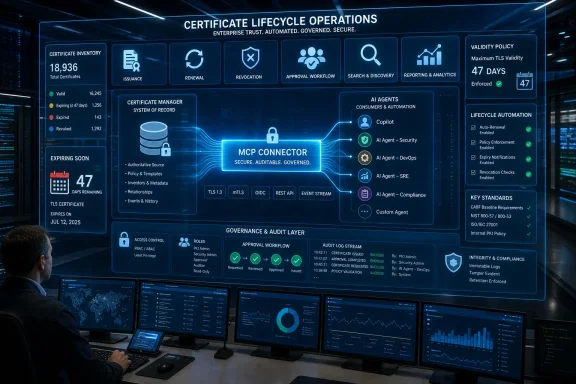
Sectigo’s positioning is therefore not just about certificates. It is about whether a security infrastructure vendor can present MCP as a governed execution channel rather than a speculative automation toy. The company says its server is hosted by Sectigo, connects customer-selected MCP-compatible agents to Sectigo Certificate Manager, and requires no additional infrastructure for customers to deploy.
That hosted model is central to the product’s enterprise story. It avoids asking customers to stand up and secure yet another integration server while keeping Sectigo Certificate Manager as the system of record. In theory, the AI agent becomes an interface, not the authority.
The distinction matters because IT teams have already learned to be suspicious of “AI-powered” anything that floats above existing permissions. If a product claims to save time by stepping around role-based access control, audit trails, or approval workflows, it is not automation. It is a compliance incident waiting for a calendar invite.
That is the right emphasis. In certificate lifecycle management, ease of use is valuable only if it does not dilute control. A renewal, revocation, replacement, or issuance request may sound routine, but each of those actions changes the trust posture of a service. The system has to know who is asking, what they are allowed to do, which approvals apply, and what evidence must be preserved afterward.
This is where Sectigo is trying to draw a line between a production system and a clever integration demo. The MCP server is meant to act as a secure connection between an enterprise’s preferred AI agent and the Sectigo platform, while the certificate platform still handles permissions, approval workflows, and audit logging. That means the agent can help express and route intent, but it should not become a shadow administrator.
The phrase agentic AI often implies software that can independently pursue goals and execute tasks. In a certificate environment, that independence has to be carefully bounded. A useful agent might identify certificates approaching expiration and draft renewal actions; a dangerous one might decide that an unexpected validation failure is reason enough to alter production trust without human approval.
Sectigo’s thesis is that enterprises want the first model, not the second. It is a pragmatic bet. Most large organizations are not ready to let AI autonomously manage core trust infrastructure, but many are ready to let AI reduce the friction around known, policy-controlled tasks.
The operational burden is not just renewal frequency. Shorter lifetimes also force better inventory, faster validation, cleaner ownership, and more resilient deployment pipelines. If an organization does not know where its certificates are, who owns them, or how they are installed, shrinking validity periods expose that ignorance with brutal regularity.
That is why vendors in this space are emphasizing certificate lifecycle management rather than certificate issuance alone. Issuance is the easy part. The hard part is knowing every certificate in use, mapping it to a business service, validating domain control, getting the right approvals, deploying the replacement, verifying that the old certificate is gone, and proving later that the process happened correctly.
Natural language can help with the human side of that workflow. An administrator might ask which externally facing certificates expire in the next two weeks, which business units own them, and which renewals are blocked. That is faster than navigating several dashboards if the underlying data is trustworthy.
But shorter certificate lifetimes also raise the penalty for hallucinated confidence. If an AI agent misreads an inventory, omits a dependency, or misunderstands a service name, a human may move faster in the wrong direction. The best MCP implementations will therefore be the boring ones: scoped tools, explicit confirmations, visible change plans, and logs that can survive both audit and incident review.
That sprawl is exactly why certificate lifecycle management becomes painful at scale. Microsoft’s ecosystem gives administrators powerful certificate infrastructure, particularly through Active Directory Certificate Services and enterprise policy tooling, but the day-to-day reality often includes multiple CAs, cloud services, third-party public certificates, internal private trust, and application teams that treat certificates as deployment artifacts rather than managed identities.
Sectigo’s MCP server is aimed most directly at customers using Sectigo Certificate Manager, not at replacing Microsoft-native PKI administration. Still, WindowsForum readers should see the larger pattern. AI agents are being invited into the management plane, and certificate operations are one of the first places where that invitation could have real consequences.
A Copilot-connected workflow that can query certificate inventory and initiate governed actions may sound appealing to Microsoft-centric teams. It also introduces a new architectural question: which system owns the truth? Sectigo’s answer is that SCM remains the system of record, with the AI agent acting through it.
That answer is sensible, but it will need to be tested in messy enterprise reality. Administrators will want to know how identity is mapped from agent to user, how approvals appear, how failed actions are reported, what happens when the AI agent’s context is incomplete, and whether every operation is visible in the same audit trail as conventional SCM activity.
Read-only MCP integrations are easier to trust. They can summarize certificate inventory, identify risk, answer policy questions, or surface expiring assets without directly changing production state. That is useful, but it leaves the human administrator to click through the actual remediation.
Write-capable integrations are where the productivity promise lives. If an agent can initiate issuance, renewal, replacement, revocation, and approval workflows, it can reduce the number of consoles and handoffs involved in routine certificate administration. It can also create a much more consequential failure mode.
This is the fundamental trade-off Sectigo is asking customers to accept. A read-only assistant can be wrong and annoying; an action-capable assistant can be wrong and disruptive. The safeguard is not to pretend the AI is infallible, but to constrain its tools so that every action remains attributable, policy-bound, reversible where possible, and visible to administrators.
That makes the MCP server less like a chatbot and more like a privileged integration endpoint. Enterprises should treat it accordingly. It belongs in security architecture reviews, identity governance discussions, change-management policy, and incident response planning, not merely in a vendor innovation slide deck.
Certificate management intensifies those concerns. An MCP server that can act on certificate infrastructure is not just reading business data; it is touching the fabric of encrypted communication and service identity. If an attacker can manipulate an agent’s instructions, compromise a connector, abuse delegated permissions, or trick a user into approving the wrong action, the consequences could include outages, unauthorized certificates, or weakened trust relationships.
Sectigo’s hosted approach may reduce some customer-side deployment risk, but it does not eliminate the need for careful configuration. Customers still have to decide which agents are allowed to connect, which users can invoke which tools, how sensitive prompts and outputs are handled, and how actions are approved. The governance boundary is only useful if enterprises actually draw it.
The most dangerous failure would be treating AI prompts as equivalent to administrative intent. They are not. A prompt is an input that may include ambiguity, copied text, incomplete context, or malicious content from somewhere else in the agent’s workspace. The system must verify the authenticated user, the requested action, the target asset, and the applicable policy before doing anything meaningful.
This is where traditional IT control frameworks still matter. Least privilege, separation of duties, change windows, logging, approval chains, and break-glass procedures may sound old-fashioned next to agentic AI, but they are precisely the mechanisms that keep agentic AI from becoming agentic chaos.
It can also create a false sense of simplicity. Certificate operations are full of naming collisions, inherited ownership, forgotten dependencies, and environment-specific quirks. A service name may not map cleanly to a certificate. A certificate may be installed in multiple places. A renewal may require coordination with a load balancer, a Kubernetes ingress controller, a legacy appliance, or a maintenance window.
Good AI tooling should expose that complexity rather than hiding it. If an agent finds three matching certificates, it should say so. If a renewal requires approval, it should show the policy boundary. If a certificate is installed in places the system cannot update automatically, it should not imply the job is finished after issuance.
The best version of Sectigo’s product would make certificate management more legible. It would let administrators query the estate conversationally, turn findings into governed actions, and preserve enough context that teams can understand later what changed and why. The worst version would turn ambiguous prompts into ticket noise or, worse, production changes that require forensic archaeology.
That openness gives Sectigo a stronger enterprise story than a proprietary assistant would. If the value sits in SCM’s policy engine, certificate inventory, and lifecycle workflows, then the conversational surface should be flexible. Customers can choose the agent environment that fits their existing procurement, identity, data-handling, and productivity stack.
For Microsoft-oriented organizations, Copilot compatibility will naturally attract attention. But the real issue is not whether an admin can use a familiar assistant. It is whether that assistant can interact with certificate infrastructure through a controlled, auditable channel rather than through brittle scripts, browser automation, or pasted secrets.
This is where MCP could become genuinely useful. It offers a common integration pattern that may reduce the temptation to build unsafe shortcuts. If enterprises can connect agents to tools through explicit capabilities and governed permissions, they have a better chance of preventing the sprawl of unofficial automation that often follows every new platform shift.
Still, vendor-neutral does not mean risk-neutral. Every supported agent brings its own data handling, identity integration, prompt-management behavior, and administrative model. Enterprises will need to evaluate the whole chain, not just the Sectigo endpoint.
That is why the most compelling case for Sectigo’s MCP server is not that AI makes certificate administration futuristic. It is that AI, used carefully, may make the tedious parts of certificate administration less likely to be skipped. If administrators can ask better questions faster, detect expiring assets earlier, and trigger governed remediation with fewer handoffs, the organization’s outage risk may fall.
The phrase “used carefully” is doing a lot of work. Certificate automation succeeds only when inventory, ownership, policy, and deployment are mature enough to support it. An AI interface cannot fix an organization that does not know which teams own which certificates or where private keys are stored. It can, however, make those gaps more visible.
That visibility may be the underrated benefit. A conversational query that reveals hundreds of unmanaged or poorly attributed certificates is not just a convenience feature. It is an uncomfortable audit of operational maturity.
Sectigo’s MCP server will be judged by what happens then. Does it ask clarifying questions? Does it surface the exact target and action before execution? Does it enforce approval workflows even when the prompt sounds urgent? Does it record the human identity behind the request? Does it make rollback or remediation obvious when something fails?
These details are less glamorous than “agentic AI,” but they decide whether the product belongs in serious infrastructure operations. Enterprises do not need AI that sounds confident. They need systems that fail safely.
There is also a cultural adjustment ahead. Administrators will need to learn how to operate through agents without overtrusting them. Security teams will need to define acceptable use. Auditors will need to understand how agent-mediated changes are logged. Incident responders will need to reconstruct actions that began as natural-language requests.
That is not a reason to avoid the technology. It is a reason to treat the launch as a new control plane, not a new skin.
That is the right architecture for this moment. Enterprises are curious about AI operations, but they remain deeply cautious about giving agents unsupervised authority over security infrastructure. A hosted MCP server that routes actions through existing permissions and approvals is a more credible path than a standalone assistant with broad administrative credentials.
The concrete implications are straightforward:
 Sectigo Puts AI Where Certificate Spreadsheets Go to Die
Certificate lifecycle management has always lived in the uncomfortable space between security hygiene and operational plumbing. Everyone agrees certificates are critical, but in many organizations they are still tracked through a mixture of discovery tools, ticket queues, renewal calendars, vendor portals, and the institutional memory of the person who set up the load balancer three jobs ago.Sectigo’s MCP server arrives at a moment when that model is becoming harder to defend. Public TLS certificate lifetimes are already shrinking under the CA/Browser Forum’s staged plan, with the industry moving from the long-familiar 398-day world toward a 47-day maximum by 2029. That turns certificate management from an annual compliance nuisance into something closer to a continuous operations discipline.
In that environment, the appeal of a natural-language interface is obvious. An administrator who can ask an AI agent to find expiring certificates, renew a specific asset, or start an approval workflow is not merely getting a nicer search box. They are getting a layer that could compress discovery, decision-making, and execution into a single interaction.
But that compression is exactly why this launch matters. Certificates are not low-stakes documents; they are machine identity, encryption, authentication, and availability all bound together. A botched renewal can knock a public service offline, while an overly casual revocation can break internal systems that nobody remembered depended on the same trust chain.
MCP Is Becoming the USB-C Port for Enterprise AI
The Model Context Protocol has quickly become one of the more important pieces of plumbing in the enterprise AI stack because it gives agents a structured way to talk to external tools and data sources. In plain English, MCP lets an AI assistant do more than answer questions from a static knowledge base. It can discover available tools, request actions, and return results through a common interface.That is why vendors are racing to attach MCP servers to operational systems. The protocol offers a convenient story for enterprises that do not want every AI integration to become a one-off custom project. If agents are going to move from demo environments into real workflows, they need standardized connectors to ticketing systems, cloud APIs, databases, developer tools, and now certificate management platforms.
Sectigo’s positioning is therefore not just about certificates. It is about whether a security infrastructure vendor can present MCP as a governed execution channel rather than a speculative automation toy. The company says its server is hosted by Sectigo, connects customer-selected MCP-compatible agents to Sectigo Certificate Manager, and requires no additional infrastructure for customers to deploy.
That hosted model is central to the product’s enterprise story. It avoids asking customers to stand up and secure yet another integration server while keeping Sectigo Certificate Manager as the system of record. In theory, the AI agent becomes an interface, not the authority.
The distinction matters because IT teams have already learned to be suspicious of “AI-powered” anything that floats above existing permissions. If a product claims to save time by stepping around role-based access control, audit trails, or approval workflows, it is not automation. It is a compliance incident waiting for a calendar invite.
The Product Is Really Selling Governance, Not Conversation
Sectigo’s announcement leans heavily on natural-language certificate operations, but the more serious selling point is governance. The company is arguing that AI-driven certificate actions can remain inside the same policy boundaries that already apply to human administrators using Sectigo Certificate Manager.That is the right emphasis. In certificate lifecycle management, ease of use is valuable only if it does not dilute control. A renewal, revocation, replacement, or issuance request may sound routine, but each of those actions changes the trust posture of a service. The system has to know who is asking, what they are allowed to do, which approvals apply, and what evidence must be preserved afterward.
This is where Sectigo is trying to draw a line between a production system and a clever integration demo. The MCP server is meant to act as a secure connection between an enterprise’s preferred AI agent and the Sectigo platform, while the certificate platform still handles permissions, approval workflows, and audit logging. That means the agent can help express and route intent, but it should not become a shadow administrator.
The phrase agentic AI often implies software that can independently pursue goals and execute tasks. In a certificate environment, that independence has to be carefully bounded. A useful agent might identify certificates approaching expiration and draft renewal actions; a dangerous one might decide that an unexpected validation failure is reason enough to alter production trust without human approval.
Sectigo’s thesis is that enterprises want the first model, not the second. It is a pragmatic bet. Most large organizations are not ready to let AI autonomously manage core trust infrastructure, but many are ready to let AI reduce the friction around known, policy-controlled tasks.
The Short-Certificate Era Changes the Math
The certificate industry’s move toward shorter public TLS lifetimes is the backdrop that makes this announcement more than another AI feature launch. When certificates lasted years, manual processes could survive longer than they deserved. When certificates move toward 47-day validity, weak automation becomes a reliability risk.The operational burden is not just renewal frequency. Shorter lifetimes also force better inventory, faster validation, cleaner ownership, and more resilient deployment pipelines. If an organization does not know where its certificates are, who owns them, or how they are installed, shrinking validity periods expose that ignorance with brutal regularity.
That is why vendors in this space are emphasizing certificate lifecycle management rather than certificate issuance alone. Issuance is the easy part. The hard part is knowing every certificate in use, mapping it to a business service, validating domain control, getting the right approvals, deploying the replacement, verifying that the old certificate is gone, and proving later that the process happened correctly.
Natural language can help with the human side of that workflow. An administrator might ask which externally facing certificates expire in the next two weeks, which business units own them, and which renewals are blocked. That is faster than navigating several dashboards if the underlying data is trustworthy.
But shorter certificate lifetimes also raise the penalty for hallucinated confidence. If an AI agent misreads an inventory, omits a dependency, or misunderstands a service name, a human may move faster in the wrong direction. The best MCP implementations will therefore be the boring ones: scoped tools, explicit confirmations, visible change plans, and logs that can survive both audit and incident review.
Windows Shops Will Care Because Certificates Are Everywhere
For Windows-heavy environments, certificates are not confined to public websites. They sit behind VPNs, Wi-Fi authentication, Remote Desktop gateways, Exchange and hybrid mail flows, Intune and device management, code signing, internal web apps, smart cards, EAP-TLS, AD CS templates, load balancers, proxies, and a long list of appliances that never seem to have a modern API.That sprawl is exactly why certificate lifecycle management becomes painful at scale. Microsoft’s ecosystem gives administrators powerful certificate infrastructure, particularly through Active Directory Certificate Services and enterprise policy tooling, but the day-to-day reality often includes multiple CAs, cloud services, third-party public certificates, internal private trust, and application teams that treat certificates as deployment artifacts rather than managed identities.
Sectigo’s MCP server is aimed most directly at customers using Sectigo Certificate Manager, not at replacing Microsoft-native PKI administration. Still, WindowsForum readers should see the larger pattern. AI agents are being invited into the management plane, and certificate operations are one of the first places where that invitation could have real consequences.
A Copilot-connected workflow that can query certificate inventory and initiate governed actions may sound appealing to Microsoft-centric teams. It also introduces a new architectural question: which system owns the truth? Sectigo’s answer is that SCM remains the system of record, with the AI agent acting through it.
That answer is sensible, but it will need to be tested in messy enterprise reality. Administrators will want to know how identity is mapped from agent to user, how approvals appear, how failed actions are reported, what happens when the AI agent’s context is incomplete, and whether every operation is visible in the same audit trail as conventional SCM activity.
“Read-Only” Was the Safe Demo; Write Access Is the Real Product
Sectigo is also making a competitive claim: that many alternatives in certificate lifecycle management are read-only, geographically limited, or narrower in operational scope. The read-only distinction is important because it marks the divide between AI as a reporting assistant and AI as an operational interface.Read-only MCP integrations are easier to trust. They can summarize certificate inventory, identify risk, answer policy questions, or surface expiring assets without directly changing production state. That is useful, but it leaves the human administrator to click through the actual remediation.
Write-capable integrations are where the productivity promise lives. If an agent can initiate issuance, renewal, replacement, revocation, and approval workflows, it can reduce the number of consoles and handoffs involved in routine certificate administration. It can also create a much more consequential failure mode.
This is the fundamental trade-off Sectigo is asking customers to accept. A read-only assistant can be wrong and annoying; an action-capable assistant can be wrong and disruptive. The safeguard is not to pretend the AI is infallible, but to constrain its tools so that every action remains attributable, policy-bound, reversible where possible, and visible to administrators.
That makes the MCP server less like a chatbot and more like a privileged integration endpoint. Enterprises should treat it accordingly. It belongs in security architecture reviews, identity governance discussions, change-management policy, and incident response planning, not merely in a vendor innovation slide deck.
The Attack Surface Moves With the Interface
The security conversation around MCP is still catching up to the speed of adoption. Standardizing agent-to-tool communication is useful, but standardization does not automatically solve trust, authorization, prompt injection, tool poisoning, or confused-deputy problems. If anything, it gives attackers a clearer target class to study.Certificate management intensifies those concerns. An MCP server that can act on certificate infrastructure is not just reading business data; it is touching the fabric of encrypted communication and service identity. If an attacker can manipulate an agent’s instructions, compromise a connector, abuse delegated permissions, or trick a user into approving the wrong action, the consequences could include outages, unauthorized certificates, or weakened trust relationships.
Sectigo’s hosted approach may reduce some customer-side deployment risk, but it does not eliminate the need for careful configuration. Customers still have to decide which agents are allowed to connect, which users can invoke which tools, how sensitive prompts and outputs are handled, and how actions are approved. The governance boundary is only useful if enterprises actually draw it.
The most dangerous failure would be treating AI prompts as equivalent to administrative intent. They are not. A prompt is an input that may include ambiguity, copied text, incomplete context, or malicious content from somewhere else in the agent’s workspace. The system must verify the authenticated user, the requested action, the target asset, and the applicable policy before doing anything meaningful.
This is where traditional IT control frameworks still matter. Least privilege, separation of duties, change windows, logging, approval chains, and break-glass procedures may sound old-fashioned next to agentic AI, but they are precisely the mechanisms that keep agentic AI from becoming agentic chaos.
The Human Interface May Be the Biggest Change
For all the attention on protocols, the most immediate change may be psychological. Administrators who would never casually browse through a certificate management console might feel more comfortable asking an AI agent, “Which certificates are about to expire?” or “Renew the certificate for this service.” That lower barrier can improve hygiene by making routine checks easier.It can also create a false sense of simplicity. Certificate operations are full of naming collisions, inherited ownership, forgotten dependencies, and environment-specific quirks. A service name may not map cleanly to a certificate. A certificate may be installed in multiple places. A renewal may require coordination with a load balancer, a Kubernetes ingress controller, a legacy appliance, or a maintenance window.
Good AI tooling should expose that complexity rather than hiding it. If an agent finds three matching certificates, it should say so. If a renewal requires approval, it should show the policy boundary. If a certificate is installed in places the system cannot update automatically, it should not imply the job is finished after issuance.
The best version of Sectigo’s product would make certificate management more legible. It would let administrators query the estate conversationally, turn findings into governed actions, and preserve enough context that teams can understand later what changed and why. The worst version would turn ambiguous prompts into ticket noise or, worse, production changes that require forensic archaeology.
Vendor-Neutral Agents Are a Smart Enterprise Bet
Sectigo’s decision to support customer-selected MCP-compatible agents, including Claude and Microsoft Copilot, is more than a checklist item. It acknowledges that enterprises are unlikely to standardize on a single AI assistant across every department and workflow. Security teams, developers, help desks, and business users may all adopt different tools for different reasons.That openness gives Sectigo a stronger enterprise story than a proprietary assistant would. If the value sits in SCM’s policy engine, certificate inventory, and lifecycle workflows, then the conversational surface should be flexible. Customers can choose the agent environment that fits their existing procurement, identity, data-handling, and productivity stack.
For Microsoft-oriented organizations, Copilot compatibility will naturally attract attention. But the real issue is not whether an admin can use a familiar assistant. It is whether that assistant can interact with certificate infrastructure through a controlled, auditable channel rather than through brittle scripts, browser automation, or pasted secrets.
This is where MCP could become genuinely useful. It offers a common integration pattern that may reduce the temptation to build unsafe shortcuts. If enterprises can connect agents to tools through explicit capabilities and governed permissions, they have a better chance of preventing the sprawl of unofficial automation that often follows every new platform shift.
Still, vendor-neutral does not mean risk-neutral. Every supported agent brings its own data handling, identity integration, prompt-management behavior, and administrative model. Enterprises will need to evaluate the whole chain, not just the Sectigo endpoint.
Certificate Automation Is Becoming an Availability Strategy
It is tempting to frame certificate lifecycle management as a security issue, but many executives first discover it as an availability issue. The site goes dark. The API fails. The mobile app throws trust errors. The VPN stops accepting clients. Suddenly a small object with a date field becomes a board-level incident.That is why the most compelling case for Sectigo’s MCP server is not that AI makes certificate administration futuristic. It is that AI, used carefully, may make the tedious parts of certificate administration less likely to be skipped. If administrators can ask better questions faster, detect expiring assets earlier, and trigger governed remediation with fewer handoffs, the organization’s outage risk may fall.
The phrase “used carefully” is doing a lot of work. Certificate automation succeeds only when inventory, ownership, policy, and deployment are mature enough to support it. An AI interface cannot fix an organization that does not know which teams own which certificates or where private keys are stored. It can, however, make those gaps more visible.
That visibility may be the underrated benefit. A conversational query that reveals hundreds of unmanaged or poorly attributed certificates is not just a convenience feature. It is an uncomfortable audit of operational maturity.
The Real Test Will Be the First Bad Prompt
Every new management interface eventually meets a bad input. Someone asks for the wrong certificate. Someone uses an old service name. Someone pastes a confusing incident note into an agent. Someone asks for a renewal during an outage and assumes the system understands the production blast radius.Sectigo’s MCP server will be judged by what happens then. Does it ask clarifying questions? Does it surface the exact target and action before execution? Does it enforce approval workflows even when the prompt sounds urgent? Does it record the human identity behind the request? Does it make rollback or remediation obvious when something fails?
These details are less glamorous than “agentic AI,” but they decide whether the product belongs in serious infrastructure operations. Enterprises do not need AI that sounds confident. They need systems that fail safely.
There is also a cultural adjustment ahead. Administrators will need to learn how to operate through agents without overtrusting them. Security teams will need to define acceptable use. Auditors will need to understand how agent-mediated changes are logged. Incident responders will need to reconstruct actions that began as natural-language requests.
That is not a reason to avoid the technology. It is a reason to treat the launch as a new control plane, not a new skin.
The Certificate Bot Has to Earn Its Change Window
Sectigo’s announcement is strongest when read as an incremental shift rather than a revolution. The company is not claiming that AI should replace certificate lifecycle management. It is claiming that AI agents can become a governed interface into an existing CLM platform.That is the right architecture for this moment. Enterprises are curious about AI operations, but they remain deeply cautious about giving agents unsupervised authority over security infrastructure. A hosted MCP server that routes actions through existing permissions and approvals is a more credible path than a standalone assistant with broad administrative credentials.
The concrete implications are straightforward:
- Sectigo’s MCP server is generally available worldwide for Sectigo Certificate Manager and is designed to support natural-language certificate operations through compatible AI agents.
- The server supports operational tasks such as issuance, renewal, revocation, replacement, approval, search, and reporting while keeping Sectigo Certificate Manager as the system of record.
- The product’s real value depends less on conversational polish than on whether permissions, approvals, and audit logs remain enforceable during agent-mediated actions.
- Shorter TLS certificate lifetimes make certificate automation more urgent because manual renewal processes will become less sustainable as the industry moves toward 47-day public certificates.
- Enterprises should evaluate MCP certificate workflows as privileged operational integrations, not as harmless chatbot features.
- Windows and Microsoft-centric shops should pay particular attention to identity mapping, Copilot integration, AD CS coexistence, and audit visibility before expanding use.
References
- Primary source: SecurityBrief UK
Published: 2026-06-05T09:50:36.529551
Sectigo launches MCP server for certificate management
Enterprise security teams can now use AI prompts to renew or revoke certificates without bypassing Sectigo's approval and audit controls. securitybrief.co.uk
- Related coverage: sectigo.com
- Related coverage: scworld.com
Sectigo launches AI-powered server for certificate lifecycle management | brief | SC Media
The MCP Server for Sectigo Certificate Manager acts as a secure intermediary between AI agents, such as Microsoft Copilot and Claude, and Sectigo's certificate management platform.www.scworld.com - Related coverage: businesswire.com
- Related coverage: channelinsider.com
Sectigo Launches MCP Server for CLM
Sectigo launches a production-ready MCP server to bring agentic AI workflows to certificate lifecycle management for enterprises and partners. www.channelinsider.com
- Related coverage: ar.linkedin.com
Sectigo | LinkedIn
Sectigo | 93.188 seguidores en LinkedIn. Certificate Lifecycle Management for the modern enterprise. Sectigo delivers Simplicity at Scale. | Expired certificates shouldn’t be the reason your business goes down. Sectigo is the industry’s most trusted CA-agnostic Certificate Lifecycle Management...ar.linkedin.com
- Related coverage: taolis.net
TLS証明書47日時代への備え|CA/B Forum SC-081v3 | タオリス人機和総研
CA/Browser ForumがTLS証明書有効期間を47日に短縮。ACME自動化、CLMプラットフォーム選定、PQC対応のロードマップを解説。www.taolis.net - Related coverage: certpulse.dev
The 47-Day Certificate Timeline: What Every DevOps Team Needs to Know | CertPulse
The CA/Browser Forum voted to shorten TLS certificate lifetimes to 47 days by 2029. Here is the full timeline, what breaks, and what your team should do now.certpulse.dev
- Related coverage: abhs.in
SSL Certificate Validity Drops to 47 Days by 2029: Automate Now | Abhishek Gautam
SSL validity drops to 200 days (2026), 100 days (2027), 47 days (2029). Apple, Google, Mozilla voted yes. Automate with ACME and cert-manager now.www.abhs.in
- Related coverage: fixmycert.com
The 47-Day Certificate Timeline: SC-081v3 Explained
CA/Browser Forum Ballot SC-081v3 reduces TLS certificate validity from 398 to 47 days by 2029. Live countdowns, phase breakdowns, and action items.fixmycert.com - Related coverage: support.dnsimple.com
SSL Certificate Validity Changes (2026 - 2029) - DNSimple Help
Learn about the 2026 SSL certificate validity changes. Purchase before March 15, 2026 to receive a certificate with the current extended validity period.support.dnsimple.com
- Related coverage: syntacticsinc.com
The 47-Day SSL/TLS Certificate Validity Starts in 2026
Prepare for the CA/Browser Forum's 47-day SSL/TLS mandate. Learn the phased timeline, what changes in 2026, and how to automate before it's too late.www.syntacticsinc.com
