

EHS Insight announced on June 30, 2026, that its environmental, health, safety, and ESG management platform now supports Model Context Protocol, letting authorized users query live EHS Insight data from Claude, ChatGPT, and Microsoft Copilot. The claim is not just another “AI copilot” press release; it is a bet that workplace safety data should move into the same conversational layer where employees already draft reports, triage risks, and ask operational questions. If the implementation holds up, the important change is not that EHS software has gained a chatbot. It is that the EHS system is becoming an authenticated data service for other people’s AI tools.
The most revealing line in EHS Insight’s announcement is not the boast about being first. It is the promise that safety and compliance teams can ask plain-language questions without exports, dashboards, or a new tool to learn. That is the pitch every enterprise software vendor now wants to make, but in EHS it lands with unusual force because the daily work is spread across incident records, audits, corrective actions, permits, observations, training histories, and regulatory reports.
For years, software vendors have treated dashboards as the answer to that fragmentation. Dashboards are useful when the question is already known, the metric is already modeled, and the audience wants a repeatable view. They are much less useful when a safety manager asks a compound, situational question after an incident, such as whether the injured worker had appeared in recent observation records or whether an overdue corrective action came from the same audit cycle.
That is where EHS Insight wants MCP to matter. The company says its connector lets a user authenticate with existing EHS Insight credentials, add the platform as a data source inside a supported assistant, and start asking questions against live, permissioned data. In the company’s framing, the AI tool does not merely summarize a static export; it plans and executes queries through the connector and returns the answer inside Claude, ChatGPT, or Copilot.
The distinction is important. A spreadsheet uploaded into a chatbot is a snapshot, stripped of permissions, auditability, and context. A governed connector is at least an attempt to keep the system of record intact while making the interface conversational. The enterprise AI story has been full of magical thinking, but this is one of the places where the architecture actually matters.
That makes MCP sound like middleware, and in some ways it is. But its strategic effect is bigger than the plumbing. It changes the center of gravity from the SaaS application’s own interface to the assistant where the user is already working.
EHS Insight’s announcement leans directly into that shift. The company already offers embedded AI features inside its own platform for tasks such as incident review, corrective-action suggestions, permit analysis, searching, trending, and reporting. The new MCP connector does not replace those features. It extends the data outward, turning EHS Insight into a live source that outside assistants can interrogate.
That is a meaningful architectural choice. A proprietary in-app copilot keeps the user in the vendor’s application and gives the vendor more control over the experience. An MCP connector accepts that users may live in several AI environments and that the EHS system must participate there rather than force a return trip to the application for every question.
For IT departments, that is both attractive and uncomfortable. It offers a cleaner alternative to copy-paste AI use, but it also means sanctioned assistants become a new access path into regulated operational data. The front door has moved.
MCP has moved quickly because it solves a problem the AI industry created for itself. Large language models can generate fluent answers, but enterprise value often depends on whether they can securely reach the right internal system at the right time. Without that, the assistant is either guessing, waiting for a user to upload data, or trapped inside a narrow vendor-built feature.
That is why the timing of EHS Insight’s move is more interesting than the marketing superlative. EHS has not usually been the earliest adopter category for new software interface patterns. It is operational, regulated, heavily permissioned, and often distributed across facilities where “data quality” is not an abstract governance slogan but the difference between a useful report and a compliance problem.
If MCP is showing up here, it suggests the protocol is moving past developer enthusiasm and into line-of-business systems with real audit exposure. That is the kind of migration that separates a clever integration standard from an enterprise platform pattern.
That is why EHS is a revealing test case for enterprise AI. In many office workflows, a slightly wrong AI answer is irritating. In safety and compliance, a slightly wrong answer can misdirect an investigation, omit a record from a report, or give management false confidence that an issue has been resolved.
The best version of this technology does not make the AI the authority. It makes the AI a faster interface to the authority. The system of record remains EHS Insight. The user’s permissions still matter. The query path is logged. The assistant helps retrieve, correlate, and draft, but the human still owns the compliance judgment.
That last part should not be treated as a formality. Safety reporting and regulatory documentation are full of terms that look simple until they meet real-world edge cases. Whether an incident is recordable, whether a corrective action is truly closed, whether an observation is relevant to an injury investigation, and whether a summary is ready for submission are not merely database joins. They are professional determinations.
EHS Insight’s pitch works best when read as an analyst accelerator, not a compliance autopilot. The company’s own examples point in that direction: ask the system a messy operational question, get a structured answer quickly, then use that answer as a basis for review.
IT leaders have spent the last two years trying to stop unsanctioned AI use with policy, training, and data-loss warnings. Those measures help, but they do not remove the underlying incentive. If a compliance analyst can save hours by asking a model to summarize incident trends, the organization needs a safe path for that workflow or it will eventually inherit an unsafe one.
MCP-style connectors are an answer to that pressure. They promise to let the assistant retrieve only what the authenticated user can access, without requiring a bulk export. They also make the interaction observable. EHS Insight says MCP sessions use the user’s existing credentials, enforce role-based permissions, and audit-log queries.
That is the right direction, but it is not a magic shield. Governance has to include more than authentication. Enterprises will need to decide which assistants are approved, which MCP servers can be connected, what kinds of prompts and results are logged, how long logs are retained, and whether highly sensitive records should be accessible through conversational tools at all.
In other words, MCP can reduce shadow AI. It does not eliminate the need for AI governance. It moves the fight from “please stop uploading spreadsheets” to “which live tools should this assistant be allowed to call, under which identity, and for which tasks?”
For customers, that can turn into a new form of lock-in. A vendor-built copilot may answer only the questions the vendor anticipated, price AI features in ways customers cannot easily compare, and keep the user inside a single application even when the work spans multiple systems. A platform assistant may be more flexible, but only if the business applications expose their data and actions in a way that assistant can understand.
MCP gives software vendors a way to say they are not choosing one model ecosystem. EHS Insight can support Claude, ChatGPT, and Copilot through a common protocol rather than building entirely separate integrations for each. Customers can pick the assistant that fits their enterprise agreements, internal policies, and user habits.
That does not mean MCP is fully neutral in practice. Client support varies. Security models vary. The user experience in Claude is not the same as in ChatGPT or Copilot. Enterprise controls differ across providers, and a connector that works elegantly in one environment may feel less mature in another.
Still, the direction is clear. The AI assistant market is not going to settle into one universal front end. Enterprises will have multiple assistants for different populations and workflows. In that world, a protocol-level integration is more durable than a single-vendor chatbot bolted onto an EHS dashboard.
That could change how EHS work appears inside the daily rhythm of an enterprise. A manager preparing for an operations meeting might ask for overdue corrective actions without opening the EHS application. A compliance officer drafting a report in a Microsoft 365 workflow could pull current incident counts without waiting on an analyst. A site leader could ask Copilot for trends across audits, observations, and incidents, assuming the connector exposes those capabilities and permissions allow it.
This is the promise Microsoft has been circling with Copilot: not merely text generation, but business-context retrieval across systems. The challenge has always been that business context lives in third-party applications, not just in Exchange mailboxes and SharePoint files. MCP gives vendors such as EHS Insight a standardized way to plug into that world.
The Windows endpoint still matters in that scenario. If a user’s AI assistant becomes a live interface into regulated operational systems, device compliance, identity posture, browser controls, data-loss prevention, and endpoint monitoring become part of the AI access chain. The conversation may happen in a chat pane, but the risk surface includes the PC, the identity provider, the assistant, the connector, and the source application.
That is a very Microsoft-shaped problem. It is also why IT teams should resist treating MCP connectors as “just another integration.” They are integrations into the new interface layer.
There is nothing inherently wrong with user-driven setup when it respects existing permissions and approved AI environments. In fact, low-friction connection is part of the value proposition. If every plain-language query requires a ticket, the organization will drift back to exports and workarounds.
But “no IT involvement” cannot mean “no IT visibility.” Enterprises will want centralized controls over whether MCP access is enabled, which domains or tenants are allowed, whether users can connect personal AI accounts, and whether certain roles or data categories are excluded. They will also want reporting that shows adoption patterns and unusual query behavior.
EHS Insight’s statement that queries are audit-logged is therefore more than a compliance checkbox. Audit logs are the mechanism by which organizations can compare the theoretical permission model with actual usage. If the connector becomes popular, those logs may reveal not only security events but also the operational questions users were previously unable to answer efficiently.
That is one of the underappreciated benefits of governed AI access. Shadow workflows disappear into unmanaged files. Logged conversational queries can show where the business is struggling to extract value from its own systems.
For an EHS connector, the immediate risk is less sci-fi than practical. A prompt could retrieve more context than the user intended. A poorly scoped tool could expose sensitive incident details. A model could summarize records in a misleading way. A user could paste the result into a report without checking source records. An assistant connected to multiple tools could combine data in ways governance teams did not anticipate.
The answer is not to reject MCP. The answer is to treat it like a privileged integration pattern. Read-only access may be appropriate for some roles, while write actions should be much more tightly controlled. Sensitive fields may need redaction. High-risk workflows may require confirmation steps, human review, or in-product completion rather than free-form execution from a chat interface.
The protocol can standardize the connection. It cannot standardize every organization’s appetite for risk. That remains an IT, security, legal, and operations decision.
This is where EHS Insight’s positioning around existing credentials and role-based permissions is necessary but not sufficient. It solves the first-order access question: who is allowed to see what? It does not by itself solve second-order questions about how AI-mediated outputs are interpreted, stored, shared, or used in regulated decisions.
What is changing is the assumption that every useful question must be pre-modeled as a dashboard tile. EHS work contains too many ad hoc investigations for that model to be enough. The useful question often emerges after the incident, during the audit, or in the uncomfortable meeting where someone asks why a known hazard was not corrected sooner.
Conversational querying is strongest in that gap. It lets users move from a known metric to a chain of follow-up questions: which site, which department, which audit, which owner, which observation, which repeated condition. Done well, it compresses the time between suspicion and evidence.
That compression has cultural consequences. If managers can ask better questions more easily, excuses based on reporting latency get weaker. If corrective actions can be surfaced across audits and ownership chains in seconds, overdue work becomes harder to bury. If incident and observation records can be correlated without specialist SQL skills, prevention analysis becomes more accessible.
The risk, again, is false confidence. Fast answers are seductive. The organizations that benefit most will be those that pair speed with verification.
There is a product-management fork here. One path is to build deeper in-app AI that is highly tuned to EHS workflows, with curated prompts, guided actions, and domain-specific validation. The other is to expose live capabilities outward through standards such as MCP, accepting that the assistant experience may be owned by someone else. The best vendors will likely do both.
That dual approach makes sense because not all AI use cases belong in the same place. A complex incident investigation workflow may need structured steps inside the EHS application. A quick question about overdue audit actions may be perfectly suited to Copilot or ChatGPT. A regulatory report draft may start in an assistant but need final validation against the source system.
The winners will not be the vendors that simply sprinkle AI branding across menus. They will be the vendors that understand where judgment, workflow, data retrieval, and governance each belong.
EHS Insight’s announcement is therefore a signal to the EHS software market: the AI interface is becoming portable. If your data cannot travel securely to the assistant, users may make it travel insecurely by other means.
For incident correlations, the assistant should make it easy to trace back to the underlying observation and injury records. For overdue corrective actions, it should show owners, due dates, audit references, and status fields. For OSHA summaries, it should separate draft language from recordable-incident determinations and source counts.
This is where many enterprise AI demos fall apart. They show the answer but not the work. In low-risk settings, that may be acceptable. In EHS, the user needs a way to challenge the answer, refine the query, and document the source.
If EHS Insight gets this right, the MCP connector could become more than a convenience layer. It could become an investigative interface that shortens the path from question to evidence. If it gets this wrong, the connector will be another impressive demo that cautious organizations disable or restrict to narrow read-only scenarios.
The difference will be visible quickly in real deployments. Users will either trust the tool enough to incorporate it into review cycles, or they will treat it as a drafting aid that still requires manual verification in the EHS platform.
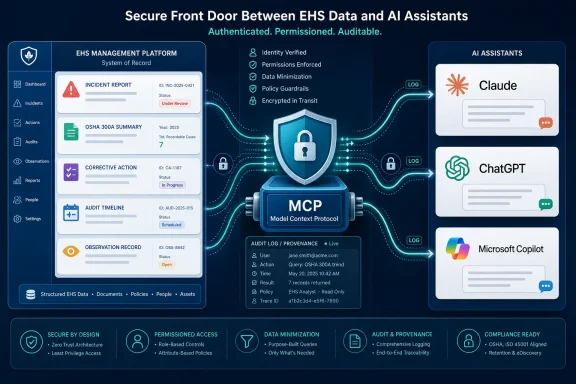 EHS Insight Is Selling a Connector, but the Real Product Is Friction Removal
The most revealing line in EHS Insight’s announcement is not the boast about being first. It is the promise that safety and compliance teams can ask plain-language questions without exports, dashboards, or a new tool to learn. That is the pitch every enterprise software vendor now wants to make, but in EHS it lands with unusual force because the daily work is spread across incident records, audits, corrective actions, permits, observations, training histories, and regulatory reports.For years, software vendors have treated dashboards as the answer to that fragmentation. Dashboards are useful when the question is already known, the metric is already modeled, and the audience wants a repeatable view. They are much less useful when a safety manager asks a compound, situational question after an incident, such as whether the injured worker had appeared in recent observation records or whether an overdue corrective action came from the same audit cycle.
That is where EHS Insight wants MCP to matter. The company says its connector lets a user authenticate with existing EHS Insight credentials, add the platform as a data source inside a supported assistant, and start asking questions against live, permissioned data. In the company’s framing, the AI tool does not merely summarize a static export; it plans and executes queries through the connector and returns the answer inside Claude, ChatGPT, or Copilot.
The distinction is important. A spreadsheet uploaded into a chatbot is a snapshot, stripped of permissions, auditability, and context. A governed connector is at least an attempt to keep the system of record intact while making the interface conversational. The enterprise AI story has been full of magical thinking, but this is one of the places where the architecture actually matters.
MCP Turns the AI Assistant Into a Front Door, Not a Destination
Model Context Protocol began as Anthropic’s attempt to standardize how AI applications connect to tools, data sources, and services. The simple idea is that assistants should not need bespoke one-off integrations for every system they touch. Instead, a tool or application can expose capabilities through an MCP server, while a client such as Claude, ChatGPT, Copilot, an IDE, or an agent framework can discover and call those capabilities in a common way.That makes MCP sound like middleware, and in some ways it is. But its strategic effect is bigger than the plumbing. It changes the center of gravity from the SaaS application’s own interface to the assistant where the user is already working.
EHS Insight’s announcement leans directly into that shift. The company already offers embedded AI features inside its own platform for tasks such as incident review, corrective-action suggestions, permit analysis, searching, trending, and reporting. The new MCP connector does not replace those features. It extends the data outward, turning EHS Insight into a live source that outside assistants can interrogate.
That is a meaningful architectural choice. A proprietary in-app copilot keeps the user in the vendor’s application and gives the vendor more control over the experience. An MCP connector accepts that users may live in several AI environments and that the EHS system must participate there rather than force a return trip to the application for every question.
For IT departments, that is both attractive and uncomfortable. It offers a cleaner alternative to copy-paste AI use, but it also means sanctioned assistants become a new access path into regulated operational data. The front door has moved.
The “First EHS Platform” Claim Matters Less Than the Timing
EHS Insight says it is the first EHS platform to connect live program data to Claude, ChatGPT, and Microsoft Copilot through MCP. As with most “first” claims in enterprise software, the practical value will depend on what ships, what is generally available, what customers can configure, and how broad the supported use cases really are. The more durable point is that EHS vendors are now being pulled into the same integration race that has already reshaped developer tools, customer support platforms, document systems, and workflow automation.MCP has moved quickly because it solves a problem the AI industry created for itself. Large language models can generate fluent answers, but enterprise value often depends on whether they can securely reach the right internal system at the right time. Without that, the assistant is either guessing, waiting for a user to upload data, or trapped inside a narrow vendor-built feature.
That is why the timing of EHS Insight’s move is more interesting than the marketing superlative. EHS has not usually been the earliest adopter category for new software interface patterns. It is operational, regulated, heavily permissioned, and often distributed across facilities where “data quality” is not an abstract governance slogan but the difference between a useful report and a compliance problem.
If MCP is showing up here, it suggests the protocol is moving past developer enthusiasm and into line-of-business systems with real audit exposure. That is the kind of migration that separates a clever integration standard from an enterprise platform pattern.
Safety Data Is a Bad Place for AI Theater
The examples EHS Insight gives are deliberately practical. Find incidents where the injured person appeared in a work observation within two weeks before the injury. Show corrective actions past due from Q2 audits and identify the owners. Draft an OSHA 300A summary for the year. These are not novelty prompts; they are the sort of cross-record questions that consume analyst time because the data is present but not conveniently assembled.That is why EHS is a revealing test case for enterprise AI. In many office workflows, a slightly wrong AI answer is irritating. In safety and compliance, a slightly wrong answer can misdirect an investigation, omit a record from a report, or give management false confidence that an issue has been resolved.
The best version of this technology does not make the AI the authority. It makes the AI a faster interface to the authority. The system of record remains EHS Insight. The user’s permissions still matter. The query path is logged. The assistant helps retrieve, correlate, and draft, but the human still owns the compliance judgment.
That last part should not be treated as a formality. Safety reporting and regulatory documentation are full of terms that look simple until they meet real-world edge cases. Whether an incident is recordable, whether a corrective action is truly closed, whether an observation is relevant to an injury investigation, and whether a summary is ready for submission are not merely database joins. They are professional determinations.
EHS Insight’s pitch works best when read as an analyst accelerator, not a compliance autopilot. The company’s own examples point in that direction: ask the system a messy operational question, get a structured answer quickly, then use that answer as a basis for review.
The Export-to-ChatGPT Problem Was Always Going to Force This Moment
The announcement’s sharpest security argument is that governed MCP access is safer than employees exporting data to Excel and uploading it into a chatbot with no audit trail. That is not a hypothetical risk. It is the everyday enterprise AI workaround: when official tools do not meet the user where the work happens, users build their own path with copy, paste, downloads, and personal accounts.IT leaders have spent the last two years trying to stop unsanctioned AI use with policy, training, and data-loss warnings. Those measures help, but they do not remove the underlying incentive. If a compliance analyst can save hours by asking a model to summarize incident trends, the organization needs a safe path for that workflow or it will eventually inherit an unsafe one.
MCP-style connectors are an answer to that pressure. They promise to let the assistant retrieve only what the authenticated user can access, without requiring a bulk export. They also make the interaction observable. EHS Insight says MCP sessions use the user’s existing credentials, enforce role-based permissions, and audit-log queries.
That is the right direction, but it is not a magic shield. Governance has to include more than authentication. Enterprises will need to decide which assistants are approved, which MCP servers can be connected, what kinds of prompts and results are logged, how long logs are retained, and whether highly sensitive records should be accessible through conversational tools at all.
In other words, MCP can reduce shadow AI. It does not eliminate the need for AI governance. It moves the fight from “please stop uploading spreadsheets” to “which live tools should this assistant be allowed to call, under which identity, and for which tasks?”
Open Standards Are a Strategy Against Copilot Lock-In
EHS Insight’s announcement draws a contrast between its MCP approach and proprietary in-app copilots. That contrast is partly self-serving, but it also captures a real anxiety in the market. Every enterprise vendor wants to wrap its product in an AI assistant, and every platform company wants to make its own assistant the place where work happens.For customers, that can turn into a new form of lock-in. A vendor-built copilot may answer only the questions the vendor anticipated, price AI features in ways customers cannot easily compare, and keep the user inside a single application even when the work spans multiple systems. A platform assistant may be more flexible, but only if the business applications expose their data and actions in a way that assistant can understand.
MCP gives software vendors a way to say they are not choosing one model ecosystem. EHS Insight can support Claude, ChatGPT, and Copilot through a common protocol rather than building entirely separate integrations for each. Customers can pick the assistant that fits their enterprise agreements, internal policies, and user habits.
That does not mean MCP is fully neutral in practice. Client support varies. Security models vary. The user experience in Claude is not the same as in ChatGPT or Copilot. Enterprise controls differ across providers, and a connector that works elegantly in one environment may feel less mature in another.
Still, the direction is clear. The AI assistant market is not going to settle into one universal front end. Enterprises will have multiple assistants for different populations and workflows. In that world, a protocol-level integration is more durable than a single-vendor chatbot bolted onto an EHS dashboard.
Copilot Makes This a Windows and Microsoft 365 Story
For WindowsForum readers, the Microsoft angle is not incidental. Copilot is increasingly the AI layer Microsoft wants to spread across Windows, Microsoft 365, developer tools, security products, and low-code platforms. If EHS Insight data can be queried from Copilot through MCP, then safety and compliance information becomes part of the broader Microsoft productivity surface many organizations already license and govern.That could change how EHS work appears inside the daily rhythm of an enterprise. A manager preparing for an operations meeting might ask for overdue corrective actions without opening the EHS application. A compliance officer drafting a report in a Microsoft 365 workflow could pull current incident counts without waiting on an analyst. A site leader could ask Copilot for trends across audits, observations, and incidents, assuming the connector exposes those capabilities and permissions allow it.
This is the promise Microsoft has been circling with Copilot: not merely text generation, but business-context retrieval across systems. The challenge has always been that business context lives in third-party applications, not just in Exchange mailboxes and SharePoint files. MCP gives vendors such as EHS Insight a standardized way to plug into that world.
The Windows endpoint still matters in that scenario. If a user’s AI assistant becomes a live interface into regulated operational systems, device compliance, identity posture, browser controls, data-loss prevention, and endpoint monitoring become part of the AI access chain. The conversation may happen in a chat pane, but the risk surface includes the PC, the identity provider, the assistant, the connector, and the source application.
That is a very Microsoft-shaped problem. It is also why IT teams should resist treating MCP connectors as “just another integration.” They are integrations into the new interface layer.
Under-One-Minute Setup Is a Promise IT Should Read Carefully
EHS Insight says setup takes under one minute and requires no IT involvement. From a user-adoption standpoint, that is exactly the message customers want to hear. From an enterprise governance standpoint, it is also the line that should make administrators sit up straight.There is nothing inherently wrong with user-driven setup when it respects existing permissions and approved AI environments. In fact, low-friction connection is part of the value proposition. If every plain-language query requires a ticket, the organization will drift back to exports and workarounds.
But “no IT involvement” cannot mean “no IT visibility.” Enterprises will want centralized controls over whether MCP access is enabled, which domains or tenants are allowed, whether users can connect personal AI accounts, and whether certain roles or data categories are excluded. They will also want reporting that shows adoption patterns and unusual query behavior.
EHS Insight’s statement that queries are audit-logged is therefore more than a compliance checkbox. Audit logs are the mechanism by which organizations can compare the theoretical permission model with actual usage. If the connector becomes popular, those logs may reveal not only security events but also the operational questions users were previously unable to answer efficiently.
That is one of the underappreciated benefits of governed AI access. Shadow workflows disappear into unmanaged files. Logged conversational queries can show where the business is struggling to extract value from its own systems.
MCP’s Security Story Is Still Being Written
The security debate around MCP has become louder as adoption has grown. Researchers and practitioners have raised concerns about tool poisoning, prompt injection, insecure local transports, excessive tool permissions, and the difficulty of reasoning about what an agent can do once it can call multiple external systems. Some of those risks are implementation-specific. Others are native to the idea of giving probabilistic software access to deterministic tools.For an EHS connector, the immediate risk is less sci-fi than practical. A prompt could retrieve more context than the user intended. A poorly scoped tool could expose sensitive incident details. A model could summarize records in a misleading way. A user could paste the result into a report without checking source records. An assistant connected to multiple tools could combine data in ways governance teams did not anticipate.
The answer is not to reject MCP. The answer is to treat it like a privileged integration pattern. Read-only access may be appropriate for some roles, while write actions should be much more tightly controlled. Sensitive fields may need redaction. High-risk workflows may require confirmation steps, human review, or in-product completion rather than free-form execution from a chat interface.
The protocol can standardize the connection. It cannot standardize every organization’s appetite for risk. That remains an IT, security, legal, and operations decision.
This is where EHS Insight’s positioning around existing credentials and role-based permissions is necessary but not sufficient. It solves the first-order access question: who is allowed to see what? It does not by itself solve second-order questions about how AI-mediated outputs are interpreted, stored, shared, or used in regulated decisions.
The Dashboard Era Is Not Ending, but Its Monopoly Is
It would be easy to overstate this announcement as the death of dashboards. That would be wrong. Dashboards remain valuable for recurring metrics, executive reporting, trend monitoring, and standard operating rhythms. A safety director still needs reliable leading and lagging indicators. A plant manager still needs a known view of overdue actions. An auditor still needs evidence, not just a conversational answer.What is changing is the assumption that every useful question must be pre-modeled as a dashboard tile. EHS work contains too many ad hoc investigations for that model to be enough. The useful question often emerges after the incident, during the audit, or in the uncomfortable meeting where someone asks why a known hazard was not corrected sooner.
Conversational querying is strongest in that gap. It lets users move from a known metric to a chain of follow-up questions: which site, which department, which audit, which owner, which observation, which repeated condition. Done well, it compresses the time between suspicion and evidence.
That compression has cultural consequences. If managers can ask better questions more easily, excuses based on reporting latency get weaker. If corrective actions can be surfaced across audits and ownership chains in seconds, overdue work becomes harder to bury. If incident and observation records can be correlated without specialist SQL skills, prevention analysis becomes more accessible.
The risk, again, is false confidence. Fast answers are seductive. The organizations that benefit most will be those that pair speed with verification.
EHS Vendors Now Have to Decide What Their AI Layer Is For
EHS Insight’s move also pressures competitors. Vendors that have spent the last year building proprietary copilots now have to explain whether those copilots are the destination or merely one interface among many. Customers will ask whether their EHS data can be used safely from the assistants they have already standardized on. “Use our chatbot instead” may not be a satisfying answer.There is a product-management fork here. One path is to build deeper in-app AI that is highly tuned to EHS workflows, with curated prompts, guided actions, and domain-specific validation. The other is to expose live capabilities outward through standards such as MCP, accepting that the assistant experience may be owned by someone else. The best vendors will likely do both.
That dual approach makes sense because not all AI use cases belong in the same place. A complex incident investigation workflow may need structured steps inside the EHS application. A quick question about overdue audit actions may be perfectly suited to Copilot or ChatGPT. A regulatory report draft may start in an assistant but need final validation against the source system.
The winners will not be the vendors that simply sprinkle AI branding across menus. They will be the vendors that understand where judgment, workflow, data retrieval, and governance each belong.
EHS Insight’s announcement is therefore a signal to the EHS software market: the AI interface is becoming portable. If your data cannot travel securely to the assistant, users may make it travel insecurely by other means.
The Real Test Is Whether the Answers Are Inspectable
The most important unanswered product question is how inspectable the MCP answers are. A safety manager should not have to trust a paragraph from an assistant without knowing which records, filters, and assumptions produced it. In compliance-heavy workflows, provenance is not an advanced feature. It is the difference between a useful assistant and a liability generator.For incident correlations, the assistant should make it easy to trace back to the underlying observation and injury records. For overdue corrective actions, it should show owners, due dates, audit references, and status fields. For OSHA summaries, it should separate draft language from recordable-incident determinations and source counts.
This is where many enterprise AI demos fall apart. They show the answer but not the work. In low-risk settings, that may be acceptable. In EHS, the user needs a way to challenge the answer, refine the query, and document the source.
If EHS Insight gets this right, the MCP connector could become more than a convenience layer. It could become an investigative interface that shortens the path from question to evidence. If it gets this wrong, the connector will be another impressive demo that cautious organizations disable or restrict to narrow read-only scenarios.
The difference will be visible quickly in real deployments. Users will either trust the tool enough to incorporate it into review cycles, or they will treat it as a drafting aid that still requires manual verification in the EHS platform.
What the EHS Insight MCP Move Tells IT Before the Pilot Starts
EHS Insight’s MCP connector is not just a feature for safety departments; it is a test case for how line-of-business systems will plug into general-purpose AI assistants. The practical lessons are already clear enough for IT teams planning pilots.- Organizations should treat MCP connectors as governed enterprise integrations, not casual chatbot add-ons.
- Existing role-based permissions are necessary, but administrators still need tenant-level controls, logging, retention policies, and approved-assistant boundaries.
- The safest early use cases are read-heavy workflows where the assistant retrieves, correlates, and drafts rather than directly changing records.
- Safety and compliance teams should require answer provenance, including links or references back to the underlying records inside the system of record.
- The strongest business case is not replacing EHS professionals, but reducing the analyst time spent assembling cross-record answers from data the organization already has.
- The biggest unmanaged risk remains the old workaround: exporting sensitive operational data into spreadsheets and feeding it to unsanctioned AI tools.
References
- Primary source: AiThority
Published: 2026-06-30T14:50:16.649789
EHS Insight is the First EHS Platform with MCP, Connecting Live Safety Data to Claude, ChatGPT, and Copilot
EHS Insight, a leading EHS and ESG management platform today announced the launch of its Model Context Protocol (MCP) integration.aithority.com - Related coverage: natlawreview.com
- Related coverage: ehsinsight.com
EHS Insight's Task Assistant AI, Analytical AI, and the MCP Connector for Claude, ChatGPT, and Copilot
EHS Insight ships AI in three layers: task assistant AI embedded in workflows, built-in analytical AI inside the platform, and the new Model Context Protocol connector that brings your live EHS data into Claude, ChatGPT, and Microsoft Copilot. Open standard. Live data. Your permissions.www.ehsinsight.com
- Related coverage: techcrunch.com
OpenAI adopts rival Anthropic's standard for connecting AI models to data | TechCrunch
OpenAI is embracing rival Anthropic's standard, Model Context Protocol (MCP), for connecting AI assistants to the systems where data resides.techcrunch.com - Official source: microsoft.com
Anthropic joins the multi-model lineup in Microsoft Copilot Studio | Microsoft Copilot Blog
In addition to default OpenAI models, Copilot Studio customers can now build agents with Anthropic models Claude Sonnet 4 and Claude Opus 4.1www.microsoft.com - Related coverage: windowscentral.com
Claude AI now plugs into Outlook, Teams, and OneDrive | Windows Central
Microsoft's AI diversification continues as it pulls away from overreliance on OpenAI.www.windowscentral.com
