

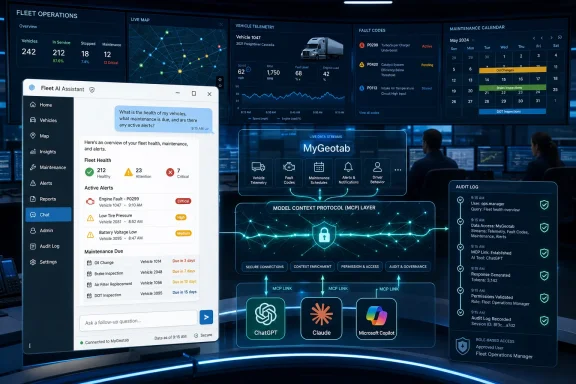
Geotab launched its Model Context Protocol Connector on June 17, 2026, giving fleets a way to connect live MyGeotab operational data and Geotab’s Ace agentic platform to approved AI tools including ChatGPT, Claude, Microsoft Copilot, and other MCP-compatible environments. The pitch is not that another chatbot has arrived in fleet management. It is that the data layer beneath the chatbot is finally close enough to live operations to matter. For WindowsForum readers, the story is less about trucking than about the next enterprise integration pattern: AI assistants are becoming front ends for governed business systems, and MCP is the plug they increasingly expect.
As detailed by Geotab in its launch materials and reported by Fleet Equipment, the connector is meant to let fleet users ask plain-language questions, generate reports, create alerts, schedule maintenance, and execute multi-step workflows without leaving the AI platform their organization already permits. That sounds like the familiar “natural language analytics” promise, but the operational stakes are higher when the underlying system tracks vehicles, drivers, fuel, safety, maintenance, and asset utilization in near real time. A bad answer in a spreadsheet is annoying; a bad answer in a fleet workflow can mean missed service, compliance exposure, or unsafe equipment on the road.
The smartest part of Geotab’s announcement is that it avoids pretending fleets need yet another proprietary AI destination. Geotab already has Ace, its own agentic AI platform, but the MCP Connector frames Ace less as a walled garden and more as a capability that can travel into the tools employees already use. That is a subtle but important shift.
Enterprise AI has been stuck between two unsatisfying models. One model asks workers to copy data into a general-purpose assistant and hope policy, memory, and retention settings are configured correctly. The other asks workers to adopt a vendor-specific AI surface bolted onto each line-of-business application. Geotab’s connector tries to thread the needle by letting the assistant stay where the user is while the operational truth remains in MyGeotab.
That distinction matters because fleets do not suffer from a shortage of dashboards. They suffer from too many dashboards, too many exports, and too much latency between the person asking the question and the system that can actually answer it. If a maintenance director asks why roadside failures are rising on a particular tractor group, the answer may involve fault codes, odometer history, inspection timing, route patterns, driver behavior, and prior repairs. The AI interface is only valuable if it can reach that context without turning the workflow into another manual data project.
Geotab says it processes roughly 37 trillion data points per year from more than 6 million connected vehicles across 160 countries. That number is central to the pitch because AI output is only as useful as the freshness, structure, and permissioning of the data behind it. Mike Branch, Geotab’s vice president of data and analytics, put it plainly in the company’s announcement: high-quality information is what gives AI a measurable operational impact.
For IT departments, the appeal is obvious. Instead of building a bespoke integration for every pairing of model and application, vendors can expose capabilities through a standard that multiple AI clients understand. In theory, the same fleet connector can be made available to Claude, ChatGPT, Copilot, or another internal agent without rebuilding the whole integration from scratch.
That does not make MCP magic. It does, however, create a common design language for a problem enterprises were already facing. Once workers begin asking AI systems to summarize tickets, draft customer responses, inspect telemetry, reconcile invoices, or schedule maintenance, the assistant needs governed access to the systems of record. MCP gives vendors and platform teams a cleaner way to expose that access than paste-in prompts and fragile browser automation.
Microsoft’s support for MCP in Copilot Studio is part of why this announcement should interest Windows and Microsoft 365 administrators. Copilot’s enterprise story depends on being more than a Microsoft Graph summarizer. The more third-party systems expose MCP-compatible endpoints, the more realistic it becomes for Copilot-style agents to act as cross-system workflow surfaces rather than just document companions.
That complexity is exactly where AI vendors like to promise transformation, but it is also where generic models tend to fail. A large language model can explain what a fault code means in general terms. It cannot know whether a specific vehicle’s fault pattern is urgent unless it can see the vehicle, its history, its route, the fleet’s maintenance policy, and the business context around downtime.
Geotab’s connector aims to close that gap by allowing approved AI tools to query live MyGeotab data and use Ace’s fleet-specific intelligence. The company says users can ask plain-English questions about fuel, trips, logs, vehicle health, driver behavior, route efficiency, and maintenance needs. More importantly, Geotab says the connector can support actions such as creating dashboards, setting up rules and alerts, organizing groups, scheduling maintenance, generating reports, and building applications.
That last category — taking action — is where the risk and value both increase. Reporting is one thing; changing operational state is another. A read-only assistant can mislead a user, but an action-capable assistant can misconfigure a rule, trigger an alert storm, schedule the wrong vehicle, or expose sensitive data if governance is weak. The connector’s real test will be whether it makes action safe enough for production use rather than impressive enough for a conference demo.
The phrase “weeks of manual analysis” should catch an IT manager’s attention. Many organizations still treat AI productivity as a matter of better drafting, faster summarization, or code assistance. But the bigger economic prize is the removal of low-status glue work: exporting data, cleaning it, correlating it, formatting it, and turning it into a decision artifact that is stale by the time it reaches a manager.
Fleet maintenance is full of that glue work. A team may know the data exists, but not have the time or tooling to continuously ask new questions of it. If an AI assistant can safely turn “show me the tractor groups with rising fault frequency and maintenance deferrals” into a live analysis, the productivity gain is not just faster reporting. It is a change in how often managers can afford to ask operational questions.
Still, customer quotes are not longitudinal evidence. The interesting question is what happens after the first wave of reporting wins. Does the connector reduce downtime? Does it change maintenance compliance? Does it improve fuel performance or safety outcomes? Does it produce fewer false positives than conventional dashboards? Those are the metrics that will separate durable AI integration from executive theater.
But an open standard is not the same thing as open season. The hard problem is not merely whether an AI client can connect to MyGeotab. The hard problem is whether the organization can control what the assistant may see, what it may do, who approved the action, where the prompt and response are retained, and how the workflow is audited after the fact.
Geotab says the connector enforces existing MyGeotab user permissions, which is the right starting point. If a dispatcher cannot see a certain region, driver group, or asset class in MyGeotab, the AI assistant should not become a side door. Permission inheritance is table stakes for any serious enterprise connector.
Yet permission inheritance alone is not full governance. Agentic systems introduce questions that classic role-based access control did not have to answer as often. Should a user who can manually create an alert also be allowed to ask an AI to create 50 alerts? Should a maintenance manager be able to schedule service through an assistant without human confirmation? Should an AI-generated report be labeled as such when it enters a compliance workflow? These are policy decisions, not connector features.
Microsoft’s Copilot strategy has always been strongest where data is already inside Microsoft 365, Windows, GitHub, Azure, or Dynamics. MCP changes the map by making third-party operational systems more accessible to Copilot-style agents. If vendors like Geotab expose governed MCP connectors, Copilot can become a practical interface for non-Microsoft operational data while still sitting inside an organization’s approved Microsoft environment.
That is both an opportunity and a support burden. Admins will need to understand which MCP servers are approved, which identities they use, which scopes they request, and how tool calls are logged. The familiar SaaS questions — single sign-on, conditional access, tenant boundaries, audit retention, DLP, eDiscovery, and incident response — do not disappear because the interface is conversational.
The endpoint layer also matters. A user asking Copilot a fleet question from a managed Windows device is different from a user connecting a personal AI account to a business system from an unmanaged browser session. Geotab’s language about “approved AI platforms” is doing real work here. The connector is not a consumer toy if implemented correctly; it is an enterprise integration point that should live inside existing policy.
A spreadsheet may be stale, but it is inspectable. A manager can see formulas, filters, and source tabs. An AI-generated answer can feel more magical and less auditable, especially when it summarizes multiple operational domains into a confident paragraph. That is why fleet-specific grounding matters. Users need not only an answer but a path back to the underlying vehicles, drivers, trips, fault codes, and maintenance records.
The best version of Geotab’s connector would not replace dashboards and reports. It would make them easier to create, interrogate, and refine. A user might begin with a natural-language question, receive an answer, drill into the underlying dataset, generate a dashboard, and then create an alert rule if the pattern matters. In that flow, AI becomes an accelerator for conventional governance rather than an opaque substitute for it.
The worst version would be a black-box assistant that tells managers what to do without enough evidence, context, or friction. That is the trap for all agentic business software. The more capable the assistant becomes, the more tempting it is to hide complexity. But operations leaders need the opposite: faster access to complexity, not its disappearance.
The necessary controls are not glamorous. Organizations will need clear approval tiers for read, write, and administrative actions. They will need audit logs that capture the user request, the tool calls made, the data sources consulted, the proposed action, and the final execution. They will need rollback paths when an AI-assisted workflow produces the wrong operational change.
They will also need prompt and output handling rules. Fleet data can reveal routes, customer locations, driver behavior, asset utilization, and operational vulnerabilities. Even if the connector respects MyGeotab permissions, the AI platform receiving context must be governed under enterprise terms. A personal chatbot session is not an acceptable destination for sensitive operational telemetry.
None of this means fleets should avoid AI connectors. It means the first production deployments should focus on workflows where the value is clear and the blast radius is bounded. Reporting, anomaly detection, maintenance prioritization, and dashboard creation are natural early candidates. Fully autonomous operational changes should arrive more slowly.
A proprietary assistant gives the vendor control over experience, domain logic, and monetization. An open connector gives the customer control over workflow, model choice, and enterprise governance. Vendors that offer only the first risk becoming yet another tab. Vendors that offer only the second risk turning themselves into backend plumbing. The stronger play is to provide domain intelligence that can appear wherever the customer’s AI work happens.
That is what Geotab is attempting with Ace and MCP. Ace supplies fleet-specific reasoning and data interpretation. MCP supplies the transport into tools like Claude, ChatGPT, and Copilot. MyGeotab remains the operational system of record. If the architecture works as advertised, each layer has a role.
This also changes vendor lock-in. Geotab’s announcement argues that customers should not be limited to one AI ecosystem. That is a customer-friendly message, but it also positions Geotab as the stable data intelligence layer beneath a volatile AI market. Models will change. Assistants will rise and fall. The fleet data remains valuable.
That is a broader lesson for every enterprise AI deployment. AI does not absolve companies from information architecture. It punishes the absence of it. A model connected to inconsistent permissions, stale groups, duplicated assets, and unclear ownership will produce answers that are harder to trust because they arrive with fluent confidence.
Fleet operators should treat MCP rollout as an opportunity to clean house. Review who can see what. Confirm that vehicle groups reflect current operations. Decide which workflows are safe for AI-assisted action. Establish naming conventions that make plain-language queries less ambiguous. The connector may be new, but the preparation is classic IT hygiene.
The payoff is that once the foundation is clean, natural-language access becomes genuinely useful. Users who would never build a BI report can ask operational questions. Managers can test hypotheses faster. Analysts can spend less time preparing data and more time challenging conclusions. That is the kind of AI adoption that survives budget scrutiny.
For IT leaders, the lesson is to treat AI connectors as production integrations from day one. They deserve the same scrutiny as any system that touches operational data. That means identity, logging, data retention, approval workflows, endpoint controls, and vendor risk reviews. The interface may look like chat, but the architecture is application integration.
For fleet leaders, the lesson is to start where the pain is measurable. If reporting takes weeks, attack reporting. If maintenance prioritization is reactive, use AI to surface risk earlier. If alerts are noisy, use the connector to analyze and refine them. The technology should earn trust by improving a workflow people already understand.
As detailed by Geotab in its launch materials and reported by Fleet Equipment, the connector is meant to let fleet users ask plain-language questions, generate reports, create alerts, schedule maintenance, and execute multi-step workflows without leaving the AI platform their organization already permits. That sounds like the familiar “natural language analytics” promise, but the operational stakes are higher when the underlying system tracks vehicles, drivers, fuel, safety, maintenance, and asset utilization in near real time. A bad answer in a spreadsheet is annoying; a bad answer in a fleet workflow can mean missed service, compliance exposure, or unsafe equipment on the road.
 Geotab Is Selling the Data Layer, Not the Chatbot
The smartest part of Geotab’s announcement is that it avoids pretending fleets need yet another proprietary AI destination. Geotab already has Ace, its own agentic AI platform, but the MCP Connector frames Ace less as a walled garden and more as a capability that can travel into the tools employees already use. That is a subtle but important shift.Enterprise AI has been stuck between two unsatisfying models. One model asks workers to copy data into a general-purpose assistant and hope policy, memory, and retention settings are configured correctly. The other asks workers to adopt a vendor-specific AI surface bolted onto each line-of-business application. Geotab’s connector tries to thread the needle by letting the assistant stay where the user is while the operational truth remains in MyGeotab.
That distinction matters because fleets do not suffer from a shortage of dashboards. They suffer from too many dashboards, too many exports, and too much latency between the person asking the question and the system that can actually answer it. If a maintenance director asks why roadside failures are rising on a particular tractor group, the answer may involve fault codes, odometer history, inspection timing, route patterns, driver behavior, and prior repairs. The AI interface is only valuable if it can reach that context without turning the workflow into another manual data project.
Geotab says it processes roughly 37 trillion data points per year from more than 6 million connected vehicles across 160 countries. That number is central to the pitch because AI output is only as useful as the freshness, structure, and permissioning of the data behind it. Mike Branch, Geotab’s vice president of data and analytics, put it plainly in the company’s announcement: high-quality information is what gives AI a measurable operational impact.
MCP Turns AI From a Window Into a Workbench
Model Context Protocol, introduced by Anthropic in late 2024, is often described as a universal connector for AI systems and external tools. That description is technically accurate but undersells the change. MCP is not just another API wrapper; it is part of a broader move to make AI assistants capable of discovering tools, requesting context, and taking action across approved systems.For IT departments, the appeal is obvious. Instead of building a bespoke integration for every pairing of model and application, vendors can expose capabilities through a standard that multiple AI clients understand. In theory, the same fleet connector can be made available to Claude, ChatGPT, Copilot, or another internal agent without rebuilding the whole integration from scratch.
That does not make MCP magic. It does, however, create a common design language for a problem enterprises were already facing. Once workers begin asking AI systems to summarize tickets, draft customer responses, inspect telemetry, reconcile invoices, or schedule maintenance, the assistant needs governed access to the systems of record. MCP gives vendors and platform teams a cleaner way to expose that access than paste-in prompts and fragile browser automation.
Microsoft’s support for MCP in Copilot Studio is part of why this announcement should interest Windows and Microsoft 365 administrators. Copilot’s enterprise story depends on being more than a Microsoft Graph summarizer. The more third-party systems expose MCP-compatible endpoints, the more realistic it becomes for Copilot-style agents to act as cross-system workflow surfaces rather than just document companions.
The Fleet Use Case Makes the AI Hype Concrete
Fleet management is a useful test case because the work is operationally messy. Vehicles move. Drivers change routes. Fuel costs fluctuate. Faults appear before humans notice them. Maintenance schedules compete with delivery deadlines. Safety risk is distributed across machines, people, roads, and time.That complexity is exactly where AI vendors like to promise transformation, but it is also where generic models tend to fail. A large language model can explain what a fault code means in general terms. It cannot know whether a specific vehicle’s fault pattern is urgent unless it can see the vehicle, its history, its route, the fleet’s maintenance policy, and the business context around downtime.
Geotab’s connector aims to close that gap by allowing approved AI tools to query live MyGeotab data and use Ace’s fleet-specific intelligence. The company says users can ask plain-English questions about fuel, trips, logs, vehicle health, driver behavior, route efficiency, and maintenance needs. More importantly, Geotab says the connector can support actions such as creating dashboards, setting up rules and alerts, organizing groups, scheduling maintenance, generating reports, and building applications.
That last category — taking action — is where the risk and value both increase. Reporting is one thing; changing operational state is another. A read-only assistant can mislead a user, but an action-capable assistant can misconfigure a rule, trigger an alert storm, schedule the wrong vehicle, or expose sensitive data if governance is weak. The connector’s real test will be whether it makes action safe enough for production use rather than impressive enough for a conference demo.
Central Transport’s Claude Deployment Is the Proof Point Geotab Needed
Geotab’s announcement includes a customer example from Central Transport, which is using the MCP Connector with Claude for fleet reporting and analysis. Jon Hanvey, the company’s director of tractor maintenance, said the integration replaced weeks of manual analysis with instant, deeper reporting. That is exactly the kind of quote every enterprise AI vendor wants because it moves the conversation from possibility to labor displacement inside a real workflow.The phrase “weeks of manual analysis” should catch an IT manager’s attention. Many organizations still treat AI productivity as a matter of better drafting, faster summarization, or code assistance. But the bigger economic prize is the removal of low-status glue work: exporting data, cleaning it, correlating it, formatting it, and turning it into a decision artifact that is stale by the time it reaches a manager.
Fleet maintenance is full of that glue work. A team may know the data exists, but not have the time or tooling to continuously ask new questions of it. If an AI assistant can safely turn “show me the tractor groups with rising fault frequency and maintenance deferrals” into a live analysis, the productivity gain is not just faster reporting. It is a change in how often managers can afford to ask operational questions.
Still, customer quotes are not longitudinal evidence. The interesting question is what happens after the first wave of reporting wins. Does the connector reduce downtime? Does it change maintenance compliance? Does it improve fuel performance or safety outcomes? Does it produce fewer false positives than conventional dashboards? Those are the metrics that will separate durable AI integration from executive theater.
Open Standards Do Not Remove the Governance Problem
Geotab is right to emphasize that MCP gives customers AI platform choice. That matters because enterprises are already fragmented across OpenAI, Anthropic, Microsoft, Google, internal models, and vertical AI tools. A fleet operator that standardizes on Copilot for Microsoft 365 should not have to abandon that environment to use fleet intelligence. Another that permits Claude for analysis should not be forced into a different AI stack.But an open standard is not the same thing as open season. The hard problem is not merely whether an AI client can connect to MyGeotab. The hard problem is whether the organization can control what the assistant may see, what it may do, who approved the action, where the prompt and response are retained, and how the workflow is audited after the fact.
Geotab says the connector enforces existing MyGeotab user permissions, which is the right starting point. If a dispatcher cannot see a certain region, driver group, or asset class in MyGeotab, the AI assistant should not become a side door. Permission inheritance is table stakes for any serious enterprise connector.
Yet permission inheritance alone is not full governance. Agentic systems introduce questions that classic role-based access control did not have to answer as often. Should a user who can manually create an alert also be allowed to ask an AI to create 50 alerts? Should a maintenance manager be able to schedule service through an assistant without human confirmation? Should an AI-generated report be labeled as such when it enters a compliance workflow? These are policy decisions, not connector features.
Windows Shops Should Read This as a Copilot Integration Story
WindowsForum readers may not manage fleets, but many manage the platforms through which employees will touch AI. That makes this launch relevant beyond transportation. The future of Copilot, ChatGPT Enterprise, Claude, and similar systems depends on whether they can become governed access points to business data without becoming uncontrolled exfiltration machines.Microsoft’s Copilot strategy has always been strongest where data is already inside Microsoft 365, Windows, GitHub, Azure, or Dynamics. MCP changes the map by making third-party operational systems more accessible to Copilot-style agents. If vendors like Geotab expose governed MCP connectors, Copilot can become a practical interface for non-Microsoft operational data while still sitting inside an organization’s approved Microsoft environment.
That is both an opportunity and a support burden. Admins will need to understand which MCP servers are approved, which identities they use, which scopes they request, and how tool calls are logged. The familiar SaaS questions — single sign-on, conditional access, tenant boundaries, audit retention, DLP, eDiscovery, and incident response — do not disappear because the interface is conversational.
The endpoint layer also matters. A user asking Copilot a fleet question from a managed Windows device is different from a user connecting a personal AI account to a business system from an unmanaged browser session. Geotab’s language about “approved AI platforms” is doing real work here. The connector is not a consumer toy if implemented correctly; it is an enterprise integration point that should live inside existing policy.
The Real Competition Is the Spreadsheet
Geotab’s most dangerous competitor may not be another fleet AI platform. It may be Excel, CSV exports, and the shadow reporting processes that fleets already trust because they are visible, familiar, and politically safe. AI tools must beat those workflows not only on speed but on explainability and accountability.A spreadsheet may be stale, but it is inspectable. A manager can see formulas, filters, and source tabs. An AI-generated answer can feel more magical and less auditable, especially when it summarizes multiple operational domains into a confident paragraph. That is why fleet-specific grounding matters. Users need not only an answer but a path back to the underlying vehicles, drivers, trips, fault codes, and maintenance records.
The best version of Geotab’s connector would not replace dashboards and reports. It would make them easier to create, interrogate, and refine. A user might begin with a natural-language question, receive an answer, drill into the underlying dataset, generate a dashboard, and then create an alert rule if the pattern matters. In that flow, AI becomes an accelerator for conventional governance rather than an opaque substitute for it.
The worst version would be a black-box assistant that tells managers what to do without enough evidence, context, or friction. That is the trap for all agentic business software. The more capable the assistant becomes, the more tempting it is to hide complexity. But operations leaders need the opposite: faster access to complexity, not its disappearance.
Agentic Fleet Workflows Will Need Guardrails That Feel Boring
The word agentic has become one of the AI industry’s most abused adjectives, but in this case it points to a real product boundary. A chatbot answers. An agent does. The moment an assistant can create alerts, schedule maintenance, modify settings, or organize groups, boring governance becomes the main event.The necessary controls are not glamorous. Organizations will need clear approval tiers for read, write, and administrative actions. They will need audit logs that capture the user request, the tool calls made, the data sources consulted, the proposed action, and the final execution. They will need rollback paths when an AI-assisted workflow produces the wrong operational change.
They will also need prompt and output handling rules. Fleet data can reveal routes, customer locations, driver behavior, asset utilization, and operational vulnerabilities. Even if the connector respects MyGeotab permissions, the AI platform receiving context must be governed under enterprise terms. A personal chatbot session is not an acceptable destination for sensitive operational telemetry.
None of this means fleets should avoid AI connectors. It means the first production deployments should focus on workflows where the value is clear and the blast radius is bounded. Reporting, anomaly detection, maintenance prioritization, and dashboard creation are natural early candidates. Fully autonomous operational changes should arrive more slowly.
Geotab’s Move Shows Where Vertical SaaS Is Heading
Geotab is not alone in recognizing that vertical SaaS vendors need an AI integration strategy that extends beyond their own interface. Every business application with valuable live data now faces the same question: should it build its own assistant, expose its data to outside assistants, or do both? The answer increasingly looks like both.A proprietary assistant gives the vendor control over experience, domain logic, and monetization. An open connector gives the customer control over workflow, model choice, and enterprise governance. Vendors that offer only the first risk becoming yet another tab. Vendors that offer only the second risk turning themselves into backend plumbing. The stronger play is to provide domain intelligence that can appear wherever the customer’s AI work happens.
That is what Geotab is attempting with Ace and MCP. Ace supplies fleet-specific reasoning and data interpretation. MCP supplies the transport into tools like Claude, ChatGPT, and Copilot. MyGeotab remains the operational system of record. If the architecture works as advertised, each layer has a role.
This also changes vendor lock-in. Geotab’s announcement argues that customers should not be limited to one AI ecosystem. That is a customer-friendly message, but it also positions Geotab as the stable data intelligence layer beneath a volatile AI market. Models will change. Assistants will rise and fall. The fleet data remains valuable.
The Early Winner Is the Organization With Clean Permissions
The organizations best positioned to benefit from Geotab’s connector are not necessarily the ones most excited about AI. They are the ones with disciplined data governance already in place. If user roles, asset groups, maintenance workflows, and reporting structures are messy in MyGeotab, the AI interface will inherit that mess and make it conversational.That is a broader lesson for every enterprise AI deployment. AI does not absolve companies from information architecture. It punishes the absence of it. A model connected to inconsistent permissions, stale groups, duplicated assets, and unclear ownership will produce answers that are harder to trust because they arrive with fluent confidence.
Fleet operators should treat MCP rollout as an opportunity to clean house. Review who can see what. Confirm that vehicle groups reflect current operations. Decide which workflows are safe for AI-assisted action. Establish naming conventions that make plain-language queries less ambiguous. The connector may be new, but the preparation is classic IT hygiene.
The payoff is that once the foundation is clean, natural-language access becomes genuinely useful. Users who would never build a BI report can ask operational questions. Managers can test hypotheses faster. Analysts can spend less time preparing data and more time challenging conclusions. That is the kind of AI adoption that survives budget scrutiny.
The Connector Is Small, but the Pattern Is Big
Geotab’s MCP Connector is a fleet product, but the pattern behind it is likely to spread across line-of-business systems. AI assistants are becoming the new shell for enterprise software, and MCP is one of the standards trying to make that shell less brittle. The winners will not be the vendors with the flashiest demos; they will be the ones that combine live data, domain context, permission inheritance, and auditable action.For IT leaders, the lesson is to treat AI connectors as production integrations from day one. They deserve the same scrutiny as any system that touches operational data. That means identity, logging, data retention, approval workflows, endpoint controls, and vendor risk reviews. The interface may look like chat, but the architecture is application integration.
For fleet leaders, the lesson is to start where the pain is measurable. If reporting takes weeks, attack reporting. If maintenance prioritization is reactive, use AI to surface risk earlier. If alerts are noisy, use the connector to analyze and refine them. The technology should earn trust by improving a workflow people already understand.
The Dashboard Is Becoming a Conversation, but the Audit Log Still Wins
The practical reading of Geotab’s launch is straightforward:- Geotab’s MCP Connector connects live MyGeotab data and Ace capabilities to approved AI tools such as ChatGPT, Claude, Microsoft Copilot, and other MCP-compatible platforms.
- The connector is designed for both answers and actions, including reports, alerts, maintenance scheduling, dashboards, rules, and multi-step fleet workflows.
- The open-standard approach gives customers more AI platform choice than a single proprietary assistant would, but it does not eliminate the need for governance.
- Existing MyGeotab permissions are a necessary foundation, but organizations still need approval policies, audit trails, retention rules, and clear limits on agentic actions.
- The strongest early use cases are likely to be reporting, analysis, maintenance prioritization, and workflow acceleration rather than fully autonomous operational control.
- Windows and Microsoft shops should see this as part of the larger Copilot-era shift in which approved AI assistants become front ends for third-party business systems.
References
- Primary source: Fleet Equipment Magazine
Published: 2026-07-06T16:05:12.283055
Geotab MCP Connector Links Fleet Data to AI Tools
Geotab MCP Connector links MyGeotab data with approved AI tools so fleets can query data, run workflows, and act.www.fleetequipmentmag.com - Related coverage: geotab.com
Geotab MCP Connector | Geotab
Connect your live fleet data to ChatGPT, Claude, or Copilot with the Geotab MCP Connector. Get instant answers about vehicles, trips, drivers, and more — no coding required.www.geotab.com
- Related coverage: support.geotab.com
Getting started with MyGeotab MCP
Set up the MyGeotab MCP integration, connect your AI assistant, and explore the capabilities and use cases available to your fleet. support.geotab.com
- Related coverage: sdcexec.com
Geotab Launches AI Connector for Fleets | Supply & Demand Chain Executive
The Geotab MCP Connector gives customers the flexibility to connect their fleet intelligence to the AI platform of their choice rather than being locked into a single ecosystem. www.sdcexec.com
- Related coverage: gadgets360.com
- Related coverage: techradar.com
How to reliably connect LLMs to real-world data and systems | TechRadar
MCP Is great, but it isn’t the whole AI answerwww.techradar.com