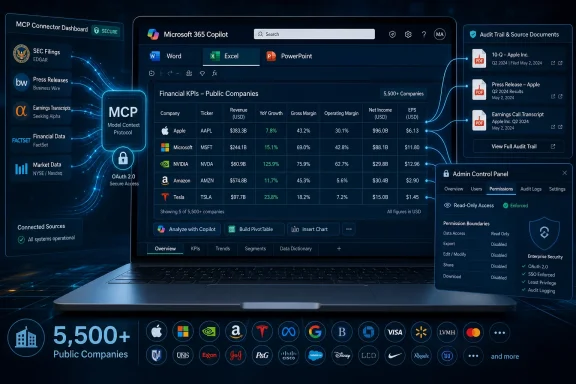
Daloopa announced on June 25, 2026, in New York that it has launched a Model Context Protocol connector for Microsoft 365 Copilot, bringing its structured, source-linked financial data into Copilot workflows across Word, Excel, and PowerPoint. The headline is not simply that another data vendor has joined the Copilot ecosystem. It is that Microsoft’s office suite is becoming a front end for specialized, auditable AI work, and finance is one of the first verticals where the stakes are high enough to expose whether that model works. Daloopa’s pitch is blunt: if investment firms are going to let AI draft reports, build models, and flag quarterly inflections, the data underneath cannot be a scraped approximation.
Microsoft 365 Copilot has always had an awkward gap between the demo and the desk. In a demo, Copilot summarizes meetings, drafts memos, and turns a few prompts into a deck. At an investment firm, the same assistant is being asked to reason over filings, reconcile metrics, compare quarters, and produce output that someone may act on with real capital.
That is why Daloopa’s connector matters more than its modest surface area suggests. The company says its platform covers more than 5,500 public companies globally, with datapoints linked back to original sources. In financial research, that source trail is not a nicety. It is the difference between a model that can be reviewed and one that becomes an expensive rumor generator.
The Daloopa connector is built around Model Context Protocol, or MCP, the open standard popularized by Anthropic and increasingly adopted across the AI stack as a way for models and agents to call external tools and retrieve external data. In Microsoft’s world, MCP is now part of the connective tissue for Copilot Studio and Microsoft 365 Copilot connectors. For users, the practical meaning is simple: Copilot can be grounded in outside systems without every vendor inventing its own bespoke integration.
Daloopa is positioning itself as a data layer rather than just another terminal, spreadsheet add-in, or research portal. That framing is important. If the AI assistant becomes the interface, the database that feeds it becomes harder to displace.
Those are not flashy AI-native canvases. They are where finance already does much of its work. Excel remains the living room of the analyst model. Word carries research notes, investment memos, and client-ready commentary. PowerPoint packages the conclusion for an investment committee, portfolio manager, or client meeting.
By bringing Daloopa data into Microsoft 365 Copilot, the workflow shifts from “go find the data, paste it into the model, cite the source, write the memo” toward “ask the assistant to retrieve, structure, compare, and draft.” That does not eliminate the analyst. It changes where the analyst spends attention: less on mechanical collection, more on judgment, skepticism, and narrative.
That is the bullish version, anyway. The cautious version is that Microsoft 365 becomes another place where bad prompts can manufacture confident nonsense unless the underlying data, permissions, and citations are handled carefully. Daloopa’s emphasis on source-linked datapoints is therefore not marketing decoration. It is the necessary defense against the obvious failure mode.
Financial firms have experimented with general-purpose chatbots, internal copilots, and research assistants for several years now. The consistent complaint has not been that the models are useless. It has been that they are unreliable when disconnected from governed, current, firm-approved data. A chatbot that knows accounting vocabulary but invents a revenue number is worse than no chatbot at all.
Daloopa has already moved in that direction. The Microsoft 365 Copilot connector follows recently announced integrations involving OpenAI’s ChatGPT and Anthropic’s Claude. The company is clearly betting that investment firms will not standardize on a single model vendor, and that the winning data providers will be those that can feed multiple assistants through a common protocol.
That is a sensible bet. Banks, hedge funds, asset managers, and research teams are unlikely to run all work through one model or one software surface. Some teams will prefer Copilot because it sits inside Microsoft 365. Others will use Claude for long-document analysis, ChatGPT for general research workflows, or specialized internal agents for compliance-sensitive tasks. The data layer that works across those environments has a chance to become infrastructure.
This is also why “LLM-agnostic” has become a serious enterprise selling point rather than a slogan. Corporate buyers do not want their most valuable data workflows fused to one model provider’s roadmap. They want optionality, even if in practice they end up consolidating around a small number of platforms.
For Daloopa, MCP is a distribution strategy. For Microsoft, it is an ecosystem strategy. For the customer, it is either welcome interoperability or a new governance problem, depending on how well the connector is deployed.
Generative AI has been strongest in prose and weakest where exactness matters. Finance lives in the uncomfortable middle. Analysts need language, but the language is only useful if it rests on precise numbers, definitions, and time periods. “Revenue growth accelerated” is not an insight unless the assistant knows which revenue line, which quarter, which reporting basis, and which comparable period.
Daloopa’s data model is aimed at that problem. The company’s MCP documentation describes tools for discovering covered companies, searching metrics and series, retrieving company fundamentals, pulling document content, and obtaining stock price data. In human terms, that means an AI agent should be able to ask structured questions instead of rummaging through raw filings like a distracted intern.
That matters because financial statements are deceptively messy. Companies rename segments, adjust non-GAAP metrics, restate figures, change disclosure formats, and bury important commentary in footnotes or earnings-call transcripts. An assistant that treats all text as equal context will miss some of that structure. A data layer built for line items, periods, filings, and source locations has a better shot.
But the spreadsheet also exposes the limits of the promise. Excel users will want more than summarized answers. They will want formulas, scenario tables, linked assumptions, audit trails, and repeatability. A Copilot-generated model that cannot be inspected cell by cell will not survive serious use. The strongest adoption path is not AI replacing the spreadsheet; it is AI reducing the friction of building and checking one.
That distinction should keep expectations grounded. The near-term win is not autonomous investing. It is faster retrieval, cleaner first drafts, better comparison tables, and fewer hours spent copying data from one system into another.
A general-purpose model can produce a fluent explanation of why a company’s margins moved. It may even be directionally right. The problem is that “directionally right” is a dangerous standard when the output is feeding a valuation model, a trade idea, or a client note. The analyst needs to know where every number came from.
Daloopa’s announcement repeatedly leans on auditability: structured data, original-source links, and AI-ready fundamentals. That is not accidental. In enterprise AI, the competitive advantage is moving from model cleverness to evidence handling. The question is no longer just “can the AI answer?” It is “can the AI show its work in a way that satisfies the person who signs off?”
Microsoft has been moving in the same direction with Copilot connectors. Its connector architecture distinguishes between synced connectors, which ingest and index content into Microsoft Graph, and federated connectors, which can retrieve data in real time through MCP without copying everything into Graph. For regulated or fast-moving datasets, that federated approach is especially relevant because it can keep authoritative data in the source system while still making it available to Copilot at query time.
That design does not magically solve governance. It shifts the burden. Firms still need authentication, authorization, logging, data-loss prevention, and review processes. But it is a better foundation than dumping sensitive or dynamic information into an ungoverned prompt box.
The strongest version of this product is one where Copilot’s answer includes not only a polished sentence or table, but a defensible chain back to the underlying filing, transcript, presentation, or datapoint. In finance, confidence without provenance is just theater.
If Copilot is going to become that interface, it has to reach beyond Microsoft’s own data. Email, chats, documents, and calendars are powerful context, but most businesses run on external systems of record: CRMs, ticketing platforms, data warehouses, ERP systems, code repositories, and specialist databases. Copilot becomes more useful as it becomes less confined to Microsoft 365.
That is where connectors become strategic. They turn Copilot from a productivity assistant into a possible operating layer over enterprise data. The Daloopa connector is a finance-specific example, but the pattern applies across legal research, procurement, healthcare operations, customer support, software development, and compliance.
Microsoft also benefits from letting specialized vendors solve specialized grounding. It does not need to become a financial data company to make Copilot useful for investors. It needs trusted financial data companies to expose their systems safely inside the Copilot experience.
That creates a familiar platform bargain. Partners get distribution into the Microsoft 365 workflow. Microsoft gets a richer Copilot story. Customers get convenience, but also another dependency on Microsoft’s admin controls, licensing model, and connector ecosystem.
For WindowsForum readers, the operating-system angle is indirect but real. The future Microsoft is building is not limited to Windows as a desktop shell. It is Windows, Microsoft 365, Entra, Graph, Copilot, and third-party connectors braided into one work environment. The PC remains the device, but the workspace is increasingly an authenticated AI surface stretched across apps.
MCP’s appeal is standardization, but standards also create repeatable attack surfaces. A connector that can retrieve sensitive data must be configured with care. A tool description that is too broad, a permission boundary that is too loose, or an agent prompt that can be manipulated by hostile content can turn convenience into exposure.
Microsoft’s documentation for custom federated connectors emphasizes read-only tools, authentication, and user-scoped access. That is the right direction. For investment firms, however, “read-only” is not the same as low-risk. Research data, positions, models, watchlists, and client materials can be sensitive even when nobody is changing a database record.
Daloopa’s connector appears focused on supplying Daloopa’s own financial dataset into Copilot rather than giving Copilot broad access to a firm’s internal research environment. That lowers some risk. But once the data enters a prompt-driven workflow, firms still need to think about retention, output sharing, cross-document leakage, and how employees are trained to verify AI-generated material.
The cultural risk is subtler. Analysts under deadline may begin to trust Copilot’s fluency before they trust its evidence. The source links help, but only if teams actually click them, review them, and maintain a habit of skepticism. AI does not remove the need for controls; it makes sloppy controls scale faster.
This is where sysadmins and Microsoft 365 administrators become central to the AI rollout, even in industries where the business users own the workflow. The connector has to be deployed, permissioned, monitored, and sometimes disabled. The age of agentic workflows is also the age of admin-center consequences.
For decades, specialized data products won by owning the interface. Bloomberg Terminal is the most famous example, but the pattern is everywhere: the data vendor builds the workflow, the screen, the shortcuts, the alerts, and the habit. AI threatens to unbundle that relationship. If users increasingly ask an assistant rather than navigate a terminal, the data provider must make sure the assistant is calling its data.
Daloopa seems to understand that. Its value is not just in presenting financial data to a human analyst, but in making that data legible to agents. That means structured schemas, source mappings, metric discovery, document retrieval, and compatibility with multiple LLM platforms.
This shift could pressure every high-value information provider. Legal databases, medical references, market intelligence vendors, developer documentation platforms, and research archives will all face the same question: are they destinations, or are they context providers? The answer may be both, but the balance is changing.
Microsoft benefits if that context flows into Copilot. OpenAI benefits if it flows into ChatGPT. Anthropic benefits if it flows into Claude. Customers benefit only if the flow is accurate, governed, and portable enough to avoid a new generation of lock-in disguised as openness.
MCP is not a magic guarantee of portability. Implementations differ, authentication varies, and commercial terms still matter. But it gives vendors a common grammar for becoming useful to agents. That is why a finance connector can be read as part of a much larger platform story.
Some of that will happen. Much of it is already happening in fragments. But the hard part is not producing more analysis; it is producing analysis that deserves trust.
Investment research is full of judgment calls that do not reduce cleanly to data retrieval. Which metric matters this quarter? Which management explanation is credible? Which one-time cost is actually recurring? Which consensus assumption is stale? Which risk is underpriced because everyone is using the same neat dataset?
AI can accelerate the mechanical layers around those questions. It can surface anomalies, retrieve historical comparisons, and draft an initial memo. It can reduce the blank-page problem and the copy-paste tax. But someone still owns the thesis.
That may be the best argument for this kind of connector. Not that it replaces analysts, but that it makes their work more inspectable. A Copilot workflow grounded in Daloopa data could, in theory, show the model output, the underlying metric, and the source document in one chain. That is better than a manually assembled spreadsheet whose provenance lives in the memory of the associate who built it at 1:00 a.m.
Still, firms should be wary of confusing faster work with better work. The productivity dividend is real only if review discipline keeps pace.
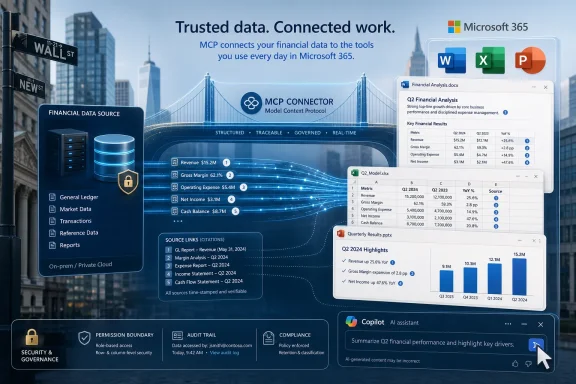 Copilot Gets a Finance Plug-In, but the Real Product Is Trust
Microsoft 365 Copilot has always had an awkward gap between the demo and the desk. In a demo, Copilot summarizes meetings, drafts memos, and turns a few prompts into a deck. At an investment firm, the same assistant is being asked to reason over filings, reconcile metrics, compare quarters, and produce output that someone may act on with real capital.That is why Daloopa’s connector matters more than its modest surface area suggests. The company says its platform covers more than 5,500 public companies globally, with datapoints linked back to original sources. In financial research, that source trail is not a nicety. It is the difference between a model that can be reviewed and one that becomes an expensive rumor generator.
The Daloopa connector is built around Model Context Protocol, or MCP, the open standard popularized by Anthropic and increasingly adopted across the AI stack as a way for models and agents to call external tools and retrieve external data. In Microsoft’s world, MCP is now part of the connective tissue for Copilot Studio and Microsoft 365 Copilot connectors. For users, the practical meaning is simple: Copilot can be grounded in outside systems without every vendor inventing its own bespoke integration.
Daloopa is positioning itself as a data layer rather than just another terminal, spreadsheet add-in, or research portal. That framing is important. If the AI assistant becomes the interface, the database that feeds it becomes harder to displace.
Microsoft’s Office Apps Are Becoming the New Research Terminal
The most interesting part of the announcement is not the acronym. It is the destination: Word, Excel, and PowerPoint.Those are not flashy AI-native canvases. They are where finance already does much of its work. Excel remains the living room of the analyst model. Word carries research notes, investment memos, and client-ready commentary. PowerPoint packages the conclusion for an investment committee, portfolio manager, or client meeting.
By bringing Daloopa data into Microsoft 365 Copilot, the workflow shifts from “go find the data, paste it into the model, cite the source, write the memo” toward “ask the assistant to retrieve, structure, compare, and draft.” That does not eliminate the analyst. It changes where the analyst spends attention: less on mechanical collection, more on judgment, skepticism, and narrative.
That is the bullish version, anyway. The cautious version is that Microsoft 365 becomes another place where bad prompts can manufacture confident nonsense unless the underlying data, permissions, and citations are handled carefully. Daloopa’s emphasis on source-linked datapoints is therefore not marketing decoration. It is the necessary defense against the obvious failure mode.
Financial firms have experimented with general-purpose chatbots, internal copilots, and research assistants for several years now. The consistent complaint has not been that the models are useless. It has been that they are unreliable when disconnected from governed, current, firm-approved data. A chatbot that knows accounting vocabulary but invents a revenue number is worse than no chatbot at all.
MCP Turns the Data Vendor Into an Agent Supplier
MCP is often described as a USB-C port for AI applications, a universal-ish way for assistants to connect to tools and data. The analogy is imperfect, but it captures the commercial shift. If AI agents can call MCP servers, then every serious enterprise data provider is under pressure to expose its product as an agent-readable service.Daloopa has already moved in that direction. The Microsoft 365 Copilot connector follows recently announced integrations involving OpenAI’s ChatGPT and Anthropic’s Claude. The company is clearly betting that investment firms will not standardize on a single model vendor, and that the winning data providers will be those that can feed multiple assistants through a common protocol.
That is a sensible bet. Banks, hedge funds, asset managers, and research teams are unlikely to run all work through one model or one software surface. Some teams will prefer Copilot because it sits inside Microsoft 365. Others will use Claude for long-document analysis, ChatGPT for general research workflows, or specialized internal agents for compliance-sensitive tasks. The data layer that works across those environments has a chance to become infrastructure.
This is also why “LLM-agnostic” has become a serious enterprise selling point rather than a slogan. Corporate buyers do not want their most valuable data workflows fused to one model provider’s roadmap. They want optionality, even if in practice they end up consolidating around a small number of platforms.
For Daloopa, MCP is a distribution strategy. For Microsoft, it is an ecosystem strategy. For the customer, it is either welcome interoperability or a new governance problem, depending on how well the connector is deployed.
The Spreadsheet Is Still the Battlefield
Excel is where this announcement will be judged.Generative AI has been strongest in prose and weakest where exactness matters. Finance lives in the uncomfortable middle. Analysts need language, but the language is only useful if it rests on precise numbers, definitions, and time periods. “Revenue growth accelerated” is not an insight unless the assistant knows which revenue line, which quarter, which reporting basis, and which comparable period.
Daloopa’s data model is aimed at that problem. The company’s MCP documentation describes tools for discovering covered companies, searching metrics and series, retrieving company fundamentals, pulling document content, and obtaining stock price data. In human terms, that means an AI agent should be able to ask structured questions instead of rummaging through raw filings like a distracted intern.
That matters because financial statements are deceptively messy. Companies rename segments, adjust non-GAAP metrics, restate figures, change disclosure formats, and bury important commentary in footnotes or earnings-call transcripts. An assistant that treats all text as equal context will miss some of that structure. A data layer built for line items, periods, filings, and source locations has a better shot.
But the spreadsheet also exposes the limits of the promise. Excel users will want more than summarized answers. They will want formulas, scenario tables, linked assumptions, audit trails, and repeatability. A Copilot-generated model that cannot be inspected cell by cell will not survive serious use. The strongest adoption path is not AI replacing the spreadsheet; it is AI reducing the friction of building and checking one.
That distinction should keep expectations grounded. The near-term win is not autonomous investing. It is faster retrieval, cleaner first drafts, better comparison tables, and fewer hours spent copying data from one system into another.
Source Links Are the Antidote to AI’s Most Expensive Habit
The finance industry has a low tolerance for hallucination, but it has a high appetite for speed. That tension is exactly where Daloopa is trying to plant itself.A general-purpose model can produce a fluent explanation of why a company’s margins moved. It may even be directionally right. The problem is that “directionally right” is a dangerous standard when the output is feeding a valuation model, a trade idea, or a client note. The analyst needs to know where every number came from.
Daloopa’s announcement repeatedly leans on auditability: structured data, original-source links, and AI-ready fundamentals. That is not accidental. In enterprise AI, the competitive advantage is moving from model cleverness to evidence handling. The question is no longer just “can the AI answer?” It is “can the AI show its work in a way that satisfies the person who signs off?”
Microsoft has been moving in the same direction with Copilot connectors. Its connector architecture distinguishes between synced connectors, which ingest and index content into Microsoft Graph, and federated connectors, which can retrieve data in real time through MCP without copying everything into Graph. For regulated or fast-moving datasets, that federated approach is especially relevant because it can keep authoritative data in the source system while still making it available to Copilot at query time.
That design does not magically solve governance. It shifts the burden. Firms still need authentication, authorization, logging, data-loss prevention, and review processes. But it is a better foundation than dumping sensitive or dynamic information into an ungoverned prompt box.
The strongest version of this product is one where Copilot’s answer includes not only a polished sentence or table, but a defensible chain back to the underlying filing, transcript, presentation, or datapoint. In finance, confidence without provenance is just theater.
Microsoft’s Enterprise AI Strategy Needs Partners Like This
Microsoft’s AI strategy has often been described as a model strategy because of its OpenAI partnership. That misses the more durable move: Microsoft is trying to make Copilot the enterprise interface for work.If Copilot is going to become that interface, it has to reach beyond Microsoft’s own data. Email, chats, documents, and calendars are powerful context, but most businesses run on external systems of record: CRMs, ticketing platforms, data warehouses, ERP systems, code repositories, and specialist databases. Copilot becomes more useful as it becomes less confined to Microsoft 365.
That is where connectors become strategic. They turn Copilot from a productivity assistant into a possible operating layer over enterprise data. The Daloopa connector is a finance-specific example, but the pattern applies across legal research, procurement, healthcare operations, customer support, software development, and compliance.
Microsoft also benefits from letting specialized vendors solve specialized grounding. It does not need to become a financial data company to make Copilot useful for investors. It needs trusted financial data companies to expose their systems safely inside the Copilot experience.
That creates a familiar platform bargain. Partners get distribution into the Microsoft 365 workflow. Microsoft gets a richer Copilot story. Customers get convenience, but also another dependency on Microsoft’s admin controls, licensing model, and connector ecosystem.
For WindowsForum readers, the operating-system angle is indirect but real. The future Microsoft is building is not limited to Windows as a desktop shell. It is Windows, Microsoft 365, Entra, Graph, Copilot, and third-party connectors braided into one work environment. The PC remains the device, but the workspace is increasingly an authenticated AI surface stretched across apps.
The Risk Moves From Chatbots to Connectors
The more useful an AI assistant becomes, the more dangerous a bad integration becomes.MCP’s appeal is standardization, but standards also create repeatable attack surfaces. A connector that can retrieve sensitive data must be configured with care. A tool description that is too broad, a permission boundary that is too loose, or an agent prompt that can be manipulated by hostile content can turn convenience into exposure.
Microsoft’s documentation for custom federated connectors emphasizes read-only tools, authentication, and user-scoped access. That is the right direction. For investment firms, however, “read-only” is not the same as low-risk. Research data, positions, models, watchlists, and client materials can be sensitive even when nobody is changing a database record.
Daloopa’s connector appears focused on supplying Daloopa’s own financial dataset into Copilot rather than giving Copilot broad access to a firm’s internal research environment. That lowers some risk. But once the data enters a prompt-driven workflow, firms still need to think about retention, output sharing, cross-document leakage, and how employees are trained to verify AI-generated material.
The cultural risk is subtler. Analysts under deadline may begin to trust Copilot’s fluency before they trust its evidence. The source links help, but only if teams actually click them, review them, and maintain a habit of skepticism. AI does not remove the need for controls; it makes sloppy controls scale faster.
This is where sysadmins and Microsoft 365 administrators become central to the AI rollout, even in industries where the business users own the workflow. The connector has to be deployed, permissioned, monitored, and sometimes disabled. The age of agentic workflows is also the age of admin-center consequences.
A Small Connector Points to a Bigger Unbundling
Daloopa’s announcement is easy to file as niche finance news. That would be a mistake.For decades, specialized data products won by owning the interface. Bloomberg Terminal is the most famous example, but the pattern is everywhere: the data vendor builds the workflow, the screen, the shortcuts, the alerts, and the habit. AI threatens to unbundle that relationship. If users increasingly ask an assistant rather than navigate a terminal, the data provider must make sure the assistant is calling its data.
Daloopa seems to understand that. Its value is not just in presenting financial data to a human analyst, but in making that data legible to agents. That means structured schemas, source mappings, metric discovery, document retrieval, and compatibility with multiple LLM platforms.
This shift could pressure every high-value information provider. Legal databases, medical references, market intelligence vendors, developer documentation platforms, and research archives will all face the same question: are they destinations, or are they context providers? The answer may be both, but the balance is changing.
Microsoft benefits if that context flows into Copilot. OpenAI benefits if it flows into ChatGPT. Anthropic benefits if it flows into Claude. Customers benefit only if the flow is accurate, governed, and portable enough to avoid a new generation of lock-in disguised as openness.
MCP is not a magic guarantee of portability. Implementations differ, authentication varies, and commercial terms still matter. But it gives vendors a common grammar for becoming useful to agents. That is why a finance connector can be read as part of a much larger platform story.
The Numbers Will Still Need a Human Owner
The temptation around AI in finance is to imagine a fully automated research pipeline: ingest filings, detect inflections, update models, draft reports, generate slides, and recommend action. Daloopa’s own announcement gestures toward many of those use cases, including quarterly inflection detection, scenario modeling, and research drafting.Some of that will happen. Much of it is already happening in fragments. But the hard part is not producing more analysis; it is producing analysis that deserves trust.
Investment research is full of judgment calls that do not reduce cleanly to data retrieval. Which metric matters this quarter? Which management explanation is credible? Which one-time cost is actually recurring? Which consensus assumption is stale? Which risk is underpriced because everyone is using the same neat dataset?
AI can accelerate the mechanical layers around those questions. It can surface anomalies, retrieve historical comparisons, and draft an initial memo. It can reduce the blank-page problem and the copy-paste tax. But someone still owns the thesis.
That may be the best argument for this kind of connector. Not that it replaces analysts, but that it makes their work more inspectable. A Copilot workflow grounded in Daloopa data could, in theory, show the model output, the underlying metric, and the source document in one chain. That is better than a manually assembled spreadsheet whose provenance lives in the memory of the associate who built it at 1:00 a.m.
Still, firms should be wary of confusing faster work with better work. The productivity dividend is real only if review discipline keeps pace.
The Daloopa Deal Shows Where Copilot Is Becoming Serious
The practical lessons from this announcement are less about one vendor than about the direction of enterprise AI inside Microsoft 365. Copilot is becoming more credible where it can call trusted systems, and less credible where it is left to improvise from generic knowledge.- Daloopa’s Microsoft 365 Copilot connector brings structured, source-linked financial data into Word, Excel, and PowerPoint workflows.
- The integration follows Daloopa’s MCP moves with ChatGPT and Claude, signaling a deliberate multi-model strategy rather than a single-platform bet.
- Microsoft’s MCP-based federated connector model is important because it can retrieve data at query time without requiring all content to be indexed into Microsoft Graph.
- The immediate value for investment teams is likely faster data retrieval, modeling support, inflection analysis, and research drafting, not fully autonomous investment judgment.
- The biggest operational risk is not that Copilot will be useless, but that useful outputs will be trusted faster than they are verified.
- For IT administrators, connectors are now part of the AI control plane, with authentication, permissions, monitoring, and data governance becoming central to deployment.
References
- Primary source: TipRanks
Published: 2026-06-25T14:18:07.757357
- Official source: microsoft.com
Extend agents with Model Context Protocol (MCP) in Copilot Studio | Microsoft Copilot Blog
Discover how Model Context Protocol (MCP) extends Microsoft Copilot Studio, connecting agents to data, APIs, and external systems.www.microsoft.com - Official source: learn.microsoft.com
Set up custom federated connectors - Microsoft 365 Copilot connectors | Microsoft Learn
Learn how to build, authenticate, and deploy a custom federated connector that brings your organization's proprietary data into Microsoft 365 Copilot through the Model Context Protocol (MCP).learn.microsoft.com - Official source: devblogs.microsoft.com
Build declarative agents for Microsoft 365 Copilot with MCP - Microsoft 365 Developer Blog
With introduction of MCP support, it’s now much easier for developers to integrate their business workflows, SaaS, and LoB systems into Copilot via declarative agent.devblogs.microsoft.com - Official source: developer.microsoft.com
Getting Started with Model Context Protocol (MCP) | #CopilotChronicles | Microsoft Reactor
Learn new skills, meet new peers, and find career mentorship. Virtual events are running around the clock so join us anytime, anywhere!developer.microsoft.com - Related coverage: prnewswire.com
Daloopa expands financial data access with new MCP connector for Microsoft 365 Copilot integration, bringing trusted financial data directly into AI workflows
/PRNewswire/ -- Daloopa, the essential data infrastructure for AI and agentic workflows in financial services, today announced a new Model Context Protocol... www.prnewswire.com
- Official source: support.microsoft.com
Understand Copilot connectors | Microsoft Support
Understand Copilot connectorssupport.microsoft.com - Related coverage: docs.daloopa.com
- Official source: techcommunity.microsoft.com
Connecting an Agent in Copilot Studio to an MCP Server | Microsoft Community Hub
Supercharge your Copilot agent—connect to live data with MCP and unlock real-time, context-aware intelligence! techcommunity.microsoft.com
- Related coverage: windowscentral.com
Build 2026 only makes sense if you remember Build 2025: a look back at the groundwork of the "age of AI agents" | Windows Central
Microsoft’s latest announcements build directly on the architecture it introduced a year ago.www.windowscentral.com - Official source: cdn-dynmedia-1.microsoft.com
microsoft copilot studio licensing guide november 2025 pub2
PDF documentcdn-dynmedia-1.microsoft.com
- Official source: fpc.microsoft.com
- Related coverage: alfapeople.com