

The AI Race Moves From Demo Theater to the Systems Room
The first wave of generative AI in the enterprise was unusually good at producing executive enthusiasm and unusually uneven at producing production systems. Companies could put a chatbot over a knowledge base, summarize support tickets, generate code snippets, or draft procurement language without rethinking how work actually moved through their organizations. That was useful, but it was not the reinvention pitch vendors sold.
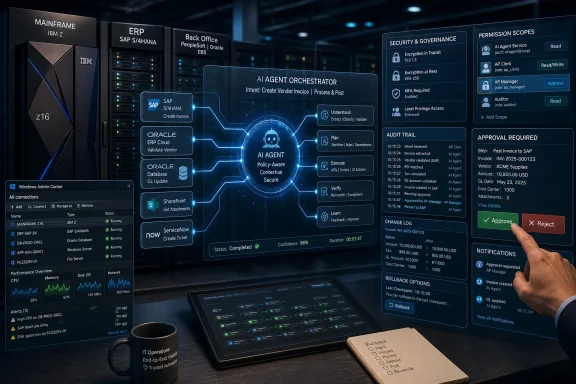
Agentic AI raises the bar because it is supposed to do more than answer. It is supposed to act: open a ticket, check an entitlement, query a customer record, validate a control, trigger a workflow, escalate a case, reconcile a purchase order, or recommend a remediation step. The moment software starts acting inside the enterprise, the hard problems stop being about prompt quality and start being about identity, authorization, auditability, data freshness, and rollback.
That is why IBM and ServiceNow’s announcement matters. It places the emphasis where large-enterprise AI projects have been bogging down: not at the conversational interface, but at the layer where governed data, workflow state, integration logic, and human approval chains meet. The companies are effectively arguing that agentic AI will not become real in regulated industries until it can operate safely across the old systems that still run the business.
This is a less glamorous pitch than “your employees will each have a personal AI assistant.” It is also more believable. Banks, manufacturers, insurers, hospitals, and government agencies do not lack AI pilots; they lack production paths that do not require ripping out decades of working software.
ServiceNow Wants to Be the Control Plane, Not Just the Ticketing System
ServiceNow has spent years trying to escape the mental box marked IT service management. The company still makes much of its money from workflows that look familiar to anyone who has opened, assigned, escalated, or closed an enterprise ticket. But its strategic ambition is broader: to become the system where work is modeled, governed, and routed across the organization.
Workflow Data Fabric fits that ambition. The idea is to let ServiceNow reason over enterprise data without forcing every relevant record into ServiceNow’s own database first. In vendor language, this is about federated data access and zero-copy style integration. In practical terms, it is about giving workflows and AI agents enough context to act while leaving many source systems where they are.
That matters because the enterprise is not a clean diagram. Customer records may sit in Salesforce, SAP, Oracle, bespoke SQL databases, document repositories, file shares, mainframe applications, and departmental applications nobody wants to admit are still critical. If an AI agent can only operate inside one neat SaaS boundary, it will be impressive in demos and brittle in production.
ServiceNow’s pitch is that its platform already understands business process. It knows the incident, the asset, the user, the approval chain, the policy, and the service relationship. If it can extend that context across external systems, it becomes a plausible control plane for agents that need to do work rather than merely describe it.
The risk is that “control plane” can become a nicer phrase for “another expensive integration layer.” ServiceNow customers already know the platform’s value depends heavily on data hygiene, implementation discipline, and the quality of the underlying configuration management database. AI does not remove that dependency. It raises the cost of getting it wrong.
IBM Brings the Old-World Enterprise Map That AI Still Needs
IBM’s role in this alliance is not simply to bring watsonx branding to a ServiceNow press release. IBM’s advantage is that it has spent decades living in the awkward places modern SaaS vendors prefer to abstract away: mainframes, hybrid estates, regulated workloads, custom integration projects, and enterprise transformation programs that move slowly because they cannot fail.
That is not a fashionable advantage, but it is a real one. The systems most resistant to replacement are often the systems with the deepest business logic. They are the billing engines, claims platforms, core banking applications, manufacturing systems, procurement workflows, and customized ERP extensions that have survived because they work and because replacing them would be risky, expensive, or politically impossible.
IBM’s watsonx stack gives the alliance an AI and data platform, while IBM Consulting gives it an implementation channel. That second part may prove more important than the first. Many enterprise AI failures are not model failures; they are integration failures, governance failures, data readiness failures, and organizational-change failures.
ServiceNow has the workflow footprint. IBM has the services army and the legacy-system credibility. Together, they are making a classic enterprise-software argument: large customers do not just buy software; they buy a route through complexity.
The Windows administrator or enterprise architect should read that carefully. This is not a plug-and-play AI future. It is a professional-services-heavy future, with reference architectures, identity mapping, data-access policies, workflow redesign, audit requirements, and long deployment cycles hiding behind polished keynote language.
The Legacy Layer Is Not a Bug in the Enterprise; It Is the Enterprise
There is a persistent fantasy in the technology industry that legacy systems exist only because enterprises are slow, conservative, or insufficiently visionary. Sometimes that is true. More often, legacy systems exist because they encode years of business rules that no one has fully documented and no replacement program has been able to reproduce safely.
That is the target IBM and ServiceNow are aiming at. The announcement talks about the “AI-ready data problem” and the “legacy application layer,” which sounds abstract until you translate it into operational reality. AI agents need context, but much of the context sits behind old interfaces, batch jobs, customized schemas, undocumented dependencies, and security models designed long before LLMs were part of the architecture discussion.
Moving that data into a new AI environment is rarely simple. It creates duplication, governance risk, latency, synchronization problems, and new attack surfaces. Worse, it often forces enterprises to decide which version of the truth an agent should trust when different systems disagree.
A federated approach is appealing because it promises to leave systems of record in place while exposing enough governed context for AI workflows to operate. That does not make the problem disappear. It shifts the burden to connectors, metadata, entitlements, semantic mapping, and runtime controls.
This is where the alliance becomes strategically coherent. ServiceNow wants to coordinate work across systems; IBM wants to help modernize and mediate the systems themselves. The combined pitch is that agentic AI can sit above the legacy estate without pretending the legacy estate has vanished.
Agentic AI Turns Governance From Compliance Theater Into Runtime Architecture
The more autonomous an enterprise agent becomes, the less acceptable it is to treat governance as a quarterly review process. A chatbot that gives a bad answer is a quality problem. An agent that changes a customer record, approves the wrong access request, or triggers an operational workflow without proper context is a systems problem.
That is why the ServiceNow-IBM framing leans so heavily on governed data and workflow control. Agents need to know not just what information exists, but whether they are allowed to use it, whether it is current, whether an action requires human approval, and how the decision will be audited later. These are familiar enterprise requirements, but agentic AI compresses them into real-time execution.
For IT departments, this means the agent layer will become another privileged actor in the environment. It will need identities, scopes, logs, policies, secrets, monitoring, incident response procedures, and kill switches. Treating agents as magical productivity tools is a security mistake; treating them as software principals with delegated authority is closer to reality.
That also changes the role of platforms like ServiceNow. A workflow system that knows who requested what, which system was touched, which approval was required, and what business service was affected becomes more than an administrative tool. It becomes part of the evidence chain.
IBM’s relevance here comes from regulated-enterprise muscle memory. Large customers will want AI systems that can explain enough, restrict enough, and preserve enough evidence to survive audit, litigation, and regulatory scrutiny. The alliance is selling not just automation, but defensible automation.
Microsoft Is the Rival Lurking Behind the Enterprise Pitch
No enterprise AI alliance can be understood without Microsoft in the background. Microsoft has the productivity suite, the operating system footprint, Azure, Entra identity, GitHub, Dynamics, Power Platform, and a Copilot brand that has become shorthand for AI assistance at work. That gives it a distribution advantage few vendors can match.
IBM and ServiceNow are not trying to beat Microsoft at being ubiquitous on the desktop. They are trying to win a different buying conversation: the one that happens when a global bank, insurer, manufacturer, or public agency asks how to make AI agents work across hybrid systems that include mainframes, old ERP estates, custom workflows, and heavily governed data. In that conversation, Microsoft’s breadth is powerful, but it is not automatically decisive.
The distinction matters for Windows-heavy organizations. Copilot may be the first AI surface many employees encounter, especially inside Microsoft 365 and Windows-adjacent workflows. But the question of whether an AI agent can safely remediate an outage, approve a procurement exception, or reconcile a finance workflow depends on deeper integration than the desktop assistant.
ServiceNow and IBM are trying to occupy the layer beneath the user-facing AI experience. They are saying, in effect, that the winning enterprise agent is not necessarily the one with the best chat window. It is the one that can reach the right data, follow the right workflow, and leave the right audit trail.
That is a credible counterposition. It is also a difficult one to sell if Microsoft keeps bundling AI deeper into the software stack customers already license. The IBM-ServiceNow alliance must prove that specialization and legacy reach can beat platform gravity.
The Consulting Revenue Is a Feature, Not a Side Effect
A cynical reading of the announcement is that it creates more consulting work. A more accurate reading is that the consulting work is the product’s path to reality. Large-enterprise agentic AI will not be installed like a browser extension.
IBM Consulting stands to benefit if customers decide that agentic AI requires modernization projects, data-governance work, process redesign, and integration across older systems. ServiceNow gets a partner with enough scale to implement complex deployments across industries and geographies. Customers get a vendor pairing that can plausibly say it understands both the workflow layer and the old systems underneath it.
This is not new enterprise software economics. It is the familiar triangle of platform subscription, integration services, and long-term account expansion. What is new is the AI justification for doing work that many enterprises already knew they needed to do.
That has consequences for CIOs. A request for “agentic AI” may become the politically acceptable wrapper for cleaning up identity, data catalogs, CMDB accuracy, process ownership, application rationalization, and security controls. The technology may be new, but much of the required groundwork is the old backlog with better funding language.
The danger is that organizations buy the wrapper and skip the groundwork. An AI agent operating on stale records, incomplete service maps, or inconsistent entitlement data will not become trustworthy because it is connected to a premium platform. It will become a faster way to expose the organization’s existing disorder.
The First Use Cases Show Where the Real Money Is
The announced direction points toward four practical areas: IT operations, customer service, finance and procurement, and regulatory compliance. These are not random choices. They are places where large enterprises have high labor cost, repetitive process, significant integration pain, and strong incentives to reduce cycle time.
Autonomous IT operations is the most obvious starting point for the WindowsForum audience. IT service management already lives in ServiceNow for many organizations, and IBM already has a presence in hybrid infrastructure management. An agent that can correlate incidents, query system state, recommend remediation, and open or update tickets is easier to justify than an agent making open-ended business decisions.
Customer service is more complicated. The promise is attractive: an agent that can see the customer, the entitlement, the order, the service history, the policy, and the escalation path without forcing a human to swivel between systems. The risk is equally obvious: customer-facing automation magnifies errors quickly, especially when legacy customer-master data is incomplete or contradictory.
Finance and procurement automation is where integration depth becomes critical. Enterprises often run heavily customized ERP environments, with approval rules and exception paths that reflect years of organizational compromise. Agentic AI can help if it respects those rules. It can create chaos if it treats procurement as a text-generation problem.
Compliance and risk workflows may be the most defensible early market. Automated controls testing, evidence collection, audit-trail generation, and policy mapping are painful enough that customers may tolerate slower deployments if the result reduces manual work. The bar for trust is high, but the business case is concrete.
Hyperscaler Spending Solves the Wrong Half of the Problem
The broader AI market is awash in infrastructure spending. Cloud providers and large technology companies are pouring capital into data centers, accelerators, networking, power, and model-serving capacity. That matters, but it does not automatically solve the enterprise deployment bottleneck.
Compute capacity can make models faster and more available. It cannot decide which legacy system contains the authoritative customer status. It cannot infer whether a procurement exception requires two approvals or three. It cannot guarantee that an AI agent has the right to query a particular table or trigger a particular workflow.
This is the gap IBM and ServiceNow are trying to monetize. Hyperscalers build the capacity; enterprise platforms and integrators turn that capacity into something a regulated company can actually use. The opportunity is not merely to run AI workloads, but to make them operationally acceptable.
That distinction explains why the alliance is more interesting than a routine partner announcement. It acknowledges that the hard part of enterprise AI is often not invention, but deployment. The future may be full of agents, but those agents still need plumbing.
For IT leaders, the lesson is blunt. Buying access to a powerful model is not the same as building an AI operating model. The latter requires data governance, workflow design, security controls, monitoring, incident response, and a clear answer to the question of who owns the outcome when the agent acts.
The Market Will Reward Proof, Not Architecture Diagrams
The announcement gives IBM and ServiceNow a strong story, but the enterprise software market has heard strong AI stories before. The proof will come in shipped joint solutions, customer references, measurable productivity gains, and deployments that survive contact with real audit and security requirements.
Investors may like the shape of the narrative because it connects AI enthusiasm to existing enterprise budgets. ServiceNow can sell deeper platform adoption. IBM can attach consulting and software revenue. Both companies can present themselves as practical AI vendors rather than model-chasing spectators.
But the risk case is real. Integration complexity can slow deployments. Customers may discover that their data readiness is worse than expected. Microsoft may package comparable capabilities into existing enterprise agreements. Smaller AI-native vendors may undercut specific use cases with faster, narrower tools.
There is also a trust problem that no press release can solve. Agentic AI requires organizations to let software take steps that previously required humans, scripts, or tightly bounded automation. That trust will be earned incrementally, workflow by workflow, not granted because two CEOs shared a keynote narrative.
The next year will therefore be less about grand strategy than operational evidence. Do the joint solutions ship on time? Do they work outside carefully selected lighthouse customers? Do they reduce manual toil without increasing incident volume? Do auditors accept the evidence trail? Do administrators feel in control?
The Windows Enterprise Should Read This as an Operations Story
For Windows shops, the immediate relevance is not whether watsonx beats Copilot in a branding contest. It is whether the organization’s operational data is clean enough, governed enough, and connected enough for any agentic platform to be useful. The same truth applies whether the agent comes from Microsoft, ServiceNow, IBM, Salesforce, SAP, Oracle, or a startup.
Many Windows-heavy enterprises already sit on Microsoft 365, Entra ID, Intune, Defender, Azure, Configuration Manager remnants, PowerShell automation, ticketing systems, asset databases, and line-of-business applications that have accumulated over years. Agentic AI will touch those environments through identity, endpoint state, service health, access requests, vulnerability workflows, and incident response. That makes platform selection important, but readiness more important.
The ServiceNow-IBM alliance is a reminder that AI strategy cannot be separated from systems administration. The agent needs the same things a good admin needs: accurate inventory, reliable logs, clear ownership, least-privilege access, documented processes, and a way to undo mistakes. Without those, autonomy is just automation with better marketing.
This is where enterprise IT can push back usefully. The right question is not “Which AI agent should we buy?” It is “Which workflows are safe, bounded, measurable, and valuable enough to automate first?” Vendors will sell transformation. Administrators should demand blast-radius control.
The Practical Read on IBM, ServiceNow, and the Agentic Bet
The alliance is easiest to understand as a wager that the next phase of enterprise AI will be won in the integration layer, not the chatbot layer. IBM and ServiceNow are strongest where the enterprise is most complicated, and that is precisely where agentic AI has struggled to move beyond pilots.
- IBM and ServiceNow are targeting the two blockers that matter most in large enterprises: AI-ready data and safe access to legacy application logic.
- ServiceNow’s Workflow Data Fabric is central because agents need governed context across systems, not just a conversational interface.
- IBM’s consulting and legacy-system experience may be as important as watsonx because most deployments will require heavy integration work.
- Microsoft remains the competitive pressure point because Copilot has distribution advantages across Windows, Microsoft 365, Azure, and identity.
- The first successful deployments are likely to be bounded workflows in IT operations, compliance, customer service, procurement, and finance rather than open-ended autonomous agents.
- Enterprises should treat agents as privileged software actors that require identity controls, audit trails, monitoring, and clear rollback procedures.
The alliance does not prove that agentic AI is ready to run the enterprise. It proves that the vendors closest to the enterprise’s old machinery now understand where the blockage is. If IBM and ServiceNow can turn that understanding into reliable deployments, the story of enterprise AI in 2026 may shift from dazzling demos to the slower, more consequential work of making old systems act with new intelligence.
References
- IBM and ServiceNow Join Forces on Enterprise Agentic AI The Eastern Herald · 2026-06-13T17:50:07.731712