

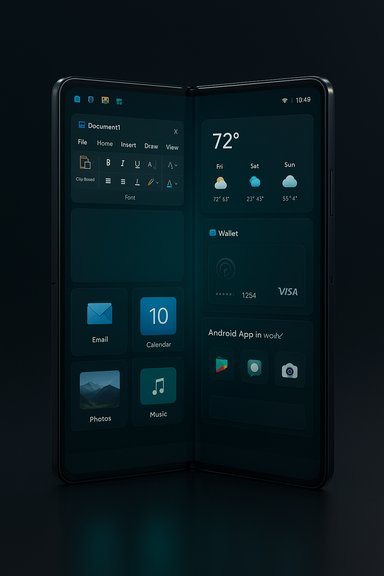
A striking fan concept called Windows Astria has reignited a recurring conversation: what if Microsoft’s mobile experiment had evolved instead of ending? The Astria mockups — a Fluent Design‑heavy, Aero‑tinged reimagining of a modern Windows phone that runs Android apps natively and scales to foldables — are as much a design brief as they are a nostalgic wink. They remind readers and designers why Windows Phone’s visual language still inspires loyalty, and they force a sober look at the technical, commercial, and strategic obstacles that historically sank Microsoft’s smartphone effort. The story of Astria is therefore two stories: a creative, well‑executed fan vision, and a case study in why reviving a platform is far easier in pixels than in product roadmaps.
The Microsoft mobile saga is familiar: from the novelty and praise for Live Tiles and the Lumia line to the eventual write‑off and retreat from first‑party phones. Microsoft CEO Satya Nadella has publicly described exiting the phone business as one of the most difficult strategic decisions of his tenure, conceding that “there could have been ways we could have made it work by perhaps reinventing the category of computing between PCs, tablets, and phones.” Former CEO Steve Ballmer has also been unusually candid about Microsoft’s failures in mobile. He says the company’s mix of “paranoia and confidence” — and the tendency to graft Windows into markets where it “didn’t naturally go” — were major mistakes that blunted Microsoft’s smartphone prospects. Those candid admissions are part of what makes Astria more than fan art: the concept taps a persistent “what if” about a product category Microsoft once insisted could be its own. Yet bridging nostalgia and engineering reality remains the central tension—Astria’s visual triumphs are straightforward; recovering an ecosystem and developer momentum is not.
Satya Nadella’s candid regret and Steve Ballmer’s frank after‑action critique both frame the contemporary question: could Microsoft have made a phone work, and if so, under what conditions might it work now? Astria provides a vivid answer to the “how it could look” part of that query. The “how it could succeed” part remains a business and engineering puzzle — one that requires more than inspired mockups. The lesson for readers and product teams is clear: design vision can reignite imagination and guide engineering, but reviving a platform requires the rare combination of compelling UX, developer momentum, viable distribution economics, and sustained corporate will.
Source: Windows Central Windows Phone lives again with Astria though it’s only a fan‑driven concept
 Background
The Microsoft mobile saga is familiar: from the novelty and praise for Live Tiles and the Lumia line to the eventual write‑off and retreat from first‑party phones. Microsoft CEO Satya Nadella has publicly described exiting the phone business as one of the most difficult strategic decisions of his tenure, conceding that “there could have been ways we could have made it work by perhaps reinventing the category of computing between PCs, tablets, and phones.” Former CEO Steve Ballmer has also been unusually candid about Microsoft’s failures in mobile. He says the company’s mix of “paranoia and confidence” — and the tendency to graft Windows into markets where it “didn’t naturally go” — were major mistakes that blunted Microsoft’s smartphone prospects. Those candid admissions are part of what makes Astria more than fan art: the concept taps a persistent “what if” about a product category Microsoft once insisted could be its own. Yet bridging nostalgia and engineering reality remains the central tension—Astria’s visual triumphs are straightforward; recovering an ecosystem and developer momentum is not.Overview: What Windows Astria proposes
At a glance, Astria is a high‑polish redesign that blends three visual and technical instincts:- A modernized Fluent Design shell with deep use of Mica, translucency, and refined shadows echoing Aero Glass aesthetics.
- The revival of Live Tiles, reinterpreted as dynamic, information‑dense elements adapted to large, high‑DPI, and foldable screens.
- Native execution of Android apps through a WSA‑like subsystem so the app ecosystem barrier disappears and the Windows UX remains consistent.
Why Astria resonates: design, nostalgia, and practical ideas
Visual coherence and the return of polish
Astria’s strongest immediate appeal is cohesion. Fans of Windows Phone and Windows’ Aero era respond not simply to cosmetics, but to an aesthetic that felt purposeful and refined. The concept’s consistent corner radii, layered translucency, and motion timing give the UI a single voice — something many users argue Windows lost under successive incremental changes. These are not trivial details. Consistent visual language reduces cognitive load and gives a platform perceived reliability. Concept coverage across enthusiast communities makes this point repeatedly: small, aligned visual systems feel finished and trustworthy.Live Tiles reimagined
Live Tiles were once the defining characteristic of Windows Phone: glanceable, contextual information surfaced without launching apps. Astria reinterprets Live Tiles as modern, density‑aware components that work on mobile and unfolded foldable screens. The appeal is clear: tiles become a lightweight information layer that aids quick glances and deepens glance-to-action flows. For users who want one‑tap information without persistent notifications, this is an attractive compromise. Design discussions identify Live Tiles’ comeback as one of the concept’s most emotionally persuasive choices.Practical UI choices, not gimmicks
Astria avoids the trap of overreaching. Rather than being a laundry list of hypothetical features, the concept emphasizes a set of pragmatic UI and app integrations: consistent dark mode, dockable widgets, improved Start/Launcher behavior scaled for small and foldable screens, and touch‑first optimizations in core Office apps. These moves resonate because they solve real friction points many users experience across mobile and desktop environments. Community concept threads emphasize this mix of nostalgia and pragmatic polish as the reason such mockups gain traction.Technical claims and verifiable realities
Concepts often blur the line between aesthetics and engineering feasibility. Some Astria claims are purely visual; others are technical assertions that need verification.- Claim: Astria runs Android apps natively via a WSA‑style runtime. Technically plausible: Microsoft’s Windows Subsystem for Android (WSA) previously allowed Android apps to run on Windows 11 using a virtualized Android runtime and tight shell integration. That capability made Android apps behave like native Windows windows (taskbar entries, notifications, copy/paste), but Microsoft deprecated WSA’s official Amazon Appstore integration, with end‑of‑support timelines announced and widely reported. Treat Astria’s WSA‑style claim as conceptual: the idea is possible, but the existing Microsoft pathway (WSA + Amazon Appstore) no longer has the company’s long‑term support guarantee.
- Claim: Heavy PC apps (3D Viewer, desktop Word) can run natively on a phone. This is aspirational. Running full desktop workloads on a phone requires either powerful local silicon (think the highest‑end mobile SoCs or specialized NPUs) or cloud/streaming fallbacks. Performance parity with laptops is not feasible on current mobile SoCs, although scaled or recompiled versions of desktop apps can be practical. The concept’s screenshots showing full Ribbon UIs and 3D Viewer are persuasive visuals, but representative prototypes — not delivered, production‑grade apps. Consider these demonstrations as UX storytelling rather than confirmed engineering blueprints.
- Claim: Foldable support and adaptive layouts will future‑proof the OS. This is sound design thinking. Foldables and large‑format devices require fluid, continuity‑aware shell models; the concept’s adaptive layouts are a practical direction. Many contemporary OS teams already work on continuity across screen modes, and the proposed changes mirror real engineering approaches: responsive layouts, multi‑window adjustments, and multi‑process lifecycle management. Implementation complexity remains high, but the direction is aligned with industry trends.
The ecosystem problem: why look and polish were never the whole story
Reimagining UI and restoring polish addresses only one core failure of Windows Phone: the app ecosystem. The historical cause of Windows Phone’s commercial failure was not solely UX; it was the lack of third‑party developer momentum, an unfamiliar app architecture for many vendors, and the network effects enjoyed by iOS and Android.- Developers choose platforms that reach users. Without a strong installed base or straightforward developer tooling and incentives, porting efforts stall.
- A unique mobile runtime (WinRT/WinPhone app model) and API differences created friction that Apple and Google’s ecosystems avoided through larger market share and developer familiarity.
- Lock‑in effects (users, advertisers, platform partners) reinforced dominance for Android/iOS, making a comeback substantially harder as the market matured.
Strategic and business realities Microsoft would face
Recreating a mobile platform is not only a technical project — it’s a long‑term product, partner, and market strategy. Below are real constraints and considerations any company (including Microsoft) would face if it tried to ship something like Astria:- Hardware parity and the performance floor
- To deliver the translucency, animations, and on‑device AI where Astria shines, Microsoft would need to ensure minimum hardware performance across its target devices. Polished visuals demand GPU acceleration and modern drivers — a perennial challenge across PC and phone markets.
- Developer incentives and compatibility
- Even with Android compatibility, phone‑specific integrations (widgets, deep system hooks, Live Tile equivalents) require developer buy‑in and time to polish. Microsoft would need robust developer outreach, tooling, and incentives to make enhanced integrations worthwhile.
- App distribution and store economics
- Amazon Appstore was the official distribution route for Android apps on Windows; its deprecation complicates a Microsoft‑managed path. Any new approach must solve app discovery, payments, and developer revenue share — often sensitive economic levers.
- Enterprise and privacy controls
- Enterprises expect predictable update channels, policy controls, and auditability. An agentic or AI‑forward mobile experience would require granular controls and an enterprise management model to be viable in business contexts.
- Long runway and marketing
- Winning back market share is not a short flight. Any relaunch would need a multi‑year road map, subsidized hardware partner relationships, and a clear differentiation strategy vs. entrenched incumbents.
What a realistic, incremental revival would look like
If Microsoft or a major OEM wanted to revive a Windows‑flavored mobile experience aligned with Astria’s strengths, a staged, pragmatic plan would be the most realistic path. A sensible roadmap might look like:- Ship UI and shell innovations to existing Windows 11 devices first.
- Lean on the PC base to test the visual language (Mica, refined translucency, live-tile‑style widgets) before porting to constrained mobile hardware.
- Reintroduce a supported Android compatibility layer — but as a certified, lightweight runtime with clear privacy and update guarantees.
- This requires either new Microsoft investment in a supported runtime or deep partner ecosystem plays (OEMs, Google/AOSP forks).
- Target a niche device class first: enterprise foldables or productivity‑centric phones.
- Start where users value continuity with PC workflows and are more tolerant of price/power tradeoffs.
- Build strong developer incentives for native integrations.
- Offer tooling, revenue guarantees, and simple API layers that make adding Live Tile/Widget integrations low friction.
- Harden enterprise management and privacy models.
- Offer configurable agent/AI controls, logging, and policy controls to enable broad corporate adoption.
Strengths of the Astria concept — and the risks it elegantly exposes
Strengths
- Design clarity: Astria shows how consistent visual language and purposeful motion can make an OS feel polished again. Communities repeatedly praise this as a major win for user experience.
- Pragmatic nostalgia: The concept revives Live Tiles thoughtfully rather than simply rehashing the past — updating them for density, foldables, and modern information needs.
- Ecosystem realism: By proposing a WSA‑style Android compatibility layer, Astria recognizes the fundamental importance of app availability — a key commercial insight many fan concepts skip.
Risks and blind spots
- Engineering complexity: Achieving the visual polish across the broad device spectrum Windows targets is hard. Lower‑end devices will be the hardest to serve without leaving users with degraded experiences.
- Ecosystem dependency: The Android compatibility route depends on a supported, updated runtime and curated distribution; Microsoft’s previous deprecation of WSA shows how strategic priorities can shift. Anyone relying on WSA’s prior model must treat that path as fragile.
- Market economics: Reviving a platform costs more than an R&D sprint — it requires long term investment, OEM alignment, and marketing muscle against incumbents who already own app ecosystems and distribution channels. Ballmer’s “too confident” observation is a cautionary framing: technology alone won’t win market share without strategy and sustained execution.
Conclusion
Windows Astria is more than a beautiful reel; it is a design argument and a strategic prompt. The mockup demonstrates that the aesthetic and interaction DNA of Windows Phone — the clarity of Live Tiles, the tactile translucency of Aero, the baseline productivity integration of Office — can be reimagined for modern hardware and expectations. But concept art never carries the full burden of real product constraints: developer ecosystems, long‑term support obligations, hardware variability, and, crucially, market incentives.Satya Nadella’s candid regret and Steve Ballmer’s frank after‑action critique both frame the contemporary question: could Microsoft have made a phone work, and if so, under what conditions might it work now? Astria provides a vivid answer to the “how it could look” part of that query. The “how it could succeed” part remains a business and engineering puzzle — one that requires more than inspired mockups. The lesson for readers and product teams is clear: design vision can reignite imagination and guide engineering, but reviving a platform requires the rare combination of compelling UX, developer momentum, viable distribution economics, and sustained corporate will.
Source: Windows Central Windows Phone lives again with Astria though it’s only a fan‑driven concept
