

Windows Central launched REPLAY on May 22, 2026, as a community gaming hub where readers can submit short gameplay clips from PC, Xbox, and handheld devices for editorial featuring and a monthly $100 or £100 Amazon gift card prize. The pitch is simple, but the timing is not accidental. Windows Central is not merely asking for funny Forza crashes and improbable Halo clutches; it is trying to rebuild the kind of participatory web that made specialist tech sites matter before platforms flattened everything into engagement paste. REPLAY is a small feature with a bigger argument inside it: the future of community media may depend less on smarter feeds than on giving people a reason to show up as themselves.
The launch post frames REPLAY almost defiantly, invoking the now-familiar sense that the modern internet has become overrun by AI filler, rage-bait feeds, and communities hollowed out by platform incentives. That language could have collapsed into nostalgia, but Windows Central uses it to make a practical move. It asks readers to send in the weird, funny, triumphant, embarrassing pieces of play that algorithmic platforms often consume but rarely preserve as community memory.
That matters because gaming clips are one of the last broadly understood folk languages of the web. A thirty-second video of a physics bug, a botched stealth run, or a last-second survival moment needs no elaborate context. It is instantly legible, and, crucially, it invites response rather than passive consumption.
Windows Central’s bet is that this kind of submission loop can make a publication feel less like a broadcast tower and more like a clubhouse. The company is not pretending that a clip hub will fix platform decay. It is arguing, more modestly and more plausibly, that a media brand with a committed audience can create small zones where human taste still outruns automated sorting.
The prize is part of the hook, but it is not the soul of the feature. A $100 or £100 Amazon gift card can motivate submissions, yet the more important reward is recognition by an editorial team and a community that understands the joke. That distinction is the whole difference between a contest and a culture.
That is an editorial choice. The internet already has plenty of places that reward optimization, polish, and competitive hierarchy. Twitch, YouTube, TikTok, Discord, and platform-native sharing systems all produce their own versions of gaming fame, but they tend to privilege scale, speed, and repeatable performance. REPLAY is instead built around moments that are memorable because they are singular.
That makes it more interesting than a standard “submit your best clip” campaign. The best gaming stories are often not the best gaming performances. They are the moments that become private folklore between friends: the boss fight won with one health point left, the vehicle that clipped through a mountain, the stealth mission ruined by a panicked grenade throw.
For a Windows-focused publication, that is also a smart way to include the modern PC gaming audience without turning the site into a leaderboard. The launch explicitly welcomes PC, Xbox, and handheld players, including the ROG Ally and Steam Deck crowd. That reflects where Windows gaming now lives: not just under desks, but on couches, in backpacks, and in a widening class of handheld PCs that blur console and computer habits.
That shift is tailor-made for community storytelling. Handheld PC owners swap performance settings, battery compromises, launcher frustrations, controller mappings, and “you won’t believe this runs here” moments. Their gaming lives are technical and emotional at once, which is exactly the mix Windows Central has always been positioned to cover.
REPLAY gives that audience a lighter-weight way to participate. Not every reader wants to write a forum guide, argue over benchmarks, or dissect Windows 11 update behavior. But many will clip a strange crash, a perfect jump, or a handheld miracle and send it in.
The deeper opportunity is that clips can become gateways into richer discussion. A funny video from a handheld might lead to talk about drivers, frame generation, game compatibility, thermal limits, Xbox app behavior, or SteamOS versus Windows. The clip is the doorbell; the community is what happens after someone answers.
Forums are unfashionable until you need them. They are slower than social feeds, harder to juice for viral growth, and less glamorous than video platforms. But for technical communities, they remain one of the few formats that can support memory, troubleshooting, reputation, and continuity.
That is particularly important for a site covering Windows, Xbox, Surface, PCs, and Microsoft’s wider ecosystem. A comment thread under a news post can catch immediate reaction, but it is rarely the best place to solve a driver problem, compare upgrade paths, or maintain a long-running discussion about Insider builds. A forum can do those things because it is organized around topics and people, not just around the latest article.
Windows Central says it is not abandoning comments; rather, it wants forums to coexist with them. That is the right instinct. Comments are good for immediacy, while forums are good for accumulation. A healthy publication needs both if it wants readers to become participants rather than drive-by reactors.
Forums solve a different problem. They are not just places to talk; they are places where knowledge hardens into an archive. A thread about a Windows update bug, a Surface repair experience, or a handheld performance fix can remain useful long after the first burst of attention fades.
That archival function is central to technology communities. The best forum posts often become unofficial documentation, especially when official documentation is incomplete, slow, or written for a different audience. For sysadmins and enthusiasts, the answer is frequently found not in the pristine vendor page but in the messy thread where ten people tried ten things and one finally worked.
By teasing a revamped forum layout and structure, Windows Central is implicitly acknowledging that community is not just vibes. It requires infrastructure. Good intentions do not organize discussions, surface expertise, moderate bad behavior, or make old answers findable. The software and structure matter.
In that environment, human curation becomes a feature rather than a quaint editorial leftover. Windows Central says REPLAY winners will be chosen by real people, not AI-generated judging. That line lands because readers increasingly suspect that automated systems are mediating more of their digital lives than anyone admits.
The irony is that gaming clips themselves are highly compatible with algorithmic platforms. Short, visual, emotional, and instantly scannable, they are exactly the kind of media social feeds love. But Windows Central is trying to pull that format into a different context, one where editorial taste and community identity matter more than raw reach.
That is a subtle but important distinction. The same clip can mean different things depending on where it lives. On a massive platform, it is content; in a community hub, it can become a shared reference point.
REPLAY is not investigative journalism, and it does not need to be. Its value is participatory. It gives readers a low-friction ritual: capture, submit, maybe get featured, maybe win a prize, definitely see what others are playing. Repeated often enough, that ritual can build attachment.
Windows Central’s anniversary framing sharpens the point. As the site approaches its 20th year, it is looking back to its origins as a community-driven operation rather than treating growth as a one-way march toward corporate polish. That is a useful corrective in a media environment where “professionalization” too often means sanding off the very eccentricity that made a publication worth reading.
The danger, of course, is that nostalgia can become costume. A forum revival and a clip hub will only matter if they are actively tended, moderated, and integrated into the site’s daily life. Community cannot be relaunched like a logo; it has to be maintained like a garden.
That is standard, but it is still worth taking seriously. Community features succeed when the rules feel clear and proportionate. They fail when users feel harvested, surprised, or used as cheap content fuel for a brand that gives little back.
Windows Central’s public language leans heavily on reciprocity: send us your clips, we will feature the best ones, and each month someone gets a prize. The editorial challenge will be keeping that exchange feeling fair after the novelty wears off. If the hub becomes a one-way intake pipe for free content, readers will notice.
The best version of REPLAY would do more than display winning clips. It would credit creators clearly, showcase a range of platforms and genres, and let the community develop recurring tastes and in-jokes. The worst version would become a thin promotional wrapper around a submission form.
The same is true for revived forums. A forum without moderation is not a community; it is an abandoned lot. The old web was not kinder by default, and anyone who remembers legacy forums honestly remembers both the camaraderie and the gatekeeping, the helpful experts and the petty turf wars.
Windows Central’s advantage is that its audience already has a shared center of gravity. Readers are there for Windows, Xbox, PCs, Microsoft, and the adjacent hardware universe. That common interest will not eliminate conflict, but it gives moderators and editors a stronger foundation than a general-purpose social feed.
The publication should resist the temptation to make everything frictionless. Healthy communities often need a little friction: clear topic areas, visible norms, accountable identities, and enough moderation presence to make good contributors feel protected. The goal is not maximum posting volume. The goal is a place people are willing to return to.
That makes Windows Central’s human-centered approach more pointed. If platforms are moving toward machine-generated memory, specialist communities can offer something different: interpretation. A system can identify that something happened; people can decide whether it was funny, impressive, cursed, or worth remembering.
The future of gaming media may involve both. Automated tools will make capturing easier, especially for players who do not want to manage recording software or storage. But the social meaning of those captures will still depend on context. A perfect clip with no community around it is just another file.
For Windows users, that interplay matters because the PC remains the most flexible and chaotic gaming platform. It is where storefronts overlap, drivers misbehave, mods flourish, anti-cheat systems collide with operating-system changes, and handhelds keep forcing new interface compromises. If any gaming community can turn technical mess into entertainment, it is the Windows crowd.
Feeds are rented land. Search traffic shifts, social algorithms pivot, AI summaries intercept clicks, and platform owners change the rules with little warning. A publication that has no direct relationship with its readers is always one distribution tweak away from crisis.
A community, by contrast, is harder to build but harder to copy. It gives readers a reason to visit intentionally. It gives editors a feedback loop that is richer than analytics. It gives a site texture, which is exactly what AI-generated content struggles to fake convincingly over time.
The challenge is patience. Community features rarely produce the clean immediate metrics that executives love. They compound slowly, through habits and rituals. Windows Central is making a long bet that a site with nearly two decades of history can still convert recognition into participation.
If Windows Central follows through, REPLAY could become more than a monthly contest. It could become a front porch for the site’s next era, a place where the Windows gaming community laughs first and argues later, where handheld tinkerers and Xbox loyalists and PC obsessives recognize one another as regulars rather than metrics. The web does not become human again through slogans; it becomes human when people are given places worth returning to, and Windows Central has just made its first serious move toward building one.
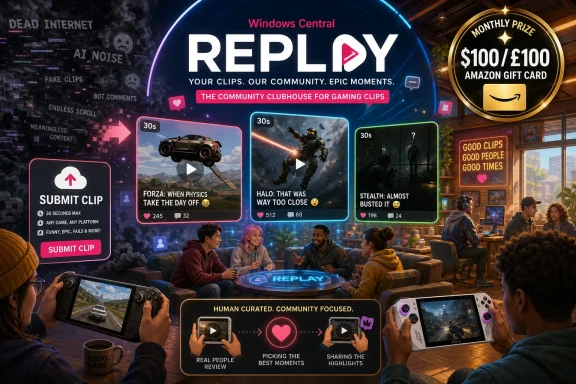 Windows Central Turns a Clip Contest Into a Vote Against the Dead Internet
The launch post frames REPLAY almost defiantly, invoking the now-familiar sense that the modern internet has become overrun by AI filler, rage-bait feeds, and communities hollowed out by platform incentives. That language could have collapsed into nostalgia, but Windows Central uses it to make a practical move. It asks readers to send in the weird, funny, triumphant, embarrassing pieces of play that algorithmic platforms often consume but rarely preserve as community memory.That matters because gaming clips are one of the last broadly understood folk languages of the web. A thirty-second video of a physics bug, a botched stealth run, or a last-second survival moment needs no elaborate context. It is instantly legible, and, crucially, it invites response rather than passive consumption.
Windows Central’s bet is that this kind of submission loop can make a publication feel less like a broadcast tower and more like a clubhouse. The company is not pretending that a clip hub will fix platform decay. It is arguing, more modestly and more plausibly, that a media brand with a committed audience can create small zones where human taste still outruns automated sorting.
The prize is part of the hook, but it is not the soul of the feature. A $100 or £100 Amazon gift card can motivate submissions, yet the more important reward is recognition by an editorial team and a community that understands the joke. That distinction is the whole difference between a contest and a culture.
The Smartest Part of REPLAY Is That It Refuses to Worship Skill
REPLAY’s most revealing detail is what it does not prioritize. Windows Central is not asking for esports-grade performances, world-record clears, or perfectly edited influencer montages. The examples in the launch post lean toward chaos: a car launched into the sky by a Forza glitch, an accidental sniper shot, a barely survived encounter that feels more like slapstick than mastery.That is an editorial choice. The internet already has plenty of places that reward optimization, polish, and competitive hierarchy. Twitch, YouTube, TikTok, Discord, and platform-native sharing systems all produce their own versions of gaming fame, but they tend to privilege scale, speed, and repeatable performance. REPLAY is instead built around moments that are memorable because they are singular.
That makes it more interesting than a standard “submit your best clip” campaign. The best gaming stories are often not the best gaming performances. They are the moments that become private folklore between friends: the boss fight won with one health point left, the vehicle that clipped through a mountain, the stealth mission ruined by a panicked grenade throw.
For a Windows-focused publication, that is also a smart way to include the modern PC gaming audience without turning the site into a leaderboard. The launch explicitly welcomes PC, Xbox, and handheld players, including the ROG Ally and Steam Deck crowd. That reflects where Windows gaming now lives: not just under desks, but on couches, in backpacks, and in a widening class of handheld PCs that blur console and computer habits.
The Handheld PC Has Made Windows Gaming Feel Personal Again
The mention of handhelds is not just a throwaway nod to hardware trends. Devices like the ROG Ally and Steam Deck have changed how PC gaming circulates socially. A gaming PC used to be a station; now, increasingly, it is an object people carry, customize, troubleshoot, and show off in the same breath.That shift is tailor-made for community storytelling. Handheld PC owners swap performance settings, battery compromises, launcher frustrations, controller mappings, and “you won’t believe this runs here” moments. Their gaming lives are technical and emotional at once, which is exactly the mix Windows Central has always been positioned to cover.
REPLAY gives that audience a lighter-weight way to participate. Not every reader wants to write a forum guide, argue over benchmarks, or dissect Windows 11 update behavior. But many will clip a strange crash, a perfect jump, or a handheld miracle and send it in.
The deeper opportunity is that clips can become gateways into richer discussion. A funny video from a handheld might lead to talk about drivers, frame generation, game compatibility, thermal limits, Xbox app behavior, or SteamOS versus Windows. The clip is the doorbell; the community is what happens after someone answers.
The Forum Tease Is the Real News Hiding Behind the Clip Reel
REPLAY is presented as the first step in a broader 2026 community roadmap, and the most consequential part of that roadmap is the promised return of Windows Central’s forums. That is where the launch post moves from a fun gaming initiative into a broader media strategy. Windows Central is signaling that comments and social posts are not enough.Forums are unfashionable until you need them. They are slower than social feeds, harder to juice for viral growth, and less glamorous than video platforms. But for technical communities, they remain one of the few formats that can support memory, troubleshooting, reputation, and continuity.
That is particularly important for a site covering Windows, Xbox, Surface, PCs, and Microsoft’s wider ecosystem. A comment thread under a news post can catch immediate reaction, but it is rarely the best place to solve a driver problem, compare upgrade paths, or maintain a long-running discussion about Insider builds. A forum can do those things because it is organized around topics and people, not just around the latest article.
Windows Central says it is not abandoning comments; rather, it wants forums to coexist with them. That is the right instinct. Comments are good for immediacy, while forums are good for accumulation. A healthy publication needs both if it wants readers to become participants rather than drive-by reactors.
The Return of Forums Is a Rejection of Platform Amnesia
Social platforms are structurally bad at remembering. They are optimized for the next item, the next outrage, the next clip, the next prompt, the next argument. Even when useful information appears there, it is often buried, decontextualized, or rendered nearly impossible to retrieve weeks later.Forums solve a different problem. They are not just places to talk; they are places where knowledge hardens into an archive. A thread about a Windows update bug, a Surface repair experience, or a handheld performance fix can remain useful long after the first burst of attention fades.
That archival function is central to technology communities. The best forum posts often become unofficial documentation, especially when official documentation is incomplete, slow, or written for a different audience. For sysadmins and enthusiasts, the answer is frequently found not in the pristine vendor page but in the messy thread where ten people tried ten things and one finally worked.
By teasing a revamped forum layout and structure, Windows Central is implicitly acknowledging that community is not just vibes. It requires infrastructure. Good intentions do not organize discussions, surface expertise, moderate bad behavior, or make old answers findable. The software and structure matter.
The AI Backdrop Makes Human Curation Feel Newly Valuable
The launch post’s complaint about AI-generated “slop” is blunt, but it reflects a real change in how readers experience the web. Search results, social feeds, and even niche content surfaces have become noisier as generative tools lower the cost of producing plausible but forgettable material. The result is not simply that there is more content; it is that trust has become harder work.In that environment, human curation becomes a feature rather than a quaint editorial leftover. Windows Central says REPLAY winners will be chosen by real people, not AI-generated judging. That line lands because readers increasingly suspect that automated systems are mediating more of their digital lives than anyone admits.
The irony is that gaming clips themselves are highly compatible with algorithmic platforms. Short, visual, emotional, and instantly scannable, they are exactly the kind of media social feeds love. But Windows Central is trying to pull that format into a different context, one where editorial taste and community identity matter more than raw reach.
That is a subtle but important distinction. The same clip can mean different things depending on where it lives. On a massive platform, it is content; in a community hub, it can become a shared reference point.
Community Journalism Needs Participation, Not Just Pageviews
The phrase “community journalism” gets abused because it is easy to say and hard to practice. In its weakest form, it means little more than asking readers to comment after the publication has already decided what matters. In its stronger form, it means readers help shape the institution’s agenda, memory, and voice.REPLAY is not investigative journalism, and it does not need to be. Its value is participatory. It gives readers a low-friction ritual: capture, submit, maybe get featured, maybe win a prize, definitely see what others are playing. Repeated often enough, that ritual can build attachment.
Windows Central’s anniversary framing sharpens the point. As the site approaches its 20th year, it is looking back to its origins as a community-driven operation rather than treating growth as a one-way march toward corporate polish. That is a useful corrective in a media environment where “professionalization” too often means sanding off the very eccentricity that made a publication worth reading.
The danger, of course, is that nostalgia can become costume. A forum revival and a clip hub will only matter if they are actively tended, moderated, and integrated into the site’s daily life. Community cannot be relaunched like a logo; it has to be maintained like a garden.
The Prize Is Nice, but the Trust Model Is the Hard Part
The REPLAY terms matter because user-generated media always carries obligations. When readers submit clips, they are not just sending a funny video into the void. They are granting a publication permission to host, edit, display, and distribute their work, while also affirming that the footage does not violate relevant game or platform rules.That is standard, but it is still worth taking seriously. Community features succeed when the rules feel clear and proportionate. They fail when users feel harvested, surprised, or used as cheap content fuel for a brand that gives little back.
Windows Central’s public language leans heavily on reciprocity: send us your clips, we will feature the best ones, and each month someone gets a prize. The editorial challenge will be keeping that exchange feeling fair after the novelty wears off. If the hub becomes a one-way intake pipe for free content, readers will notice.
The best version of REPLAY would do more than display winning clips. It would credit creators clearly, showcase a range of platforms and genres, and let the community develop recurring tastes and in-jokes. The worst version would become a thin promotional wrapper around a submission form.
Moderation Will Decide Whether the Clubhouse Stays Habitable
Any community push eventually becomes a moderation story. Gaming clips may seem benign compared with political arguments or operating-system flame wars, but user submissions can still raise problems: copyrighted overlays, offensive usernames, harassment, cheating accusations, exploit footage, or clips that depend on humiliating someone else. A site that invites the public in must be ready to set boundaries.The same is true for revived forums. A forum without moderation is not a community; it is an abandoned lot. The old web was not kinder by default, and anyone who remembers legacy forums honestly remembers both the camaraderie and the gatekeeping, the helpful experts and the petty turf wars.
Windows Central’s advantage is that its audience already has a shared center of gravity. Readers are there for Windows, Xbox, PCs, Microsoft, and the adjacent hardware universe. That common interest will not eliminate conflict, but it gives moderators and editors a stronger foundation than a general-purpose social feed.
The publication should resist the temptation to make everything frictionless. Healthy communities often need a little friction: clear topic areas, visible norms, accountable identities, and enough moderation presence to make good contributors feel protected. The goal is not maximum posting volume. The goal is a place people are willing to return to.
Microsoft’s Ecosystem Is Becoming More Social, Whether Microsoft Leads or Not
There is another layer here: Windows gaming itself is becoming more clip-aware. Xbox Game Bar, the Xbox app, platform capture tools, handheld companion software, and cloud-connected profiles all point toward a future in which gameplay moments are increasingly collected, summarized, and surfaced. Microsoft has been experimenting with recap-style experiences, and the broader industry is clearly fascinated by automated highlight detection.That makes Windows Central’s human-centered approach more pointed. If platforms are moving toward machine-generated memory, specialist communities can offer something different: interpretation. A system can identify that something happened; people can decide whether it was funny, impressive, cursed, or worth remembering.
The future of gaming media may involve both. Automated tools will make capturing easier, especially for players who do not want to manage recording software or storage. But the social meaning of those captures will still depend on context. A perfect clip with no community around it is just another file.
For Windows users, that interplay matters because the PC remains the most flexible and chaotic gaming platform. It is where storefronts overlap, drivers misbehave, mods flourish, anti-cheat systems collide with operating-system changes, and handhelds keep forcing new interface compromises. If any gaming community can turn technical mess into entertainment, it is the Windows crowd.
The Site Is Betting That Readers Want a Home, Not Just a Feed
Windows Central’s broader 2026 community push includes REPLAY, forums, live shows, podcasts, comment improvements, and free Insider membership. Taken together, those pieces suggest a media strategy built around belonging rather than pure distribution. That is unfashionable in some corners of digital publishing, but it may be the only durable play for enthusiast sites.Feeds are rented land. Search traffic shifts, social algorithms pivot, AI summaries intercept clicks, and platform owners change the rules with little warning. A publication that has no direct relationship with its readers is always one distribution tweak away from crisis.
A community, by contrast, is harder to build but harder to copy. It gives readers a reason to visit intentionally. It gives editors a feedback loop that is richer than analytics. It gives a site texture, which is exactly what AI-generated content struggles to fake convincingly over time.
The challenge is patience. Community features rarely produce the clean immediate metrics that executives love. They compound slowly, through habits and rituals. Windows Central is making a long bet that a site with nearly two decades of history can still convert recognition into participation.
REPLAY Only Works If Windows Central Lets Readers Leave Fingerprints
The concrete news is easy to summarize, but the strategic test is bigger than the announcement. Windows Central has opened a REPLAY hub for gaming clips, is offering a monthly gift card prize, plans to feature community submissions alongside staff picks, and is teasing a broader return to forum-centered discussion. That is the scaffolding. The culture is still unwritten.- Windows Central’s REPLAY is built around short community-submitted gaming clips from PC, Xbox, and handheld players.
- The monthly standout clip earns a $100 or £100 Amazon gift card, with winners selected by people rather than automated judging.
- The feature is part of a wider 2026 community roadmap that includes a planned forum revamp.
- The strongest editorial signal is that Windows Central is prioritizing funny, strange, and memorable moments rather than only elite gameplay.
- The long-term success of the project will depend on moderation, creator credit, clear rules, and whether the community feels genuinely visible.
- The move reflects a broader shift among enthusiast publications toward direct reader relationships as algorithmic platforms become less dependable.
If Windows Central follows through, REPLAY could become more than a monthly contest. It could become a front porch for the site’s next era, a place where the Windows gaming community laughs first and argues later, where handheld tinkerers and Xbox loyalists and PC obsessives recognize one another as regulars rather than metrics. The web does not become human again through slogans; it becomes human when people are given places worth returning to, and Windows Central has just made its first serious move toward building one.
References
- Primary source: Windows Central
Published: Fri, 22 May 2026 18:20:15 GMT
Celebrating the community: Introducing Windows Central REPLAY, a new way to win prizes and share your wildest gaming moments | Windows Central
Making gaming fun again—one clip at a time, and you're the star.www.windowscentral.com - Related coverage: gamesradar.com
Replay's May theme is Arc Raiders: send us clips for a chance to win a £/$250 Amazon voucher! | GamesRadar+
Replay is GamesRadar's community series where you can submit gaming clips and streams for a chance to win Amazon vouchers.www.gamesradar.com - Related coverage: forums.windowscentral.com
- Related coverage: gamespot.com
Next-Gen Xbox Could Use AI To Share Your Best Moments - Report - GameSpot
Dubbed "Highlight Reels," the feature seems to let you create a sort of sizzle reel of your most memorable moments "without leaving gameplay."www.gamespot.com - Related coverage: forums.pcgamer.com
- Related coverage: msreview.net
Windows Central Replay: Покажите свои лучшие игровые моменты и выигрывайте!
Хотите показать свои лучшие игровые моменты? Windows Central Replay ждет ваших эпичных побед! Участвуйте в конкурсе «Игра месяца» и выигрывайте крутые призы....msreview.net
