

Microsoft’s reported Windows K2 initiative is an internal, quality-focused effort formed in late 2025 to improve Windows 11 through 2026 and 2027, with Microsoft emphasizing performance, reliability, interface “craft,” and renewed community engagement rather than shipping a separate Windows release. The shorthand is new, but the problem is old: Windows has become the thing users tolerate before they get to the thing they actually wanted to do. If K2 is real in the way Windows Central’s sources describe it, Microsoft is not merely patching bugs; it is trying to reverse a collapse in goodwill caused by years of friction, clutter, forced defaults, uneven updates, and AI-first product decisions that often felt user-second.
The danger for Microsoft is that Windows is too important to be loved only by inertia. It still runs the world’s desks, fleets, labs, kiosks, gaming rigs, and developer workstations, but dominance is not the same as trust. K2 matters because it suggests Microsoft has finally understood that Windows 11’s biggest competitor is not macOS, ChromeOS, Linux, or SteamOS. It is the memory of Windows itself when it felt faster, quieter, and more under the user’s control.
Windows K2 is not Windows 12 in disguise, at least not according to the reporting around it. It is better understood as a management doctrine: a cross-team quality push meant to change how Windows is built, validated, discussed, and shipped. That distinction matters, because Microsoft’s problem is not a missing version number. It is the accumulated feeling that Windows 11 has too often made the simple things harder while asking users to applaud the strategic things.
The phrase “performance, craft, and reliability” sounds like the kind of bland corporate triad that can be printed on a slide and forgotten by the next reorg. But in Windows’ case, those three words are also an indictment. Performance means Microsoft knows too many users perceive Windows 11 as heavier than it should be. Craft means it knows the interface has felt inconsistent, unfinished, or strangely contemptuous of muscle memory. Reliability means it knows updates, drivers, shell components, Bluetooth, printers, sleep states, search, File Explorer, and authentication have generated enough daily annoyance to corrode the brand.
The fourth pillar, community, may be the most revealing. Microsoft does not need more telemetry to know that users dislike being surprised by ads, nags, defaults, and feature regressions. It needs a working relationship with the people who live inside Windows all day and who have learned to treat every “new experience” as a euphemism for another interruption. Bringing back Insider meetups and making Windows engineers more visible is a small gesture, but it points at a larger truth: Windows cannot be repaired only by instrumentation. It has to be repaired socially.
That is why K2, if Microsoft follows through, could be more consequential than a traditional release cycle. Windows 11 did not fail because it lacked ambition. It failed in the places where operating systems are supposed to disappear.
The taskbar lost capabilities that had been present for years. The Start menu became less flexible. Context menus hid familiar commands. Default browser and app choices became a campaign rather than a setting. Microsoft account prompts proliferated. Widgets, feeds, recommendations, Edge nudges, OneDrive prompts, Teams integrations, Copilot placements, and “suggestions” arrived with the heavy hand of a company that could not decide whether Windows was an operating system or a distribution channel.
This is where the trust problem became structural. Individual annoyances can be forgiven. A slow menu here, a bad update there, a missing setting somewhere else — none of these alone breaks a platform with Windows’ gravity. But when every surface appears available for monetization, promotion, or experimentation, users stop seeing rough edges and start seeing intent.
For enthusiasts, this has been especially corrosive. These are the users who once installed beta builds for fun, defended Microsoft’s architectural compromises, and understood why legacy compatibility made Windows messy. They could forgive complexity. What they struggled to forgive was condescension: the sense that Microsoft knew what users wanted, because what users wanted happened to align perfectly with Microsoft’s cloud, AI, subscription, and engagement goals.
K2 is therefore not just a quality push. It is a test of whether Microsoft can subordinate strategy to product again.
Microsoft promised faster and more dependable File Explorer, lower memory usage, smoother navigation, better update controls, clearer Insider channels, improved Feedback Hub visibility, fewer unnecessary Copilot entry points, more reliable Windows Hello, stronger driver and app stability, better Bluetooth and USB behavior, improved WSL performance, and the return of taskbar positioning options. That is not a moonshot feature list. It is a repair estimate.
The most damning part is how ordinary many of the promised fixes are. File Explorer should not need a redemption arc. Users should not have to wait half a decade for taskbar flexibility to be treated as a serious usability concern. Windows Update should not need to reassure people that restarts will be less disruptive. Copilot should not have had to invade enough surfaces that “reducing unnecessary entry points” became a headline.
But ordinary fixes are precisely what Windows 11 needs. Microsoft has spent years selling the PC as the frontier of hybrid work, cloud productivity, local AI, and silicon differentiation. The customer, meanwhile, often just wants the Start menu to open instantly, the right-click menu to show the command they need, the laptop to wake properly, and the update system not to ambush them before a meeting.
That gap is the heart of the Windows 11 backlash. Microsoft kept narrating the future while users were filing complaints about the present.
Windows 11’s craft problem is visible in small moments. Some settings live in the modern Settings app while others still route through old Control Panel surfaces. Some menus use the new design language while others preserve legacy density. Some recommendations are helpful, while others feel like ads wearing a productivity badge. Some AI features are genuinely useful, while others appear because Microsoft needed Copilot to exist in more places by the end of the quarter.
The Windows shell has always been a museum of eras, and that is part of its charm. Nobody expects Windows to have the pristine coherence of a mobile operating system designed after the web matured. But there is a difference between useful legacy and neglect. Craft means deciding that consistency, predictability, and user agency are not cosmetic concerns. They are core platform features.
This is why the taskbar matters beyond the taskbar. Restoring the ability to move it is not going to transform Windows 11 by itself. But it would signal that Microsoft understands the emotional weight of removed affordances. When users complain about lost features, they are not always asking for nostalgia. Often they are asking Microsoft to respect workflows that were developed over years and then broken by executive taste.
Craft also means restraint. A well-crafted operating system does not treat every empty pixel as real estate for engagement. It does not confuse discoverability with nagging. It does not make users feel that saying “no” merely postpones the next attempt.
A Bluetooth problem on one laptop is a support ticket. A driver regression across thousands of machines is a business event. A failed update on a gaming PC ruins an evening. A failed update wave in an enterprise can trigger rollback planning, incident bridges, compliance anxiety, and a sudden rediscovery of why staged deployment rings exist. If Microsoft wants K2 to win trust, reliability cannot mean only “fewer Reddit complaints.” It has to mean fewer surprises for the people who administer Windows at scale.
This is where Microsoft has an advantage and a burden. No desktop operating system faces the same hardware diversity, peripheral sprawl, software legacy, and deployment complexity as Windows. That ecosystem is Windows’ moat, but it is also the source of its instability. A quality reset that sounds simple in a blog post becomes brutal when it has to accommodate ancient line-of-business apps, OEM utilities, consumer RGB drivers, enterprise VPN clients, game anti-cheat systems, endpoint security agents, docking stations, printers, scanners, biometric cameras, and a driver universe that never sleeps.
K2’s reported emphasis on validation across real-world hardware is therefore not a detail. It is the whole ballgame. Windows quality cannot be proven on Microsoft’s clean internal test benches alone. It has to survive the chaotic PC ecosystem users actually own.
That also means Microsoft must resist the temptation to treat Insiders primarily as a marketing community. The Insider program is useful only if feedback changes outcomes before release. If K2 makes the channels clearer, the builds higher quality, and the feedback loop more visible, Microsoft may rebuild some confidence. If it merely repackages the same uncertainty with friendlier language, power users will notice immediately.
SteamOS changed the mood. It did not replace Windows on the desktop, and it still has compatibility gaps, especially around certain anti-cheat systems and multiplayer titles. But the Steam Deck proved that a Linux-based gaming device could feel coherent, console-like, and friendly in a way Windows handhelds often did not. That contrast has been embarrassing for Microsoft.
The reported K2 goal of using SteamOS as a gaming performance benchmark is important because it acknowledges that raw compatibility is no longer enough. Windows can run more games, but handheld gaming exposes every inefficiency. Extra background processes matter. Update prompts matter. Login friction matters. Sleep and resume matter. Controller-first setup matters. The shell matters when there is no keyboard and mouse within reach.
Windows was designed to be universal. SteamOS was designed to be focused. On a desktop tower, universality wins easily. On a handheld, focus feels like quality.
Microsoft’s partnership around Xbox-branded handhelds and its work on gamepad-friendly setup are part of the response, but K2 suggests the company knows the problem runs deeper than a launcher skin. If the underlying OS consumes too much memory, wakes inconsistently, surfaces irrelevant prompts, or drops users into desktop awkwardness, no Xbox overlay will fully hide it. The gaming PC is no longer just a Windows stronghold. It is a place where Windows must prove it can get out of the way.
That sequencing mattered. When a user sees AI buttons appearing in Notepad, Paint, Photos, Snipping Tool, search, the taskbar, and the broader Windows experience while File Explorer still feels sluggish, the conclusion is obvious: Microsoft has time for its priorities, not yours. That may be unfair to the engineers doing the work, but it is devastatingly plausible from the outside.
The right lesson is not that AI has no place in Windows. Local and cloud-assisted AI could become genuinely useful in accessibility, search, automation, image handling, troubleshooting, summarization, and device management. A PC that can explain why a driver failed, find a buried setting, summarize system changes, or automate a repetitive workflow would be valuable. But useful AI has to be earned.
The operating system has a special trust boundary. Users can ignore a bad web feature. They cannot ignore the shell, update flow, file manager, login system, and default app surfaces. When AI appears in those places before the fundamentals feel excellent, it reads as intrusion rather than assistance.
K2’s reported emphasis on craft is therefore also an AI governance problem. Microsoft must learn to ask not merely whether Copilot can appear somewhere, but whether it should. In Windows, placement is product philosophy.
That sounds glib, but it is the core strategic issue. Windows is not just an operating system inside Microsoft. It is a funnel into Microsoft accounts, Edge, Bing, OneDrive, Microsoft 365, Copilot, Store apps, Xbox services, developer tooling, security subscriptions, and cloud management. The temptation to use Windows as leverage is enormous. The cost of that leverage is user trust.
K2 reportedly includes internal changes around how teams contribute code to Windows, with a stronger obsession over quality replacing a more feature-shipping style of agility. If true, that is the part to watch most closely. Microsoft does not lack talented engineers. It lacks a consistently user-respecting product governor strong enough to say no to clutter, no to premature integrations, no to growth hacks, and no to features whose main virtue is that they advance another Microsoft business.
The company has done this before, or at least come close. Windows 7 repaired much of Vista’s reputational damage not by reinventing the PC, but by being faster, more compatible, more polished, and less painful. Windows 10 recovered from Windows 8’s touch-first overreach by restoring desktop sanity. The pattern is familiar: Microsoft pushes too hard, users revolt, Microsoft rediscovers fundamentals.
But Windows 11’s situation is different because the pressure to insert services into the OS is stronger than ever. AI is not a side project. It is Microsoft’s central growth narrative. Subscriptions are not optional seasoning. They are the company’s financial engine. Search, ads, cloud storage, identity, and management all want privileged placement. A quality-first Windows has to disappoint some of those internal stakeholders.
That is why K2’s credibility will not be determined by how often Microsoft says “quality.” It will be determined by what Microsoft is willing to remove.
Users do not need K2 wallpaper. They do not need a splash screen thanking them for feedback. They do not need a Copilot-written tour of quality improvements. They need fewer papercuts. They need old decisions reversed where those decisions were wrong. They need settings that stay set, defaults that respect intent, updates that behave predictably, and a shell that feels fast even on ordinary hardware.
For sysadmins, the ask is similarly practical. They need fewer policy surprises, fewer consumer experiences bleeding into managed environments, clearer update behavior, better release notes, stronger rollback paths, and fewer changes that make sense in a demo but create help-desk load in the field. Enterprise trust is built through boring consistency, not launch-event enthusiasm.
For developers, Microsoft needs to make Windows feel like the best workstation again, not merely the most compatible one. WSL improvements matter here. So do faster file operations, better terminal and shell integration, reliable networking, sensible security boundaries, and fewer background distractions. Developers are often the first to forgive complexity, but they are also the first to punish friction with migration.
For gamers, Microsoft has to admit that “runs everything” is no longer a complete answer. Performance per watt, handheld usability, driver sanity, shader behavior, suspend-and-resume reliability, store neutrality, and controller-first flows are now part of the platform experience. SteamOS did not beat Windows by having more software. It embarrassed Windows by feeling purpose-built.
A serious K2 effort should make Windows 11 feel lighter without requiring new hardware. It should make File Explorer boringly fast. It should reduce the number of times users feel marketed to inside system surfaces. It should restore meaningful customization where Windows 11 removed it for aesthetic neatness. It should make updates more predictable and less coercive. It should give Insiders and IT admins clearer signals about what is changing and why.
Most importantly, it should make Windows feel as though the user is the customer again. That phrase may sound sentimental, but it is the operating system’s central contract. The OS sits between the person and everything else they do. If it starts acting like a salesman, the relationship changes.
Microsoft will be tempted to measure success through sentiment scores, feedback dashboards, adoption curves, and engagement. Those metrics have value, but they can also obscure the obvious. A trusted Windows is one users do not have to fight.
Windows still has the deepest bench in personal computing: unmatched compatibility, vast hardware choice, enterprise manageability, gaming reach, developer flexibility, and decades of user habit. But habit is not affection, and compatibility is not pride. K2 is Microsoft’s chance to prove that Windows 11 can become something more than the unavoidable substrate of PC life — not by dazzling users with the next strategic frontier, but by making the old promise feel true again: turn on the PC, trust it, and get to work.
Source: Gamereactor UK Windows K2 is Microsoft's plan to win back trust of users
The danger for Microsoft is that Windows is too important to be loved only by inertia. It still runs the world’s desks, fleets, labs, kiosks, gaming rigs, and developer workstations, but dominance is not the same as trust. K2 matters because it suggests Microsoft has finally understood that Windows 11’s biggest competitor is not macOS, ChromeOS, Linux, or SteamOS. It is the memory of Windows itself when it felt faster, quieter, and more under the user’s control.
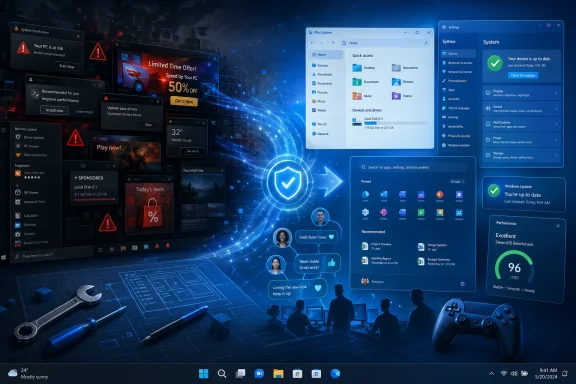 Microsoft’s Trust Problem Has a Codename Now
Windows K2 is not Windows 12 in disguise, at least not according to the reporting around it. It is better understood as a management doctrine: a cross-team quality push meant to change how Windows is built, validated, discussed, and shipped. That distinction matters, because Microsoft’s problem is not a missing version number. It is the accumulated feeling that Windows 11 has too often made the simple things harder while asking users to applaud the strategic things.The phrase “performance, craft, and reliability” sounds like the kind of bland corporate triad that can be printed on a slide and forgotten by the next reorg. But in Windows’ case, those three words are also an indictment. Performance means Microsoft knows too many users perceive Windows 11 as heavier than it should be. Craft means it knows the interface has felt inconsistent, unfinished, or strangely contemptuous of muscle memory. Reliability means it knows updates, drivers, shell components, Bluetooth, printers, sleep states, search, File Explorer, and authentication have generated enough daily annoyance to corrode the brand.
The fourth pillar, community, may be the most revealing. Microsoft does not need more telemetry to know that users dislike being surprised by ads, nags, defaults, and feature regressions. It needs a working relationship with the people who live inside Windows all day and who have learned to treat every “new experience” as a euphemism for another interruption. Bringing back Insider meetups and making Windows engineers more visible is a small gesture, but it points at a larger truth: Windows cannot be repaired only by instrumentation. It has to be repaired socially.
That is why K2, if Microsoft follows through, could be more consequential than a traditional release cycle. Windows 11 did not fail because it lacked ambition. It failed in the places where operating systems are supposed to disappear.
Windows 11 Became a Strategy Before It Became a Better Desktop
The first years of Windows 11 were defined by a strange imbalance. Microsoft had a clean visual language, a centered Start menu, stronger hardware security baselines, and a story about modernizing the PC. But many of the changes users noticed most were not improvements so much as negotiations.The taskbar lost capabilities that had been present for years. The Start menu became less flexible. Context menus hid familiar commands. Default browser and app choices became a campaign rather than a setting. Microsoft account prompts proliferated. Widgets, feeds, recommendations, Edge nudges, OneDrive prompts, Teams integrations, Copilot placements, and “suggestions” arrived with the heavy hand of a company that could not decide whether Windows was an operating system or a distribution channel.
This is where the trust problem became structural. Individual annoyances can be forgiven. A slow menu here, a bad update there, a missing setting somewhere else — none of these alone breaks a platform with Windows’ gravity. But when every surface appears available for monetization, promotion, or experimentation, users stop seeing rough edges and start seeing intent.
For enthusiasts, this has been especially corrosive. These are the users who once installed beta builds for fun, defended Microsoft’s architectural compromises, and understood why legacy compatibility made Windows messy. They could forgive complexity. What they struggled to forgive was condescension: the sense that Microsoft knew what users wanted, because what users wanted happened to align perfectly with Microsoft’s cloud, AI, subscription, and engagement goals.
K2 is therefore not just a quality push. It is a test of whether Microsoft can subordinate strategy to product again.
Pavan Davuluri’s Quality Memo Was Really a Public Apology in Engineering Language
Microsoft’s March 2026 Windows quality message from Pavan Davuluri was notable less for any single promise than for its tone. The company did not say, in blunt language, “we made Windows annoying.” Companies rarely do. But the substance of the memo came close enough for anyone fluent in Redmondese.Microsoft promised faster and more dependable File Explorer, lower memory usage, smoother navigation, better update controls, clearer Insider channels, improved Feedback Hub visibility, fewer unnecessary Copilot entry points, more reliable Windows Hello, stronger driver and app stability, better Bluetooth and USB behavior, improved WSL performance, and the return of taskbar positioning options. That is not a moonshot feature list. It is a repair estimate.
The most damning part is how ordinary many of the promised fixes are. File Explorer should not need a redemption arc. Users should not have to wait half a decade for taskbar flexibility to be treated as a serious usability concern. Windows Update should not need to reassure people that restarts will be less disruptive. Copilot should not have had to invade enough surfaces that “reducing unnecessary entry points” became a headline.
But ordinary fixes are precisely what Windows 11 needs. Microsoft has spent years selling the PC as the frontier of hybrid work, cloud productivity, local AI, and silicon differentiation. The customer, meanwhile, often just wants the Start menu to open instantly, the right-click menu to show the command they need, the laptop to wake properly, and the update system not to ambush them before a meeting.
That gap is the heart of the Windows 11 backlash. Microsoft kept narrating the future while users were filing complaints about the present.
“Craft” Is the Word Microsoft Uses When It Means “Stop Irritating People”
Of K2’s reported pillars, craft may be the hardest to measure and the easiest to dismiss. Performance can be benchmarked. Reliability can be expressed in crash rates, rollback rates, driver failures, successful updates, and telemetry. Craft is softer. It is the difference between a platform that feels considered and one that feels assembled by committees with different OKRs.Windows 11’s craft problem is visible in small moments. Some settings live in the modern Settings app while others still route through old Control Panel surfaces. Some menus use the new design language while others preserve legacy density. Some recommendations are helpful, while others feel like ads wearing a productivity badge. Some AI features are genuinely useful, while others appear because Microsoft needed Copilot to exist in more places by the end of the quarter.
The Windows shell has always been a museum of eras, and that is part of its charm. Nobody expects Windows to have the pristine coherence of a mobile operating system designed after the web matured. But there is a difference between useful legacy and neglect. Craft means deciding that consistency, predictability, and user agency are not cosmetic concerns. They are core platform features.
This is why the taskbar matters beyond the taskbar. Restoring the ability to move it is not going to transform Windows 11 by itself. But it would signal that Microsoft understands the emotional weight of removed affordances. When users complain about lost features, they are not always asking for nostalgia. Often they are asking Microsoft to respect workflows that were developed over years and then broken by executive taste.
Craft also means restraint. A well-crafted operating system does not treat every empty pixel as real estate for engagement. It does not confuse discoverability with nagging. It does not make users feel that saying “no” merely postpones the next attempt.
Reliability Is Where Consumer Frustration and Enterprise Risk Become the Same Story
For home users, reliability failures are annoying. For IT departments, they are operational risk. The difference is scale, not kind.A Bluetooth problem on one laptop is a support ticket. A driver regression across thousands of machines is a business event. A failed update on a gaming PC ruins an evening. A failed update wave in an enterprise can trigger rollback planning, incident bridges, compliance anxiety, and a sudden rediscovery of why staged deployment rings exist. If Microsoft wants K2 to win trust, reliability cannot mean only “fewer Reddit complaints.” It has to mean fewer surprises for the people who administer Windows at scale.
This is where Microsoft has an advantage and a burden. No desktop operating system faces the same hardware diversity, peripheral sprawl, software legacy, and deployment complexity as Windows. That ecosystem is Windows’ moat, but it is also the source of its instability. A quality reset that sounds simple in a blog post becomes brutal when it has to accommodate ancient line-of-business apps, OEM utilities, consumer RGB drivers, enterprise VPN clients, game anti-cheat systems, endpoint security agents, docking stations, printers, scanners, biometric cameras, and a driver universe that never sleeps.
K2’s reported emphasis on validation across real-world hardware is therefore not a detail. It is the whole ballgame. Windows quality cannot be proven on Microsoft’s clean internal test benches alone. It has to survive the chaotic PC ecosystem users actually own.
That also means Microsoft must resist the temptation to treat Insiders primarily as a marketing community. The Insider program is useful only if feedback changes outcomes before release. If K2 makes the channels clearer, the builds higher quality, and the feedback loop more visible, Microsoft may rebuild some confidence. If it merely repackages the same uncertainty with friendlier language, power users will notice immediately.
The Gaming Angle Is Where SteamOS Made Windows Look Vulnerable
For years, PC gaming was Windows’ safest emotional territory. Even people who disliked Windows used it because the game library, drivers, anti-cheat support, launchers, mods, tools, and hardware ecosystem made the choice obvious. Linux gaming improved dramatically, but Windows remained the default because default mattered.SteamOS changed the mood. It did not replace Windows on the desktop, and it still has compatibility gaps, especially around certain anti-cheat systems and multiplayer titles. But the Steam Deck proved that a Linux-based gaming device could feel coherent, console-like, and friendly in a way Windows handhelds often did not. That contrast has been embarrassing for Microsoft.
The reported K2 goal of using SteamOS as a gaming performance benchmark is important because it acknowledges that raw compatibility is no longer enough. Windows can run more games, but handheld gaming exposes every inefficiency. Extra background processes matter. Update prompts matter. Login friction matters. Sleep and resume matter. Controller-first setup matters. The shell matters when there is no keyboard and mouse within reach.
Windows was designed to be universal. SteamOS was designed to be focused. On a desktop tower, universality wins easily. On a handheld, focus feels like quality.
Microsoft’s partnership around Xbox-branded handhelds and its work on gamepad-friendly setup are part of the response, but K2 suggests the company knows the problem runs deeper than a launcher skin. If the underlying OS consumes too much memory, wakes inconsistently, surfaces irrelevant prompts, or drops users into desktop awkwardness, no Xbox overlay will fully hide it. The gaming PC is no longer just a Windows stronghold. It is a place where Windows must prove it can get out of the way.
AI Was Not the Original Sin, but It Became the Symbol
It would be too easy to say Windows 11’s trust problem is simply about Copilot. The frustration predates Microsoft’s AI frenzy. Users were already unhappy with missing taskbar features, heavier system requirements, Start menu compromises, Edge promotion, account pressure, and inconsistent UI migrations. Copilot became the symbol because it arrived with such visible executive urgency while old complaints remained unresolved.That sequencing mattered. When a user sees AI buttons appearing in Notepad, Paint, Photos, Snipping Tool, search, the taskbar, and the broader Windows experience while File Explorer still feels sluggish, the conclusion is obvious: Microsoft has time for its priorities, not yours. That may be unfair to the engineers doing the work, but it is devastatingly plausible from the outside.
The right lesson is not that AI has no place in Windows. Local and cloud-assisted AI could become genuinely useful in accessibility, search, automation, image handling, troubleshooting, summarization, and device management. A PC that can explain why a driver failed, find a buried setting, summarize system changes, or automate a repetitive workflow would be valuable. But useful AI has to be earned.
The operating system has a special trust boundary. Users can ignore a bad web feature. They cannot ignore the shell, update flow, file manager, login system, and default app surfaces. When AI appears in those places before the fundamentals feel excellent, it reads as intrusion rather than assistance.
K2’s reported emphasis on craft is therefore also an AI governance problem. Microsoft must learn to ask not merely whether Copilot can appear somewhere, but whether it should. In Windows, placement is product philosophy.
The Hardest Fix Is Microsoft’s Incentive Structure
Every Windows comeback story eventually runs into the same question: can Microsoft stop being Microsoft long enough to make Windows better?That sounds glib, but it is the core strategic issue. Windows is not just an operating system inside Microsoft. It is a funnel into Microsoft accounts, Edge, Bing, OneDrive, Microsoft 365, Copilot, Store apps, Xbox services, developer tooling, security subscriptions, and cloud management. The temptation to use Windows as leverage is enormous. The cost of that leverage is user trust.
K2 reportedly includes internal changes around how teams contribute code to Windows, with a stronger obsession over quality replacing a more feature-shipping style of agility. If true, that is the part to watch most closely. Microsoft does not lack talented engineers. It lacks a consistently user-respecting product governor strong enough to say no to clutter, no to premature integrations, no to growth hacks, and no to features whose main virtue is that they advance another Microsoft business.
The company has done this before, or at least come close. Windows 7 repaired much of Vista’s reputational damage not by reinventing the PC, but by being faster, more compatible, more polished, and less painful. Windows 10 recovered from Windows 8’s touch-first overreach by restoring desktop sanity. The pattern is familiar: Microsoft pushes too hard, users revolt, Microsoft rediscovers fundamentals.
But Windows 11’s situation is different because the pressure to insert services into the OS is stronger than ever. AI is not a side project. It is Microsoft’s central growth narrative. Subscriptions are not optional seasoning. They are the company’s financial engine. Search, ads, cloud storage, identity, and management all want privileged placement. A quality-first Windows has to disappoint some of those internal stakeholders.
That is why K2’s credibility will not be determined by how often Microsoft says “quality.” It will be determined by what Microsoft is willing to remove.
A Better Windows 11 Cannot Arrive as Another Campaign
The danger now is that Microsoft turns K2 itself into a brand moment. The company is very good at naming initiatives, publishing manifestos, holding community events, and producing a sense of motion. It is less reliable at sustaining restraint after the first wave of goodwill returns.Users do not need K2 wallpaper. They do not need a splash screen thanking them for feedback. They do not need a Copilot-written tour of quality improvements. They need fewer papercuts. They need old decisions reversed where those decisions were wrong. They need settings that stay set, defaults that respect intent, updates that behave predictably, and a shell that feels fast even on ordinary hardware.
For sysadmins, the ask is similarly practical. They need fewer policy surprises, fewer consumer experiences bleeding into managed environments, clearer update behavior, better release notes, stronger rollback paths, and fewer changes that make sense in a demo but create help-desk load in the field. Enterprise trust is built through boring consistency, not launch-event enthusiasm.
For developers, Microsoft needs to make Windows feel like the best workstation again, not merely the most compatible one. WSL improvements matter here. So do faster file operations, better terminal and shell integration, reliable networking, sensible security boundaries, and fewer background distractions. Developers are often the first to forgive complexity, but they are also the first to punish friction with migration.
For gamers, Microsoft has to admit that “runs everything” is no longer a complete answer. Performance per watt, handheld usability, driver sanity, shader behavior, suspend-and-resume reliability, store neutrality, and controller-first flows are now part of the platform experience. SteamOS did not beat Windows by having more software. It embarrassed Windows by feeling purpose-built.
The Windows K2 Scorecard Will Be Written in Daily Annoyances
The right way to judge K2 is not by whether Microsoft ships one heroic update. It is by whether the daily texture of Windows changes over the next 12 to 24 months. The company’s promises are broad enough that almost any improvement can be folded into the story. Users should be more demanding than that.A serious K2 effort should make Windows 11 feel lighter without requiring new hardware. It should make File Explorer boringly fast. It should reduce the number of times users feel marketed to inside system surfaces. It should restore meaningful customization where Windows 11 removed it for aesthetic neatness. It should make updates more predictable and less coercive. It should give Insiders and IT admins clearer signals about what is changing and why.
Most importantly, it should make Windows feel as though the user is the customer again. That phrase may sound sentimental, but it is the operating system’s central contract. The OS sits between the person and everything else they do. If it starts acting like a salesman, the relationship changes.
Microsoft will be tempted to measure success through sentiment scores, feedback dashboards, adoption curves, and engagement. Those metrics have value, but they can also obscure the obvious. A trusted Windows is one users do not have to fight.
Redmond’s Climb Back Up K2 Has Only a Few Real Milestones
If Microsoft wants this initiative to be remembered as more than another Windows quality slogan, the visible proof needs to arrive in ordinary places. The promise is not that Windows becomes glamorous. The promise is that it becomes dependable enough to stop being the story.- Microsoft needs to show measurable performance gains in File Explorer, Start, search, app launching, memory use, and common shell interactions on existing Windows 11 PCs.
- Microsoft needs to restore user choice where Windows 11 removed it, including taskbar flexibility, quieter widgets, saner defaults, and more transparent update controls.
- Microsoft needs to treat Copilot as a feature that earns placement through usefulness, not as a corporate mandate that appears wherever a button can fit.
- Microsoft needs to make the Insider program feel consequential again by proving that feedback changes builds before problems reach mainstream users.
- Microsoft needs to close the handheld gaming experience gap with SteamOS by improving not just frame rates, but setup, sleep, controller navigation, background overhead, and recovery.
- Microsoft needs to keep quality work visible through 2027 rather than front-loading a few symbolic reversals and returning to the old growth-hack reflex.
Windows still has the deepest bench in personal computing: unmatched compatibility, vast hardware choice, enterprise manageability, gaming reach, developer flexibility, and decades of user habit. But habit is not affection, and compatibility is not pride. K2 is Microsoft’s chance to prove that Windows 11 can become something more than the unavoidable substrate of PC life — not by dazzling users with the next strategic frontier, but by making the old promise feel true again: turn on the PC, trust it, and get to work.
Source: Gamereactor UK Windows K2 is Microsoft's plan to win back trust of users
