

Windows Movie Maker 6.0 is newly making the rounds on Windows 11 after a community uploader posted a working installer to the Internet Archive on June 30, 2026, reviving Microsoft’s long-discontinued consumer video editor outside any official support channel. The news is small in the way retro-computing stories are small: a file appears, nostalgia spikes, and a familiar blue-gray interface briefly escapes the museum. But it also says something sharper about Windows in 2026. Users are not only missing an app; they are missing a kind of software Microsoft no longer seems eager to make.
The obvious story is that Movie Maker is back, at least unofficially. The more interesting story is that people noticed so quickly. In an era when Windows ships with cloud accounts, subscription nudges, AI hooks, and web-backed first-party apps, a 2000s-era video editor has become a symbol of a different bargain: the PC as a local machine, the app as a tool, and the user as the person in charge.
Windows Movie Maker was never a professional editor, and that was the point. It was the application you opened because it was already there, because it did one obvious job, and because it did not ask you to understand codecs, color spaces, proxy media, or export pipelines before you could make a birthday slideshow. It was crude, occasionally unstable, and responsible for more star wipes than the internet deserved, but it gave ordinary Windows users a first encounter with editing as making, not merely consuming.
That memory matters because Movie Maker occupied a specific cultural slot. It was not just bundled software; it was a gateway drug for digital creativity on the home PC. For students, parents, hobbyists, teachers, and small organizations, it lowered the threshold between “I have some clips” and “I made a video.”
Microsoft’s decision to discontinue Movie Maker years ago made sense in the narrow product-management sense. The old codebase belonged to a different Windows era, and video creation had moved toward mobile apps, web tools, and social platforms. But discontinuation created a gap that Microsoft never quite filled emotionally, even when it filled it functionally.
That distinction is why this Internet Archive upload has traveled so far. Users are not comparing Movie Maker 6.0 feature-by-feature against Clipchamp, DaVinci Resolve, Premiere Elements, or CapCut. They are comparing the feeling of opening a simple local tool against the feeling of being routed through a modern service.
Yet Clipchamp also embodies the Microsoft of the 2020s: service-connected, account-aware, cloud-adjacent, and strategically useful beyond the immediate task at hand. That does not make it bad software. It does make it a different kind of software.
For many Windows users, the complaint is not that Clipchamp cannot edit video. The complaint is that it feels like another front door into Microsoft’s broader ecosystem. When a basic editing workflow becomes entangled with sign-ins, cloud storage prompts, OneDrive behavior, or web-app assumptions, the tool stops feeling like part of the operating system and starts feeling like a tenant inside it.
Movie Maker’s appeal is partly that it predates that bargain. It does not know what a Microsoft 365 upsell is. It does not care about cross-device project sync. It does not have a growth team. It launches, imports media, lets the user assemble something, and exports the result. That simplicity is not merely nostalgia; it is a product philosophy.
That creates a messy preservation problem. Users want familiar tools, but old executables circulating through forums, mirrors, and file-sharing sites carry real risk. Some are legitimate. Some are repackaged. Some are bundled with junk. Some are simply impossible to verify without hashes, signatures, provenance, or a sacrificial virtual machine.
The Movie Maker 6.0 upload sits in that uncomfortable middle ground. The community report says it works on Windows 7, Windows 10, and Windows 11. Neowin’s write-up notes that users have been confirming success. But Microsoft is not distributing it, supporting it, patching it, or standing behind it.
That matters. A nostalgia download is still executable code. On a modern Windows 11 PC, running an old installer from a community archive is a security decision, not just a sentimental one.
But in this case, caution is not paranoia. SmartScreen and Defender exist precisely because executable downloads from outside known channels are one of the oldest ways Windows users get burned. A Movie Maker installer may be harmless, but the category it belongs to — old Windows software fetched from a community upload — is inherently high-friction.
That is the trade-off preservationists live with. The more abandoned a program becomes, the more likely users are to retrieve it from informal sources. The more informal the source, the more likely modern Windows is to question it. Microsoft’s withdrawal from distribution does not eliminate demand; it pushes demand into spaces where trust is harder to establish.
For IT pros, the answer is simple: do not treat this as a deployable app. Test it in a virtual machine, isolate it from production systems, verify the file where possible, and assume nothing about long-term compatibility. For home users, the practical advice is just as plain: if you are going to run it, understand that you are stepping outside the supported Windows experience.
Video editing is particularly sensitive to that shift. Video files are large, personal, and often private. A parent trimming family footage, a teacher assembling classroom clips, or a small business cutting a quick instructional video may not want project metadata, cloud dependencies, or account requirements involved at all. They may just want to open files on disk and export a finished MP4.
This is where Movie Maker’s limitations become part of its charm. It cannot do most of what modern tools can do, but it also does not impose much of a worldview. It is not trying to be a content platform. It is not nudging the user toward a branded workflow. It is a small tool for a finite job.
That sounds quaint until you realize how rare it has become. The modern software industry is very good at adding features that create dependency. It is less good at preserving tools that simply end.
Still, the recurring affection for Movie Maker should tell Microsoft something useful. There is persistent demand for a lightweight, local, beginner-friendly video editor that feels native to Windows and does not behave like a funnel. Clipchamp may be the official answer, but it is not the emotional answer.
That gap is not unique to video editing. Paint survived because it became culturally untouchable, and Notepad has endured because its minimalism is the feature. PowerToys thrives because it gives enthusiasts practical utilities without pretending every small tool must become a service. Movie Maker belonged to that family of Windows software: approachable, limited, direct, and memorable.
A modern Movie Maker would not need to be a clone. It could support current formats, hardware acceleration, better export presets, accessibility improvements, and safer media handling. But it would need to preserve the core contract: local projects, no mandatory cloud, no account wall for basic editing, and an interface that assumes the user wants to finish a task rather than enter an ecosystem.
But “launches on Windows 11” is not the same as “reliably supported on Windows 11.” Old video software depends on old assumptions about codecs, graphics APIs, file paths, permissions, and system components. A workflow that works for one user’s AVI or WMV files may fall over when fed newer phone footage, high-efficiency codecs, variable frame-rate video, HDR clips, or large 4K media.
That mismatch is likely to be the first disappointment for anyone expecting Movie Maker to return as a daily driver. The app belongs to an era when consumer video was lower resolution, file formats were narrower, and publishing destinations were simpler. It may run, but it will not magically become a 2026 editor.
That does not make the revival pointless. It just defines its proper place. Movie Maker on Windows 11 is best understood as a nostalgia tool, a preservation artifact, and perhaps a lightweight editor for simple legacy workflows. It is not a supported replacement for modern video production.
That distinction matters because Windows users have seen many fake or repackaged “Movie Maker” downloads over the years. Some use familiar branding to promote unrelated editors. Others exploit search traffic from people trying to recover the old Microsoft app. The name itself has become a lure.
The Internet Archive is more reputable than a random download farm, but it is still not Microsoft. That means users should bring the same skepticism they would bring to any unofficial executable. The fact that the app is beloved does not make the supply chain clean.
For WindowsForum readers, this is the practical dividing line: curiosity is fine; casual deployment is not. A retro app running on a personal test machine is one thing. Installing it across school, nonprofit, office, or family systems because “Movie Maker is back” is another.
This is not simply a matter of sentimentality. Windows is not only an enterprise operating system or a gaming platform; it is also the place where millions of people learned basic digital creation. They edited photos, burned CDs, made videos, wrote school reports, customized desktops, and experimented. Those bundled tools taught users what a PC was for.
When Microsoft removes or transforms that layer, it changes the perceived character of Windows. A platform that once felt like a box of tools can start to feel like a dashboard of services. That may be more profitable, more maintainable, and more aligned with cloud-era Microsoft, but it also narrows the emotional bond that made Windows durable in the first place.
The Movie Maker reaction is therefore not really about whether star wipes deserve preservation. It is about whether Windows still has room for small, useful, offline-first tools that ask very little and give users confidence quickly.
Old media applications also occupy a risky category. Video and image parsers have historically been a rich attack surface, because malformed files can trigger unexpected behavior in code that was never written with today’s threat environment in mind. Even if the installer is pristine, the app itself was not designed for the 2026 security landscape.
That does not mean every Movie Maker session is a danger. It does mean users should be honest about what they are doing. Running abandoned software is a trade: you gain familiarity and simplicity, but you give up the protections that come from active maintenance and vendor accountability.
The safer path is containment. Use a non-critical machine, a virtual machine, or at least a standard user account. Avoid opening untrusted media files. Do not grant unnecessary network access. Keep expectations modest and backups current.
If old software disappears entirely, we lose more than code. We lose the ability to understand how ordinary users interacted with computers in a given era. Screenshots and reviews help, but running the application reveals the assumptions built into the interface: what tasks were considered normal, what file formats mattered, what “easy” meant at the time.
The Internet Archive’s role is valuable precisely because vendors rarely treat consumer software as heritage. Companies preserve brands when they are useful and discard installers when they are not. Communities preserve experience.
The condition is honesty. Preservation should not be confused with endorsement, support, or safety. A responsible revival says: here is the old tool, here is what people have reported, here is what it is not, and here is why caution matters.
The obvious story is that Movie Maker is back, at least unofficially. The more interesting story is that people noticed so quickly. In an era when Windows ships with cloud accounts, subscription nudges, AI hooks, and web-backed first-party apps, a 2000s-era video editor has become a symbol of a different bargain: the PC as a local machine, the app as a tool, and the user as the person in charge.
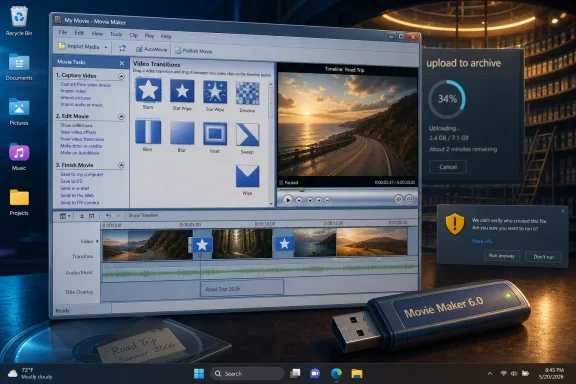 The App Microsoft Left Behind Still Has an Audience
Windows Movie Maker was never a professional editor, and that was the point. It was the application you opened because it was already there, because it did one obvious job, and because it did not ask you to understand codecs, color spaces, proxy media, or export pipelines before you could make a birthday slideshow. It was crude, occasionally unstable, and responsible for more star wipes than the internet deserved, but it gave ordinary Windows users a first encounter with editing as making, not merely consuming.That memory matters because Movie Maker occupied a specific cultural slot. It was not just bundled software; it was a gateway drug for digital creativity on the home PC. For students, parents, hobbyists, teachers, and small organizations, it lowered the threshold between “I have some clips” and “I made a video.”
Microsoft’s decision to discontinue Movie Maker years ago made sense in the narrow product-management sense. The old codebase belonged to a different Windows era, and video creation had moved toward mobile apps, web tools, and social platforms. But discontinuation created a gap that Microsoft never quite filled emotionally, even when it filled it functionally.
That distinction is why this Internet Archive upload has traveled so far. Users are not comparing Movie Maker 6.0 feature-by-feature against Clipchamp, DaVinci Resolve, Premiere Elements, or CapCut. They are comparing the feeling of opening a simple local tool against the feeling of being routed through a modern service.
Clipchamp Solved the Product Problem, Not the Trust Problem
Microsoft’s official answer to consumer video editing is Clipchamp, and on paper that answer is defensible. Clipchamp is more modern, more capable, and better aligned with today’s video formats and workflows than Movie Maker ever was. It supports templates, browser-based editing, stock assets, text-to-speech features, and the kind of timeline experience that feels more contemporary than dragging clips around in a Vista-era shell.Yet Clipchamp also embodies the Microsoft of the 2020s: service-connected, account-aware, cloud-adjacent, and strategically useful beyond the immediate task at hand. That does not make it bad software. It does make it a different kind of software.
For many Windows users, the complaint is not that Clipchamp cannot edit video. The complaint is that it feels like another front door into Microsoft’s broader ecosystem. When a basic editing workflow becomes entangled with sign-ins, cloud storage prompts, OneDrive behavior, or web-app assumptions, the tool stops feeling like part of the operating system and starts feeling like a tenant inside it.
Movie Maker’s appeal is partly that it predates that bargain. It does not know what a Microsoft 365 upsell is. It does not care about cross-device project sync. It does not have a growth team. It launches, imports media, lets the user assemble something, and exports the result. That simplicity is not merely nostalgia; it is a product philosophy.
The Internet Archive Becomes the Unofficial Windows Time Machine
The new installer’s presence on the Internet Archive is fitting. The Archive has become one of the places where abandoned software keeps a second life, not because it is officially blessed, but because official channels so often erase the past. When vendors stop hosting installers, old applications do not vanish from memory; they vanish from safe, obvious access.That creates a messy preservation problem. Users want familiar tools, but old executables circulating through forums, mirrors, and file-sharing sites carry real risk. Some are legitimate. Some are repackaged. Some are bundled with junk. Some are simply impossible to verify without hashes, signatures, provenance, or a sacrificial virtual machine.
The Movie Maker 6.0 upload sits in that uncomfortable middle ground. The community report says it works on Windows 7, Windows 10, and Windows 11. Neowin’s write-up notes that users have been confirming success. But Microsoft is not distributing it, supporting it, patching it, or standing behind it.
That matters. A nostalgia download is still executable code. On a modern Windows 11 PC, running an old installer from a community archive is a security decision, not just a sentimental one.
SmartScreen Is Not the Villain Here
It is tempting to frame Windows Defender or SmartScreen warnings as Microsoft being hostile to old software. Sometimes Windows does over-warn, especially when a file has low reputation, an old signature, or unusual distribution patterns. For retro enthusiasts, that can feel like the operating system is policing history.But in this case, caution is not paranoia. SmartScreen and Defender exist precisely because executable downloads from outside known channels are one of the oldest ways Windows users get burned. A Movie Maker installer may be harmless, but the category it belongs to — old Windows software fetched from a community upload — is inherently high-friction.
That is the trade-off preservationists live with. The more abandoned a program becomes, the more likely users are to retrieve it from informal sources. The more informal the source, the more likely modern Windows is to question it. Microsoft’s withdrawal from distribution does not eliminate demand; it pushes demand into spaces where trust is harder to establish.
For IT pros, the answer is simple: do not treat this as a deployable app. Test it in a virtual machine, isolate it from production systems, verify the file where possible, and assume nothing about long-term compatibility. For home users, the practical advice is just as plain: if you are going to run it, understand that you are stepping outside the supported Windows experience.
Movie Maker’s Return Exposes a Local-First Hunger
The enthusiasm around Movie Maker is not only about old UI chrome. It is about local-first software at a moment when even mundane tools increasingly assume cloud participation. Windows users have spent years watching basic tasks migrate into accounts, subscriptions, Store packages, web wrappers, and services that can change behavior without the clarity of a traditional version upgrade.Video editing is particularly sensitive to that shift. Video files are large, personal, and often private. A parent trimming family footage, a teacher assembling classroom clips, or a small business cutting a quick instructional video may not want project metadata, cloud dependencies, or account requirements involved at all. They may just want to open files on disk and export a finished MP4.
This is where Movie Maker’s limitations become part of its charm. It cannot do most of what modern tools can do, but it also does not impose much of a worldview. It is not trying to be a content platform. It is not nudging the user toward a branded workflow. It is a small tool for a finite job.
That sounds quaint until you realize how rare it has become. The modern software industry is very good at adding features that create dependency. It is less good at preserving tools that simply end.
Nostalgia Is Doing Product Research Microsoft Should Be Doing
Every retro revival carries the risk of overreading. People are allowed to miss things because they were young when they used them. Not every burst of nostalgia is a market signal, and not every old app deserves resurrection.Still, the recurring affection for Movie Maker should tell Microsoft something useful. There is persistent demand for a lightweight, local, beginner-friendly video editor that feels native to Windows and does not behave like a funnel. Clipchamp may be the official answer, but it is not the emotional answer.
That gap is not unique to video editing. Paint survived because it became culturally untouchable, and Notepad has endured because its minimalism is the feature. PowerToys thrives because it gives enthusiasts practical utilities without pretending every small tool must become a service. Movie Maker belonged to that family of Windows software: approachable, limited, direct, and memorable.
A modern Movie Maker would not need to be a clone. It could support current formats, hardware acceleration, better export presets, accessibility improvements, and safer media handling. But it would need to preserve the core contract: local projects, no mandatory cloud, no account wall for basic editing, and an interface that assumes the user wants to finish a task rather than enter an ecosystem.
The Windows 11 Compatibility Story Is Encouraging but Fragile
The reports of Movie Maker 6.0 working on Windows 11 are unsurprising and remarkable at the same time. Windows has long prided itself on backward compatibility, and many old Win32 applications continue to run because Microsoft has spent decades making sure yesterday’s software does not instantly become landfill. That compatibility is one of the platform’s great strengths.But “launches on Windows 11” is not the same as “reliably supported on Windows 11.” Old video software depends on old assumptions about codecs, graphics APIs, file paths, permissions, and system components. A workflow that works for one user’s AVI or WMV files may fall over when fed newer phone footage, high-efficiency codecs, variable frame-rate video, HDR clips, or large 4K media.
That mismatch is likely to be the first disappointment for anyone expecting Movie Maker to return as a daily driver. The app belongs to an era when consumer video was lower resolution, file formats were narrower, and publishing destinations were simpler. It may run, but it will not magically become a 2026 editor.
That does not make the revival pointless. It just defines its proper place. Movie Maker on Windows 11 is best understood as a nostalgia tool, a preservation artifact, and perhaps a lightweight editor for simple legacy workflows. It is not a supported replacement for modern video production.
The Real Risk Is Confusing “Available” With “Back”
The phrase “you can now download it on Windows 11” is technically accurate in the informal sense, but it risks implying a kind of return that has not happened. Microsoft has not restored Movie Maker. It has not posted a new installer, issued compatibility guidance, or folded the app into the Microsoft Store. A community member uploaded a setup file, and users are reporting that it works.That distinction matters because Windows users have seen many fake or repackaged “Movie Maker” downloads over the years. Some use familiar branding to promote unrelated editors. Others exploit search traffic from people trying to recover the old Microsoft app. The name itself has become a lure.
The Internet Archive is more reputable than a random download farm, but it is still not Microsoft. That means users should bring the same skepticism they would bring to any unofficial executable. The fact that the app is beloved does not make the supply chain clean.
For WindowsForum readers, this is the practical dividing line: curiosity is fine; casual deployment is not. A retro app running on a personal test machine is one thing. Installing it across school, nonprofit, office, or family systems because “Movie Maker is back” is another.
Microsoft’s Abandoned Consumer Tools Keep Haunting Windows
Movie Maker’s afterlife fits a larger pattern in Microsoft’s consumer history. The company has repeatedly built tools that ordinary users loved, then either folded them into broader strategies, neglected them, or replaced them with something more strategically aligned but less beloved. The result is a graveyard of fondly remembered software that still shapes expectations for Windows.This is not simply a matter of sentimentality. Windows is not only an enterprise operating system or a gaming platform; it is also the place where millions of people learned basic digital creation. They edited photos, burned CDs, made videos, wrote school reports, customized desktops, and experimented. Those bundled tools taught users what a PC was for.
When Microsoft removes or transforms that layer, it changes the perceived character of Windows. A platform that once felt like a box of tools can start to feel like a dashboard of services. That may be more profitable, more maintainable, and more aligned with cloud-era Microsoft, but it also narrows the emotional bond that made Windows durable in the first place.
The Movie Maker reaction is therefore not really about whether star wipes deserve preservation. It is about whether Windows still has room for small, useful, offline-first tools that ask very little and give users confidence quickly.
The Security Case Against Nostalgia Is Stronger Than Fans Want to Admit
There is a reason enterprises prefer supported software, and it is not because sysadmins hate fun. Unsupported applications create uncertainty. They do not receive security fixes, they may rely on deprecated components, and they complicate incident response because no vendor will help when something breaks.Old media applications also occupy a risky category. Video and image parsers have historically been a rich attack surface, because malformed files can trigger unexpected behavior in code that was never written with today’s threat environment in mind. Even if the installer is pristine, the app itself was not designed for the 2026 security landscape.
That does not mean every Movie Maker session is a danger. It does mean users should be honest about what they are doing. Running abandoned software is a trade: you gain familiarity and simplicity, but you give up the protections that come from active maintenance and vendor accountability.
The safer path is containment. Use a non-critical machine, a virtual machine, or at least a standard user account. Avoid opening untrusted media files. Do not grant unnecessary network access. Keep expectations modest and backups current.
The Preservation Argument Still Wins, With Conditions
Despite the risks, software preservation matters. Consumer applications like Movie Maker are part of computing history, and computing history is not only mainframes, kernels, and corporate milestones. It is also the tools people used to make vacation montages, school assignments, wedding DVDs, YouTube intros, and family archives.If old software disappears entirely, we lose more than code. We lose the ability to understand how ordinary users interacted with computers in a given era. Screenshots and reviews help, but running the application reveals the assumptions built into the interface: what tasks were considered normal, what file formats mattered, what “easy” meant at the time.
The Internet Archive’s role is valuable precisely because vendors rarely treat consumer software as heritage. Companies preserve brands when they are useful and discard installers when they are not. Communities preserve experience.
The condition is honesty. Preservation should not be confused with endorsement, support, or safety. A responsible revival says: here is the old tool, here is what people have reported, here is what it is not, and here is why caution matters.
A Tiny Installer Became a Referendum on Modern Windows
The Movie Maker 6.0 revival is best read as a small event with oversized meaning. It is not a revolution in Windows video editing, but it is a useful signal about what some users feel they have lost.- Windows Movie Maker 6.0 is circulating through a community upload, not through an official Microsoft release or support channel.
- Early reports say the installer can work on Windows 7, Windows 10, and Windows 11, but compatibility should be treated as anecdotal rather than guaranteed.
- Clipchamp remains Microsoft’s official video-editing direction, with more modern capabilities but a very different service-connected product philosophy.
- Anyone testing the old installer should treat it like unsupported executable code and use a virtual machine or non-critical system where possible.
- The renewed attention around Movie Maker shows continued demand for simple, local-first creative tools on Windows.
References
- Primary source: Neowin
Published: Wed, 01 Jul 2026 15:42:00 GMT
Loading…
www.neowin.net - Official source: support.microsoft.com
Create films with a video editor | Microsoft Support
Learn how to use Clipchamp to create, edit, and share your own custom videos.support.microsoft.com - Related coverage: windowslatest.com
Loading…
www.windowslatest.com - Related coverage: arstechnica.com
Loading…
arstechnica.com - Official source: answers.microsoft.com
Loading…
answers.microsoft.com - Official source: techcommunity.microsoft.com
Loading…
techcommunity.microsoft.com