

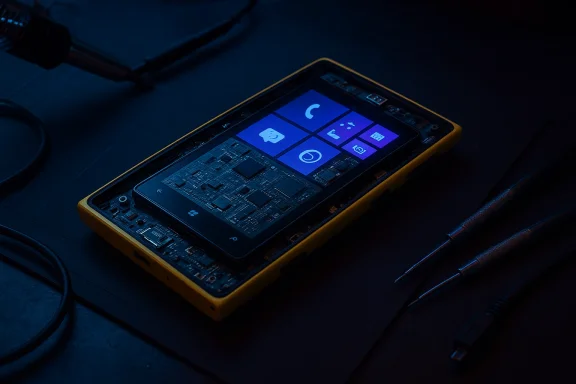
A one‑off hardware hack and a string of enthusiastic community proofs‑of‑concept have produced a tidy headline: “Windows Phone is back from the dead... kind of.” The reality is both less dramatic and far more revealing — what we’re seeing right now is not a corporate resurrection but a fertile mix of nostalgia, technical craft, and strategic thought experiments that illuminate why Windows Phone failed and what a realistic comeback would actually require.
Background: what prompted the headlines
Windows Phone — later rebadged as Windows 10 Mobile — remains one of the most discussed “what if?” stories in modern consumer tech. Enthusiasts still revere the tile‑based UI, the live glanceability of Live Tiles, and the early promise of Continuum: the idea that a phone could become a desktop when docked. That emotional legacy, combined with recent high‑visibility hobbyist projects (physical mods that house modern internals in classic Lumia shells and experiments that boot Windows 11 ARM on phones), has repeatedly reignited media coverage and forum debate.Two recent classes of demonstrations dominate the conversation:
[LISTST]
[*]Mechanical/hardware grafts that preserve Lumia shells while fitting modern internals from donors such as contemporary iPhones — a vivid, tactile nostalgia play that produces a functioning handset with classic looks but modern guts.
[*]Software experiments that use community projects (often called Project Renegade or Renegade‑style work) to boot UEFI and Windows 11 ARM images on phone SoCs, proving technical possibility but exposing severe real‑world limitations like battery drain, thermal stress, and missing drivers.
[/LIST]
Both approaches are technically impressive and culturally resonant, but neither equates to a commercially viable platform revival. These activities are best read as demonstrations: they show what enthusiasts can do with enough skill and time, not what a global OS ecosystem requires.
The hardware graft: nostalgia made tangible
What happened in the shop
A recent build took the shell of a Lumia 1020 — one of the most iconic Lumia designs — and transplanted the internals of a modern donor device to create a working smartphone that looks like a time capsule. The builder reported functioning cellular service (where hardware aligned with local bands), contemporary performance thanks to modern silicon, and the immediate visual satisfaction of seeing a Lumia exterior come to life again. As a technical craft proof, the project highlights ingenuity and mechanical skill while deliberately playing to nostalgia.What it proves — and what it doesn’t
The graft proves one thing clearly: industrial design and UI can be preserved or reimagined independently of the software stack. But it also exposes critical limits:- App ecosystems, developer tooling, carrier agreements, and long‑term updates — the structural elements that sustained competing mobile platforms — are absent from such builds. A shell with modern internals is not a platform.
- Hardware‑backed services (contactless payments, device attestation, secure elements) often rely on tightly coupled secure hardware and firmware. Transplants risk breaking these features, or at minimum leaving them unsupported without vendor cooperation. Builders reported plausible payment issues and cautioned that claims about secure service continuity should be audited.
Community software experiments: booting Windows on phones
The Renegade route and Windows 11 on ARM
A small but persistent set of hobbyists has adapted smartphone UEFI environments and loaded ARM builds of Windows 11 on phone hardware. Notable demonstrations involved marathon install sessions, driver hunting, and dozens of hours of tuning to coax desktop Windows into a mobile footprint. These projects consistently illustrate technical possibility — but also highlight severe penalties in usability.Real limitations shown in hands‑on tests
Reports from these experiments repeatedly document the same practical problems:- Battery life that drops to a few hours under normal use due to desktop power management profiles and missing SoC power optimizations.
- Thermal issues, including sustained high temperatures that would be unacceptable for consumer daily drivers.
- Missing or incomplete drivers for touch, camera, modem, and fast‑charging subsystems, producing degraded user experiences.
- Slow or nonexistent fast‑charging and poor power management because desktop driver stacks aren’t tuned for mobile hardware.
Why the platform failed the first time — and why that history matters
The structural problems were not just Microsoft’s product design
The classical diagnosis is straightforward: Windows Phone failed because it could not build and sustain a competitive app ecosystem or secure the broad OEM/carrier support necessary to scale. The acquisition of Nokia’s Devices & Services business in 2013 — a multibillion‑euro strategic move intended to accelerate hardware reach — failed to produce the requisite market momentum, and Microsoft eventually stepped back from first‑party handset ambitions after sustained losses. Those corporate decisions and market realities shaped the platform’s decline and remain relevant to any conversation about a comeback.The app economy is the single biggest barrier
Platforms win or lose on network effects. Developers build for where users are; users choose platforms where apps are abundant. Windows Phone’s paucity of mainstream apps created a negative feedback loop: fewer users led to less developer interest, which led to fewer apps and even less user adoption. Any revival must confront this same dynamic with credible, durable incentives for developers.The technical reality checklist for any credible revival
A credible, sustainable revival would need to deliver all of the following — not as promises but as operational guarantees:- A modern, actively maintained mobile OS stack with secure update channels and a commitment to multi‑year security and feature updates.
- A robust developer story: simple porting tools, clear API compatibility, commercially attractive monetization, and migration guarantees that prevent the “runtime deprecation” problem that defeated earlier compatibility layers.
- Carrier and OEM partnerships that provide certified modem stacks, global band support, and payment transit assurances.
- Hardware certification and secure element provisioning so device attestation and contactless payments function without fragile hacks.
- A unique value proposition — beyond nostalgia — that draws users to switch (e.g., deep Microsoft 365/Copilot integration for enterprise users, differentiated power/workflow features, or a dock‑centric pocket PC model).
Plausible revival scenarios — ranked by realism
- Niche pocket PC / enterprise device (most plausible)
- A premium, dock‑focused Arm pocket PC that runs a Windows‑flavored shell and prioritizes Microsoft 365/Copilot integration.
- This approach sidesteps the need for a mass consumer app ecosystem by leaning on web apps, Microsoft cloud services, and enterprise provisioning.
- It requires fewer carriers and can be distributed via enterprise channels or direct sales.
- Android base with Microsoft UX (low risk, low purity)
- Microsoft has used Android as a foundation before (Surface Duo): the company places Microsoft services and UX at the front while relying on Android for app parity.
- This isn’t a true Windows Phone revival; it’s a Microsoft‑branded skin atop Android that provides app coverage but not a native new platform.
- A new Microsoft mobile OS with native app ecosystem (least likely)
- A full new OS with long‑term commitments, developer incentives, and carrier/OEM cooperation. This is the classic “true revival,” but it’s also the most expensive and risky.
- Microsoft would need a strategic reason, a multi‑year commitment, and clear developer economics — a tall order in today’s mobile duopoly.
- Community‑driven revival (ongoing but noncommercial)
- Hobbyists and modders keep the spirit alive through ports, concepts, and physical grafts. These projects inform design thinking but do not replace commercial ecosystems.
The business and legal risks of hobbyist revival projects
Hobbyist projects are great for community morale, but they raise a slew of practical and legal considerations:- Warranty and safety: mixing components, batteries, and power systems voids manufacturer warranties and can create battery safety risks if not handled to commercial testing standards.
- Proprietary firmware and licensing: distributing devices that contain proprietary firmware keys or closed‑source software without vendor authorization risks legal pushback.
- Carrier certification and payment compliance: devices sold or distributed publicly typically require regulatory and carrier certification; hobbyist one‑offs are not covered, and attempting to commercialize them invites serious compliance hurdles.
Why some elements of Windows Phone still matter
It’s tempting to dismiss nostalgia as mere wistfulness, but several design ideas from Windows Phone retain genuine product value:- Live Tiles’ emphasis on glanceable, glance‑first information anticipated many of today’s widget and glance paradigms. A modern reimagining could offer real UX differentiation if executed with modern privacy and battery trade‑offs in mind.
- Continuum and dock‑centric workflows prefigured today’s dockable pockets of compute. As Arm performance improves and Windows on Arm grows more capable, pockets that blur phone and PC could be commercially compelling for niche segments.
- Microsoft’s cloud services (Office, Teams, OneDrive, Copilot) provide a natural ecosystem that could be married to hardware in a way that matters to enterprise buyers and power users. If Microsoft ever pursued a revival seriously, the company’s existing subscription economics would shape the go‑to‑market play.
What the latest coverage and forums are getting right — and where they overreach
What coverage often gets right:- Enthusiasts’ projects are technically impressive and culturally resonant; the community’s continued interest demonstrates an enduring design legacy.
- Any viable corporate return would look different from the Lumia era; a focused, measured approach that leverages Microsoft services and targets niche markets is the most pragmatic path.
- “Windows Phone is back” as a headline misreads craft projects and experimental ports as platform comebacks. The current activity lacks the developer economics, carrier partnerships, and product commitments required for a genuine comeback.
- Claims that Microsoft “must” have a phone to succeed in AI or cloud are speculative and not supported by public evidence; Microsoft’s cloud and AI strategies can — and do — operate at scale without a first‑party handset. Such pronouncements should be treated as opinion rather than fact.
Practical advice for enthusiasts and Windows users
- For modders and collectors: preserve classic hardware if you value historical artifacts; dismantling iconic units for one‑off grafts sacrifices irreplaceable design pieces. If you attempt transplants, be conscious of RF tuning, battery safety, and long‑term reliability.
- For developers and product teams: study the UX concepts (glanceability, tile affordances, dock workflows) and consider how to integrate those ideas into existing Windows and Android surfaces instead of betting on a full platform revival. Modular UX experiments across modern devices are a lower‑risk way to test the value of Windows Phone design patterns.
- For readers excited by the headlines: temper enthusiasm with realism. Hobbyist builds and demos are fascinating and instructive, but they are not a substitute for the massive, multi‑year investment required to relaunch a credible mobile platform.
Conclusion: a small flame, not a bonfire — and why that still matters
The recent stories about Windows Phone “coming back” capture something real: a passionate community and a set of design ideas that still influence modern interfaces. The hardware grafts and Windows‑on‑phone experiments are compelling technical theater and useful design probes. But they are not evidence of a corporate or commercial revival. What they do offer is a clearer view of the twin problems that sank Windows Phone the first time: lack of developer momentum and the enormous operational cost of sustaining a mobile platform.If Microsoft or an OEM ever chooses to re‑enter mobile in a meaningful way, the likely route is incremental and niche‑first: pocket PCs for enterprise, dockable productivity devices that leverage Microsoft 365 and Copilot, or Android‑based devices with a deeply integrated Microsoft UX. Each path requires binding commitments to developers, carriers, and customers — commitments that hobbyists and nostalgic headlines cannot substitute.
For now, Windows Phone lives on where it always has in recent years: in the imagination of designers, the workbenches of modders, and the forums of enthusiasts. Those places keep the idea alive and occasionally produce innovations worth borrowing. They do not — yet — show that the platform itself has returned.
Source: Neowin https://www.neowin.net/amp/windows-phone-is-back-from-the-dead-kind-of/
