

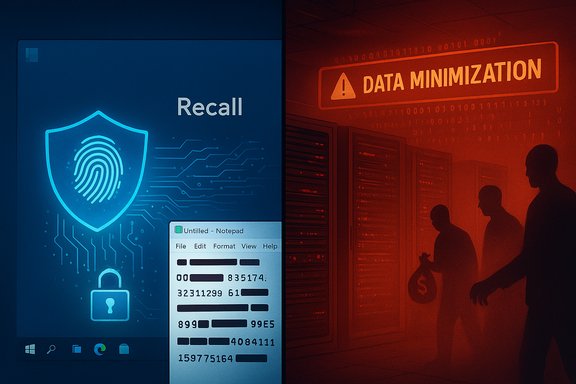
Microsoft’s AI ambitions and a separate mass data extortion attempt collided this week into a stark reminder: powerful machine intelligence and sprawling analytics ecosystems can both improve productivity and create new, outsized privacy risks when the implementation or supply chain fails. Reports that Microsoft’s Windows Recall — the screenshot‑and‑search feature in Windows 11 tied to Copilot+ PCs — can capture sensitive data even when filters are enabled, and a parallel extortion campaign by the ShinyHunters gang claiming to hold over 200 million Pornhub premium records, together highlight two very different but related threat models: local AI features that collect fine‑grained user activity, and third‑party analytics pipelines that centralize activity logs and become high‑value breach targets.
Background / Overview
Windows Recall is an on‑device AI feature Microsoft designed to make past activity searchable by taking periodic snapshots of the desktop and storing them securely on the local machine. It was conceived as a productivity aid — search your recent code edits, conversations, or files without remembering filenames. Microsoft positioned the design to emphasize local processing, encryption, and biometric gated access, and initially limited Recall to Copilot+ PCs where an on‑board NPU (neural processing unit) accelerates private AI tasks. However, security researchers and testers have found that the feature’s sensitive‑data filter is imperfect, and the feature’s default behavior and attack surface raised immediate privacy concerns. Separately, cybersecurity outlets and major wire services have reported that the extortion group ShinyHunters claims to have harvested analytics events tied to Pornhub Premium users — allegedly a dataset of roughly 94 GB and more than 200 million records containing email addresses, video search and viewing events, and approximate user locations and timestamps. ShinyHunters has attempted to extort Pornhub, threatening to publish the dataset unless paid; Pornhub acknowledged a cybersecurity incident affecting select Premium users and pointed investigators to a third‑party analytics provider, while that provider has contested aspects of the public narrative. The result is a messy, high‑impact incident that feeds sextortion scams, threatens reputations, and underlines the risk of outsourced telemetry.What Windows Recall is — and what went wrong
How Recall is supposed to work
Windows Recall was built as a local, AI‑assisted activity index: it takes frequent, encrypted snapshots of the visible desktop and extracts searchable vectors so users can ask queries like “Where did I see that link about invoices?” or “When did Sarah send the meeting notes?” Key design claims from Microsoft include:- Local-only processing: snapshot analysis and indexing occur on the device, not in the cloud.
- Encryption + biometric gating: snapshot data and the associated vector database are encrypted and require Windows Hello / biometric authentication to decrypt or search.
- Sensitive-data filtering: the system ships with a filter intended to discard snapshots that contain credit cards, government IDs, passwords, or content from filtered apps and private sessions.
The empirical problem: Recall captured credit‑card and ID data during tests
Independent testing by journalists and researchers found concrete failure modes. In one widely reported test, a researcher entered mock credit‑card numbers, Social Security numbers, and other sensitive values into Notepad and an HTML form; Recall recorded snapshots that contained those values despite the sensitive‑data filter being enabled. The behavior appears inconsistent: Recall blocked captures on major, recognized payment pages (for example, certain ecommerce checkout pages), but it captured the same kinds of data when the input occurred in user‑constructed pages or generic apps. That inconsistency suggests the filter relies on heuristics or site/app whitelists that don’t generalize to custom input contexts. At the same time, other testers report receiving the expected filtering behavior in some scenarios, indicating non‑uniform operation across builds, configurations, or test cases. Microsoft paused and iterated on Recall’s design multiple times, hardening the setup and making onboarding opt‑in while adding just‑in‑time decryption and Virtualization‑Based Security (VBS) enclaves to protect the snapshot data. Those mitigations help, but they do not remove the need for accurate content detection and clear user defaults.Why this matters: attack vectors and threat models
Recall’s fundamental risk derives from collecting extremely detailed UI state at high cadence:- Local malware or an attacker with system privileges can read snapshot files or extract decrypted vectors if the biometric gating or enclave is bypassed.
- Misclassification of filtered content means sensitive values (credit cards, IDs, passwords) can be preserved where users expect them to be purged.
- Unofficial tools and porting efforts already exist that enable Recall on unsupported hardware, widening the feature’s footprint beyond the Copilot+ hardware posture Microsoft intended. That increases the number of devices running the feature without guaranteed silicon‑level protections.
The Pornhub / Mixpanel incident: what we know and what remains contested
Timeline and the raw claims
In mid‑December, multiple outlets reported that ShinyHunters sent extortion notices claiming to possess analytics data tied to Pornhub Premium members. The hackers allege they extracted ~94 GB containing over 200 million records of historical search, watch and download activity. The leaked sample shown to journalists reportedly contained email addresses, event types (watch/download), video URLs and titles, search keywords, timestamps, and approximate locations. Pornhub publicly stated the incident affected a “limited set of analytics events for some Premium users” and emphasized that passwords, payment details, and government IDs were not exposed. Mixpanel, the third‑party analytics provider mentioned in public statements, denied that the leak stemmed from its November incident for some customers and suggested some data could have been accessed via legitimate access at a customer as far back as 2023; meanwhile investigators and reporters continue to gather evidence.What’s corroborated, and what should be treated cautiously
Multiple independent outlets — Reuters, Forbes, The Guardian, TechCrunch and others — have reported the extortion claim and analyzed samples and company statements. The most credible, load‑bearing points are:- ShinyHunters claimed responsibility and provided sample data to journalists.
- The sample shown to reporters included email addresses, video activity, search keywords, timestamps, and approximate locations.
- Pornhub acknowledged an incident involving analytics events for some Premium users but denied a breach of its primary systems and said no passwords or payment card details were exposed.
- The precise origin of the data (whether Mixpanel’s November compromise, a different third‑party, or an authorized export from a corporate account) is disputed. Mixpanel has publicly described the November incident and later clarified aspects of its scope; forensic attribution is ongoing.
- The absolute record count (201,211,943) and the complete contents of the dataset come from the extortionists’ claims and samples; independent third‑party verification of the full dataset has not been published as of reporting. Treat the exact figure as a claimed value until a forensic response confirms it.
Why analytics telemetry is such a juicy target
Analytics platforms like Mixpanel centralize large volumes of event logs that can include surprisingly sensitive context: search queries, location pings, device fingerprints, and itemized content events. Those logs were created for product improvement and behavior analysis — not for preserving privacy — and therefore can contain detailed behavioral trails that are extremely valuable to extortionists, fraudsters, and data brokers. A single breach of that telemetry pipeline can cascade across thousands of customers and millions of users.How these two stories connect: AI functionality vs telemetry risk
At first glance, a Windows 11 on‑device AI feature and an extorted web‑service analytics dump seem unrelated. But they share the same core dilemmas:- Data minimization: both systems collected more granular data than users might expect — Recall capturing full UI snapshots by design, and analytics capturing detailed event histories for product telemetry. Both increase the volume and sensitivity of stored data.
- Failure modes outside the vendor’s direct control: Recall depends on accurate classification heuristics; analytics security depends on third‑party protections, access controls, and supply‑chain hygiene. One is a local classification problem; the other is a supply‑chain and access‑control problem. Both require layered defense.
- New incentives for attackers: collectors of sensitive behavioral data — whether stored locally or centrally — become high‑value targets. The richer the dataset, the higher the rewards for theft or extortion.
Practical guidance for Windows users and Pornhub (or similar) customers
For Windows users who run or evaluate Recall (or similar AI features)
- If you don’t need Recall, disable it or delay opting in until auditors and security testers confirm the filter behavior on your build.
- Use devices with the intended hardware posture (Copilot+ PCs with NPU) and avoid sideloaded or unofficial apps that enable Recall on unsupported hardware. Unofficial ports can bypass the hardware protections Microsoft depends on.
- Keep Windows fully patched and subscribe to security updates; enable Windows Hello and biometric gating to enforce just‑in‑time decryption where supported.
- Apply standard endpoint hygiene: anti‑malware tools, enable disk encryption (BitLocker), restrict administrative privileges, and monitor for unusual process activity that could indicate exfiltration attempts.
For users affected by the Pornhub analytics leak (or similar breaches)
- Treat any notification about being part of a breached dataset as a cue to harden all accounts that share the same email. Enable MFA everywhere and scrutinize password reuse.
- Expect sextortion phishing and do not pay extortion demands — instead, report extortionate emails to law enforcement and your email provider. Keep evidence (screenshots, emails) in a secure place for investigators.
- Watch for spear‑phishing tied to your viewing activity (attackers weaponize contextual knowledge), and consider using burner/payment addresses and privacy‑oriented account practices in future paid services.
Strengths, weaknesses, and a critical assessment
Notable strengths
- Microsoft’s design decisions for Recall — local processing, encryption, and biometric gating — demonstrate a privacy‑forward architecture compared with cloud‑first alternatives. The company’s responsiveness (delays, opt‑in flows, additional enclave protections) shows a willingness to iterate after public scrutiny.
- The Pornhub incident prompted rapid engagement between affected vendors and security teams; the public discussion has shone light on problems in the analytics supply chain and accelerated vendor disclosure practices. Multiple independent outlets reporting and examining samples increases transparency even amid noisy extortion claims.
Significant weaknesses and risks
- Heuristic filters are brittle. A filter that blocks recognized payment forms but fails on custom inputs creates a false sense of protection — users will assume their data is safe when it is not. That cognitive gap is dangerous.
- Local data is not immune. On‑device storage can be stolen, especially on devices without the targeted hardware or when attackers gain local privileges. Adding an AI feature increases the attack surface and the amount of sensitive data at rest.
- Third‑party telemetry centralizes risk. Analytics providers consolidate event logs from many customers, making them high‑value single points of failure if access controls, least privilege, and monitoring are inadequate. The supply‑chain nature of these relationships complicates attribution and remediation.
Where vendors should improve
- Defaults should favor opt‑out for broad, continuous capture of user activity. If convenience features require extensive data collection, the default must be conservative.
- Filtering must be auditable. Vendors should publish reproducible test results and threat models that show how sensitive data is detected under adversarial inputs. Independent third‑party testing should be routine for privacy‑impacting features.
- Supply chains should adopt stronger telemetry minimization and stronger contractual controls over pipeline access, logging, and breach disclosure. Customers of analytics services need clear, auditable guarantees about retention windows and event sanitization.
Final verdict and cautions
AI features like Windows Recall and analytics event pipelines both offer clear utility, but they cannot be considered safe by design without rigorous, adversarial validation and conservative defaults. Microsoft’s adjustments to Recall — deferring rollout, requiring opt‑in, adding enclave protections and biometric gating — are important and correct steps, but they do not eliminate the need for improved content detection and for caution among users, particularly on unsupported hardware where protections may be absent. Likewise, the Pornhub / Mixpanel / ShinyHunters saga is a textbook case of why companies must assume telemetry can be weaponized. The claimed scale of the dataset is large and harmful; until forensic verification is complete, treat the exact numbers as claims, but treat the risk to affected users as real. Extortion claims and leaked samples should be prosecuted and investigated, and companies using third‑party analytics should consider data minimization, pseudonymization, and access hardening as table stakes. These incidents are not isolated curiosities — they illustrate a systemic tension in modern software: the push to use telemetry and AI to make software smarter, faster, and more helpful, and the countervailing need to design for least privilege, minimal retention, and auditable protection. Where convenience and productivity require fine‑grained insight into user actions, designers must offset that need with stronger technical guarantees and conservative user defaults. The onus is on vendors to prove that convenience does not come at the cost of catastrophic data exposure, and on users to apply cautious operational practices until those guarantees are demonstrably robust.This article summarized the current public record: independent tests showing Windows Recall’s filtering inconsistencies, Microsoft’s subsequent mitigation steps, and the ongoing, complex investigation into the ShinyHunters extortion claim against Pornhub’s analytics data. Where claims remain unverified — particularly exact record counts and the definitive origin of the leaked analytics dataset — those points are presented as claims rather than settled facts. The combined lesson is clear: AI and analytics create new concentrations of sensitive data, and protecting users requires both better engineering and better governance.
Source: Inbox.lv News feed at Inbox.lv -
