

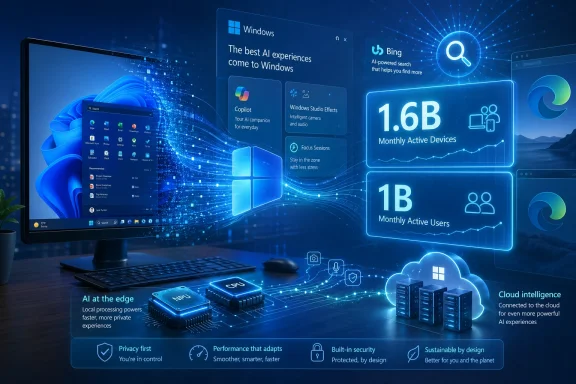
Microsoft used its April 29, 2026, fiscal third-quarter earnings call to say Windows now exceeds 1.6 billion monthly active devices and Bing has reached 1 billion monthly active users for the first time. The numbers matter less as a victory lap than as a map of Microsoft’s next consumer strategy. Satya Nadella is no longer talking about Windows merely as a delivery vehicle for Azure, Microsoft 365, or Copilot. He is talking about the PC as Microsoft’s last great consumer beachhead — and Bing as the proof that distribution, defaults, AI, and persistence can still move a supposedly mature market.
For most of the cloud era, Windows has been treated like Microsoft’s old family mansion: valuable, sturdy, impossible to ignore, but no longer where the company threw its best parties. Azure got the growth story. Microsoft 365 got the recurring revenue story. GitHub and Copilot got the developer glamour. Windows got Patch Tuesday, OEM licensing, and the occasional keynote cameo when a new Surface needed a stage.
That made Nadella’s framing on the Q3 call unusually pointed. Microsoft said it is doing the “foundational work” needed to win back fans across Windows, Xbox, Bing, and Edge, with a near-term focus on fundamentals, quality, and core users. That is corporate language, but the subtext is plain enough: Microsoft knows it has annoyed a meaningful slice of its most loyal audience.
The 1.6 billion Windows figure is therefore not simply a scale metric. It is a reminder that Microsoft still owns the operating layer for a vast share of personal computing. Even if the PC is not the growth engine it was in the 1990s or the pandemic hardware boom, it remains the place where Microsoft can place software, services, identity, ads, AI assistants, search boxes, app stores, and cloud hooks in front of users without asking anyone else’s permission.
The irony is that this renewed humility arrives alongside an enormous show of strength. Microsoft reported $82.9 billion in quarterly revenue, up 18 percent year over year, with Microsoft Cloud revenue reaching $54.5 billion. The company’s AI business, by its own accounting, surpassed a $37 billion annual revenue run rate. Windows is no longer the financial center of Microsoft. But it may again become the strategic center of Microsoft’s consumer ambitions.
That does not make the number unimportant. A stable or modestly growing Windows base in 2026 is still strategically valuable because the PC market has had to absorb inflation, memory-price pressure, enterprise refresh timing, and the messy end of Windows 10 support. Microsoft’s own CFO commentary pointed to complex PC dynamics and noted that Windows OEM revenue would face tough comparisons tied partly to Windows 10 end-of-support effects.
The distinction matters. “Windows has 1.6 billion monthly active devices” tells us Microsoft’s installed base remains colossal. It does not tell us how many users are on Windows 11, how many are still clinging to Windows 10 through Extended Security Updates, how many are enterprise-managed, how many are low-end PCs in emerging markets, or how much of the count comes from actual daily engagement rather than occasional activity.
For IT pros, that missing breakdown is the story inside the story. A single monthly active device count smooths over the messy reality of the Windows estate: incompatible hardware, TPM requirements, application dependencies, regulated environments, VDI footprints, education labs, kiosk systems, and home machines that still run because they are “good enough.” Microsoft sees a platform. Admins see a migration spreadsheet with red cells everywhere.
Still, 1.6 billion gives Microsoft an argument it badly needs. In a world where Apple owns premium consumer mindshare, Google owns mobile search defaults, and AI startups own much of the cultural imagination, Windows remains the installed-base monster. Microsoft does not need every Windows user to love Windows. It needs enough of them to stay, engage, search, subscribe, and eventually use AI features that make the PC feel newly central.
Now Microsoft says Bing has crossed 1 billion monthly active users for the first time. That does not mean Bing has become Google. It does mean the old “nobody uses Bing” line is no longer analytically useful. A billion monthly users is not a niche, even if many of those users arrive through Windows Search, Edge defaults, Microsoft Start, Copilot, enterprise policy, or the rewards machinery that keeps some consumers coming back.
The more interesting point is that Bing’s growth is occurring in the AI-search transition. Microsoft moved early by welding conversational AI onto Bing, then folding that capability into Copilot branding while continuing to use Bing as the web substrate. For users, the boundary between search engine, answer engine, chatbot, browser sidebar, and Windows assistant is increasingly blurry. For Microsoft, that blur is the product.
Search advertising excluding traffic acquisition costs grew 12 percent in the quarter, according to Microsoft’s results, driven by volume and revenue per search across Edge and Bing. That is the part investors care about. But Windows users should care about the mechanism, because Microsoft’s search ambitions are inseparable from the design of Windows, Edge, widgets, Start, Copilot, and default app prompts.
This is where Microsoft’s fan-recovery campaign will be tested. Bing can grow because it is useful. It can also grow because Microsoft keeps placing it in the path of users who did not ask for it. The former builds loyalty. The latter builds resentment, and Windows enthusiasts have long memories.
Edge is Microsoft’s bridge between the operating system and the open web. On managed Windows PCs, it is often the browser IT can control most deeply. On consumer PCs, it is the browser Microsoft can promote most aggressively. On AI PCs, it is a canvas for sidebar assistants, summarization, page context, shopping agents, and search experiences that do not fit neatly into the old address-bar model.
This is why Bing and Edge should be read together. Microsoft’s search growth is not just about a better search page. It is about the surface area around search: browser defaults, Windows entry points, Copilot routing, Microsoft Rewards, and enterprise environments where Edge is no longer treated as an Internet Explorer punchline but as a Chromium browser with native management hooks.
The risk is that Microsoft has historically overplayed this hand. Windows users have seen too many prompts asking them to reconsider default browsers, too many post-update screens pushing services, and too many attempts to recapture attention under the banner of helpfulness. Edge’s share gains are real enough for Microsoft to brag about them. Whether those gains translate into affection is another question.
If Nadella’s “win back fans” line means anything, Microsoft has to prove Edge and Bing can compete through utility rather than friction. That means fewer dark-pattern-adjacent nudges and more reasons an informed user would choose the Microsoft stack on purpose.
For years, the complaint has not simply been that Microsoft added too much. It is that Microsoft added too much while leaving basics feeling inconsistent: Settings versus Control Panel remnants, unpredictable update behavior, ads and recommendations in system surfaces, uneven performance on modest hardware, and a general sense that Windows was being optimized for Microsoft’s funnel rather than the user’s workflow.
Microsoft appears to understand that AI features will not land well on top of a desktop experience people already distrust. The phrase “unmetered intelligence at the edge” may thrill an investor audience, but on a low-RAM laptop it sounds like a threat unless Windows itself feels lighter, more predictable, and more respectful. A smarter PC that is slower, noisier, and more intrusive is not a better PC.
This is where the Windows 10 end-of-support transition still casts a shadow. Windows 10 support ended on October 14, 2025, pushing consumers and enterprises toward Windows 11, new hardware, paid security extensions, or unsupported risk. That transition may help OEM revenue in bursts and improve Windows 11 adoption statistics, but it also concentrates user frustration. People who feel forced to move are less forgiving when the destination nags them.
The Windows team’s challenge is therefore brutally practical. Before Microsoft can sell users on local AI, agentic workflows, and a more intelligent desktop, it has to make the update button feel less like a roulette wheel. Fundamentals are not a nostalgic detour from AI. They are the prerequisite for it.
That is the strategic reason Microsoft still cares so deeply about Windows. The company can sell cloud AI through Azure, but cloud-only AI has cost, latency, privacy, and margin constraints. If some inference can run locally on NPUs, GPUs, or CPUs, Microsoft can offer richer experiences without sending every request through expensive datacenter capacity. The PC becomes not just a client, but a distributed AI endpoint.
This also helps explain the obsession with Copilot+ PCs, NPUs, and Windows features that assume more capable local hardware. Microsoft wants the next PC refresh cycle to be about more than replacing aging Windows 10 machines. It wants the refresh to feel like the arrival of a new class of computer, one where AI is not a website tab but a system capability.
The problem is that users do not buy architectural narratives. They buy battery life, speed, compatibility, reliability, and features that save time. If “AI at the edge” means better search across local files, faster dictation, smarter accessibility, local meeting summaries, and useful automation that respects privacy, it can matter. If it means more Copilot buttons and cloud upsell panels, it will feel like Clippy with a datacenter budget.
For sysadmins, the edge-AI pitch also raises governance questions. Which models run locally? What telemetry leaves the device? How are prompts logged? Can features be disabled by policy? Does local AI change data classification assumptions? The PC as an AI endpoint is powerful, but it also expands the management surface.
That context makes the Windows and Bing milestones more important, not less. Microsoft is trying to prove that consumer engagement can be rebuilt even when hardware and gaming are uneven. Bing’s billion users, Edge’s long share-gain streak, 95 million Microsoft 365 consumer subscribers, and 1.6 billion Windows devices form a portfolio argument: the consumer business is not one product, but a mesh of surfaces.
The company’s challenge is that those surfaces often collide. Windows users may like Microsoft 365 but resent OneDrive prompts. They may use Edge at work but install Chrome at home. They may enjoy Game Pass but dislike pricing changes. They may appreciate Bing’s AI answers but distrust Windows Search sending them to the web. Microsoft’s consumer story is powerful because everything connects; it is vulnerable for the same reason.
This is the central tension of Nadella’s “win back fans” campaign. Fans do not want every Microsoft property cross-promoted inside every other Microsoft property. They want coherence without coercion. They want the benefits of integration without feeling trapped in a growth experiment.
The old Microsoft could win by controlling the platform. The new Microsoft has to win by making that control feel useful.
Source: Windows Latest Microsoft's Satya Nadella confirms 1.6 billion monthly Windows users, Bing crosses 1 billion for the first time
 Microsoft Rediscovers the Consumer Platform It Never Really Lost
For most of the cloud era, Windows has been treated like Microsoft’s old family mansion: valuable, sturdy, impossible to ignore, but no longer where the company threw its best parties. Azure got the growth story. Microsoft 365 got the recurring revenue story. GitHub and Copilot got the developer glamour. Windows got Patch Tuesday, OEM licensing, and the occasional keynote cameo when a new Surface needed a stage.That made Nadella’s framing on the Q3 call unusually pointed. Microsoft said it is doing the “foundational work” needed to win back fans across Windows, Xbox, Bing, and Edge, with a near-term focus on fundamentals, quality, and core users. That is corporate language, but the subtext is plain enough: Microsoft knows it has annoyed a meaningful slice of its most loyal audience.
The 1.6 billion Windows figure is therefore not simply a scale metric. It is a reminder that Microsoft still owns the operating layer for a vast share of personal computing. Even if the PC is not the growth engine it was in the 1990s or the pandemic hardware boom, it remains the place where Microsoft can place software, services, identity, ads, AI assistants, search boxes, app stores, and cloud hooks in front of users without asking anyone else’s permission.
The irony is that this renewed humility arrives alongside an enormous show of strength. Microsoft reported $82.9 billion in quarterly revenue, up 18 percent year over year, with Microsoft Cloud revenue reaching $54.5 billion. The company’s AI business, by its own accounting, surpassed a $37 billion annual revenue run rate. Windows is no longer the financial center of Microsoft. But it may again become the strategic center of Microsoft’s consumer ambitions.
The 1.6 Billion Number Is Huge, but Not the Growth Story Microsoft Wants You to Imagine
There is a temptation to read 1.6 billion monthly active Windows devices as a dramatic surge. It is not that simple. Microsoft has used versions of “more than a billion” or “billions of PCs” language for years, and earlier public references put the Windows PC base around 1.5 billion. On that backdrop, 1.6 billion is impressive, but it is not a rocket ship.That does not make the number unimportant. A stable or modestly growing Windows base in 2026 is still strategically valuable because the PC market has had to absorb inflation, memory-price pressure, enterprise refresh timing, and the messy end of Windows 10 support. Microsoft’s own CFO commentary pointed to complex PC dynamics and noted that Windows OEM revenue would face tough comparisons tied partly to Windows 10 end-of-support effects.
The distinction matters. “Windows has 1.6 billion monthly active devices” tells us Microsoft’s installed base remains colossal. It does not tell us how many users are on Windows 11, how many are still clinging to Windows 10 through Extended Security Updates, how many are enterprise-managed, how many are low-end PCs in emerging markets, or how much of the count comes from actual daily engagement rather than occasional activity.
For IT pros, that missing breakdown is the story inside the story. A single monthly active device count smooths over the messy reality of the Windows estate: incompatible hardware, TPM requirements, application dependencies, regulated environments, VDI footprints, education labs, kiosk systems, and home machines that still run because they are “good enough.” Microsoft sees a platform. Admins see a migration spreadsheet with red cells everywhere.
Still, 1.6 billion gives Microsoft an argument it badly needs. In a world where Apple owns premium consumer mindshare, Google owns mobile search defaults, and AI startups own much of the cultural imagination, Windows remains the installed-base monster. Microsoft does not need every Windows user to love Windows. It needs enough of them to stay, engage, search, subscribe, and eventually use AI features that make the PC feel newly central.
Bing’s Billion Is the More Surprising Flex
The Bing milestone is more startling because Bing has spent most of its life as a punchline with a balance sheet. For years, the lazy joke was that Bing existed because Microsoft could not psychologically tolerate leaving search to Google. The business reality was always more complicated: search advertising is too lucrative, too strategic, and too adjacent to the browser and operating system to abandon.Now Microsoft says Bing has crossed 1 billion monthly active users for the first time. That does not mean Bing has become Google. It does mean the old “nobody uses Bing” line is no longer analytically useful. A billion monthly users is not a niche, even if many of those users arrive through Windows Search, Edge defaults, Microsoft Start, Copilot, enterprise policy, or the rewards machinery that keeps some consumers coming back.
The more interesting point is that Bing’s growth is occurring in the AI-search transition. Microsoft moved early by welding conversational AI onto Bing, then folding that capability into Copilot branding while continuing to use Bing as the web substrate. For users, the boundary between search engine, answer engine, chatbot, browser sidebar, and Windows assistant is increasingly blurry. For Microsoft, that blur is the product.
Search advertising excluding traffic acquisition costs grew 12 percent in the quarter, according to Microsoft’s results, driven by volume and revenue per search across Edge and Bing. That is the part investors care about. But Windows users should care about the mechanism, because Microsoft’s search ambitions are inseparable from the design of Windows, Edge, widgets, Start, Copilot, and default app prompts.
This is where Microsoft’s fan-recovery campaign will be tested. Bing can grow because it is useful. It can also grow because Microsoft keeps placing it in the path of users who did not ask for it. The former builds loyalty. The latter builds resentment, and Windows enthusiasts have long memories.
Edge Is the Quiet Lever Behind the Bing Story
Nadella also said Edge has taken share for 20 consecutive quarters. That claim is easy to underestimate because browser share shifts slowly and Chrome remains the gravitational center of the web. But Edge does not need to dethrone Chrome to be strategically successful. It needs to become large enough to make Bing, Microsoft account sign-in, Copilot, shopping features, enterprise policy, and web app integration matter at scale.Edge is Microsoft’s bridge between the operating system and the open web. On managed Windows PCs, it is often the browser IT can control most deeply. On consumer PCs, it is the browser Microsoft can promote most aggressively. On AI PCs, it is a canvas for sidebar assistants, summarization, page context, shopping agents, and search experiences that do not fit neatly into the old address-bar model.
This is why Bing and Edge should be read together. Microsoft’s search growth is not just about a better search page. It is about the surface area around search: browser defaults, Windows entry points, Copilot routing, Microsoft Rewards, and enterprise environments where Edge is no longer treated as an Internet Explorer punchline but as a Chromium browser with native management hooks.
The risk is that Microsoft has historically overplayed this hand. Windows users have seen too many prompts asking them to reconsider default browsers, too many post-update screens pushing services, and too many attempts to recapture attention under the banner of helpfulness. Edge’s share gains are real enough for Microsoft to brag about them. Whether those gains translate into affection is another question.
If Nadella’s “win back fans” line means anything, Microsoft has to prove Edge and Bing can compete through utility rather than friction. That means fewer dark-pattern-adjacent nudges and more reasons an informed user would choose the Microsoft stack on purpose.
Windows Fundamentals Become an AI Strategy
The most revealing part of Nadella’s Windows comments was not the device count. It was the mention of performance improvements for lower-memory devices, a streamlined Windows Update experience, and a renewed focus on core features and fundamentals. That is exactly the vocabulary Windows users have been begging Microsoft to use.For years, the complaint has not simply been that Microsoft added too much. It is that Microsoft added too much while leaving basics feeling inconsistent: Settings versus Control Panel remnants, unpredictable update behavior, ads and recommendations in system surfaces, uneven performance on modest hardware, and a general sense that Windows was being optimized for Microsoft’s funnel rather than the user’s workflow.
Microsoft appears to understand that AI features will not land well on top of a desktop experience people already distrust. The phrase “unmetered intelligence at the edge” may thrill an investor audience, but on a low-RAM laptop it sounds like a threat unless Windows itself feels lighter, more predictable, and more respectful. A smarter PC that is slower, noisier, and more intrusive is not a better PC.
This is where the Windows 10 end-of-support transition still casts a shadow. Windows 10 support ended on October 14, 2025, pushing consumers and enterprises toward Windows 11, new hardware, paid security extensions, or unsupported risk. That transition may help OEM revenue in bursts and improve Windows 11 adoption statistics, but it also concentrates user frustration. People who feel forced to move are less forgiving when the destination nags them.
The Windows team’s challenge is therefore brutally practical. Before Microsoft can sell users on local AI, agentic workflows, and a more intelligent desktop, it has to make the update button feel less like a roulette wheel. Fundamentals are not a nostalgic detour from AI. They are the prerequisite for it.
The PC Is Becoming Microsoft’s Edge-Computing Argument
Nadella’s line that Windows will extend to deliver “unmetered intelligence at the edge” deserves scrutiny. In Microsoft’s cloud vocabulary, the edge usually means compute close to where data is created. In consumer Windows, it means something more intimate: AI running on or near the device, integrated into the shell, apps, files, meetings, browser sessions, and personal context.That is the strategic reason Microsoft still cares so deeply about Windows. The company can sell cloud AI through Azure, but cloud-only AI has cost, latency, privacy, and margin constraints. If some inference can run locally on NPUs, GPUs, or CPUs, Microsoft can offer richer experiences without sending every request through expensive datacenter capacity. The PC becomes not just a client, but a distributed AI endpoint.
This also helps explain the obsession with Copilot+ PCs, NPUs, and Windows features that assume more capable local hardware. Microsoft wants the next PC refresh cycle to be about more than replacing aging Windows 10 machines. It wants the refresh to feel like the arrival of a new class of computer, one where AI is not a website tab but a system capability.
The problem is that users do not buy architectural narratives. They buy battery life, speed, compatibility, reliability, and features that save time. If “AI at the edge” means better search across local files, faster dictation, smarter accessibility, local meeting summaries, and useful automation that respects privacy, it can matter. If it means more Copilot buttons and cloud upsell panels, it will feel like Clippy with a datacenter budget.
For sysadmins, the edge-AI pitch also raises governance questions. Which models run locally? What telemetry leaves the device? How are prompts logged? Can features be disabled by policy? Does local AI change data classification assumptions? The PC as an AI endpoint is powerful, but it also expands the management surface.
The Consumer Segment Is Still the Weak Link in a Very Strong Quarter
Microsoft’s overall quarter was strong enough that the consumer wobble can be easy to miss. More Personal Computing revenue declined 1 percent to $13.2 billion. Windows OEM and Devices revenue fell 2 percent. Xbox content and services revenue declined 5 percent. Against Azure’s 40 percent growth and Microsoft Cloud’s $54.5 billion quarter, the consumer business looks less like the engine and more like the complicated inheritance.That context makes the Windows and Bing milestones more important, not less. Microsoft is trying to prove that consumer engagement can be rebuilt even when hardware and gaming are uneven. Bing’s billion users, Edge’s long share-gain streak, 95 million Microsoft 365 consumer subscribers, and 1.6 billion Windows devices form a portfolio argument: the consumer business is not one product, but a mesh of surfaces.
The company’s challenge is that those surfaces often collide. Windows users may like Microsoft 365 but resent OneDrive prompts. They may use Edge at work but install Chrome at home. They may enjoy Game Pass but dislike pricing changes. They may appreciate Bing’s AI answers but distrust Windows Search sending them to the web. Microsoft’s consumer story is powerful because everything connects; it is vulnerable for the same reason.
This is the central tension of Nadella’s “win back fans” campaign. Fans do not want every Microsoft property cross-promoted inside every other Microsoft property. They want coherence without coercion. They want the benefits of integration without feeling trapped in a growth experiment.
The old Microsoft could win by controlling the platform. The new Microsoft has to win by making that control feel useful.
Microsoft’s Numbers Are a Mandate, Not a Medal
The concrete readout from the quarter is less about celebration than obligation. Microsoft has the users, the browser, the search engine, the AI infrastructure, and the operating system surface to reshape consumer computing again. That scale removes excuses.- Windows now exceeds 1.6 billion monthly active devices, but Microsoft still has not provided the OS-version transparency that would show how healthy the Windows 11 transition really is.
- Bing reaching 1 billion monthly active users is a genuine milestone, especially because search advertising revenue is still growing across Bing and Edge.
- Edge’s 20-quarter share-gain streak matters because the browser is Microsoft’s control plane for search, AI, identity, and enterprise web management.
- Windows 10’s October 2025 end of support remains a major force behind PC refresh behavior, but it also increases user sensitivity to Windows 11 quality problems.
- Microsoft’s renewed talk about fundamentals is not cosmetic; it is the price of admission for putting more AI into the operating system.
- The phrase “unmetered intelligence at the edge” will only resonate if users experience it as faster, calmer, more private computing rather than another layer of prompts.
Source: Windows Latest Microsoft's Satya Nadella confirms 1.6 billion monthly Windows users, Bing crosses 1 billion for the first time