

Households across the UK have been urged to open windows for 10 minutes during Thursday and Friday even as Storm Goretti brings snow, ice and bitter cold — advice framed as a simple defence against condensation, damp and mould but one that needs careful, situational judgement when severe weather and poor outdoor air are factors.
Storm Goretti has been described by the Met Office as a “multi‑hazard” system bringing heavy snow, very strong winds and heavy rain across different parts of the UK on Thursday into Friday, with amber and yellow warnings in force for snow and wind in several areas and the potential for locally significant accumulations on higher ground. Forecast guidance from the Met Office highlights accumulations of around 5–10 cm widely, 15–25 cm in places and up to 30 cm in isolated locations, and warns of strong coastal gusts and hazardous travel conditions. At the same time, multiple local and national outlets have carried a renewed public message — reflected in an item circulated by national press — that households should briefly open windows in cold weather to reduce indoor moisture and the risk of damp and mould. That recommendation, summarised as “open windows for 10 minutes”, was reported alongside comments from a blinds industry design manager and repeated in local coverage; the short‑burst ventilation message mirrors long‑standing public‑health and building‑science guidance on intermittent airing. Readers should note the original local article referenced by some social posts is intermittently unavailable, so treat individual headlines as prompts to consult primary health and weather guidance rather than as stand‑alone instructions.
However, the press framing also compresses nuance. The best guidance is conditional: open windows when outdoor air is clean, prioritise short bursts and source control (extractors, lids on pans), and consider filtration where opening windows is harmful. In some reproductions the attribution of the quote to a blinds industry figure was published without an accessible original link; where exact wording or credentials cannot be independently located the quote should be treated as industry comment rather than an authoritative public‑health prescription. Readers are therefore advised to pair the headline advice with local weather and air‑quality checks and official guidance from health or housing authorities.
Source: Daily Express Households urged to open windows for 10 minutes on Thursday and Friday
 Background / Overview
Storm Goretti has been described by the Met Office as a “multi‑hazard” system bringing heavy snow, very strong winds and heavy rain across different parts of the UK on Thursday into Friday, with amber and yellow warnings in force for snow and wind in several areas and the potential for locally significant accumulations on higher ground. Forecast guidance from the Met Office highlights accumulations of around 5–10 cm widely, 15–25 cm in places and up to 30 cm in isolated locations, and warns of strong coastal gusts and hazardous travel conditions. At the same time, multiple local and national outlets have carried a renewed public message — reflected in an item circulated by national press — that households should briefly open windows in cold weather to reduce indoor moisture and the risk of damp and mould. That recommendation, summarised as “open windows for 10 minutes”, was reported alongside comments from a blinds industry design manager and repeated in local coverage; the short‑burst ventilation message mirrors long‑standing public‑health and building‑science guidance on intermittent airing. Readers should note the original local article referenced by some social posts is intermittently unavailable, so treat individual headlines as prompts to consult primary health and weather guidance rather than as stand‑alone instructions.Why ventilation still matters in winter
The problem: condensation, damp and mould
Indoor moisture accumulates from everyday activities — cooking, showering, drying laundry indoors and ordinary respiration. When warm, humid indoor air meets cool surfaces (windows, external walls), condensation forms; persistent condensation promotes mould growth and long‑term damp problems that damage fabric and harm health. Government guidance and health reviews make clear that damp and mould produce allergens, spores and irritants that predominantly affect the airways and lungs, and that the longer problems persist the worse the health impacts become for everyone — particularly children, older people and those with pre‑existing respiratory disease.The mechanism: why a 5–15 minute airing works
Natural ventilation dilutes indoor moisture, carbon dioxide and airborne particles by replacing stale indoor air with outdoor air. Building‑science and public‑health briefs repeatedly show that short, decisive bursts of ventilation — often described in practical guidance as 5–15 minutes in winter, or roughly 10 minutes in simpler public messages — can rapidly reduce humidity and airborne contaminants while limiting heat loss compared with leaving windows ajar for hours. This approach (known in German as “Stoßlüften” or “shock ventilation”) is effective when outdoor air is reasonably clean and when cross‑ventilation is used.The official context: what agencies actually say
- GOV.UK and technical emergency modelling briefs that informed pandemic guidance recommended short, repeated ventilation — for workplaces, a repeated pattern such as opening windows intermittently for 10 minutes each hour where natural ventilation is the only option. That guidance was aimed at reducing airborne transmission risk in shared spaces and is the origin of the simple “10‑minute” slogan used in some headlines.
- Major UK health and consumer health organisations advise homeowners to ventilate for short periods several times daily and to use extractor fans when cooking or bathing; trustworthy consumer health pages recommend opening windows for up to 10 minutes a few times a day to help reduce condensation and keep indoor air fresh.
- Local councils and housing authorities explicitly recommend cross‑ventilating for around ten minutes as a simple, energy‑aware step to reduce moisture and the risk of mould in homes; their practical tips also stress running extractor fans and keeping furniture off external walls to improve airflow.
What the newspaper report said — and what could not be independently verified
National press coverage summarised the guidance as a reminder to open windows for 10 minutes on Thursday and Friday, attributed a quote about condensation and short bursts of ventilation to a Blinds2go design manager and urged readers to consider when to open and close curtains to capture solar heat. That practical framing is consistent with broader guidance, but attempts to locate the original local copy and the exact press quote show that the local article or linked page has been intermittently unavailable in some reproductions — which makes direct verification of that specific quote difficult at the moment. Treat the 10‑minute phrasing as a succinct translation of longer technical guidance rather than as a one‑size‑fits‑all rule.Practical guidance: how to ventilate during a storm without freezing your house
The public message is simple; the execution needs caution and common sense in severe weather. Below is an actionable, prioritized checklist that households can use during Storm Goretti (or any cold, snowy weather) to reduce condensation and damp while minimising heat loss, discomfort and safety risks.Immediate priorities (what to do first)
- Prioritise kitchens and bathrooms. Run extractor fans when cooking and bathing and keep them on for several minutes afterwards to remove moisture at source. If no extractor is present, open a window briefly as soon as steam is produced.
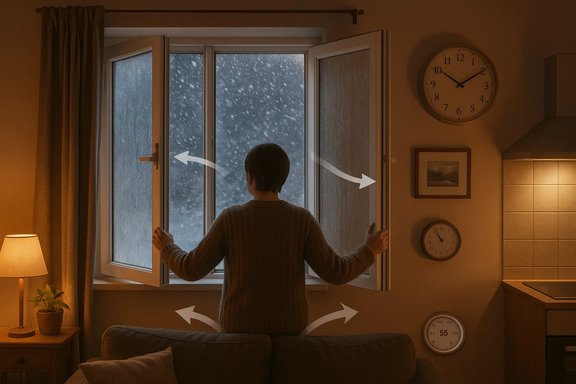
- Use short, sharp bursts of ventilation. When outdoor air is clean and wind or heavy driving snow aren’t creating safety issues, open windows wide for 5–10 minutes rather than leaving them cracked for hours. In houses with good cross‑ventilation, opening opposite windows for that short period exchanges air quickly.
- Time ventilation when it’s safest. Avoid opening windows during the height of strong gusts or when heavy snow is being driven into window frames; instead aim for calmer periods or open high‑level windows first (top sash) to reduce draughts. Met Office warnings for Storm Goretti show periods of particularly high winds and snowfall where opening windows on affected elevations would be inadvisable.
If you have vulnerable occupants at home
- Keep living and sleeping spaces warm. For elderly or clinically vulnerable people, the priority is maintaining indoor temperature (public guidance suggests around 18°C as a minimum comfort threshold where possible) and combining shorter ventilation bursts with continuous background heating or mechanical filtration to avoid temperature drops. If heating is constrained, focus ventilation on damp‑prone rooms only, not occupied bedrooms during the night.
If outdoor air quality is poor
- Don’t open windows when outside air is polluted. During wildfire smoke, industrial plumes, or very high local traffic pollution, opening windows can make indoor air worse. Instead, close windows and vents, run mechanical filtration (HVAC with good filters) or portable HEPA air purifiers sized to the room (run with windows closed). National agencies and technical briefs explicitly warn against opening windows in high‑AQI events.
Security and practical safety
- Avoid leaving windows open unattended during periods of strong wind or heavy snowfall; snow and water ingress can damage property and create hazards.
- Protect electrics and soft furnishings near windows if snow or driving rain is possible during ventilation.
- Use trickle vents where available for low‑level continuous ventilation that causes less heat loss and can be safer in severe weather.
A short step‑by‑step routine to follow (10‑minute ventilation, made practical)
- Heat the room briefly (if possible) or wait until the room is comfortably warm.
- Open two windows on opposite sides of the room (or open one window widely and a door to allow airflow through the house) for 5–10 minutes. This creates cross‑ventilation and rapid exchange.
- Run extractors in kitchen and bathroom while airing and for several minutes after use.
- Close windows, lower blinds/curtains and restore normal heating. Keep rooms at a steady background temperature to reduce subsequent condensation.
- Use a portable dehumidifier or HEPA air purifier in rooms where persistent damp or poor ventilation is a concern, but run these with windows closed for best effect.
Benefits — why the advice is persuasive
- Reduces condensation and mould risk. Intermittent airing removes the moist air that seeds mould growth on cool surfaces, reducing both property damage and health risk over time. Local housing authorities and national guidance link regular ventilation to lower mould risk.
- Improves immediate indoor air quality. Short ventilation bursts lower CO₂ and dilute airborne particles and VOCs from cooking and domestic products, which can aid alertness and reduce stale odours. Building‑science briefs and consumer health guidance back these short bursts as energy‑efficient air‑exchange tactics.
- Low cost and accessible. Opening a window is free, immediate and widely accessible — a key reason public campaigns have emphasised it as a first‑line household action.
Risks and caveats — why “open windows for 10 minutes” is not unconditional
- Heat loss and higher bills. Repeated airing in sustained freezing weather increases heating demand; households facing fuel poverty or relying on limited heating should prioritise targeted ventilation (kitchen/bathrooms) and mechanical alternatives where possible. Local housing advice emphasises balancing ventilation with maintaining an adequate baseline temperature.
- Outdoor air quality hazards. If the outside air contains smoke, heavy traffic pollution or very high pollen counts, opening windows can worsen indoor exposure to dangerous particles. In those cases, keep windows closed and use filtration instead.
- Safety in severe weather. During amber warnings for strong winds or coastal gusts the Met Office explicitly warns of hazardous conditions; opening windows on exposed elevations during gusts or driving snow risks letting water and cold into the home and could allow wind damage. Follow the Met Office warnings and avoid ventilation that risks structural or water damage.
- Oversimplification of a complex physics problem. The exact air‑exchange benefit of "10 minutes" varies greatly by room volume, window geometry, whether cross‑ventilation is possible, and outdoor conditions. A single number is a useful mnemonic but not a universal engineering specification. Technical briefs caution against treating it as a one‑size‑fits‑all prescription.
Strengths and weaknesses of the press framing
The national press story distilled a practical health measure into a single memorable instruction — open your windows for 10 minutes — which is excellent for uptake and public compliance because it is simple, low‑cost and actionable. That clarity is the article’s strength, and it aligns with public‑health messaging developed during respiratory outbreaks.However, the press framing also compresses nuance. The best guidance is conditional: open windows when outdoor air is clean, prioritise short bursts and source control (extractors, lids on pans), and consider filtration where opening windows is harmful. In some reproductions the attribution of the quote to a blinds industry figure was published without an accessible original link; where exact wording or credentials cannot be independently located the quote should be treated as industry comment rather than an authoritative public‑health prescription. Readers are therefore advised to pair the headline advice with local weather and air‑quality checks and official guidance from health or housing authorities.
Practical shopping and upgrade checklist (if damp and mould persist)
- Install or service extractor fans in kitchen and bathroom; ensure they vent to the outside.
- Fit trickle vents on windows or ensure existing vents are unobstructed.
- Consider a portable HEPA air purifier sized to the room (use CADR guidance) for rooms where ventilation is limited or where somebody is unwell.
- If central HVAC is available, consult an engineer about filter upgrades (MERV‑13 where compatible) and increased fresh‑air runtime.
- Buy a simple indoor hygrometer and CO₂ monitor; rising humidity (above ~55%) or CO₂ indicates the need for more frequent airing or mechanical ventilation. Local guidance often recommends monitoring indoor humidity to prevent mould; CO₂ is a practical proxy for stale air in busy rooms.
Conclusion — a clear but conditional headline
Short bursts of ventilation remain an effective, low‑cost tool to reduce condensation, damp and indoor pollutant levels during cold weather — and the simple message “open windows for 10 minutes” is a useful prompt that echoes established public‑health and building‑science guidance. That said, the advice must be applied with local judgement during Storm Goretti: follow Met Office amber and yellow warnings for snow, wind and ice; avoid opening windows in strong gusts, during heavy driving snow or when outside air is polluted; prioritise extractors, cross‑ventilation and short full openings rather than prolonged draughts; and protect vulnerable household members by combining brief airing with steady heating or mechanical filtration as necessary. Practical, evidence‑based habits — run extractors, do short full‑window bursts when safe, and keep furniture off cold walls — will reduce condensation and the long‑term risk of damp and mould while keeping homes as warm and secure as possible during a disruptive winter storm.Source: Daily Express Households urged to open windows for 10 minutes on Thursday and Friday
