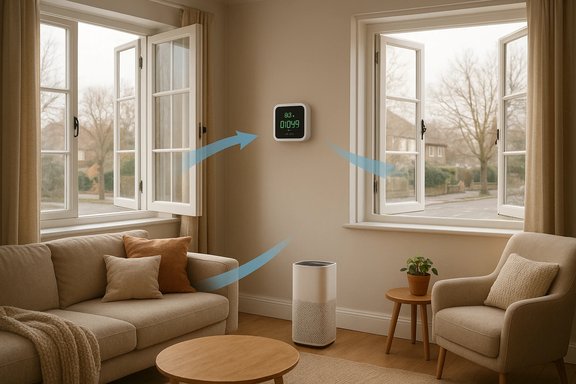
Households across the UK have been urged to “open windows for 10 minutes a day” as public health bodies renew simple ventilation advice to reduce the concentration of airborne viruses, lower indoor carbon dioxide and clear stale pollutants — advice that’s useful in ordinary seasons but that also requires important caveats when outdoor air quality is poor or temperatures plummet.
Public health guidance issued during and after the COVID-19 pandemic made ventilation a central, low-cost strategy to reduce airborne transmission of respiratory infections. National campaigns and official guidance emphasise that even short, sharp bursts of natural ventilation — for example opening windows widely for around 5–15 minutes at a time — materially dilutes airborne particles in enclosed spaces and lowers the risk of transmission when people gather indoors. That advice has been repeated across multiple government and health agency communications, and a recent wave of local reporting reiterated the same message — although the original news page linked by some readers appears to be unavailable and its wording cannot currently be verified. Ventilation guidance is simple in principle but nuanced in practice. Natural ventilation (windows, trickle vents, cross-breezes) works well when outdoor air is relatively clean; mechanical ventilation (extractor fans, HVAC systems with fresh-air intake) or HEPA filtration is often the better choice when outdoor pollution, wildfire smoke, or very high pollen counts make outside air unhealthy. Major technical briefs and emergency modelling groups explicitly recommend intermittent window opening — often phrased as “open windows for 10 minutes” or “10–15 minute bursts” — as an effective and energy-conscious way to refresh indoor air without leaving homes freezing during winter months.
Conclusion
Opening windows for short periods remains one of the simplest, most practical actions households can take to improve indoor air quality and reduce airborne infection risk — a low-cost measure backed by government guidance and building-science modelling. At the same time, the measure is not unconditional; outdoor air quality, temperature, vulnerability of occupants and household layout all change the calculus. The best approach is layered: ventilation when outside air is clean, filtration and recirculation when it is not, and sensible timing (cross-ventilation, after pollutant‑generating activities, and during quieter traffic and pollen windows). That pragmatic, context-aware strategy preserves the benefits of ventilation while minimising the risks.
Source: Manchester Evening News https://www.manchestereveningnews.co.uk/news/uk-news/households-urged-open-windows-10-33179181/
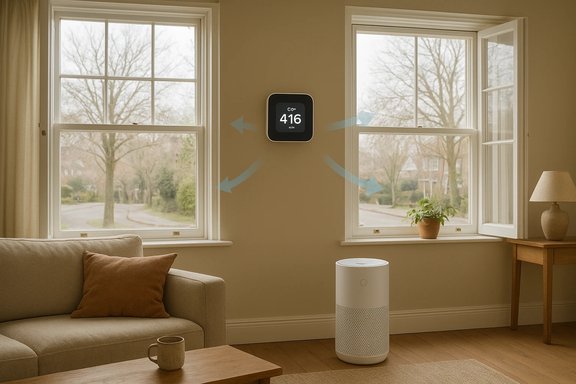 Background / Overview
Public health guidance issued during and after the COVID-19 pandemic made ventilation a central, low-cost strategy to reduce airborne transmission of respiratory infections. National campaigns and official guidance emphasise that even short, sharp bursts of natural ventilation — for example opening windows widely for around 5–15 minutes at a time — materially dilutes airborne particles in enclosed spaces and lowers the risk of transmission when people gather indoors. That advice has been repeated across multiple government and health agency communications, and a recent wave of local reporting reiterated the same message — although the original news page linked by some readers appears to be unavailable and its wording cannot currently be verified. Ventilation guidance is simple in principle but nuanced in practice. Natural ventilation (windows, trickle vents, cross-breezes) works well when outdoor air is relatively clean; mechanical ventilation (extractor fans, HVAC systems with fresh-air intake) or HEPA filtration is often the better choice when outdoor pollution, wildfire smoke, or very high pollen counts make outside air unhealthy. Major technical briefs and emergency modelling groups explicitly recommend intermittent window opening — often phrased as “open windows for 10 minutes” or “10–15 minute bursts” — as an effective and energy-conscious way to refresh indoor air without leaving homes freezing during winter months. Why short bursts of ventilation work
The physics and the health effects
When a room is occupied, people exhale carbon dioxide (CO₂) and aerosol particles; cooking, cleaning, candles and off‑gassing from furnishings add volatile organic compounds (VOCs) and particulate matter (PM). In a closed space, these pollutants accumulate. Bringing in outdoor air dilutes the concentration of those airborne contaminants quickly — often within minutes when a cross‑breeze or multiple openings create effective air flow. The practical result is:- Lower viral load: airborne virus concentrations fall as fresh air replaces contaminated air, reducing risk of infection for others in the room.
- Reduced CO₂: CO₂ levels are a practical proxy for how stale indoor air has become; lower CO₂ often correlates with improved alertness and comfort.
- Fewer VOCs and odours: short, decisive ventilation events dilute fumes from cleaning products, cooking and new furniture.
- Humidity control: airing can reduce excess humidity after showers or cooking, lowering the risk of mould growth when used sensibly.
What the official guidance says (and what it doesn’t)
Key points from government and public-health guidance
- Government public information campaigns have encouraged people to open windows for short periods when socialising indoors and to ventilate shared spaces for around 10 minutes after someone with a respiratory infection has left the room. That advice was a central message of a public campaign demonstrating how ventilation reduces airborne viral levels.
- Technical summaries used by facilities and building managers recommend intermittent airing — for example, opening windows for around 10 minutes each hour in natural‑ventilated spaces — as a pragmatic mitigation where mechanical ventilation is limited. Those technical notes draw on building-science modelling and outbreak analyses.
- Health providers and general medical guidance highlight ventilation as one of several practical steps to improve indoor air quality (alongside avoiding indoor smoking, using extractor fans, and using filtration where appropriate). They also underline that ventilation policies should be adjusted for vulnerable people (older adults, children, people with chronic lung disease) to maintain safe indoor temperatures while still improving air exchange.
What official guidance does not claim
- There is no fixed universal rule that “10 minutes” will produce identical outcomes in every home; the effectiveness depends on room size, window configuration, outdoor conditions, and whether cross‑ventilation is possible. Claims of precise percentage reductions in viral load from a single 10‑minute airing are model‑dependent and vary widely between settings. Any headline that treats “10 minutes” as a magic number for every home should be treated cautiously and read in context.
Practical, evidence‑based steps to ventilate your home safely
1. Use short, sharp bursts of ventilation
1. Open windows widely for 5–15 minutes in the rooms you’re occupying. In winter, a 5–10 minute wide opening often exchanges air quickly while reducing heat loss to a tolerable level. In milder weather, 10–15 minutes is commonly recommended. 2. When socialising indoors, open windows for 10 minutes every hour where practical — this was the core message of recent public campaigns.2. Prioritise cross‑ventilation
- Open windows or doors on opposite sides of a room or home to create a through‑draft. Cross‑ventilation dramatically increases air changes per hour and shortens the time needed to refresh air.
3. Use extractor fans and boost modes
- Kitchen and bathroom extractors are a mechanical way to remove moisture and aerosols; running them during and after cooking or showering complements window‑opening. If you have a mechanical ventilation system, use the boost or fresh‑air mode when someone is unwell.
4. When outdoor air is poor, choose filtration instead
- If outdoor air quality is poor because of wildfire smoke, heavy traffic pollution, industrial emissions or very high pollen counts, do not open windows for ventilation. Instead, switch your HVAC to recirculate mode, close external vents and consider running a portable HEPA air purifier sized for the room, or upgrading central filters to a higher‑efficiency MERV rating where compatible with your system. The U.S. EPA and other agencies explicitly warn that opening windows during smoke events increases indoor exposure.
5. Time ventilation to avoid peak outdoor pollution
- Avoid opening windows during rush hour next to busy roads, or when a nearby industrial source or open burning is producing visible smoke. Check local Air Quality Index (AQI) apps (AirNow, IQAir or local monitoring networks) and ventilate during quieter, cleaner periods.
6. Combine methods for maximum protection
- Ventilation, filtration and source control work best together: run extractors when cooking, ventilate between activities that generate aerosols (bathing, cooking), and use HEPA filtration in rooms where people gather or where a household member is unwell. Air purifiers should generally be used with windows closed for best efficiency.
Benefits and limitations — a balanced assessment
Strengths and practical benefits
- Low cost, high accessibility: Opening windows is free and immediately available in most homes; it does not require purchasing new technology. Official campaigns emphasise this accessibility for rapid public health impact.
- Rapid dilution: In many real‑world settings, a short burst of natural ventilation can halve or better the concentration of indoor aerosols and CO₂ in minutes — a meaningful reduction for transmission risk in crowded indoor settings. Modeling and outbreak analyses underpin this claim, which is why building engineers recommend it as a first-line measure.
- Secondary benefits: Regular airing reduces stale odours, lowers humidity spikes that encourage mould, and can improve sleep and concentration by keeping CO₂ levels closer to outdoor norms. Health guidance highlights these noninfectious benefits as additional reasons to ventilate.
Important limitations and risks
- Outdoor pollution and smoke: If outdoor air is contaminated — wildfire smoke, high PM2.5, heavy traffic emissions or chemical plumes — opening windows can worsen indoor air quality. Agencies such as the U.S. EPA explicitly advise against opening windows during smoke events and recommend sealing and filtration strategies instead. This is a critical caveat that flips the “open a window” rule in certain circumstances.
- Energy and comfort trade‑offs: In very cold climates or in households with vulnerable, elderly or frail occupants, frequent window opening can lower indoor temperatures. The recommended mitigation is short but full openings (5–10 minutes) and careful monitoring of room temperature, or to use mechanical ventilation strategies where available.
- Allergy season and pollen: For people with severe pollen allergies, opening windows at peak pollen times can increase symptoms. Time ventilation for early morning or later evening when pollen counts are lower, and consider mechanical filtration as an alternative.
- No single silver bullet: Ventilation is one effective layer of protection but it should be combined with other measures (vaccination where available, staying home when sick, hand hygiene, masking as appropriate) for the greatest overall benefit. Official guidance places ventilation within a package of measures rather than as a standalone cure.
Real‑world scenarios and tailored advice
If someone in your home is unwell
- Keep the sick person’s room ventilated: keep their door closed and keep a window slightly open if outdoor air is clean. If they must use shared spaces, ventilate those areas strongly during and for at least 10 minutes after use. Use extractors and consider a dedicated HEPA purifier in the room.
If you live on a busy road or near industrial sources
- Don’t open windows during known pollution peaks; use filtration and timed ventilation during quieter periods. Monitor local AQI and schedule airing for the cleanest parts of the day. If you must ventilate during higher traffic times, prioritise cross‑ventilation that doesn’t face the road, or ventilate rooms that face away from the source.
During wildfire smoke or very poor AQI
- Keep windows closed, set HVAC systems to recirculate, install good filters (MERV‑13 where compatible) and use purpose‑built HEPA purifiers — do not open windows until the AQI returns to a safe band as reported by official monitors. The EPA’s guidance on smoke explicitly warns against opening windows.
At work, in schools and in communal spaces
- Facilities with mechanical ventilation should increase fresh air intake where possible. Where natural ventilation is used, brief cross‑ventilation events and the use of CO₂ monitors to flag stale air are good practice; experts recommend aiming for lower CO₂ targets and implementing intermittent airing if continuous outdoor-air ventilation isn’t available.
Practical checklist: ventilate smart (quick reference)
- Open windows widely for 5–15 minutes (short bursts), more often when rooms are occupied.
- Prioritise cross‑ventilation: open windows on opposite sides of rooms or corridors.
- Use extractor fans and boost modes during and after cooking/showers.
- If outdoor air is poor (AQI high, smoke, heavy traffic), keep windows closed and use filtration; consult local AQI.
- Consider a portable HEPA air purifier sized to the room and run it with windows closed for best effectiveness.
- For homes with vulnerable occupants, balance ventilation events with maintaining indoor temperatures (≥18°C recommended for older adults when feasible).
What the missing Manchester Evening News page means for readers
The specific Manchester Evening News article link that prompted this discussion appears to return a “page not found” message for the URL provided, so the original copy and any direct quotes in that piece cannot be verified at this time. The broad thrust — urging people to open windows for short bursts to refresh indoor air — mirrors repeated official guidance and campaigns from national health authorities and building‑science groups, but the exact phrasing and context of the local news item cannot be confirmed until either an updated link is posted or an archive snapshot becomes available. Readers should rely on the primary health‑agency guidance (or local public‑health notices) rather than a single newspaper headline where the page is unavailable.Final analysis: why the message matters — and where to be careful
The renewed push to ventilate — “open windows for 10 minutes” — is effective public messaging because it converts a technical mitigation into a simple, repeatable habit that most households can adopt. Modelling and post‑outbreak analyses back the principle that increasing air exchanges reduces airborne concentrations of infectious aerosols, and national campaigns have deliberately highlighted short bursts to reduce the energy and comfort penalty for people in cold weather. Those are clear strengths: low cost, immediate effect, clear messaging. However, the advice must be applied with local awareness. Opening windows blindly is not always the right choice: during wildfire smoke, very poor AQI, or when living beside heavy traffic, opening windows increases exposure to harmful particles and chemicals. Equally, a literal read of “10 minutes” as a universal prescription is misleading — what matters is achieving adequate air exchange for the room and situation. Public messaging that simplifies the measure is useful for uptake but should always be paired with context-sensitive nuance — exactly the guidance found in official technical notes and public‑health websites. In short: ventilate your home — and when you do, do it smart. Use the “10‑minute” rule as a guideline, combine it with filtration and extractor fans when needed, and always check local air quality before trading outdoor pollution for indoor freshness.Conclusion
Opening windows for short periods remains one of the simplest, most practical actions households can take to improve indoor air quality and reduce airborne infection risk — a low-cost measure backed by government guidance and building-science modelling. At the same time, the measure is not unconditional; outdoor air quality, temperature, vulnerability of occupants and household layout all change the calculus. The best approach is layered: ventilation when outside air is clean, filtration and recirculation when it is not, and sensible timing (cross-ventilation, after pollutant‑generating activities, and during quieter traffic and pollen windows). That pragmatic, context-aware strategy preserves the benefits of ventilation while minimising the risks.
Source: Manchester Evening News https://www.manchestereveningnews.co.uk/news/uk-news/households-urged-open-windows-10-33179181/