

A short, sharp ventilation routine — even in freezing weather — is being promoted by public-health experts as one of the most effective, low-cost ways to reduce airborne infection risk inside homes and workplaces, but the precise headline doing the rounds on social media (a Manchester Evening News Facebook post) cannot currently be verified and requires context before being treated as universal advice.
Indoor ventilation emerged from the COVID‑19 pandemic as a mainstream public‑health topic rather than a niche building‑science detail. The basic idea is simple: airborne particles that carry viruses or other pollutants accumulate indoors when spaces are sealed. Introducing fresh outdoor air or filtering indoor air reduces the concentration of those particles and therefore lowers the chance that someone will inhale an infectious dose. National technical guidance and public‑health bodies now explicitly recommend improving ventilation as one layer of protection alongside vaccination, masking where appropriate, and staying home when ill. Health agencies have converged on two practical principles that are easy to adopt in everyday life:
Why this matters: short social posts and screenshots often remove important context — whether the advice was targeted (e.g., “if outdoor air is clean”), qualified (e.g., “for short bursts”), or aimed at specific settings (schools, households with a sick person). Public guidance on ventilation is deliberately conditional; applied without those qualifiers it can become misleading or even harmful (for example opening windows during wildfire smoke). The missing page means we must rely on established agency guidance rather than a single, unverified social post.
Opening a window is the simplest ventilation tool most people have, and when used intelligently — briefly, strategically, and with attention to outdoor air quality — it remains one of the most practical measures households and institutions can adopt to improve indoor air and reduce airborne infection risk. The social‑media headline urging people to ventilate during freezing weather captures the right instinct, but it must be paired with the situational judgement and technical safeguards that official guidance provides.
Source: facebook.com Log in to Facebook
 Background / Overview
Indoor ventilation emerged from the COVID‑19 pandemic as a mainstream public‑health topic rather than a niche building‑science detail. The basic idea is simple: airborne particles that carry viruses or other pollutants accumulate indoors when spaces are sealed. Introducing fresh outdoor air or filtering indoor air reduces the concentration of those particles and therefore lowers the chance that someone will inhale an infectious dose. National technical guidance and public‑health bodies now explicitly recommend improving ventilation as one layer of protection alongside vaccination, masking where appropriate, and staying home when ill. Health agencies have converged on two practical principles that are easy to adopt in everyday life:- Use short, strong bursts of natural ventilation (open windows widely, briefly) when outdoor air quality is good.
- Use mechanical ventilation and filtration (HVAC with higher‑efficiency filters, or portable HEPA units) when outdoor air is poor or when continuous fresh‑air intake isn’t practical.
What we could verify about the Facebook post and why it matters
The Facebook link supplied in the prompt points to a Manchester Evening News item, but the archived material and internal searches show that the specific page appears to be unavailable (returns a missing page). That prevents verification of the exact quote or any surrounding context in the original piece. Readers should therefore treat the headline as a summary rather than a verbatim expert pronouncement until the original article can be accessed or archived.Why this matters: short social posts and screenshots often remove important context — whether the advice was targeted (e.g., “if outdoor air is clean”), qualified (e.g., “for short bursts”), or aimed at specific settings (schools, households with a sick person). Public guidance on ventilation is deliberately conditional; applied without those qualifiers it can become misleading or even harmful (for example opening windows during wildfire smoke). The missing page means we must rely on established agency guidance rather than a single, unverified social post.
The science in plain language
How ventilation reduces risk
- Dilution: Bringing in outdoor air reduces the concentration of airborne particles (aerosols) that can carry viruses. Dilution reduces exposure risk for everyone in the room.
- Filtration: Filters (HVAC or portable units) do not add outside air but remove particles from indoor air. HEPA filtration and MERV‑13 rated central filters are effective at capturing fine aerosol particles.
- Air changes per hour (ACH): Measured ventilation rates (ACH) describe how many times the air in a room is replaced; combining increased ACH and filtration is the practical engineering approach to reduce airborne concentrations.
Short bursts vs. continuous ventilation
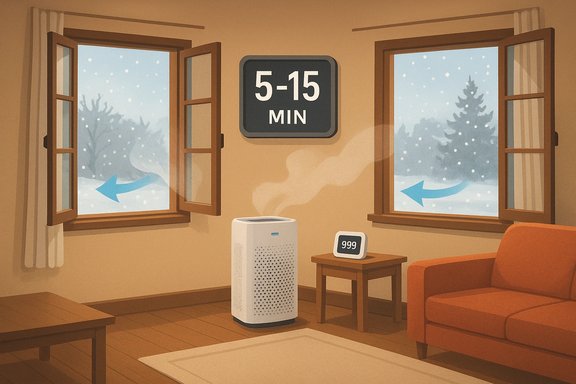
Technical briefs recommend brief, strong airing events during cold weather — commonly phrased as 5–15 minutes — rather than leaving windows open all day. Short, full openings produce rapid air exchange while limiting heat loss; in many building types this is more energy‑efficient and just as effective at reducing aerosol concentration as leaving windows cracked for hours. The German practice of “Stoßlüften” (shock ventilation) is a well‑known example.Verified, actionable guidance you can use right now
Below are evidence‑backed steps that combine guidance from public‑health agencies and building‑science recommendations.Quick household checklist — ventilate smart
- Open windows widely for 5–15 minutes at a time, especially when people arrive, after guests leave, or after aerosol‑generating activities (cooking, showers). Do this several times a day if feasible.
- Prioritise cross‑ventilation: open windows or doors on opposite sides of a room or building to create a direct airflow path. This is far more effective than one window open slightly.
- Use extractor fans (bathroom, kitchen) on boost when in use and for several minutes after; these remove moisture and aerosols directly to the outside.
- If outdoor air is not clean (smoke, high pollen, heavy traffic), keep windows closed and use filtration instead (see below). The U.S. EPA explicitly warns against opening windows during wildfire smoke events.
- Consider a portable HEPA air purifier sized to the room (CADR guidance available from EPA/AHAM). Run purifiers with windows closed for best effect.
- If your HVAC supports it, upgrade central filters to MERV‑13 where compatible, or increase runtime to raise total filtration volumes. Consult an HVAC professional if unsure.
How to size a portable air purifier (CADR)
- Measure the room floor area (square feet).
- Use the EPA/AHAM rule of thumb: choose a unit whose CADR for smoke is roughly two‑thirds of the room area (or use the manufacturer’s recommended room size). EPA provides a chart converting room area to minimum CADR.
Maintaining comfort and safety in winter
- Heat the room before airing, or open high‑level windows first (top sash), which reduces draughts while still enabling exchange of air. Several health agencies suggest airing on a schedule (for example, brief airing several times per day) rather than leaving windows open for long periods.
- For households with older or frail occupants, maintain indoor temperature at or above 18°C (64°F) where feasible; balance ventilation frequency with heating and consider mechanical filtration to reduce required airing frequency.
When opening windows is the wrong move
Wildfire smoke and high AQI
During wildfire smoke episodes or very poor local air quality, opening windows makes indoor air worse. The EPA recommends keeping windows closed, setting HVAC to recirculate or sealing outdoor intakes, and using high‑efficiency filtration or portable HEPA purifiers instead. Evacuation is necessary if smoke levels get dangerously close or there’s an active fire threat.Heavy traffic, industrial emissions, and peak pollution hours
If your home faces a busy road or industrial source, avoid ventilating during rush hour or when you can see or smell emissions. Time ventilation for quieter parts of the day and use cross‑ventilation away from the source where possible. Monitoring local AQI and satellite or app‑based pollen forecasts helps pick the best windows to open.Severe pollen seasons and respiratory allergies
Opening windows at high pollen times can exacerbate seasonal allergies. If pollen counts are high, rely on filtration or ventilate during lower‑pollen periods (early morning or late evening depending on local patterns).Technical specifications worth knowing (and their verified sources)
- Recommended short‑burst airing: 5–15 minutes for cold weather; timing can extend in warmer months. This practice appears in national guidance and building‑science briefs.
- Maintain indoor temperature for older adults: ≥18°C when feasible; pair airing with heating strategies.
- MERV‑13 (or higher if compatible) is the target filter efficiency for central systems to capture virus‑sized particles and wildfire smoke particles; check system compatibility before upgrading.
- Portable air cleaners: pick a HEPA device with a CADR sized for the room; EPA provides CADR → room‑size guidance and recommends devices certified for ozone/ electrical safety in certain states (CARB). Run them with windows closed during filtration.
- Use CO₂ monitors as a practical indicator of ventilation: rising CO₂ suggests stale air and poor ventilation; aim to reduce levels by airing or mechanical ventilation (specific CO₂ targets vary by guidance, and monitors are aids rather than definitive infection‑risk meters).
Practical, ranked steps to ventilate safely in freezing weather
- If outdoor AQI is poor (smoke/pollution), keep windows closed and use filtration (HEPA/CADR).
- If outdoor air is clean, heat the room briefly, then open windows widely for 5–15 minutes to create a short burst of exchange. Repeat several times daily as needed.
- Prioritise cross‑ventilation (opposite windows/doors) for maximum air exchange in minimal time.
- Run extractor fans during and after cooking or showering; use portable HEPA purifiers in rooms where people gather or where someone is unwell.
- Keep vulnerable household members in rooms with filtration if possible and monitor indoor temperature — avoid prolonged drops below recommended comfort thresholds.
Strengths of the “open windows” message — and why it resonates
- Low cost and universal access: Almost every household can open a window; the intervention requires no special equipment for a meaningful risk reduction. This makes the message scalable and easy to understand.
- Immediate effect: Short bursts of ventilation can quickly reduce airborne concentrations; the intervention produces rapid, measurable change in indoor air metrics like CO₂ and particulate counts.
- Complements other measures: Ventilation reduces airborne exposure but works best as part of layered protection that includes vaccination, staying home when sick, masking in high‑risk scenarios, and filtration. Authorities deliberately present ventilation as one layer rather than a standalone cure.
Potential risks, pitfalls, and messaging failures
- Missing context on outdoor air quality: A headline urging people to open windows without the caveat “if outdoor air is clean” can be dangerous during wildfire seasons or heavy pollution events. Agencies explicitly warn against opening windows in those circumstances.
- Energy and comfort: Repeated airing in very cold climates can lower indoor temperatures and raise heating bills; this is a real trade‑off for vulnerable populations and may reduce compliance. Guidance therefore recommends short bursts and mechanical filtration alternatives.
- Oversimplification risk: Messaging that reduces ventilation to a single number — “open windows for 10 minutes” — can be useful for uptake but also misleading if treated as a universal, one‑size‑fits‑all prescription. What matters is effective air exchange for the specific room and situation, which depends on window type, room volume, and building envelope.
- Unequal access to mechanical fixes: Upgrading to MERV‑13 filters or buying HEPA purifiers carries cost and compatibility barriers for some households. Public policy needs to consider equity if filtration is to be a widespread mitigation strategy.
Policy and workplace implications
Organisations, schools, and workplaces should treat ventilation as a systems issue rather than an individual habit:- Facilities should assess mechanical systems, maximise fresh air intake when safe, and ensure filters are inspected and changed appropriately. For many buildings, increasing the runtime of HVAC systems or switching to higher‑efficiency filters (MERV‑13) is practical and effective.
- Where natural ventilation is the primary method (older schools, small offices), institutions should adopt scheduled airing protocols and consider CO₂ monitoring to flag stale conditions.
- Public authorities should provide contextual, localised messaging (for example, link ventilation advice to local AQI alerts) so that simple slogans do not encourage unsafe behaviour during smoke or pollution episodes.
What we cannot verify (and how to treat unverified social posts)
The Manchester Evening News item referenced on Facebook appears to be missing, so the exact wording and the identity of the “experts” quoted cannot be confirmed from that source. Until the live article or an archived copy is available, the responsible approach is to:- Treat the FB post as a summary rather than an authoritative instruction.
- Cross‑check claims against public health agencies and building‑science guidance (as done in this article).
Bottom line — practical, evidence‑backed takeaways
- Opening windows for short bursts (5–15 minutes) is a validated, energy‑aware method to refresh indoor air and reduce airborne infection risk when outdoor air quality is good. Use cross‑ventilation where possible.
- If outdoor air is not clean (wildfire smoke, high PM2.5, heavy traffic), do not open windows; instead, keep windows closed, set HVAC to recirculate where safe, upgrade central filters to MERV‑13 if possible, and use HEPA portable air cleaners sized to the room (CADR guidance).
- Maintain indoor comfort for vulnerable people (aim ≥18°C where feasible) and prefer mechanical filtration where heating losses would be a risk.
- Use simple measurement tools (CO₂ monitors, AQI apps) to time your ventilation and make decisions that reduce unintended exposures.
Opening a window is the simplest ventilation tool most people have, and when used intelligently — briefly, strategically, and with attention to outdoor air quality — it remains one of the most practical measures households and institutions can adopt to improve indoor air and reduce airborne infection risk. The social‑media headline urging people to ventilate during freezing weather captures the right instinct, but it must be paired with the situational judgement and technical safeguards that official guidance provides.
Source: facebook.com Log in to Facebook
