
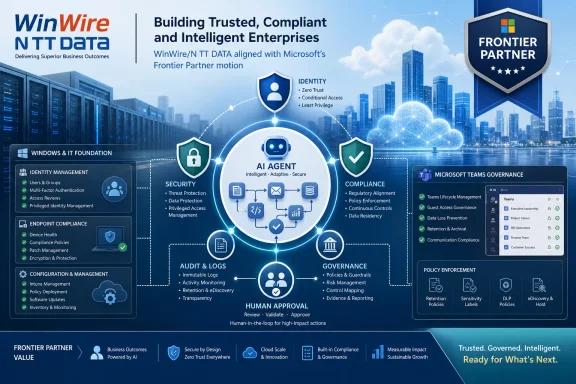
WinWire, a Microsoft-focused AI and cloud services firm now part of NTT DATA, said on June 26, 2026, that it has earned Microsoft’s Frontier Partner badge in the Microsoft AI Cloud Partner Program for enterprise AI delivery. The badge is not a consumer-facing product announcement, and it will not change a Windows desktop overnight. But it is a useful signal about where Microsoft wants the next phase of enterprise AI to happen: inside partner-led implementations, governed workflows, and production systems rather than demo stages.
Microsoft has spent the last three years making Copilot the public face of its AI strategy. The more consequential work, however, is happening behind the scenes, where customers must connect AI assistants and agents to identity systems, data estates, compliance controls, application stacks, and help desks that were never designed for autonomous software.
That is where the partner ecosystem becomes less of a sales accessory and more of the delivery mechanism. A Microsoft badge may sound like marketing garnish, but in the enterprise channel it functions as a sorting tool. It tells customers and Microsoft field teams which firms have passed at least some threshold of technical specialization, customer evidence, and alignment with Redmond’s current platform priorities.
WinWire’s Frontier Partner recognition should be read in that context. The company is not merely saying it can deploy Microsoft 365 Copilot or build an Azure AI proof of concept. It is positioning itself as a production AI integrator for regulated and complex enterprises, with Agentic AI, data engineering, cloud-native development, security, and governance bundled into a single delivery story.
That matters because the easy phase of enterprise AI is ending. The market no longer needs another lab demo showing a chatbot summarizing a document. It needs systems that can operate across business workflows without leaking data, inventing approvals, or creating an audit nightmare.
That framing is important because Microsoft is trying to avoid letting enterprise AI become a patchwork of disconnected copilots. If every department buys a different assistant, every line-of-business unit builds its own agent, and every vendor ships a private orchestration layer, the result is not transformation. It is another generation of integration debt.
The Frontier Partner badge is Microsoft’s attempt to create an identifiable class of services firms that can move customers from experimentation to scaled deployment. In practice, that means understanding more than prompts and model APIs. It means data classification, Microsoft Entra identity, application modernization, workflow design, telemetry, Purview policies, Defender posture, and the politics of enterprise change management.
WinWire’s qualification list reflects that broader stack. The company points to Solutions Partner designations across Modern Work, Digital and App Innovation, Infrastructure, Data and AI, and Security, plus advanced specializations in Copilot, AI application and platform innovation, and data security. That is exactly the kind of cross-domain résumé Microsoft wants partners to present as AI moves from isolated pilots into operational systems.
That timing makes the Frontier badge more than a trophy for WinWire’s website. It strengthens the narrative that NTT DATA is building a global Microsoft AI services engine at the moment enterprise buyers are asking who can actually implement this stuff. AI roadmaps are easy to approve; enterprise-wide AI operating models are much harder to build.
For NTT DATA, WinWire adds credibility in the middle layer between strategy decks and managed services. It can help design agentic workflows, modernize applications, engineer data foundations, and stitch those pieces into Microsoft’s platform. That is a commercially valuable position because most large customers are not looking for raw model access. They are looking for accountable delivery partners.
For Microsoft, the story is equally convenient. Every strong partner win reinforces the argument that Microsoft’s AI platform is not just a bundle of licenses but an ecosystem that can absorb enterprise complexity. If customers believe that the Microsoft stack comes with a mature services bench, they are more likely to standardize there instead of spreading AI workloads across competing clouds and point solutions.
That is also why the stakes are higher. A chatbot that drafts a memo can embarrass a user. An agent connected to tickets, purchase orders, patient workflows, software pipelines, or customer records can create operational consequences at machine speed.
This is the gap between AI experimentation and AI production. In an experiment, failure is part of discovery. In production, failure becomes a security incident, a compliance finding, a support escalation, or a financial error.
WinWire is therefore selling something more serious than model enthusiasm. Its pitch is that agentic systems need a governed delivery pattern: scoped workflows, identity-aware access, human oversight, responsible AI controls, data boundaries, and measurable business outcomes. That is the right pitch for the market Microsoft is cultivating, even if customers should still demand evidence project by project.
That is why firms like WinWire matter. A Copilot rollout can expose years of bad permissions, stale SharePoint sites, unmanaged Teams sprawl, inconsistent labels, and data owners who no longer know what they own. The license is the easy part. The cleanup is where projects slow down.
Microsoft knows this, which is why its partner messaging keeps tying AI transformation to data, security, and governance. Copilot Studio and Azure AI Foundry can help organizations build custom agents and AI applications, but those tools do not eliminate the need for architecture. They raise the importance of architecture because they make it easier for more teams to build things.
That democratization is powerful and dangerous. Low-code agent building can accelerate business process innovation, but it can also multiply shadow automation. Without a partner or internal platform team imposing standards, today’s clever departmental agent can become tomorrow’s unowned production dependency.
Healthcare AI has especially little room for vague claims. Even when AI is not making clinical decisions, it may touch protected health information, care coordination workflows, revenue-cycle systems, research data, or patient communications. A poorly governed assistant in that context is not just a productivity risk; it is a compliance and trust risk.
Life sciences adds another layer of complexity. Research, regulatory submissions, quality processes, and intellectual property all demand control over provenance and access. AI systems that cannot explain where information came from or why an action was taken will struggle in those environments, no matter how impressive the demo.
Software and digital platform companies face a different problem. They are often early adopters with strong engineering cultures, which means AI can spread quickly through development, support, sales engineering, and customer success. GitHub Copilot, Azure AI Foundry, and custom agents can improve velocity, but they also require guardrails around code quality, secrets, licensing exposure, and production change control.
That means AI adoption will show up in familiar places. IT admins will see it in identity policies, conditional access decisions, endpoint compliance requirements, data-loss prevention rules, Teams governance, SharePoint permissions, and software deployment practices. The agent may be new, but the blast radius still runs through the same enterprise plumbing.
Windows endpoints will also remain one of the main places where users encounter AI-driven workflows. A frontline employee may never log into Azure AI Foundry, but they may interact with a Copilot extension or agent embedded in Teams on a managed Windows device. If that agent retrieves the wrong document or triggers the wrong workflow, the help desk will still get the call.
This is why the partner badge matters to IT pros. The question is not whether WinWire has a nice logo from Microsoft. The question is whether enterprise AI deployments are being handled by teams that understand the operational realities of Windows estates, endpoint management, identity hygiene, and security monitoring.
That translation layer is where money will be made. Enterprises do not want bespoke chaos for every AI deployment. They want repeatable frameworks that reduce risk, shorten implementation time, and produce measurable results.
WinWire’s “AI @ Scale” language is aimed directly at that anxiety. Scale is not just more users or more tokens. It is repeatable governance, reusable integration patterns, support models, cost management, audit trails, and the ability to retire or modify agents when business processes change.
The danger is that “scale” becomes another consulting abstraction. Customers should press for specifics: what telemetry is captured, how agent permissions are scoped, how human approvals work, how failures are handled, how prompts and tools are versioned, and how data exposure is tested before launch.
They should not ignore it, but they should not overread it either. A Frontier Partner badge can help narrow the field, especially in a market crowded with firms suddenly claiming AI expertise. It cannot replace technical discovery, reference checks, security review, commercial scrutiny, and a clear statement of outcomes.
The most useful interpretation is pragmatic. WinWire’s recognition suggests Microsoft sees the company as aligned with its agentic AI delivery motion and technically qualified across relevant solution areas. It does not prove that a particular healthcare workflow, application modernization project, or Copilot deployment will deliver ROI on schedule.
That is not a criticism of WinWire. It is a reminder that AI transformation is still transformation. The hard parts are organizational, architectural, and operational, not merely model selection.
That shift changes the buyer conversation. In 2023 and 2024, the executive question was often whether generative AI was worth exploring. By mid-2026, the sharper question is which workflows can absorb AI safely and which partners can be trusted to implement them.
Procurement teams will increasingly ask for proof that AI systems can be governed. Security teams will ask how agents authenticate, what data they can see, and how actions are logged. Finance teams will ask whether consumption costs are predictable. Business owners will ask whether the system improves cycle time, quality, revenue, or customer experience.
WinWire’s announcement leans heavily into measurable ROI because that is where the market has moved. The era of “AI experimentation” as a budget justification is narrowing. The next wave of spending will demand business cases that look less like innovation theater and more like operational investment.
That gives Microsoft an advantage if it can mobilize its partner base effectively. The company already has deep relationships across enterprise productivity, identity, endpoint management, collaboration, developer tools, and cloud infrastructure. A partner who can connect those domains into an AI delivery package strengthens Microsoft’s gravitational pull.
Frontier Partner recognition is therefore both a customer signal and a channel control mechanism. It encourages partners to align with Microsoft’s preferred stack and language. It also gives Microsoft sellers a cleaner way to route AI opportunities to firms that have invested in the right certifications and specializations.
For competitors, this is the hard part of challenging Microsoft in the enterprise. Winning a benchmark or shipping a powerful model is not enough. The buyer still needs integration, governance, support, procurement simplicity, and a partner who can sit in the conference room when something breaks.
The worst outcome would be the opposite: a flood of over-permissioned agents, vague ownership, unmanaged data exposure, and executives declaring victory before operations teams understand the consequences. The industry has seen this pattern before with cloud migrations, low-code platforms, collaboration sprawl, and SaaS adoption. AI simply compresses the timeline and raises the risk.
WinWire’s Responsible AI and governance messaging is therefore not a decorative clause. It is central to whether agentic AI can become enterprise infrastructure rather than another shadow IT category. The companies that succeed here will be the ones that treat governance as design, not cleanup.
For WindowsForum’s IT pro audience, that means watching the implementation details more than the announcement language. The badge is a useful marker. The deployment model is the story.
 Microsoft’s AI Ambition Now Runs Through the Channel
Microsoft has spent the last three years making Copilot the public face of its AI strategy. The more consequential work, however, is happening behind the scenes, where customers must connect AI assistants and agents to identity systems, data estates, compliance controls, application stacks, and help desks that were never designed for autonomous software.That is where the partner ecosystem becomes less of a sales accessory and more of the delivery mechanism. A Microsoft badge may sound like marketing garnish, but in the enterprise channel it functions as a sorting tool. It tells customers and Microsoft field teams which firms have passed at least some threshold of technical specialization, customer evidence, and alignment with Redmond’s current platform priorities.
WinWire’s Frontier Partner recognition should be read in that context. The company is not merely saying it can deploy Microsoft 365 Copilot or build an Azure AI proof of concept. It is positioning itself as a production AI integrator for regulated and complex enterprises, with Agentic AI, data engineering, cloud-native development, security, and governance bundled into a single delivery story.
That matters because the easy phase of enterprise AI is ending. The market no longer needs another lab demo showing a chatbot summarizing a document. It needs systems that can operate across business workflows without leaking data, inventing approvals, or creating an audit nightmare.
The Badge Is Really About Microsoft’s Frontier Stack
Microsoft’s Frontier language is deliberately expansive. It folds together Copilot, Copilot Studio, Azure AI Foundry, Microsoft Fabric, GitHub Copilot, security tooling, governance controls, and emerging agent infrastructure into a story about “frontier firms” that use AI agents and human workers together.That framing is important because Microsoft is trying to avoid letting enterprise AI become a patchwork of disconnected copilots. If every department buys a different assistant, every line-of-business unit builds its own agent, and every vendor ships a private orchestration layer, the result is not transformation. It is another generation of integration debt.
The Frontier Partner badge is Microsoft’s attempt to create an identifiable class of services firms that can move customers from experimentation to scaled deployment. In practice, that means understanding more than prompts and model APIs. It means data classification, Microsoft Entra identity, application modernization, workflow design, telemetry, Purview policies, Defender posture, and the politics of enterprise change management.
WinWire’s qualification list reflects that broader stack. The company points to Solutions Partner designations across Modern Work, Digital and App Innovation, Infrastructure, Data and AI, and Security, plus advanced specializations in Copilot, AI application and platform innovation, and data security. That is exactly the kind of cross-domain résumé Microsoft wants partners to present as AI moves from isolated pilots into operational systems.
WinWire’s Timing Is No Accident
The announcement lands shortly after NTT DATA moved to acquire WinWire, a deal framed around expanding NTT DATA’s Microsoft Azure and AI-powered cloud transformation capabilities. WinWire brings more than a niche consulting label to that story. It gives NTT DATA a Microsoft-aligned AI services shop with deep Azure engineering capacity and a ready-made Agentic AI @ Scale framework.That timing makes the Frontier badge more than a trophy for WinWire’s website. It strengthens the narrative that NTT DATA is building a global Microsoft AI services engine at the moment enterprise buyers are asking who can actually implement this stuff. AI roadmaps are easy to approve; enterprise-wide AI operating models are much harder to build.
For NTT DATA, WinWire adds credibility in the middle layer between strategy decks and managed services. It can help design agentic workflows, modernize applications, engineer data foundations, and stitch those pieces into Microsoft’s platform. That is a commercially valuable position because most large customers are not looking for raw model access. They are looking for accountable delivery partners.
For Microsoft, the story is equally convenient. Every strong partner win reinforces the argument that Microsoft’s AI platform is not just a bundle of licenses but an ecosystem that can absorb enterprise complexity. If customers believe that the Microsoft stack comes with a mature services bench, they are more likely to standardize there instead of spreading AI workloads across competing clouds and point solutions.
Agentic AI Is Where the Sales Pitch Gets Risky
WinWire’s headline capability is its Agentic AI @ Scale framework, which it says is designed to embed intelligent, autonomous systems directly into enterprise workflows. The phrase agentic AI has become one of the most overused terms in enterprise technology, but the underlying idea is genuinely significant. Instead of waiting for a user to ask a question, an agent can pursue a goal, call tools, interact with systems, and advance a process.That is also why the stakes are higher. A chatbot that drafts a memo can embarrass a user. An agent connected to tickets, purchase orders, patient workflows, software pipelines, or customer records can create operational consequences at machine speed.
This is the gap between AI experimentation and AI production. In an experiment, failure is part of discovery. In production, failure becomes a security incident, a compliance finding, a support escalation, or a financial error.
WinWire is therefore selling something more serious than model enthusiasm. Its pitch is that agentic systems need a governed delivery pattern: scoped workflows, identity-aware access, human oversight, responsible AI controls, data boundaries, and measurable business outcomes. That is the right pitch for the market Microsoft is cultivating, even if customers should still demand evidence project by project.
Copilot Alone Was Never Going to Be Enough
Microsoft 365 Copilot is often treated as the center of Microsoft’s AI strategy because it is visible to end users. It appears in Word, Excel, Teams, Outlook, and the productivity surfaces WindowsForum readers actually touch. But the enterprise value of Copilot depends heavily on the quality, security, and structure of the data underneath it.That is why firms like WinWire matter. A Copilot rollout can expose years of bad permissions, stale SharePoint sites, unmanaged Teams sprawl, inconsistent labels, and data owners who no longer know what they own. The license is the easy part. The cleanup is where projects slow down.
Microsoft knows this, which is why its partner messaging keeps tying AI transformation to data, security, and governance. Copilot Studio and Azure AI Foundry can help organizations build custom agents and AI applications, but those tools do not eliminate the need for architecture. They raise the importance of architecture because they make it easier for more teams to build things.
That democratization is powerful and dangerous. Low-code agent building can accelerate business process innovation, but it can also multiply shadow automation. Without a partner or internal platform team imposing standards, today’s clever departmental agent can become tomorrow’s unowned production dependency.
Regulated Industries Are the Real Test
WinWire’s stated customer focus includes Healthcare and Life Sciences as well as Software and Digital Platforms. Those are not casual markets for AI adoption. They are environments where uptime, privacy, security, and auditability are not optional extras.Healthcare AI has especially little room for vague claims. Even when AI is not making clinical decisions, it may touch protected health information, care coordination workflows, revenue-cycle systems, research data, or patient communications. A poorly governed assistant in that context is not just a productivity risk; it is a compliance and trust risk.
Life sciences adds another layer of complexity. Research, regulatory submissions, quality processes, and intellectual property all demand control over provenance and access. AI systems that cannot explain where information came from or why an action was taken will struggle in those environments, no matter how impressive the demo.
Software and digital platform companies face a different problem. They are often early adopters with strong engineering cultures, which means AI can spread quickly through development, support, sales engineering, and customer success. GitHub Copilot, Azure AI Foundry, and custom agents can improve velocity, but they also require guardrails around code quality, secrets, licensing exposure, and production change control.
The Windows Angle Is Enterprise Plumbing
For Windows enthusiasts, the WinWire announcement may feel far removed from the desktop. It is not. Microsoft’s AI strategy increasingly connects Windows, Microsoft 365, Entra, Defender, Intune, Purview, Azure, and partner-built services into one administrative surface area.That means AI adoption will show up in familiar places. IT admins will see it in identity policies, conditional access decisions, endpoint compliance requirements, data-loss prevention rules, Teams governance, SharePoint permissions, and software deployment practices. The agent may be new, but the blast radius still runs through the same enterprise plumbing.
Windows endpoints will also remain one of the main places where users encounter AI-driven workflows. A frontline employee may never log into Azure AI Foundry, but they may interact with a Copilot extension or agent embedded in Teams on a managed Windows device. If that agent retrieves the wrong document or triggers the wrong workflow, the help desk will still get the call.
This is why the partner badge matters to IT pros. The question is not whether WinWire has a nice logo from Microsoft. The question is whether enterprise AI deployments are being handled by teams that understand the operational realities of Windows estates, endpoint management, identity hygiene, and security monitoring.
Microsoft Wants Partners to Productize Trust
The most interesting part of Microsoft’s Frontier Partner push is that it treats trust as something partners must operationalize. Microsoft can provide platform controls, documentation, and reference architectures, but it cannot individually redesign every customer workflow. Partners translate the platform into repeatable industry patterns.That translation layer is where money will be made. Enterprises do not want bespoke chaos for every AI deployment. They want repeatable frameworks that reduce risk, shorten implementation time, and produce measurable results.
WinWire’s “AI @ Scale” language is aimed directly at that anxiety. Scale is not just more users or more tokens. It is repeatable governance, reusable integration patterns, support models, cost management, audit trails, and the ability to retire or modify agents when business processes change.
The danger is that “scale” becomes another consulting abstraction. Customers should press for specifics: what telemetry is captured, how agent permissions are scoped, how human approvals work, how failures are handled, how prompts and tools are versioned, and how data exposure is tested before launch.
The Badge Does Not Eliminate Due Diligence
Microsoft’s own partner language is careful about what a designation means. A badge indicates that a partner has met program criteria; it is not a blanket guarantee that every future project will succeed. That distinction matters because enterprise buyers often treat ecosystem validation as a shortcut for procurement confidence.They should not ignore it, but they should not overread it either. A Frontier Partner badge can help narrow the field, especially in a market crowded with firms suddenly claiming AI expertise. It cannot replace technical discovery, reference checks, security review, commercial scrutiny, and a clear statement of outcomes.
The most useful interpretation is pragmatic. WinWire’s recognition suggests Microsoft sees the company as aligned with its agentic AI delivery motion and technically qualified across relevant solution areas. It does not prove that a particular healthcare workflow, application modernization project, or Copilot deployment will deliver ROI on schedule.
That is not a criticism of WinWire. It is a reminder that AI transformation is still transformation. The hard parts are organizational, architectural, and operational, not merely model selection.
The Enterprise AI Market Is Moving From Pilots to Procurement
The phrase “move from pilots to production” has become unavoidable because it captures the current bottleneck. Many enterprises have already tested generative AI. Fewer have turned it into a governed operating capability that survives contact with compliance, finance, security, and end users.That shift changes the buyer conversation. In 2023 and 2024, the executive question was often whether generative AI was worth exploring. By mid-2026, the sharper question is which workflows can absorb AI safely and which partners can be trusted to implement them.
Procurement teams will increasingly ask for proof that AI systems can be governed. Security teams will ask how agents authenticate, what data they can see, and how actions are logged. Finance teams will ask whether consumption costs are predictable. Business owners will ask whether the system improves cycle time, quality, revenue, or customer experience.
WinWire’s announcement leans heavily into measurable ROI because that is where the market has moved. The era of “AI experimentation” as a budget justification is narrowing. The next wave of spending will demand business cases that look less like innovation theater and more like operational investment.
Microsoft’s Partner Strategy Is Also a Competitive Weapon
Microsoft is not pursuing this partner model in a vacuum. AWS, Google Cloud, Salesforce, ServiceNow, Oracle, IBM, and a long list of specialist vendors are all trying to define how enterprise AI agents should be built, governed, bought, and managed. The platform that wins will not simply have the best model. It will have the most credible route to implementation.That gives Microsoft an advantage if it can mobilize its partner base effectively. The company already has deep relationships across enterprise productivity, identity, endpoint management, collaboration, developer tools, and cloud infrastructure. A partner who can connect those domains into an AI delivery package strengthens Microsoft’s gravitational pull.
Frontier Partner recognition is therefore both a customer signal and a channel control mechanism. It encourages partners to align with Microsoft’s preferred stack and language. It also gives Microsoft sellers a cleaner way to route AI opportunities to firms that have invested in the right certifications and specializations.
For competitors, this is the hard part of challenging Microsoft in the enterprise. Winning a benchmark or shipping a powerful model is not enough. The buyer still needs integration, governance, support, procurement simplicity, and a partner who can sit in the conference room when something breaks.
The Real Measure Will Be Boring Operational Success
The best outcome for WinWire and Microsoft would be relatively undramatic. Agents would be deployed into defined workflows, users would adopt them because they save time, security teams would retain visibility, and administrators would gain enough control to sleep at night. That is not flashy, but it is what enterprise AI needs.The worst outcome would be the opposite: a flood of over-permissioned agents, vague ownership, unmanaged data exposure, and executives declaring victory before operations teams understand the consequences. The industry has seen this pattern before with cloud migrations, low-code platforms, collaboration sprawl, and SaaS adoption. AI simply compresses the timeline and raises the risk.
WinWire’s Responsible AI and governance messaging is therefore not a decorative clause. It is central to whether agentic AI can become enterprise infrastructure rather than another shadow IT category. The companies that succeed here will be the ones that treat governance as design, not cleanup.
For WindowsForum’s IT pro audience, that means watching the implementation details more than the announcement language. The badge is a useful marker. The deployment model is the story.
The WinWire Badge Shows Where Microsoft Thinks AI Will Actually Ship
WinWire’s Frontier Partner recognition is a small announcement with a larger signal: Microsoft expects enterprise AI to be delivered through a disciplined partner ecosystem, not merely downloaded as a feature update. That is good news for organizations that need help moving from Copilot curiosity to governed workflow automation, but it also raises the standard for diligence.- WinWire’s badge places the company inside Microsoft’s preferred enterprise AI delivery motion, especially around agents, Copilot, Azure AI Foundry, and governance-heavy deployments.
- The recognition follows NTT DATA’s move to acquire WinWire, giving the announcement added weight as part of a broader Microsoft cloud and AI services expansion.
- The most important customer impact is not the badge itself but the promise of repeatable frameworks for moving AI pilots into production.
- Regulated industries such as healthcare and life sciences will test whether agentic AI can be deployed with enough control, auditability, and security to justify the risk.
- IT administrators should expect enterprise AI projects to surface in familiar operational areas, including identity, endpoint management, data security, Teams governance, and application modernization.
- Buyers should treat Microsoft validation as a useful filter, not as a substitute for project-level due diligence, security review, and measurable business outcomes.
References
- Primary source: foreignpolicyjournal.com
Published: 2026-06-26T11:26:10.049523
Loading…
www.foreignpolicyjournal.com - Official source: blogs.microsoft.com
Accelerating Frontier Transformation with Microsoft partners - The Official Microsoft Blog
AI has moved quickly from experimentation to production. Customers want measurable business outcomes, along with security, governance and responsible AI built in from day one. Microsoft partners are a meaningful differentiator to deliver these objectives. They turn ideas into deployable...blogs.microsoft.com - Official source: partner.microsoft.com
Differentiate your capabilities with Solutions Partner designations
Attain a Solutions Partner designation and drive success with badging and benefits that help you stand out to customers.partner.microsoft.com
- Official source: microsoft.com
Your request has been blocked. This could be due to several reasons.
www.microsoft.com
- Official source: learn.microsoft.com
Loading…
learn.microsoft.com - Related coverage: hso.com
Loading…
www.hso.com
- Related coverage: itpro.com
NTT Data to acquire WinWire in enterprise AI services push | ChannelPro
The deal will expand the firm's Microsoft practice and AI capabilities with an additional 1,000 Azure engineers and specialistswww.itpro.com - Official source: fpc.microsoft.com
Loading…
fpc.microsoft.com - Official source: cdn-dynmedia-1.microsoft.com
- Related coverage: s21.q4cdn.com
TD SYNNEX Achieves Microsofts Newly Established Frontier Distributor Designation 2026
PDF documents21.q4cdn.com
- Related coverage: services.global.ntt
Loading…
services.global.ntt