

WinWire’s Agentic AI @ Scale is an enterprise services framework for designing, deploying, and operating Azure-based AI agents, newly amplified by NTT DATA’s May 2026 agreement to acquire WinWire and fold more than 1,000 Azure engineers and AI specialists into its Microsoft business. The pitch is not that another chatbot has arrived. It is that the systems integrator market has found its next organizing principle: turning AI agents from impressive demos into governed business infrastructure. For WindowsForum readers, the story matters because this is where Microsoft’s AI stack stops being a keynote abstraction and becomes an implementation problem for CIOs, architects, security teams, and admins.
The most revealing thing about Agentic AI @ Scale is that it is not really a shrink-wrapped product. WinWire describes it as a playbook, framework, and services motion for moving organizations from experiments to production deployments. That framing is important because enterprise agentic AI is less like installing an app and more like redesigning a workflow around software that can plan, call tools, retrieve data, and trigger actions.
That is also why NTT DATA’s acquisition plan makes strategic sense. Buying WinWire gives NTT DATA more than a branded AI offering; it gives the company Microsoft-focused delivery capacity at the exact moment Azure customers are trying to convert Copilot enthusiasm into operational systems. The deal adds specialists in Azure AI, data engineering, Microsoft Fabric, cloud-native development, and agentic AI — the disciplines that determine whether an agent can survive contact with real enterprise data.
Microsoft has spent the past two years building the platform side of this market through Azure AI Foundry, Foundry Agent Service, Copilot Studio, Microsoft Agent Framework, Microsoft Fabric, Entra, and related governance tooling. But platforms do not implement themselves. Large organizations still need people to map legacy processes, clean data boundaries, integrate APIs, define approval gates, and monitor failure modes.
That is the opening WinWire is trying to occupy. Agentic AI @ Scale packages the messy middle between “we built a proof of concept” and “this agent is allowed to touch a production workflow.”
That distinction matters because AI agents are not static automations. A conventional workflow engine follows known steps. An agentic system may interpret a request, choose tools, gather context, decide the next action, and hand off to another agent or human. That flexibility is the appeal, but it is also the risk.
In a large company, an agent that summarizes a document is useful. An agent that updates a customer record, files a ticket, queries a warehouse system, or drafts a compliance response is something else entirely. It needs identity, permissions, logging, rollback procedures, test coverage, and escalation rules.
This is why Agentic AI @ Scale is being sold as architecture and governance as much as AI. The real customer is not the individual employee asking a bot for help. The real customer is the IT organization that must decide which actions an agent can take, which systems it can reach, and what happens when it is wrong.
Azure AI Foundry Agent Service gives developers a managed foundation for building, deploying, and scaling agents. Microsoft Agent Framework offers an open-source development layer for agentic applications. Copilot Studio gives business and low-code teams a way to build and manage agents closer to Microsoft 365 workflows. Microsoft Fabric, Azure AI Search, Logic Apps, Functions, Microsoft Graph, and Entra all become part of the larger agent substrate.
That does not mean Microsoft has solved enterprise agentic AI. It means Microsoft has assembled enough pieces that the bottleneck shifts from platform availability to implementation discipline. A company can now ask, with a straight face, whether a customer-service agent should retrieve policy documents from SharePoint, query a CRM, escalate through Teams, and write a proposed resolution back into a case system.
The problem is that each of those verbs has consequences. Retrieve what? Query under whose authority? Escalate to whom? Write with what approval? Agentic AI @ Scale exists because those questions become painfully specific once an enterprise moves past the demo.
WinWire brings NTT DATA a concentrated Microsoft capability, including more than 1,000 Azure engineers and AI specialists. That is a meaningful number not because headcount alone guarantees quality, but because enterprise AI projects are labor-intensive in ways executives often underestimate. Agents need data access patterns, prompt and tool design, retrieval tuning, workflow integration, monitoring, testing, security review, and user adoption planning.
The acquisition also strengthens NTT DATA’s North American Microsoft story. WinWire is based in Santa Clara and has delivery operations tied heavily to India, giving NTT DATA a familiar global delivery model around a hot technical category. For US enterprises, that matters because agentic AI programs are likely to be folded into broader modernization contracts rather than purchased as isolated AI experiments.
The market signal is clear: agentic AI is becoming a systems integration category. The consultancy that owns the workflow map owns the AI opportunity.
That makes them tempting. A claims processor, field technician, HR specialist, or sales operations analyst spends much of the day moving information between systems, reading documents, checking policies, and preparing next steps. Those are exactly the kinds of workflows that agentic AI vendors now describe as ripe for automation or augmentation.
But ambiguity cuts both ways. A deterministic script fails in predictable ways. An agent can fail creatively. It can select the wrong tool, retrieve irrelevant context, over-trust stale data, misunderstand policy, or take an action that is technically permitted but operationally inappropriate.
That is why the move from pilot to production is the hard part. A pilot usually proves that an agent can do something impressive in a bounded scenario. Production asks whether it can do the right thing repeatedly, under audit, with security controls, cost controls, and human oversight.
Microsoft’s ecosystem gives organizations familiar building blocks: Entra identity, Azure role-based access control, private networking, logging, policy enforcement, and compliance tooling. But familiar does not mean automatic. An agent that acts on behalf of a user introduces difficult questions about delegation, least privilege, and accountability.
If a human asks an agent to update a financial forecast, is the action attributed to the human, the agent, the service principal, or the application? If the agent accesses a document the human technically can read but should not use in that context, is that a data governance failure or expected behavior? If the agent chains multiple tools together, how does a security team reconstruct the decision path?
These are not abstract objections. They determine whether an agent can be trusted in regulated industries such as healthcare, finance, insurance, and public sector work. They also explain why WinWire’s positioning around governance, monitoring, and adoption is not just marketing language. Without those elements, agentic AI becomes another shadow automation layer.
The tradeoff is dependency. Agentic AI frameworks built deeply around Azure services may be faster to deploy for Microsoft-centric shops, but they can also reinforce platform gravity. Once agents depend on Azure AI Foundry, Microsoft Fabric, Logic Apps, Graph connectors, Entra policies, and Microsoft 365 data, moving them elsewhere becomes less a migration and more a rebuild.
That is not necessarily bad. Enterprises have always made platform bets. The honest question is whether the benefits of integration outweigh the cost of concentration.
For many Windows and Azure-heavy organizations, the answer may be yes. The bigger risk is not that they choose Microsoft. The bigger risk is that they assume choosing Microsoft automatically solves governance, quality, and operational resilience. It does not.
Agents do not make that mess disappear. They surface it. A retrieval-augmented agent that searches policy documents is only as good as the freshness, permissions, and structure of those documents. An operations agent that queries multiple systems inherits every conflict between them.
This is why WinWire’s data engineering capabilities are central to the story. Agentic AI at scale requires more than access to a large language model. It requires clean data pipelines, governed semantic layers, search indexes, event streams, and integration patterns that keep agents grounded in reliable context.
There is a useful corrective here for executives who think agentic AI will let them skip modernization. In practice, agents often increase the value of modernization because they need well-governed systems to act safely. The agent becomes a new interface on top of old complexity, but the old complexity still has to be managed.
A working pilot can be built by a small team with a narrow dataset, a few handpicked users, and a forgiving success metric. A production agent needs service-level expectations, support processes, monitoring dashboards, incident response, cost management, model evaluation, change control, and a plan for when the underlying model or API changes. It also needs business ownership, which is often harder to obtain than technical approval.
The cost profile changes accordingly. The initial agent may be cheap compared with a traditional application build. The production ecosystem around it may not be. Evaluation frameworks, observability, data governance, security architecture, training, and adoption all become recurring costs.
That is one reason consulting firms are enthusiastic. Agentic AI is not a one-time implementation if it becomes embedded in business operations. It creates an ongoing need for measurement, tuning, expansion, and governance.
The early enterprise wins are likely to happen in customer support, finance operations, healthcare administration, field service, compliance documentation, sales operations, and internal IT service management. These are workflows where people already hop between Microsoft 365, Teams, SharePoint, ticketing systems, databases, and custom applications. An agent that reduces that friction can produce measurable value.
That does not mean the endpoint is irrelevant. Identity, device posture, browser access, local data handling, and user interaction all matter. But the decisive architecture lives in Azure and the business application layer, not in a Windows shell animation.
The desktop becomes the surface. The real action is in the cloud control plane.
Prompt injection is only the most obvious risk. An agent connected to business systems must also be protected against data leakage, excessive permissions, tool misuse, unsafe actions, poisoned retrieval sources, and social engineering. If agents can send email, modify records, create tickets, or initiate transactions, attackers will try to manipulate them into doing so.
Microsoft has been emphasizing governance and observability in Azure AI Foundry for this reason. So have services firms. But security teams should be wary of any implementation that treats guardrails as a final checklist item. In agentic systems, guardrails are part of the architecture.
The practical test is simple: can the organization explain what the agent can do, what it cannot do, how those limits are enforced, and how violations are detected? If the answer is fuzzy, the agent is not production-ready.
Agentic AI @ Scale-style programs should force organizations to decide where autonomy is appropriate and where approval is mandatory. Some agents should only retrieve and recommend. Others may draft but not send. Others may execute low-risk actions automatically while escalating high-risk cases.
The design also has to account for speed. If every action requires review, the agent may not deliver meaningful efficiency. If too few actions require review, the organization may create unacceptable risk. The hard work is segmenting workflows by consequence.
This is where enterprise experience matters. A consultant who understands Azure APIs but not the business process will build a clever tool. A team that understands the workflow, controls, and failure costs may build something useful.
That is another reason the WinWire framing around proving ROI early is sensible. Agentic AI projects should start with workflows where success can be measured. If the use case is too vague — “improve knowledge work” — it will be hard to distinguish real productivity from novelty.
The best candidates are often unglamorous. A support agent that gathers context before a human opens a ticket may save minutes hundreds of times a day. A field service agent that checks parts availability, warranty status, and prior service history may reduce truck rolls. A finance agent that drafts variance explanations may shorten close cycles.
These are not science-fiction scenarios. They are business process improvements with probabilistic software in the middle.
But cynicism alone misses the shift. AI agents genuinely change what automation can attempt. They can work with unstructured text, interpret intent, summarize context, generate outputs, and operate across tools in ways traditional robotic process automation struggled to handle. The ceiling is higher.
The floor, however, is familiar. Bad process design will still produce bad automation. Poor governance will still create risk. Weak data will still degrade outcomes. A fancy agent cannot rescue an organization from unclear ownership.
That is why NTT DATA’s acquisition of WinWire should be read as both opportunity and warning. The opportunity is to industrialize agentic AI delivery on Azure. The warning is that industrialization can turn experimentation into durable dependency before enterprises fully understand what they have built.
WinWire’s acquisition places it inside a larger global services machine at a moment when Microsoft needs credible delivery stories. Customers do not just want to hear that agents are possible. They want to know who has implemented them in their industry, on their data, with their controls.
This is where NTT DATA can benefit. It already has industry relationships, global delivery capacity, and a Microsoft business unit. WinWire adds specialized Azure AI and agentic capabilities that can be plugged into larger transformation deals.
The competitive pressure will be intense. Accenture, Avanade, Deloitte, Capgemini, Infosys, TCS, Cognizant, and other major firms are all building similar narratives. The differentiator will not be who says “agentic” most often. It will be who can show repeatable outcomes without creating operational chaos.
That gives firms like NTT DATA an advantage. They can assemble tools into a managed program and carry accountability across strategy, implementation, support, and governance. For a CIO, that can be more attractive than stitching together a dozen specialist vendors.
It also raises a concern. If large integrators become the default route to production agentic AI, the market may consolidate around a handful of platform-and-services combinations. Microsoft plus a major systems integrator is a powerful bundle. It may also be hard for customers to unwind.
The smart enterprise response is not to avoid integrators. It is to insist on architectural clarity, documentation, portability where feasible, and internal capability-building. Outsourcing the build should not mean outsourcing understanding.
Many AI pilots clear the first threshold and stall before the second. That is why services frameworks are being marketed so aggressively. The enterprise pain is not inspiration; it is execution.
WinWire’s Agentic AI @ Scale pitch is strongest when understood through that lens. It is not promising that every workflow should be agentic. It is promising a way to identify the ones that might be, build them on Azure, and wrap them in enough governance to satisfy enterprise buyers.
The unresolved question is whether “at scale” will mean hundreds of valuable workflow agents or hundreds of fragile automations with a new name. The difference will depend on discipline, not branding.
It is not a shortcut. Azure customers still need to define which business processes deserve agents, what data those agents can access, how actions are approved, how results are evaluated, and how failures are contained. A framework can accelerate that work, but it cannot eliminate it.
The most successful organizations will treat Agentic AI @ Scale as a modernization program with AI at the center, not as an AI program with modernization as an afterthought. They will clean up data, rationalize workflows, strengthen identity controls, and invest in observability before handing agents broader autonomy.
That is less exciting than the demo. It is also where the real value lives.
The immediate implications are practical:
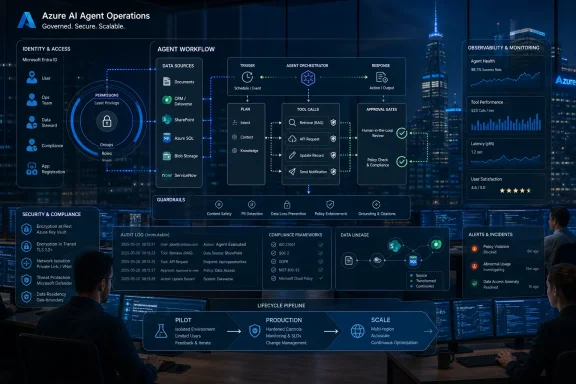 The Azure Agent Boom Has Entered Its Consulting Phase
The most revealing thing about Agentic AI @ Scale is that it is not really a shrink-wrapped product. WinWire describes it as a playbook, framework, and services motion for moving organizations from experiments to production deployments. That framing is important because enterprise agentic AI is less like installing an app and more like redesigning a workflow around software that can plan, call tools, retrieve data, and trigger actions.That is also why NTT DATA’s acquisition plan makes strategic sense. Buying WinWire gives NTT DATA more than a branded AI offering; it gives the company Microsoft-focused delivery capacity at the exact moment Azure customers are trying to convert Copilot enthusiasm into operational systems. The deal adds specialists in Azure AI, data engineering, Microsoft Fabric, cloud-native development, and agentic AI — the disciplines that determine whether an agent can survive contact with real enterprise data.
Microsoft has spent the past two years building the platform side of this market through Azure AI Foundry, Foundry Agent Service, Copilot Studio, Microsoft Agent Framework, Microsoft Fabric, Entra, and related governance tooling. But platforms do not implement themselves. Large organizations still need people to map legacy processes, clean data boundaries, integrate APIs, define approval gates, and monitor failure modes.
That is the opening WinWire is trying to occupy. Agentic AI @ Scale packages the messy middle between “we built a proof of concept” and “this agent is allowed to touch a production workflow.”
The Product Is the Method, Not the Software
The phrase “Agentic AI @ Scale” sounds like a platform, but the better interpretation is that it is a delivery model. WinWire’s own positioning emphasizes a progression from identifying use cases to proving value and then scaling what works. The company’s 3i language — Imagine, Ignite, Impact — is consultancy branding, but underneath it is a practical point: agentic AI fails when businesses treat it as a technology rollout rather than an operating model.That distinction matters because AI agents are not static automations. A conventional workflow engine follows known steps. An agentic system may interpret a request, choose tools, gather context, decide the next action, and hand off to another agent or human. That flexibility is the appeal, but it is also the risk.
In a large company, an agent that summarizes a document is useful. An agent that updates a customer record, files a ticket, queries a warehouse system, or drafts a compliance response is something else entirely. It needs identity, permissions, logging, rollback procedures, test coverage, and escalation rules.
This is why Agentic AI @ Scale is being sold as architecture and governance as much as AI. The real customer is not the individual employee asking a bot for help. The real customer is the IT organization that must decide which actions an agent can take, which systems it can reach, and what happens when it is wrong.
Microsoft’s Stack Gives WinWire a Natural Lane
WinWire’s emphasis on Microsoft Azure is not incidental. The agentic AI market is quickly becoming a contest between ecosystems, and Microsoft has a structural advantage inside organizations already standardized on Microsoft 365, Entra ID, Azure, Teams, SharePoint, Power Platform, and Windows endpoints. If an enterprise wants agents to operate across knowledge, identity, productivity, and line-of-business systems, Microsoft can credibly argue that much of the plumbing is already in place.Azure AI Foundry Agent Service gives developers a managed foundation for building, deploying, and scaling agents. Microsoft Agent Framework offers an open-source development layer for agentic applications. Copilot Studio gives business and low-code teams a way to build and manage agents closer to Microsoft 365 workflows. Microsoft Fabric, Azure AI Search, Logic Apps, Functions, Microsoft Graph, and Entra all become part of the larger agent substrate.
That does not mean Microsoft has solved enterprise agentic AI. It means Microsoft has assembled enough pieces that the bottleneck shifts from platform availability to implementation discipline. A company can now ask, with a straight face, whether a customer-service agent should retrieve policy documents from SharePoint, query a CRM, escalate through Teams, and write a proposed resolution back into a case system.
The problem is that each of those verbs has consequences. Retrieve what? Query under whose authority? Escalate to whom? Write with what approval? Agentic AI @ Scale exists because those questions become painfully specific once an enterprise moves past the demo.
The NTT DATA Deal Turns a Boutique Capability Into a Global Delivery Bet
NTT DATA’s intent to acquire WinWire should be read as part of a broader services-industry land grab. Every major integrator wants to be the firm that takes AI from boardroom promise to operational spend. The winners will not be determined only by who has the flashiest model partnerships. They will be determined by who can staff the implementation work at scale.WinWire brings NTT DATA a concentrated Microsoft capability, including more than 1,000 Azure engineers and AI specialists. That is a meaningful number not because headcount alone guarantees quality, but because enterprise AI projects are labor-intensive in ways executives often underestimate. Agents need data access patterns, prompt and tool design, retrieval tuning, workflow integration, monitoring, testing, security review, and user adoption planning.
The acquisition also strengthens NTT DATA’s North American Microsoft story. WinWire is based in Santa Clara and has delivery operations tied heavily to India, giving NTT DATA a familiar global delivery model around a hot technical category. For US enterprises, that matters because agentic AI programs are likely to be folded into broader modernization contracts rather than purchased as isolated AI experiments.
The market signal is clear: agentic AI is becoming a systems integration category. The consultancy that owns the workflow map owns the AI opportunity.
“Agents” Are a Fancy Word for a Very Old Enterprise Problem
The agentic AI hype cycle can make the technology sound unprecedented, but many of the underlying problems are old. Enterprises have always struggled to connect systems, automate approvals, reconcile data, and reduce manual work without breaking controls. The new twist is that AI agents can operate in ambiguous spaces where traditional automation was too brittle.That makes them tempting. A claims processor, field technician, HR specialist, or sales operations analyst spends much of the day moving information between systems, reading documents, checking policies, and preparing next steps. Those are exactly the kinds of workflows that agentic AI vendors now describe as ripe for automation or augmentation.
But ambiguity cuts both ways. A deterministic script fails in predictable ways. An agent can fail creatively. It can select the wrong tool, retrieve irrelevant context, over-trust stale data, misunderstand policy, or take an action that is technically permitted but operationally inappropriate.
That is why the move from pilot to production is the hard part. A pilot usually proves that an agent can do something impressive in a bounded scenario. Production asks whether it can do the right thing repeatedly, under audit, with security controls, cost controls, and human oversight.
The Real Architecture Is Permissions, Not Prompts
The public discussion around agentic AI often focuses on prompts, models, and reasoning. In enterprise environments, the more important architecture may be permissions. An AI agent is only as safe as the identity, access, and tool boundaries around it.Microsoft’s ecosystem gives organizations familiar building blocks: Entra identity, Azure role-based access control, private networking, logging, policy enforcement, and compliance tooling. But familiar does not mean automatic. An agent that acts on behalf of a user introduces difficult questions about delegation, least privilege, and accountability.
If a human asks an agent to update a financial forecast, is the action attributed to the human, the agent, the service principal, or the application? If the agent accesses a document the human technically can read but should not use in that context, is that a data governance failure or expected behavior? If the agent chains multiple tools together, how does a security team reconstruct the decision path?
These are not abstract objections. They determine whether an agent can be trusted in regulated industries such as healthcare, finance, insurance, and public sector work. They also explain why WinWire’s positioning around governance, monitoring, and adoption is not just marketing language. Without those elements, agentic AI becomes another shadow automation layer.
Azure-Native Is Convenient, but It Is Also a Lock-In Conversation
For organizations already invested in Azure, Agentic AI @ Scale offers a rational path. It lets them use existing Microsoft relationships, cloud architecture, identity systems, data platforms, and security practices. The fewer new control planes an enterprise introduces, the easier it is to get a project through architecture review.The tradeoff is dependency. Agentic AI frameworks built deeply around Azure services may be faster to deploy for Microsoft-centric shops, but they can also reinforce platform gravity. Once agents depend on Azure AI Foundry, Microsoft Fabric, Logic Apps, Graph connectors, Entra policies, and Microsoft 365 data, moving them elsewhere becomes less a migration and more a rebuild.
That is not necessarily bad. Enterprises have always made platform bets. The honest question is whether the benefits of integration outweigh the cost of concentration.
For many Windows and Azure-heavy organizations, the answer may be yes. The bigger risk is not that they choose Microsoft. The bigger risk is that they assume choosing Microsoft automatically solves governance, quality, and operational resilience. It does not.
Agentic AI Will Expose the Weak Parts of Enterprise Data
The fastest way to overestimate agentic AI is to imagine it working against perfect enterprise data. The fastest way to underestimate the implementation challenge is to ignore the actual state of corporate systems. Most large organizations have duplicate records, inconsistent metadata, undocumented integrations, aging line-of-business applications, and knowledge stores nobody fully owns.Agents do not make that mess disappear. They surface it. A retrieval-augmented agent that searches policy documents is only as good as the freshness, permissions, and structure of those documents. An operations agent that queries multiple systems inherits every conflict between them.
This is why WinWire’s data engineering capabilities are central to the story. Agentic AI at scale requires more than access to a large language model. It requires clean data pipelines, governed semantic layers, search indexes, event streams, and integration patterns that keep agents grounded in reliable context.
There is a useful corrective here for executives who think agentic AI will let them skip modernization. In practice, agents often increase the value of modernization because they need well-governed systems to act safely. The agent becomes a new interface on top of old complexity, but the old complexity still has to be managed.
The Pilot-to-Production Gap Is Where Budgets Go to Be Rewritten
Most enterprises already have AI pilots. Many have dozens. The gap is not experimentation; it is operationalization. That is the gap NTT DATA and WinWire are trying to monetize.A working pilot can be built by a small team with a narrow dataset, a few handpicked users, and a forgiving success metric. A production agent needs service-level expectations, support processes, monitoring dashboards, incident response, cost management, model evaluation, change control, and a plan for when the underlying model or API changes. It also needs business ownership, which is often harder to obtain than technical approval.
The cost profile changes accordingly. The initial agent may be cheap compared with a traditional application build. The production ecosystem around it may not be. Evaluation frameworks, observability, data governance, security architecture, training, and adoption all become recurring costs.
That is one reason consulting firms are enthusiastic. Agentic AI is not a one-time implementation if it becomes embedded in business operations. It creates an ongoing need for measurement, tuning, expansion, and governance.
Windows Shops Should Watch the Back Office Before the Desktop
For WindowsForum readers, it is tempting to connect every AI development back to the Windows desktop. Microsoft has indeed been pushing AI deeper into Windows and Microsoft 365, and agent-style experiences are gradually becoming part of how users interact with productivity software. But Agentic AI @ Scale is less about a visible Windows feature than the invisible business systems behind the user.The early enterprise wins are likely to happen in customer support, finance operations, healthcare administration, field service, compliance documentation, sales operations, and internal IT service management. These are workflows where people already hop between Microsoft 365, Teams, SharePoint, ticketing systems, databases, and custom applications. An agent that reduces that friction can produce measurable value.
That does not mean the endpoint is irrelevant. Identity, device posture, browser access, local data handling, and user interaction all matter. But the decisive architecture lives in Azure and the business application layer, not in a Windows shell animation.
The desktop becomes the surface. The real action is in the cloud control plane.
The Security Conversation Is Behind the Marketing
Agentic AI introduces a security model that is still maturing. Traditional application security assumes defined inputs, defined outputs, and relatively predictable execution paths. Agents complicate that model because they may interpret instructions, call tools, chain tasks, and respond to external content that may itself be malicious or misleading.Prompt injection is only the most obvious risk. An agent connected to business systems must also be protected against data leakage, excessive permissions, tool misuse, unsafe actions, poisoned retrieval sources, and social engineering. If agents can send email, modify records, create tickets, or initiate transactions, attackers will try to manipulate them into doing so.
Microsoft has been emphasizing governance and observability in Azure AI Foundry for this reason. So have services firms. But security teams should be wary of any implementation that treats guardrails as a final checklist item. In agentic systems, guardrails are part of the architecture.
The practical test is simple: can the organization explain what the agent can do, what it cannot do, how those limits are enforced, and how violations are detected? If the answer is fuzzy, the agent is not production-ready.
Human-in-the-Loop Is Not a Slogan; It Is a Design Decision
Vendors often reassure enterprises that humans will remain in the loop. That phrase is comforting, but it can become meaningless unless the loop is designed. A human approval step that users routinely rubber-stamp is not governance. A review queue with no context is not oversight.Agentic AI @ Scale-style programs should force organizations to decide where autonomy is appropriate and where approval is mandatory. Some agents should only retrieve and recommend. Others may draft but not send. Others may execute low-risk actions automatically while escalating high-risk cases.
The design also has to account for speed. If every action requires review, the agent may not deliver meaningful efficiency. If too few actions require review, the organization may create unacceptable risk. The hard work is segmenting workflows by consequence.
This is where enterprise experience matters. A consultant who understands Azure APIs but not the business process will build a clever tool. A team that understands the workflow, controls, and failure costs may build something useful.
The Business Case Depends on Boring Metrics
The agentic AI market is full of sweeping claims about productivity. Enterprises should demand narrower metrics. The most credible business cases will measure cycle time, handling cost, escalation rate, first-contact resolution, documentation quality, compliance defects, rework, and employee adoption.That is another reason the WinWire framing around proving ROI early is sensible. Agentic AI projects should start with workflows where success can be measured. If the use case is too vague — “improve knowledge work” — it will be hard to distinguish real productivity from novelty.
The best candidates are often unglamorous. A support agent that gathers context before a human opens a ticket may save minutes hundreds of times a day. A field service agent that checks parts availability, warranty status, and prior service history may reduce truck rolls. A finance agent that drafts variance explanations may shorten close cycles.
These are not science-fiction scenarios. They are business process improvements with probabilistic software in the middle.
The Integrators Are Rebranding Automation for the AI Era
There is a cynical reading of Agentic AI @ Scale: it is old-fashioned consulting wrapped in new AI language. That reading is not entirely wrong. Systems integrators have always sold frameworks, maturity models, accelerators, and transformation playbooks. Agentic AI gives them a fresh vocabulary and a new budget category.But cynicism alone misses the shift. AI agents genuinely change what automation can attempt. They can work with unstructured text, interpret intent, summarize context, generate outputs, and operate across tools in ways traditional robotic process automation struggled to handle. The ceiling is higher.
The floor, however, is familiar. Bad process design will still produce bad automation. Poor governance will still create risk. Weak data will still degrade outcomes. A fancy agent cannot rescue an organization from unclear ownership.
That is why NTT DATA’s acquisition of WinWire should be read as both opportunity and warning. The opportunity is to industrialize agentic AI delivery on Azure. The warning is that industrialization can turn experimentation into durable dependency before enterprises fully understand what they have built.
The Microsoft Partner Ecosystem Is Becoming the AI Supply Chain
Microsoft’s AI strategy depends heavily on partners. The company can build Azure AI Foundry, Copilot Studio, Fabric, Entra, and the developer frameworks, but it cannot personally redesign every insurer’s claims process or every manufacturer’s field service workflow. That work belongs to partners.WinWire’s acquisition places it inside a larger global services machine at a moment when Microsoft needs credible delivery stories. Customers do not just want to hear that agents are possible. They want to know who has implemented them in their industry, on their data, with their controls.
This is where NTT DATA can benefit. It already has industry relationships, global delivery capacity, and a Microsoft business unit. WinWire adds specialized Azure AI and agentic capabilities that can be plugged into larger transformation deals.
The competitive pressure will be intense. Accenture, Avanade, Deloitte, Capgemini, Infosys, TCS, Cognizant, and other major firms are all building similar narratives. The differentiator will not be who says “agentic” most often. It will be who can show repeatable outcomes without creating operational chaos.
Small Vendors Will Build the Tools; Big Firms Will Own the Programs
The agentic AI ecosystem is crowded with startups building orchestration frameworks, evaluation tools, memory layers, observability products, security controls, and agent marketplaces. Many of those tools will matter. But large enterprises often buy transformation programs through familiar vendors.That gives firms like NTT DATA an advantage. They can assemble tools into a managed program and carry accountability across strategy, implementation, support, and governance. For a CIO, that can be more attractive than stitching together a dozen specialist vendors.
It also raises a concern. If large integrators become the default route to production agentic AI, the market may consolidate around a handful of platform-and-services combinations. Microsoft plus a major systems integrator is a powerful bundle. It may also be hard for customers to unwind.
The smart enterprise response is not to avoid integrators. It is to insist on architectural clarity, documentation, portability where feasible, and internal capability-building. Outsourcing the build should not mean outsourcing understanding.
The Fine Print Behind the “At Scale” Promise
Agentic AI at scale is not a single milestone. It is a series of thresholds. The first is technical: can the agent perform the task? The second is operational: can it perform reliably under normal business conditions? The third is organizational: will people use it correctly? The fourth is governance: can the company prove it is safe, compliant, and controlled?Many AI pilots clear the first threshold and stall before the second. That is why services frameworks are being marketed so aggressively. The enterprise pain is not inspiration; it is execution.
WinWire’s Agentic AI @ Scale pitch is strongest when understood through that lens. It is not promising that every workflow should be agentic. It is promising a way to identify the ones that might be, build them on Azure, and wrap them in enough governance to satisfy enterprise buyers.
The unresolved question is whether “at scale” will mean hundreds of valuable workflow agents or hundreds of fragile automations with a new name. The difference will depend on discipline, not branding.
The WinWire Deal Gives Azure Customers a Clearer Path, Not a Shortcut
The concrete lesson from the NTT DATA-WinWire story is that enterprise agentic AI is moving from concept to procurement. It is becoming something CIOs can buy, staff, govern, and measure. That is progress.It is not a shortcut. Azure customers still need to define which business processes deserve agents, what data those agents can access, how actions are approved, how results are evaluated, and how failures are contained. A framework can accelerate that work, but it cannot eliminate it.
The most successful organizations will treat Agentic AI @ Scale as a modernization program with AI at the center, not as an AI program with modernization as an afterthought. They will clean up data, rationalize workflows, strengthen identity controls, and invest in observability before handing agents broader autonomy.
That is less exciting than the demo. It is also where the real value lives.
The Azure Agent Story Now Belongs to the Operators
Agentic AI @ Scale is useful as a market signal because it shows where the enterprise AI conversation is heading. The center of gravity is shifting from model selection to operating discipline. For Microsoft customers, that means the next wave of AI work will look more like cloud architecture, security engineering, and business process redesign than prompt experimentation.The immediate implications are practical:
- NTT DATA’s planned acquisition of WinWire strengthens its Microsoft Azure AI delivery capacity at a time when enterprises are trying to move agentic AI beyond pilots.
- Agentic AI @ Scale is best understood as a services-led operating framework, not a standalone software product that customers simply install.
- Azure-heavy organizations may benefit from Microsoft-native integration across identity, data, developer tooling, and governance, but they should also recognize the lock-in that comes with deep platform alignment.
- The hardest production questions are about permissions, observability, evaluation, data quality, and human approval, not just model intelligence.
- US enterprises using Microsoft 365 and Azure are natural targets for this approach because their collaboration, identity, and data estates already sit inside Microsoft’s orbit.
- The success of agentic AI programs will depend on measurable workflow outcomes rather than broad claims about productivity.
References
- Primary source: AD HOC NEWS
Published: Tue, 19 May 2026 12:43:08 GMT

Agentic AI @ Scale from WinWire targets enterprise Azure
Agentic AI @ Scale from WinWire focuses on automating complex business workflows on Microsoft Azurewww.ad-hoc-news.de
- Related coverage: winwire.com
Agentic AI Services | WinWire
Agentic AI services help organizations build intelligent AI agents that automate workflows, make decisions, and drive operational efficiency.www.winwire.com
- Related coverage: gateiolink.net

NTT Data acquiert le partenaire Microsoft WinWire pour 1 milliard de dollars+ afin d’ajouter 1 000+ ingénieurs en IA Azure | Gate News
D’après NTT Data, le 18 mai, l’entreprise a signé un accord définitif pour acquérir WinWire, un partenaire de Microsoft basé à Santa Clara, spécialisé dans Azurwww.gateiolink.net - Related coverage: unite.ai

NTT DATA Acquires WinWire to Expand Agentic AI and Microsoft Azure Enterprise Transformation Capabilities
NTT DATA has announced plans to acquire WinWire, a Santa Clara-based Microsoft partner focused on agentic AI, Azure-native development, cloud modernization, and enterprise data engineering. The deal reflects a broader sh...www.unite.ai
- Related coverage: windowsforum.com

NTT DATA to Acquire WinWire: Scaling Microsoft Enterprise AI With 1,000+ Azure Experts
NTT DATA signed a definitive agreement in May 2026 to acquire Santa Clara-based WinWire, a Microsoft-focused cloud and AI consultancy with delivery centers in India and more than 1,000 Azure engineers and AI specialists. The deal is less about buying another systems integrator than about buying... windowsforum.com
- Related coverage: bharataawaz.com

NTT DATA to Acquire WinWire for Enterprise AI Scalability | Bharat Aawaz - The Voice Of India! News, Updates, Politics and More!
NTT DATA to Acquire WinWire for Enterprise AI Scalability | Bharat Aawaz - The Voice Of India! News, Updates, Politics and More! | bharataawaz.com
- Related coverage: citybiz.co

NTT DATA to Acquire AI Services Firm WinWire From Sverica Capital
Sverica Capital Management LP has agreed to sell portfolio company WinWire Technologies India Pvt. Ltd. to NTT DATA Group Corp.,... Read More www.citybiz.co
- Related coverage: services.global.ntt
- Related coverage: nttdata.com
- Related coverage: assets.kpmg.com
- Official source: learn.microsoft.com
What is Microsoft Foundry Agent Service? - Microsoft Foundry
Learn about Microsoft Foundry Agent Service capabilities, agent types, tools, and runtime features for building AI agents.learn.microsoft.com - Official source: azure.microsoft.com
Foundry Agent Service | Microsoft Azure
Use Foundry Agent Service to design, deploy, and scale AI agents securely. Create enterprise-grade AI agents to automate complex business processes.azure.microsoft.com
- Official source: techcommunity.microsoft.com
Foundry Agent Service, Observability, and Foundry Portal Now Generally Available | Microsoft Foundry
Foundry Agent Service, Observability in Foundry Control Plane, and the Microsoft Foundry portal are now generally available. Build and operate secure,... techcommunity.microsoft.com
- Related coverage: artificial-intelligence-wiki.com
Azure AI Agents Guide - Foundry Agent Service | AI Wiki
Complete guide to Azure AI Agents and Microsoft Foundry Agent Service. Learn features, pricing, multi-agent orchestration, and how to build enterprise AI agents in 2025.artificial-intelligence-wiki.com
- Official source: devblogs.microsoft.com

Introducing Microsoft Agent Framework: The Open-Source Engine for Agentic AI Apps | Microsoft Foundry Blog
Why agents need a new foundation Over the last year, developers have been experimenting with AI agents in every imaginable form. Agents are not just chatbots or copilots — they are autonomous software components that can reason about goals, call tools and APIs, collaborate with other agents, and... devblogs.microsoft.com
- Official source: enablement.microsoft.com
AI Agents Hub – Microsoft Adoption
Get started building agents today with Microsoft 365 Copilot, Azure AI Foundry and Copilot Studio. enablement.microsoft.com
- Related coverage: tomshardware.com

Microsoft adds Grok 4 to Azure AI Foundry following cautious trials — Elon Musk's latest AI model is now available to deploy for "frontier‑level reasoning"
Comes with a 128K-token context window.www.tomshardware.com
- Related coverage: windowscentral.com
- Official source: cdn-dynmedia-1.microsoft.com
- Related coverage: newsroom.workday.com
