

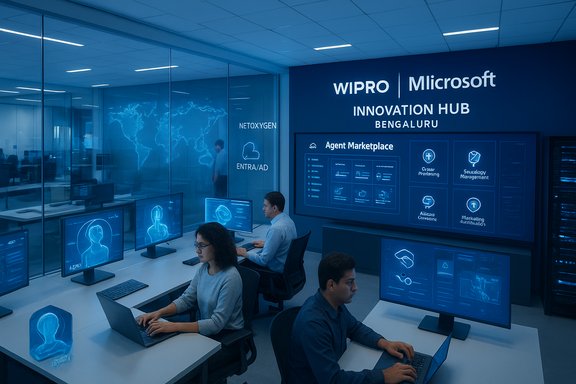
Wipro and Microsoft have signed a three‑year strategic partnership to accelerate enterprise AI adoption and opened a Microsoft Innovation Hub at Wipro’s Partner Labs in Bengaluru, a move that pairs Wipro’s consulting‑led, vertical IP and delivery capabilities with Microsoft’s cloud, Copilot ecosystem and agent orchestration stack to build industry‑specific copilots, scale internal “Client Zero” rollouts and commercialize AI agents at production scale.
The announcement arrives as part of a broader Microsoft push into India that includes a multi‑billion dollar infrastructure and skilling commitment, and positions a handful of large systems integrators as early adopters—or “Frontier Firms”—expected to embed Copilot and agentic AI deeply into operations. Microsoft framed the program as a bridge from pilot projects to enterprise production by combining platform investment, local hyperscale capacity and large‑scale skilling initiatives. Wipro’s public materials describe the pact as a three‑year collaboration that will integrate Microsoft Azure, Microsoft 365 Copilot, GitHub Copilot, Azure AI Foundry (Copilot Studio/agent orchestration tooling) and third‑party enterprise platform integrations with Wipro’s Wipro Intelligence™ suite and vertical IP such as NetOxygen, Wealth AI and Falcon Supply Chain. The joint go‑to‑market targets financial services, retail, manufacturing, healthcare & life sciences, airports and other regulated industries.
In practice, the Wipro–Microsoft alliance is a high‑stakes bet on industrializing AI for regulated enterprises. The community will watch the Innovation Hub’s first customer builds, the activation metrics on Copilot seats, and the publication of audited case studies to judge whether this partnership becomes a template for responsible, scalable enterprise AI or a well‑promoted set of staged commitments.
Source: ETV Bharat Wipro, Microsoft Ink 3-Year AI Partnership; Launch Innovation Hub In Bengaluru
 Background
The announcement arrives as part of a broader Microsoft push into India that includes a multi‑billion dollar infrastructure and skilling commitment, and positions a handful of large systems integrators as early adopters—or “Frontier Firms”—expected to embed Copilot and agentic AI deeply into operations. Microsoft framed the program as a bridge from pilot projects to enterprise production by combining platform investment, local hyperscale capacity and large‑scale skilling initiatives. Wipro’s public materials describe the pact as a three‑year collaboration that will integrate Microsoft Azure, Microsoft 365 Copilot, GitHub Copilot, Azure AI Foundry (Copilot Studio/agent orchestration tooling) and third‑party enterprise platform integrations with Wipro’s Wipro Intelligence™ suite and vertical IP such as NetOxygen, Wealth AI and Falcon Supply Chain. The joint go‑to‑market targets financial services, retail, manufacturing, healthcare & life sciences, airports and other regulated industries. What the partnership actually includes
Core commercial commitments
- A formal, three‑year strategic partnership to co‑develop and commercialize industry‑specific AI solutions and copilots.
- Launch of a Microsoft Innovation Hub inside Wipro’s Partner Labs in Bengaluru to host immersive workshops, rapid prototyping sprints, client co‑innovation sessions and governance assessments.
- Integration of Wipro Intelligence™ with Microsoft’s Copilot family, Azure AI Foundry and GitHub tooling to produce vertical copilots and an Agent Marketplace of pre‑built agents.
Scale and skilling targets (public claims)
- Wipro states plans to deploy over 50,000 Microsoft Copilot licences internally and to upskill more than 25,000 Wipro employees on Microsoft Cloud and GitHub technologies to develop an AI‑fluent workforce. These figures are reported consistently across Microsoft and partner briefings.
Why the timing matters: platform + partner
Microsoft’s larger India package—reported as a US$17.5 billion investment for cloud, AI infrastructure, skilling and operations across calendar years 2026–2029—creates a strategic backdrop for these partner pacts. Hyperscaler investment in regional data centers, in‑country processing options for Copilot, and sovereign cloud constructs reduces procurement and regulatory friction for regulated sectors like banking and healthcare, making large enterprise Copilot rollouts more feasible. The playbook is familiar: hyperscalers supply compute, model hosting, governance primitives and orchestration platforms; global systems integrators provide vertical semantics, connectors, delivery capacity and packaged IP that turn platform primitives into repeatable customer outcomes. When an SI adopts the platform internally at scale (“Client Zero”), it accelerates productization of solutions for clients. Wipro’s Innovation Hub is explicitly designed to be a physical runway for that conversion.Technical architecture and whose tools are being used
The partnership centers on Microsoft’s layered AI stack combined with Wipro’s delivery scaffolding:- Microsoft Azure: cloud and data fabric backbone for storage, model hosting, inference and sovereign tenancy.
- Microsoft 365 Copilot: knowledge‑worker productivity augmentation and the front door for enterprise copilots.
- GitHub Copilot: developer productivity and code generation integrated into CI/CD and engineering workflows.
- Azure AI Foundry / Copilot Studio: model cataloging, routing, agent orchestration, governance telemetry and provenance.
- Wipro Intelligence™, NetOxygen, Wealth AI, Falcon Supply Chain: vertical IP and accelerators to reduce integration time to ERP, core banking and manufacturing systems.
The Microsoft Innovation Hub in Bengaluru: practical role and expectations
The Innovation Hub is being marketed as a hands‑on environment where Wipro, Microsoft and clients will:- Rapidly prototype industry copilots and multi‑agent workflows in scenario labs.
- Run immersive client workshops to validate business outcomes and compliance postures.
- Expose Wipro’s Agent Marketplace and pre‑built domain agents for customer trials and customization.
- Validate sovereign‑processing setups, identity integration (Entra/AD), and human‑in‑the‑loop control designs before production rollout.
Skilling, Client Zero and the workforce strategy
Wipro plans to upskill tens of thousands of employees on Microsoft Cloud and GitHub technologies and use its internal deployments as Client Zero case studies that feed productized offerings. The stated skilling and seat targets aim to:- Build an AI‑fluent workforce of developers, prompt engineers, agent supervisors and AI ops personnel.
- Create internal productivity gains that translate into packaged client solutions.
- Populate the GitHub Center of Excellence and Copilot CoE with playbooks, CI/CD guardrails and prompt engineering best practices.
Commercial math: licences, Azure consumption and TCO
Headline licence numbers are attractive for marketing and signaling, but total cost of ownership (TCO) extends well beyond seat fees. Enterprises and partners should budget for:- Per‑user Copilot license fees (list tiers historically have been impactful to enterprise budgets).
- Ongoing Azure inference and GPU consumption for model calls, fine‑tuning and agent execution.
- Vector stores and embedding costs for retrieval‑augmented generation (RAG) workflows.
- Engineering and professional services for connectors, integrations and testing.
- Expanded AI Ops and SOC capabilities for monitoring, logging and incident response.
Strengths of the Wipro–Microsoft approach
- Speed to market: combining Microsoft’s platform with Wipro’s vertical IP and delivery network shortens the path from proof‑of‑concept to repeatable offerings for regulated industries.
- Skilling at scale: a focused internal upskilling and Client Zero posture can produce replicable operational recipes and case studies that reduce client adoption friction.
- Sovereignty and compliance posture: Microsoft’s infrastructure investment in India, including in‑country processing options, addresses a primary barrier for regulated customers wary of cross‑border data processing.
- Developer productivity: GitHub CoE and Copilot integration can materially accelerate engineering throughput when paired with hardened CI/CD and code review guardrails.
Risks, weaknesses and open questions
Activation vs purchase
Public announcements conflate licence purchases, provisioning and active, audited usage. The distinction matters: purchased seats may be dormant until identity, governance and integrations are in place. Buyers should insist on activation metrics, usage dashboards and measurable business outcomes as part of contractual commitments.Governance, auditability and safety
Agentic AI that takes actions across systems raises legal, regulatory and reputational risk. Key operational controls must include:- Agent registries and least‑privilege execution roles.
- Immutable audit trails and model provenance records.
- Human‑in‑the‑loop approvals for high‑risk operations.
- Continuous monitoring for hallucinations, bias and performance drift.
Integration complexity
Real business impact requires connectors into ERPs, core banking platforms, manufacturing execution systems and clinical records. That plumbing is often the heaviest engineering work and can dominate implementation timelines and budgets. Wipro’s vertical IP aims to reduce that lift, but customers should require clear SLAs and migration/exit clauses.Vendor lock‑in and portability
A platform‑plus‑partner model raises portability concerns. Contracts should include explicit clauses for data portability, model retraining portability, and migration planning to avoid future lock‑in costs or friction. This is especially relevant if agents are tightly coupled to Microsoft‑hosted model endpoints or proprietary orchestration flows.Regulatory scrutiny
Large platform‑led rollouts in regulated industries will draw regulator attention. Expect heightened requirements around explainability, data residency, algorithmic impact assessments and potential audits. Enterprises operating across jurisdictions should require vendors to demonstrate compliance across the relevant regulatory regimes.Competitive landscape: not the only path
Microsoft’s partner play mirrors similar hyperscaler strategies: AWS, Oracle and others have launched their own model marketplaces and agent services, often with their own partner ecosystems. Enterprises should compare roadmaps, governance tooling, TCO and regional hosting options across providers before committing to a single supplier or partner model. Wipro’s Microsoft‑first approach is strategically sensible for customers already invested in Microsoft stacks but is not the only route to industrializing AI.Practical due diligence checklist for IT leaders
- Demand activation evidence: require seat activation, weekly/monthly usage dashboards and business outcome KPIs, not just licence purchase confirmations.
- Insist on governance artifacts: agent registries, audit trails, model provenance and a human‑in‑the‑loop policy for critical operations.
- Verify sovereignty constructs: confirm in‑country processing options for sensitive workloads and ensure contractual data residency guarantees where required.
- Define exit/portability terms: negotiate clauses for data export, model retraining portability and migration assistance to avoid lock‑in.
- Budget for TCO beyond licences: include Azure inference, vector store, integration engineering and ongoing AI Ops costs.
How this could play out in the next 12–24 months
If executed with discipline, expect to see packaged, industry‑specific copilots and agent templates that reduce integration time and demonstrate measurable productivity gains within 12–24 months. Demonstrable indicators of success include published case studies with activation metrics, standardised agent templates for common business processes (e.g., loan origination, inventory reconciliation, claims triage), and audited governance artifacts. Conversely, if governance and integration are under‑invested, the rollout risks producing shallow productivity headlines without durable operational value—what some critics term “AI slop.”Final assessment
The Wipro–Microsoft three‑year pact and the Bangalore Innovation Hub are a logical step in hyperscaler partner economics: the combination of Microsoft’s platform investment and Wipro’s vertical IP and delivery scale could materially accelerate enterprise Copilot and agentic AI adoption—if the partnership delivers on activation, governance, and clear business outcomes rather than headline seat counts alone. The announced skilling and Client Zero posture are encouraging, but they are early steps. Procurement leaders and CIOs should treat the licence and skilling numbers as staged commitments and demand verifiable activation, transparent economics and robust governance before migrating mission‑critical workflows to agentic systems. The strategic logic is sound: platform + partner shortens time to production and unlocks vertical reuse. The operational reality is hard work: data plumbing, identity, observability, CI/CD guardrails and human oversight will determine whether the next wave of enterprise AI delivers durable value or becomes another cycle of expensive pilots.In practice, the Wipro–Microsoft alliance is a high‑stakes bet on industrializing AI for regulated enterprises. The community will watch the Innovation Hub’s first customer builds, the activation metrics on Copilot seats, and the publication of audited case studies to judge whether this partnership becomes a template for responsible, scalable enterprise AI or a well‑promoted set of staged commitments.
Source: ETV Bharat Wipro, Microsoft Ink 3-Year AI Partnership; Launch Innovation Hub In Bengaluru
