

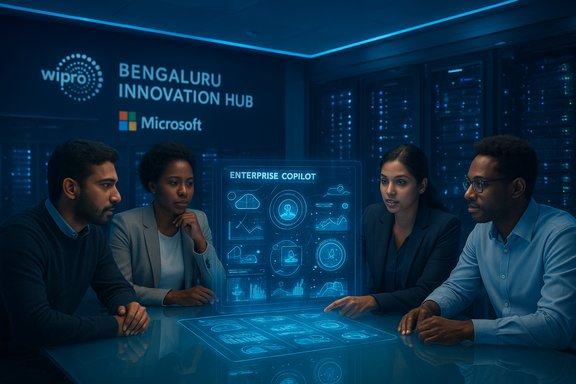
Wipro and Microsoft have launched a three‑year strategic partnership to accelerate enterprise AI adoption by pairing Wipro’s consulting and vertical IP with Microsoft’s cloud, Copilot family and agent platform — a deal that promises industry‑specific copilots, an on‑site Microsoft Innovation Hub in Bengaluru, and large internal Copilot and skilling rollouts, while also raising urgent questions about activation, governance and hyperscaler dependence.
Wipro’s three‑year arrangement with Microsoft was announced as part of Microsoft’s high‑profile India AI events, where Microsoft positioned a set of major systems‑integrator partnerships as part of a broader push to industrialize what it calls agentic AI. The collaboration is explicitly framed to combine Wipro’s domain engineering and platform IP — marketed as Wipro Intelligence™ — with Microsoft’s Azure cloud, Microsoft 365 Copilot, GitHub Copilot and Azure AI Foundry (Copilot Studio/agent orchestration tooling) to co‑build and commercialize vertical AI solutions for sectors such as financial services, retail, manufacturing, healthcare, life sciences and airports. Key public commitments announced around the partnership include:
At the same time, buyers must treat the public claims as starting points, not guarantees. Procurement teams should demand activation evidence, build rigorous governance and cost models, and negotiate portability and IP protections. The partnership’s success will be determined not by headline seat counts but by whether enterprises can convert those seats into reliable, auditable, and cost‑effective production workflows that deliver measurable business outcomes.
Source: Republic World Wipro, Microsoft Sign Three-Year Partnership to Build Enterprise AI Solutions
 Background / Overview
Wipro’s three‑year arrangement with Microsoft was announced as part of Microsoft’s high‑profile India AI events, where Microsoft positioned a set of major systems‑integrator partnerships as part of a broader push to industrialize what it calls agentic AI. The collaboration is explicitly framed to combine Wipro’s domain engineering and platform IP — marketed as Wipro Intelligence™ — with Microsoft’s Azure cloud, Microsoft 365 Copilot, GitHub Copilot and Azure AI Foundry (Copilot Studio/agent orchestration tooling) to co‑build and commercialize vertical AI solutions for sectors such as financial services, retail, manufacturing, healthcare, life sciences and airports. Key public commitments announced around the partnership include:- Launch of a Microsoft Innovation Hub inside Wipro’s Partner Labs in Bengaluru to co‑innovate, prototype and pilot enterprise copilots and agents.
- Integration plans that reference Wipro platforms NetOxygen, Wealth AI and Falcon Supply Chain as accelerators for vertical solutions.
- Wipro’s internal adoption and skilling claims: deployment of more than 50,000 Microsoft Copilot licences internally and training of 25,000+ employees on Microsoft Cloud and GitHub technologies.
What the deal actually is — scope and mechanics
What both companies say the partnership will deliver
- Co‑engineering of industry copilots and AI agents grounded in Wipro’s vertical IP and Microsoft’s model, orchestration and governance tooling. The aim is to move beyond single‑use generative assistants to agentic workflows that coordinate multi‑step processes.
- A Microsoft Innovation Hub inside Wipro’s Partner Labs in Bengaluru as the physical locus for joint sprints, client immersion workshops, live prototyping and demonstration. That hub will also expose Wipro’s Agent Marketplace of pre‑built agents to customers and partners.
- Wipro as “Customer Zero” and scale partner: the company has declared significant internal Copilot seat rollouts and skilling programs intended to produce case studies and packaged offerings for clients. Microsoft, in public messaging, combines these partner programs into a wider strategy that includes a large Azure investment in India.
Technology and product list that matters to enterprises
The joint approach is not a single product but a stacked delivery model:- Microsoft Azure (infrastructure, data platform, governance and sovereign options)
- Microsoft 365 Copilot and Copilot variants (knowledge‑worker productivity and function‑specific copilots)
- GitHub Copilot (developer productivity, code generation)
- Azure AI Foundry / Copilot Studio (model catalog, routing, agent orchestration and governance)
- Wipro Intelligence™ and Wipro’s vertical platforms: NetOxygen, Wealth AI, Falcon Supply Chain as accelerators to reduce integration lift for domain use cases.
Verifying the headline claims: what’s confirmed and what needs caution
Several items in the joint announcements are repeatedly reported across Microsoft’s own briefings and multiple independent outlets — but public repetition is not the same as verifiable, granular disclosure. Cross‑checking is essential.Copilot licence and skilling figures
- Multiple independent reports and Microsoft’s partner briefings state Wipro has deployed more than 50,000 Microsoft Copilot licences internally and is training over 25,000 employees on Microsoft Cloud / GitHub technologies. These numbers appear consistently in Microsoft’s event communications and subsequent media coverage.
- Caveat and verification note: the public statements come from on‑stage announcements and partner communications; they should be treated as commitments or delivered seat purchases rather than proof of immediate, full production activation. Independent reporters and analysts advise asking for activation dashboards, usage metrics, and timelines for license activation when evaluating the impact of such claims. The distinction between purchased licences, provisioned seats and actively used seats is material to buyers.
Integration of Wipro platforms (NetOxygen, Wealth AI, Falcon Supply Chain)
- Multiple media stories mention these three Wipro platforms being folded into the joint solution approach as vertical accelerators. This is consistent with the corporate messaging that emphasizes vertical IP reuse. However, public coverage does not yet include technical integration blueprints or API/exchange details — information enterprises will need to validate before procurement.
- Cautionary language: the claim that these platforms will be “integrated” is credible but vague until Wipro and Microsoft publish technical artifacts (connectors, data contracts, security boundary diagrams) that buyers can evaluate.
Microsoft Innovation Hub and Agent Marketplace
- The Microsoft Innovation Hub inside Wipro’s Partner Labs in Bengaluru is a clearly stated deliverable and will likely be operational as a co‑innovation facility; press coverage and Microsoft’s own reporting corroborate that. The Agent Marketplace concept also appears in partner materials. Enterprises should still request clear SLAs for demos, IP ownership terms for co‑developed agents, and a published roadmap for how marketplace agents will be certified and governed.
Why this matters: commercial and technical implications
For Wipro
- Strategic positioning: the partnership advances Wipro’s stated goal of being a Frontier Firm — a systems integrator that demonstrates large‑scale Copilot deployments and sells packaged AI services built on that internal experience.
- Acceleration of productization: combining Wipro Intelligence™ with Microsoft’s agent tooling shortens time‑to‑market for industry copilots because Wipro brings pre‑built semantics and connectors.
For Microsoft
- Distribution and scale: engaging established global integrators that serve thousands of enterprise customers is a fast route to driving Copilot adoption and Azure consumption at scale.
- Ecosystem lock‑in potential: the partnership deepens enterprise reliance on Microsoft’s cloud and Copilot ecosystem, which is commercially attractive but raises antitrust and procurement sensitivity in some markets.
For enterprise customers
- Faster pilots and packaged solutions: customers may get faster access to domain‑specific copilots rather than building internal agents from scratch.
- Operational overhead and cost: shifting from pilots to production requires investment in data engineering, governance, identity, cost controls (inference and vector store costs) and run‑book changes. Buyers must budget for ongoing cloud costs in addition to licence fees.
The innovation hub and agent marketplace: promise vs practicalities
What the hub is intended to do
- Provide a hands‑on co‑design space for enterprises to run workshops, validate assumptions and co‑develop pilots that connect enterprise systems to Copilot agents.
- Shorten iteration cycles through joint sprints and a catalogue of certified agent patterns from Wipro’s Agent Marketplace.
Practical issues enterprises should require
- IP and ownership: define who owns code, prompts, and agent logic arising from co‑development.
- Certification and governance: demand published agent certification criteria (security scans, data handling, compliance checks).
- Exit and portability: insist on data export and model artefact access to reduce lock‑in risk.
- Activation proof: require measurable KPIs (active users, task completion rates, error metrics) before milestone payments.
Risks and red flags — operational, legal and ethical
1) Activation vs purchase gap
Enterprise announcements often blur purchased licences with active, integrated seats. Large licence counts are meaningful but not definitive proof of organizational transformation. Contracts and SOWs should tie payments to activation metrics and demonstrable business outcomes.2) Vendor concentration and lock‑in
Deeper reliance on one hyperscaler for models, inference, data storage and agent orchestration amplifies pricing and policy exposure. Enterprises should design least‑privilege access, negotiate data portability clauses, and consider multi‑cloud exit scenarios.3) Governance, auditability and compliance
Agentic AI introduces complex traceability requirements: audit trails, human‑in‑the‑loop controls, versioning, model provenance and post‑deployment monitoring. Missing or immature governance can turn dramatic productivity gains into compliance and reputational liabilities.4) Hidden running costs
Large Copilot deployments create ongoing inference, storage and vector database costs that can dwarf licence fees if not carefully estimated. Enterprises must model steady‑state operating costs, not just procurement fees.5) Data residency and sovereign concerns
Microsoft has tied these partner programs to a multi‑billion dollar India investment and promises of in‑country Copilot processing — a nod to regulated sectors’ data residency needs. Nonetheless, customers in regulated industries should obtain explicit guarantees on in‑country inference, auditability and breach notification.Practical playbook for IT and procurement leaders
Enterprises considering Wipro + Microsoft offerings or similar hyperscaler–SI partnerships should treat these deals as both technology purchases and organizational change programs. A practical checklist:- Start with a narrowly scoped production pilot (3–6 months) with concrete KPIs: active seats, task success rate, time‑saved per task.
- Require activation evidence for licence claims: anonymized dashboards showing active usage, error rates and time‑to‑value metrics.
- Insist on contractual protections:
- Data portability and export rights
- IP ownership or joint ownership clauses for co‑developed agents
- SLAs for agent behaviour and incident response
- Demand governance artefacts:
- Agent registries, versioning and test harnesses
- Role‑based least‑privilege execution and audit trails
- Model provenance and bias mitigation documentation
- Model total cost of ownership:
- Include inference costs, vector DBs, data pipelines, and ongoing managed services
- Run scenario planning for peak inference loads
- Plan organizational change:
- Upskill staff in prompt engineering, AI‑ops, and agent supervision
- Create a cross‑functional AI governance council (security, legal, compliance, business owners)
- Preserve portability:
- Negotiate APIs, standardized connectors, and runbooks to avoid proprietary lock‑in
- Maintain a parallel exportable dataset and model artefacts for continuity
Strengths of the Wipro–Microsoft approach
- Speed and scale: Combining Microsoft’s platform with Wipro’s delivery and vertical IP reduces time‑to‑prototype for industry copilots.
- Workforce enablement: Large skilling programs and GitHub Center of Excellence investments (Wipro has publicly launched a GitHub CoE) help ensure developer and delivery readiness.
- Packaging of industry IP: Using NetOxygen, Wealth AI and Falcon Supply Chain as accelerators makes it easier to produce domain‑relevant copilots rather than generic assistants.
Where the approach may fall short
- Activation risk: Seat counts are headline‑friendly but require proof of ongoing usage and client outcomes; without that, deployments can look like procurement PR rather than productivity transformation.
- Complexity of agentic systems: Agents require production‑grade pipelines, governance, and observability that many organizations underestimate. The engineering lift to integrate agents with ERPs, core banking or manufacturing execution systems is nontrivial.
- Concentration risk: Heavy commitment to a single hyperscaler increases exposure to pricing changes, licensing shifts and policy changes — something procurement and legal teams must mitigate contractually.
How to read the announcement in market context
Microsoft has tied the Wipro partnership to a larger strategy that includes a multi‑billion dollar investment in India for cloud and AI infrastructure and skilling. The Wipro deal is therefore both a delivery channel and a signaling play designed to move enterprise AI from pilots to scale. For buyers and market watchers, the real test will be measured, audited outcomes over the next 6–18 months: active seat usage, measurable process improvements, and documented governance maturity.Conclusion
The Wipro–Microsoft three‑year partnership is a credible, well‑resourced attempt to industrialize enterprise copilots and agentic AI by combining Wipro’s vertical IP and engineering scale with Microsoft’s platform, models and governance tooling. The offering — anchored by a Microsoft Innovation Hub in Bengaluru and a promise of tens of thousands of Copilot licences and large skilling programmes — can materially shorten time‑to‑pilot and give organizations access to pre‑built, industry‑aware agents.At the same time, buyers must treat the public claims as starting points, not guarantees. Procurement teams should demand activation evidence, build rigorous governance and cost models, and negotiate portability and IP protections. The partnership’s success will be determined not by headline seat counts but by whether enterprises can convert those seats into reliable, auditable, and cost‑effective production workflows that deliver measurable business outcomes.
Source: Republic World Wipro, Microsoft Sign Three-Year Partnership to Build Enterprise AI Solutions
