

Wipro and Microsoft on Dec. 12, 2025 announced a three-year strategic AI partnership and the opening of a Microsoft Innovation Hub at Wipro’s Partner Labs in Bengaluru — a pact that brings together Wipro’s consulting-led engineering approach and Microsoft’s cloud and AI stack to accelerate enterprise adoption of agentic AI, deploy Microsoft Copilot at scale, and co-develop industry-specific solutions across banking, retail, manufacturing, healthcare, airports and more.
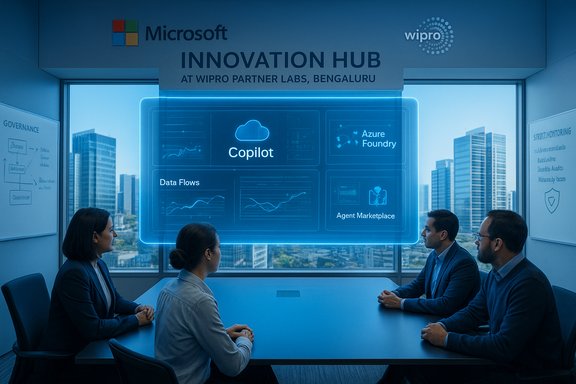
The partnership was unveiled in a Wipro press release on December 12, 2025 and positions the two companies to help enterprises become what Wipro calls “Frontier Firms” — early AI leaders that embed AI into core operations to unlock productivity and new revenue streams. The alliance pairs Wipro’s Wipro Intelligence™ suite and Partner Labs ecosystem with Microsoft’s technologies: Azure, Microsoft 365 Copilot, GitHub Copilot, Azure AI Foundry and related integrations. As announced, the deal runs three years and includes the deployment of more than 50,000 Microsoft Copilot licenses within Wipro and a program to upskill 25,000 Wipro employees on Microsoft Cloud and GitHub technologies. The agreement also inaugurates a Microsoft Innovation Hub in Bengaluru designed for client workshops, co-innovation and access to Wipro’s Agent Marketplace of AI agents built on Microsoft’s AI platform.
This announcement comes days after Microsoft publicly committed to invest US$17.5 billion in India for AI and cloud infrastructure between calendar years 2026 and 2029 — a major national-scale push that frames the Wipro collaboration within a larger wave of platform investments and ecosystem partnerships in India.
For enterprises, the marketplace now provides multiple routes to adopt copilot-driven workflows: direct Microsoft engagements, SI partnerships, or boutique specialists for niche tasks. The strategic choice will depend on required scale, industry compliance needs, and appetite for vendor-managed vs. client-owned solutions.
Strengths of the deal include clear scale ambitions, a blended platform-and-services approach, and a tangible commitment to workforce enablement. However, the initiative faces non-trivial execution risks around governance, vendor dependence, operational cost control, and the real-world depth of skills transfer. Enterprises that engage with the Wipro–Microsoft stack should be deliberate: insist on measurable business outcomes, robust security and compliance controls, and portability where feasible.
This partnership will likely accelerate enterprise experimentation and productionization of agentic AI, but the ultimate test will be whether customers realize sustained, audited improvements in outcomes and whether both partners operationalize responsible, cost-effective AI at scale. The announcement is an important signal of where enterprise AI momentum is headed — platform-scale, partner-enabled, and intensely focused on copilots and agents — but the transformation it promises will be earned only through disciplined implementation, vigilant governance and demonstrable results.
Source: newsdrum.in Wipro, Microsoft ink 3-year AI partnership; launch innovation hub in Bengaluru
 Background
The partnership was unveiled in a Wipro press release on December 12, 2025 and positions the two companies to help enterprises become what Wipro calls “Frontier Firms” — early AI leaders that embed AI into core operations to unlock productivity and new revenue streams. The alliance pairs Wipro’s Wipro Intelligence™ suite and Partner Labs ecosystem with Microsoft’s technologies: Azure, Microsoft 365 Copilot, GitHub Copilot, Azure AI Foundry and related integrations. As announced, the deal runs three years and includes the deployment of more than 50,000 Microsoft Copilot licenses within Wipro and a program to upskill 25,000 Wipro employees on Microsoft Cloud and GitHub technologies. The agreement also inaugurates a Microsoft Innovation Hub in Bengaluru designed for client workshops, co-innovation and access to Wipro’s Agent Marketplace of AI agents built on Microsoft’s AI platform.This announcement comes days after Microsoft publicly committed to invest US$17.5 billion in India for AI and cloud infrastructure between calendar years 2026 and 2029 — a major national-scale push that frames the Wipro collaboration within a larger wave of platform investments and ecosystem partnerships in India.
What the partnership covers
Core technology components
- Microsoft Azure: foundational cloud, compute and data services that will host models, data and services.
- Microsoft 365 Copilot: AI copilots for knowledge work and collaboration.
- GitHub Copilot: AI-assisted software development across Wipro engineering teams and client-facing delivery.
- Azure AI Foundry (and related Azure AI platform capabilities): model lifecycle, orchestration, and productionization tools.
- Wipro Intelligence™: Wipro’s unified suite of AI platforms, including the Wipro Innovation Network, Agent Marketplace and industry IP such as NetOxygen, Wealth AI and Falcon Supply Chain.
- Microsoft Innovation Hub (Bengaluru): a physical and virtual co-innovation space inside Wipro’s Partner Labs for immersive client workshops, pilots and industry-specific solution incubation.
Scope and scale
- Three-year collaboration focused on co-development of industry AI solutions, go-to-market initiatives and customer engagements.
- 50,000+ Microsoft Copilot licenses announced for deployment, intended to accelerate AI-first workflows internally and in client projects.
- 25,000 Wipro employees slated for upskilling on Microsoft Cloud and GitHub technologies to build an “AI-fluent” workforce.
- Joint workstreams across verticals: Financial Services, Retail, Manufacturing, Healthcare & Life Sciences, Airports and other industries.
Why this matters: strategic rationale
For Microsoft
Microsoft gains a larger, trusted services channel to push enterprise consumption of Copilots, Azure AI and SaaS envelopes across the enterprise market. Partnering with a major systems integrator like Wipro accelerates adoption of Microsoft’s sovereign and hyperscale investments in India, leverages Wipro’s global client base, and helps position Microsoft as the backbone for enterprise agentic AI transformations.For Wipro
Wipro secures privileged access to Microsoft’s cutting-edge AI stack and cloud infrastructure at a pivotal moment when customers are accelerating AI projects. The tie-up strengthens Wipro’s consulting-led capabilities with an explicit Copilot and agentic AI payload, gives its engineering teams direct access to Microsoft product roadmaps, and extends Wipro’s packaged IP (NetOxygen, Wealth AI, Falcon Supply Chain) atop Microsoft’s platform — differentiating Wipro’s services play with productized assets.For enterprise customers
Enterprises gain a one-stop avenue to operationalize Microsoft AI technologies with the hands-on services, industry molds and delivery scale of a large SI. The Microsoft Innovation Hub promises faster ideation, pilot-to-production pathways and exposure to agent marketplaces that can shorten time-to-value for AI pilots.The technical picture: what’s being deployed and how
Copilot at scale
Deploying 50,000 Copilot licenses is not just a desktop or seat-count figure; it implies:- Integration of Copilot with corporate data sources and identity systems (Microsoft Entra, Exchange, SharePoint, Teams).
- Data governance and compliance overlays to manage sensitive enterprise information.
- Training and change programs so staff can adopt AI-assisted workflows rather than treating Copilot as an occasional query tool.
Agentic AI and Agent Marketplace
Wipro’s Agent Marketplace — a catalog of pre-built AI agents — will be surfaced through the Innovation Hub and tied into Microsoft AI capabilities. These agents can automate domain tasks (e.g., claims adjudication, supply chain exception handling, revenue reconciliation). Successful productionization requires:- Model governance: versioning, performance and drift monitoring.
- Security and least-privilege access for agents acting on behalf of users.
- Explainability and audit trails to satisfy regulators and internal risk teams.
Azure AI Foundry and lifecycle tooling
Azure AI Foundry and Azure Machine Learning capabilities will underpin model training, validation and deployment pipelines. For customers, that translates to a cloud-native path from prototypes to scalable services with integrated monitoring, cost controls and MLOps.Opportunities and use cases
- Financial Services: AI copilots for financial advisors, automation of KYC/AML reviews, model-assisted fraud triage and personalized customer journeys via Wealth AI.
- Retail: Demand forecasting and inventory optimization via Falcon Supply Chain, AI-driven personalisation across e-commerce and store operations.
- Manufacturing: Predictive maintenance, quality inspection automation, and shop-floor copilots for operators to reduce downtime.
- Healthcare & Life Sciences: Clinical decision-support copilots, improved clinical trial matching, and automation of administrative processes while preserving compliance.
- Airports & Transportation: Passenger experience agents, dynamic resource allocation, and incident response assistants.
Cross-market context: why now?
The announcement aligns with several converging trends:- Cloud hyperscale expansion in India: Microsoft’s $17.5 billion commitment for 2026–2029 reflects an infrastructure buildout that makes large-scale AI projects more viable for Indian enterprises and global customers with Indian operations.
- SaaS Copilot momentum: Microsoft’s push to embed Copilot across Microsoft 365 and enterprise endpoints has created a new purchasing axis — platform subscription plus consulting to tailor Copilot to domain workflows.
- Systems integrator consolidation: TCS, Infosys, Cognizant and others have recently announced Copilot and AI partnerships and internal deployments. Large SIs are racing to productize AI services to create recurring, platform-linked revenue.
- Regulatory and sovereign cloud concerns: Enterprises are prioritizing in-country data processing and sovereign-ready architectures in regulated industries. Microsoft’s announcements about local processing for Copilot reinforce the choice of platform for companies with strict data residency needs.
Strengths of the deal
- Scale and credibility: A three-year formal arrangement plus a physical innovation hub indicates commitment beyond piecemeal pilots.
- Platform-plus-services model: Combining Microsoft’s AI stack with Wipro’s industry IP and delivery capacity reduces friction for enterprise adoption.
- Workforce upskilling: The announced 25,000-person upskilling program addresses the execution gap and boosts Wipro’s capacity to deliver at scale.
- Client Zero focus: Wipro’s intention to be an early adopter internally helps turn their own experience into refined, battle-tested offerings for customers.
- Ecosystem leverage: The hub and Agent Marketplace can accelerate reusable solution creation, shortening time-to-market for industry solutions.
Risks and limits — what to watch closely
1. Vendor lock-in and platform dependence
A deep integration with Microsoft Copilot, Azure AI Foundry and GitHub tooling can create high switching costs. Enterprises should be cautious about how much IP, data and automation logic becomes tied to a single tech stack, especially if multi-cloud or multi-model strategies are preferred.2. Data governance, privacy and compliance
Deploying Copilot and agentic AI across enterprise data pools introduces questions around:- Where prompts and outputs are processed — onshore vs. off-shore.
- Retention policies for prompts and generated content.
- Risk of accidental data leakage to models without proper prompt redaction and toolchain isolation.
3. Model risk and explainability
Agentic AI can take actions that are complex to explain. For regulated industries (finance, healthcare, public sector) this raises concerns about accountability and liability when agents make decisions. Model validation, provenance, and fall-back controls will be essential.4. Upskilling vs. reskilling reality gap
Announcing training for 25,000 employees is a strong signal, but the depth of that training matters. Superficial certifications won’t produce AI-savvy architects; companies will need extended learning paths, hands-on labs, and role-based competency frameworks to truly deliver on AI projects.5. Operationalization and cost management
Running agentic AI at scale is expensive. GPU cycles, storage, monitoring, and continuous retraining add ongoing operational costs. Without granular cost governance, early productivity gains can be eroded by runaway infrastructure spend.6. Marketplace quality variability
Agent marketplaces are only as useful as the quality and governance of the agents listed. Customers must validate performance, security posture and compliance of third-party or partner-built agents before production use.How enterprises should evaluate this offering
When assessing Wipro–Microsoft co-developed solutions, organizations should run a disciplined evaluation:- Map business outcomes: prioritize use cases with measurable KPIs (reduction in cycle time, increased revenue per customer, error reduction).
- Demand a technical runbook: require documentation on data flows, model training datasets, drift monitoring and incident response.
- Insist on contractual protections: clear SLAs, data residency clauses, IP ownership, and liability terms where agents perform decisions with material impact.
- Require pilots with representative data: one-off demos are insufficient; pilots must use realistic production-like data and measure end-to-end performance and cost.
- Verify upskilling depth: request evidence of role-based certifications, hands-on projects, and the presence of embedded AI engineers on engagement teams.
- Plan for multicloud/portability: where feasible, design solutions so key logic and data can be ported or abstracted from a single cloud provider.
Competitive landscape and industry reaction
The Wipro partnership sits alongside similar engagements between Microsoft and other large SIs. In the same timeframe, major Indian and global systems integrators publicly announced Copilot deployments and joint initiatives with Microsoft. The outcome is a rapidly maturing SI-led Copilot ecosystem where platform vendor partnerships and prepackaged industry IP will become a differentiator.For enterprises, the marketplace now provides multiple routes to adopt copilot-driven workflows: direct Microsoft engagements, SI partnerships, or boutique specialists for niche tasks. The strategic choice will depend on required scale, industry compliance needs, and appetite for vendor-managed vs. client-owned solutions.
Financial and business model implications
- The shift toward packaged AI solutions and Copilot subscriptions suggests SI revenue mixes will tilt from pure services (time-and-material) to hybrid models — subscription, outcomes-based, and managed services.
- For Microsoft, expanding Copilot seat consumption across SI clients creates sticky revenue and deeper enterprise lock-in for productivity suites.
- Wipro can monetize industry IP and the Agent Marketplace through recurring managed services and implementation fees, but must invest continuously in IP maintenance as models evolve.
Implementation checklist for CIOs and procurement teams
- Confirm which Copilot workloads will be processed within-country and secure contractual language that matches regulatory needs.
- Conduct a security posture review of Wipro’s Partner Labs and Microsoft Innovation Hub integration points if remote or on-premise connectivity is required.
- Plan a phased deployment: pilot, measured roll-out, operationalize, then scale.
- Budget for lifecycle costs: model maintenance, compute, MLOps tooling, and retraining pipelines.
- Set governance: appoint an AI risk officer, define KPIs, and schedule regular model audits.
- Negotiate exit and data extraction clauses in case the strategy needs to pivot.
Where the claim lines blur — cautionary notes
Some headline numbers — such as the deployment of over 50,000 Copilot licenses — reflect commercial commitments and initial deployments, but the real-world value depends on adoption rate, active usage, integration depth and measured business outcomes. Similarly, the pledge to upskill 25,000 employees is meaningful, but the long-term impact hinges on the quality and retention of those skills. Enterprises and investors should treat these announcements as strong signals of intent rather than guarantees of immediate business transformation.Looking ahead: what success will look like
Over the three-year horizon, measurable success for this partnership would include:- Realized productivity improvements measurable across targeted functions (e.g., 20–30% reduction in time-to-serve for key processes).
- Multiple industry-grade copilots and agents in production with monitored SLAs, clear governance, and demonstrable ROI.
- A stable pipeline of co-developed IP and repeatable offerings selling through joint GTM channels.
- Evidence of responsible AI practices: routine audits, bias mitigation, clear model lineage and compliance with data protection requirements.
Final analysis and verdict
The Wipro–Microsoft three-year partnership and the opening of the Microsoft Innovation Hub in Bengaluru are consequential moves in the enterprise AI landscape. They marry a leading global SI’s industry IP and delivery scale with Microsoft’s sprawling cloud and Copilot ecosystem at a moment when hyperscale infrastructure investments are accelerating in India and beyond.Strengths of the deal include clear scale ambitions, a blended platform-and-services approach, and a tangible commitment to workforce enablement. However, the initiative faces non-trivial execution risks around governance, vendor dependence, operational cost control, and the real-world depth of skills transfer. Enterprises that engage with the Wipro–Microsoft stack should be deliberate: insist on measurable business outcomes, robust security and compliance controls, and portability where feasible.
This partnership will likely accelerate enterprise experimentation and productionization of agentic AI, but the ultimate test will be whether customers realize sustained, audited improvements in outcomes and whether both partners operationalize responsible, cost-effective AI at scale. The announcement is an important signal of where enterprise AI momentum is headed — platform-scale, partner-enabled, and intensely focused on copilots and agents — but the transformation it promises will be earned only through disciplined implementation, vigilant governance and demonstrable results.
Source: newsdrum.in Wipro, Microsoft ink 3-year AI partnership; launch innovation hub in Bengaluru
