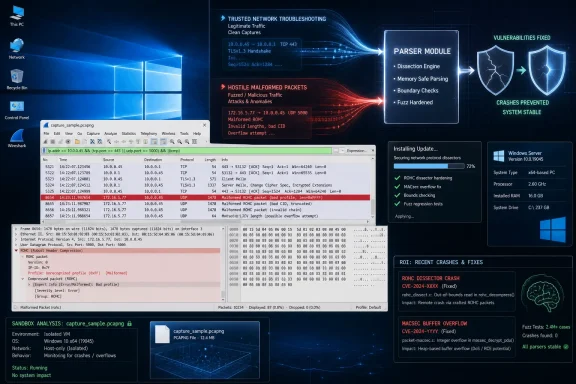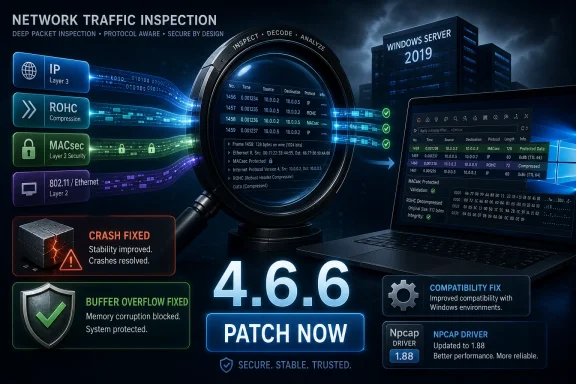
Wireshark 4.6.6, released by the Wireshark Foundation on May 19, 2026, fixes a ROHC protocol dissector crash, a MACsec global-buffer-overflow bug, Windows compatibility regressions, installer problems, and several fuzzing-discovered parser failures affecting the widely used packet analysis tool. The release is not a flashy feature drop; it is a maintenance build with a security lesson written between the lines. Packet analyzers sit at the uncomfortable boundary between trusted tools and hostile input, and Wireshark’s latest update shows how thin that boundary can be. For Windows admins, network engineers, and incident responders, the message is simple: the software used to inspect suspicious traffic must be patched with the same urgency as the systems it protects.
Wireshark occupies a privileged place in modern troubleshooting. It is the tool administrators reach for when DNS looks strange, TLS handshakes fail, VoIP calls stutter, or malware seems to be talking to something it should not. That ubiquity is exactly why a parser crash matters more than it might appear at first glance.
A packet capture is often treated as evidence, not executable risk. Analysts download it, open it, filter it, share it, and attach it to tickets. In many environments, a
Wireshark 4.6.6 is a reminder that this confidence has limits. The application is built to parse complex, frequently malformed, and sometimes deliberately hostile binary data. Every dissector is a small interpreter for a protocol’s structure, and every interpreter can be pushed into states its authors did not expect.
That does not mean Wireshark is unusually unsafe. It means Wireshark is doing a hard job in a hostile neighborhood. The 4.6.6 release matters because it tightens the defenses around that job at a moment when the security industry is belatedly recognizing that defensive tooling is also software exposed to adversarial input.
The vulnerability affects Wireshark 4.6.0 through 4.6.5 and the 4.4 branch through 4.4.15. The fix lands in Wireshark 4.6.6 and 4.4.16. According to the project’s advisory, a malformed packet could crash the ROHC dissector either when seen on the wire or when loaded from a crafted packet trace file.
That distinction is important. A live packet injection attack is plausible in some network positions, but the more familiar path for many organizations is the capture file. Incident responders routinely accept traces from customers, subsidiaries, vendors, researchers, and compromised environments. A malicious capture that reliably knocks over the analyst’s tool is not dramatic in the way remote code execution is dramatic, but it is still an attack on the investigative workflow.
The Wireshark project says it is unaware of active exploitation. That should calm panic, not reduce urgency. A crash in a protocol dissector is a denial-of-service condition against the analyst and, in some deployments, against monitoring or automated triage systems that process captures as part of a pipeline.
This is where the language of “critical” needs care. The official advisory describes a dissector crash, not a confirmed code-execution bug. But in operational terms, a crashable packet analyzer is still serious because the people opening the file are often the people trying to understand an intrusion while the clock is running.
A global-buffer-overflow bug is the sort of phrase that makes security engineers sit up straighter. The release notes do not frame this as a known remote-code-execution vulnerability, and it would be irresponsible to claim more than the project has disclosed. Still, memory boundary errors in parsers deserve attention because history has repeatedly shown how “just a crash” can become something worse under the right conditions.
The broader pattern is more revealing than any single bug. Wireshark’s value comes from its ability to decode a huge range of protocols, file formats, and capture types. That same range creates a maintenance burden that never really ends.
Protocol dissectors are inherently exposed to untrusted input. A malformed field length, a strange compression sequence, a nested structure, or an unexpected edge case can send a parser down a path that ordinary testing never covered. Wireshark’s release cadence shows the project is actively finding and fixing those cases, but it also shows why packet analysis can never be treated as a solved problem.
The technique is straightforward in concept: feed the program large volumes of malformed, mutated, or unexpected data and watch for crashes, hangs, memory errors, and undefined behavior. For a tool like Wireshark, which must interpret thousands of packet structures, fuzzing is not optional hygiene. It is the only realistic way to cover enough weirdness.
This is particularly true because real network traffic is messy. Captures are truncated, corrupted, tunneled, encapsulated, anonymized, exported by appliances, rewritten by tools, and generated by devices that interpret standards with varying degrees of enthusiasm. Attackers do not need to invent impossible inputs; they only need to find the inputs that a parser handles badly.
The good news is that the Wireshark project appears to be finding these bugs before they become public exploitation stories. The less comfortable news is that the bugs keep coming because the attack surface keeps expanding. Every new protocol, every new capture format, and every new convenience feature adds another parser path that needs to be defended.
That is the tradeoff users implicitly accept. A minimal packet viewer would be safer in one sense and useless in another. Wireshark remains valuable because it understands so much, and it remains security-sensitive for the same reason.
LTSC and server-era Windows builds are common in places where stability matters more than novelty: industrial networks, monitoring appliances, lab systems, regulated environments, and enterprise workstations managed on long refresh cycles. A packet analyzer that suddenly stops launching on those systems is not a minor annoyance. It can break a troubleshooting path that admins rely on when something else is already broken.
The release also fixes a crash when Wireshark is run under Visual Studio on Windows. That matters for developers and protocol engineers who use Wireshark alongside debugging tools, custom dissectors, or application test environments. Wireshark is not only an admin utility; it is part of the developer workflow for anyone building software that speaks over a network.
Then there is Npcap. Wireshark 4.6.6 updates the bundled Windows packet capture library from Npcap 1.87 to 1.88. Npcap is the layer that makes modern Wireshark capture practical on Windows, so changes there can affect interface enumeration, capture stability, driver behavior, and compatibility with unusual network setups.
None of these fixes will generate the same attention as a named vulnerability. But for administrators, they may determine whether the tool is deployable at all. Security patches that break old platforms create friction; security patches that restore compatibility are much easier to roll out quickly.
If a deployment tool pushes an update and silently drops optional components, administrators may not notice until a workflow fails. A capture helper, plugin, shortcut, integration, or related utility that disappears during an update can create support tickets that look unrelated to the upgrade itself. The real cost is not the missing component; it is the time spent rediscovering the dependency.
The release also fixes a packaging anomaly in which the Wireshark 4.6.5 executable became roughly twice as large as the 4.6.4 version. On a single workstation, that is mostly trivia. In tightly managed environments, unexpectedly large binaries can trip distribution rules, storage assumptions, allow-listing processes, or deployment validation checks.
This is the unglamorous side of security maintenance. Vendors and open-source projects often tell users to update immediately, and they are usually right. But enterprise administrators know that every update is also a packaging event, a compatibility test, and sometimes a rollback risk.
Wireshark 4.6.6 is stronger because it addresses both sides of that equation. It fixes parser bugs that security teams should not ignore, while also cleaning up the deployment issues that could have slowed adoption of the fix.
A protocol analyzer used in enterprise settings is rarely just the upstream application. It may be bundled with local profiles, custom coloring rules, display filters, proprietary protocol dissectors, extcap integrations, and training material tied to a specific version. A branch update can therefore ripple through more than the executable.
Wireshark 4.6.6 does not introduce new protocol support, but it updates support for protocols including BACapp, BPv7, Kafka, MACsec, PFCP, RF4CE, ROHC, RTPS-VT, SAPHDB, and SIP. It also updates capture file handling for JSON and VeriWave formats. That is the shape of a stabilization release: fewer headlines, more small corrections in places where real users already found pain.
The Unix extcap directory note fits the same pattern. The project now documents that, on Unix-like systems outside macOS app-bundle installs, extcap binaries are searched under a libexec path by default, with an environment variable available to override the location. The behavior dates back to 4.6.0, but documenting it now matters for package maintainers and admins who support external capture tools.
That detail may not affect a Windows desktop user. It absolutely affects organizations that package Wireshark across mixed fleets, build internal capture appliances, or depend on third-party extcap utilities for specialized hardware. In networking, “where does the helper binary live?” is not a philosophical question; it is the difference between a capture source appearing and vanishing.
Wireshark is a classic example of this inversion. The more useful it is during an incident, the more likely it is to be pointed at malicious traffic, suspicious files, and artifacts from compromised hosts. Its input is not merely untrusted in theory; it is often known-bad by design.
That has practical consequences. Analysts should avoid opening unknown captures casually on privileged daily-driver machines. Organizations handling hostile samples should consider isolated analysis workstations, disposable virtual machines, and controlled sharing paths for packet traces. Those mitigations are not a substitute for patching, but they reduce the blast radius when the next parser bug appears.
This is especially relevant because Wireshark is often installed on systems with elevated operational importance. A network engineer’s workstation may have VPN access, management consoles, saved credentials, jump-host routes, and privileged visibility. Even if a given bug only crashes Wireshark, the habit of treating analysis files as harmless is worth breaking.
The right model is not paranoia. It is symmetry. If defenders expect attackers to abuse Office macros, PDF readers, archive tools, and browser parsers, they should expect them to probe packet parsers too.
For Wireshark, the risk calculus is different from a typical desktop app. The users most likely to open hostile captures are also the users most likely to be working active investigations. The attacker does not need every Wireshark installation in the world to be vulnerable. They need the right analyst, the right file, and the right moment.
There is also a disclosure asymmetry. A crash caused by a malformed packet trace may be dismissed as ordinary tool instability, especially during a messy incident. Unless someone isolates the sample and reproduces the failure, exploitation attempts may not look like exploitation attempts at all.
That makes proactive updating the sensible default. The fixes are available, the affected versions are known, and the operational downside of remaining on 4.6.5 is higher now that 4.6.6 also fixes Windows compatibility and installer behavior. For organizations on the 4.4 branch, 4.4.16 provides the corresponding security fix.
The more cautious position is not to wait for a proof-of-concept. It is to assume that malformed-capture bugs will continue to be discovered and to make Wireshark updates part of the same patch rhythm as browsers, VPN clients, and remote-management tools.
The Windows 10 version 1809 and Server 2019 compatibility fix should remove one obvious blocker. Many organizations still operate Server 2019 systems in monitoring, lab, and infrastructure roles, and LTSC deployments exist precisely because admins want predictable behavior over fast feature churn. A patch that restores support for those environments deserves attention.
The Npcap update also strengthens the case for moving forward. Packet capture on Windows has always depended on the quality and compatibility of the capture driver layer. Even when a Wireshark release is framed around dissectors, Windows reliability often lives one layer below the GUI.
There is a second-order benefit as well. Standardizing on 4.6.6 reduces confusion for teams that share captures. If one analyst’s Wireshark crashes on a file that another analyst can open, the investigation immediately gains a side quest. Keeping teams aligned on a patched version makes the toolchain less noisy.
That matters because the point of Wireshark is clarity. The application is supposed to reduce uncertainty about what the network is doing. When the analyzer itself becomes uncertain, the entire troubleshooting process slows down.
Wireshark’s enduring strength is that it makes invisible network behavior visible, but 4.6.6 shows the cost of that visibility: the analyzer must continually absorb the complexity and hostility of the networks it observes. This release will not be remembered as a milestone feature upgrade, and that is exactly the point. The next era of defensive tooling will be judged less by the number of protocols it understands than by how safely it can stare into malformed, adversarial data without blinking.
The Packet Analyzer Has Become Part of the Attack Surface
Wireshark occupies a privileged place in modern troubleshooting. It is the tool administrators reach for when DNS looks strange, TLS handshakes fail, VoIP calls stutter, or malware seems to be talking to something it should not. That ubiquity is exactly why a parser crash matters more than it might appear at first glance.A packet capture is often treated as evidence, not executable risk. Analysts download it, open it, filter it, share it, and attach it to tickets. In many environments, a
.pcap file moves through email, case-management systems, malware labs, and vendor support channels with less suspicion than a Word document from the same source.Wireshark 4.6.6 is a reminder that this confidence has limits. The application is built to parse complex, frequently malformed, and sometimes deliberately hostile binary data. Every dissector is a small interpreter for a protocol’s structure, and every interpreter can be pushed into states its authors did not expect.
That does not mean Wireshark is unusually unsafe. It means Wireshark is doing a hard job in a hostile neighborhood. The 4.6.6 release matters because it tightens the defenses around that job at a moment when the security industry is belatedly recognizing that defensive tooling is also software exposed to adversarial input.
ROHC Is the Headline, but the Real Story Is Trusting Captures
The main security advisory in this release covers a crash in Wireshark’s ROHC dissector, tracked as wnpa-sec-2026-51 and Issue 21243. ROHC, or Robust Header Compression, is used to reduce overhead in constrained network environments, particularly where bandwidth efficiency matters. That kind of protocol is exactly the sort of thing Wireshark must understand if it is to remain useful outside simple office Ethernet captures.The vulnerability affects Wireshark 4.6.0 through 4.6.5 and the 4.4 branch through 4.4.15. The fix lands in Wireshark 4.6.6 and 4.4.16. According to the project’s advisory, a malformed packet could crash the ROHC dissector either when seen on the wire or when loaded from a crafted packet trace file.
That distinction is important. A live packet injection attack is plausible in some network positions, but the more familiar path for many organizations is the capture file. Incident responders routinely accept traces from customers, subsidiaries, vendors, researchers, and compromised environments. A malicious capture that reliably knocks over the analyst’s tool is not dramatic in the way remote code execution is dramatic, but it is still an attack on the investigative workflow.
The Wireshark project says it is unaware of active exploitation. That should calm panic, not reduce urgency. A crash in a protocol dissector is a denial-of-service condition against the analyst and, in some deployments, against monitoring or automated triage systems that process captures as part of a pipeline.
This is where the language of “critical” needs care. The official advisory describes a dissector crash, not a confirmed code-execution bug. But in operational terms, a crashable packet analyzer is still serious because the people opening the file are often the people trying to understand an intrusion while the clock is running.
MACsec Shows Memory Safety Is Still the Hard Problem
Wireshark 4.6.6 also fixes a MACsec dissector global-buffer-overflow issue tracked as Issue 21235. MACsec, formally IEEE 802.1AE, is used to protect Ethernet links, especially in enterprise and data-center environments where layer-2 security matters. In other words, this is not an exotic academic protocol hiding in a corner of the codebase.A global-buffer-overflow bug is the sort of phrase that makes security engineers sit up straighter. The release notes do not frame this as a known remote-code-execution vulnerability, and it would be irresponsible to claim more than the project has disclosed. Still, memory boundary errors in parsers deserve attention because history has repeatedly shown how “just a crash” can become something worse under the right conditions.
The broader pattern is more revealing than any single bug. Wireshark’s value comes from its ability to decode a huge range of protocols, file formats, and capture types. That same range creates a maintenance burden that never really ends.
Protocol dissectors are inherently exposed to untrusted input. A malformed field length, a strange compression sequence, a nested structure, or an unexpected edge case can send a parser down a path that ordinary testing never covered. Wireshark’s release cadence shows the project is actively finding and fixing those cases, but it also shows why packet analysis can never be treated as a solved problem.
Fuzzing Is Doing the Boring Work Security Actually Needs
Several items in Wireshark 4.6.6 have the fingerprints of fuzz testing. The release notes mention fuzz-job issues tied to May 2026 packet capture samples, along with the ROHC and MACsec fixes. Fuzzing is not glamorous, but it is one of the most productive ways to harden software that consumes complex binary input.The technique is straightforward in concept: feed the program large volumes of malformed, mutated, or unexpected data and watch for crashes, hangs, memory errors, and undefined behavior. For a tool like Wireshark, which must interpret thousands of packet structures, fuzzing is not optional hygiene. It is the only realistic way to cover enough weirdness.
This is particularly true because real network traffic is messy. Captures are truncated, corrupted, tunneled, encapsulated, anonymized, exported by appliances, rewritten by tools, and generated by devices that interpret standards with varying degrees of enthusiasm. Attackers do not need to invent impossible inputs; they only need to find the inputs that a parser handles badly.
The good news is that the Wireshark project appears to be finding these bugs before they become public exploitation stories. The less comfortable news is that the bugs keep coming because the attack surface keeps expanding. Every new protocol, every new capture format, and every new convenience feature adds another parser path that needs to be defended.
That is the tradeoff users implicitly accept. A minimal packet viewer would be safer in one sense and useless in another. Wireshark remains valuable because it understands so much, and it remains security-sensitive for the same reason.
Windows Users Get More Than a Security Patch
For WindowsForum readers, the Windows-specific fixes may be just as relevant as the security advisory. Wireshark 4.6.6 resolves a regression in 4.6.5 that prevented the application from running on Windows 10 version 1809, including Windows Server 2019 and some Long-Term Servicing Channel deployments. That is not a niche concern in enterprise networks.LTSC and server-era Windows builds are common in places where stability matters more than novelty: industrial networks, monitoring appliances, lab systems, regulated environments, and enterprise workstations managed on long refresh cycles. A packet analyzer that suddenly stops launching on those systems is not a minor annoyance. It can break a troubleshooting path that admins rely on when something else is already broken.
The release also fixes a crash when Wireshark is run under Visual Studio on Windows. That matters for developers and protocol engineers who use Wireshark alongside debugging tools, custom dissectors, or application test environments. Wireshark is not only an admin utility; it is part of the developer workflow for anyone building software that speaks over a network.
Then there is Npcap. Wireshark 4.6.6 updates the bundled Windows packet capture library from Npcap 1.87 to 1.88. Npcap is the layer that makes modern Wireshark capture practical on Windows, so changes there can affect interface enumeration, capture stability, driver behavior, and compatibility with unusual network setups.
None of these fixes will generate the same attention as a named vulnerability. But for administrators, they may determine whether the tool is deployable at all. Security patches that break old platforms create friction; security patches that restore compatibility are much easier to roll out quickly.
The Installer Bugs Are a Warning About Enterprise Reality
Wireshark 4.6.6 also corrects an upgrade issue in which optional Windows features were not retained unless users explicitly requested them, causing accidental feature removal during upgrades. That sort of problem sounds mundane until it happens at scale. In a managed software estate, installation defaults are not just preferences; they are operational state.If a deployment tool pushes an update and silently drops optional components, administrators may not notice until a workflow fails. A capture helper, plugin, shortcut, integration, or related utility that disappears during an update can create support tickets that look unrelated to the upgrade itself. The real cost is not the missing component; it is the time spent rediscovering the dependency.
The release also fixes a packaging anomaly in which the Wireshark 4.6.5 executable became roughly twice as large as the 4.6.4 version. On a single workstation, that is mostly trivia. In tightly managed environments, unexpectedly large binaries can trip distribution rules, storage assumptions, allow-listing processes, or deployment validation checks.
This is the unglamorous side of security maintenance. Vendors and open-source projects often tell users to update immediately, and they are usually right. But enterprise administrators know that every update is also a packaging event, a compatibility test, and sometimes a rollback risk.
Wireshark 4.6.6 is stronger because it addresses both sides of that equation. It fixes parser bugs that security teams should not ignore, while also cleaning up the deployment issues that could have slowed adoption of the fix.
The 4.6 Branch Is Still Settling Into Itself
The release notes also mention an API and ABI compatibility issue introduced in Wireshark 4.6.1 that affected plugins built for Wireshark 4.6.0. This is a subtle but important point for advanced users. Wireshark’s extensibility is one of its strengths, but plugin compatibility is a real concern for organizations that rely on custom dissectors or specialized workflows.A protocol analyzer used in enterprise settings is rarely just the upstream application. It may be bundled with local profiles, custom coloring rules, display filters, proprietary protocol dissectors, extcap integrations, and training material tied to a specific version. A branch update can therefore ripple through more than the executable.
Wireshark 4.6.6 does not introduce new protocol support, but it updates support for protocols including BACapp, BPv7, Kafka, MACsec, PFCP, RF4CE, ROHC, RTPS-VT, SAPHDB, and SIP. It also updates capture file handling for JSON and VeriWave formats. That is the shape of a stabilization release: fewer headlines, more small corrections in places where real users already found pain.
The Unix extcap directory note fits the same pattern. The project now documents that, on Unix-like systems outside macOS app-bundle installs, extcap binaries are searched under a libexec path by default, with an environment variable available to override the location. The behavior dates back to 4.6.0, but documenting it now matters for package maintainers and admins who support external capture tools.
That detail may not affect a Windows desktop user. It absolutely affects organizations that package Wireshark across mixed fleets, build internal capture appliances, or depend on third-party extcap utilities for specialized hardware. In networking, “where does the helper binary live?” is not a philosophical question; it is the difference between a capture source appearing and vanishing.
The Security Toolchain Needs Its Own Threat Model
The release lands amid a broader shift in how defenders think about their own tools. For years, security software was often treated as inherently trustworthy because its purpose was defensive. That assumption has aged badly. Endpoint agents, scanners, forensic tools, log parsers, archive handlers, and packet analyzers all consume attacker-controlled data.Wireshark is a classic example of this inversion. The more useful it is during an incident, the more likely it is to be pointed at malicious traffic, suspicious files, and artifacts from compromised hosts. Its input is not merely untrusted in theory; it is often known-bad by design.
That has practical consequences. Analysts should avoid opening unknown captures casually on privileged daily-driver machines. Organizations handling hostile samples should consider isolated analysis workstations, disposable virtual machines, and controlled sharing paths for packet traces. Those mitigations are not a substitute for patching, but they reduce the blast radius when the next parser bug appears.
This is especially relevant because Wireshark is often installed on systems with elevated operational importance. A network engineer’s workstation may have VPN access, management consoles, saved credentials, jump-host routes, and privileged visibility. Even if a given bug only crashes Wireshark, the habit of treating analysis files as harmless is worth breaking.
The right model is not paranoia. It is symmetry. If defenders expect attackers to abuse Office macros, PDF readers, archive tools, and browser parsers, they should expect them to probe packet parsers too.
The Absence of Exploitation Is Not a Permission Slip
The official advisory says the Wireshark team is unaware of exploits for the ROHC issue. That is meaningful, but it should not become an excuse for delay. Many organizations patch only when exploitation is confirmed, which is another way of saying they prefer to move after the race has started.For Wireshark, the risk calculus is different from a typical desktop app. The users most likely to open hostile captures are also the users most likely to be working active investigations. The attacker does not need every Wireshark installation in the world to be vulnerable. They need the right analyst, the right file, and the right moment.
There is also a disclosure asymmetry. A crash caused by a malformed packet trace may be dismissed as ordinary tool instability, especially during a messy incident. Unless someone isolates the sample and reproduces the failure, exploitation attempts may not look like exploitation attempts at all.
That makes proactive updating the sensible default. The fixes are available, the affected versions are known, and the operational downside of remaining on 4.6.5 is higher now that 4.6.6 also fixes Windows compatibility and installer behavior. For organizations on the 4.4 branch, 4.4.16 provides the corresponding security fix.
The more cautious position is not to wait for a proof-of-concept. It is to assume that malformed-capture bugs will continue to be discovered and to make Wireshark updates part of the same patch rhythm as browsers, VPN clients, and remote-management tools.
For Windows Admins, the Patch Priority Is Higher Than It Looks
On paper, this release fixes a crash rather than a confirmed system compromise. In practice, Windows admins should treat it as a priority update because Wireshark is often deployed in places where failure is expensive. A broken packet analyzer during an outage can prolong downtime just as surely as a broken service.The Windows 10 version 1809 and Server 2019 compatibility fix should remove one obvious blocker. Many organizations still operate Server 2019 systems in monitoring, lab, and infrastructure roles, and LTSC deployments exist precisely because admins want predictable behavior over fast feature churn. A patch that restores support for those environments deserves attention.
The Npcap update also strengthens the case for moving forward. Packet capture on Windows has always depended on the quality and compatibility of the capture driver layer. Even when a Wireshark release is framed around dissectors, Windows reliability often lives one layer below the GUI.
There is a second-order benefit as well. Standardizing on 4.6.6 reduces confusion for teams that share captures. If one analyst’s Wireshark crashes on a file that another analyst can open, the investigation immediately gains a side quest. Keeping teams aligned on a patched version makes the toolchain less noisy.
That matters because the point of Wireshark is clarity. The application is supposed to reduce uncertainty about what the network is doing. When the analyzer itself becomes uncertain, the entire troubleshooting process slows down.
The Practical Lesson Hidden in 4.6.6
Wireshark 4.6.6 is best understood as a hardening release with direct consequences for anyone who opens packet traces from outside their own machine. It fixes one formally disclosed security advisory, several parser and capture-file handling problems, and multiple Windows deployment issues that could otherwise slow adoption.- Organizations running Wireshark 4.6.0 through 4.6.5 should move to 4.6.6, while those on the 4.4 branch should move to 4.4.16 or later.
- Analysts should treat externally supplied
.pcapand trace files as untrusted input, not as inert evidence. - Windows shops affected by Wireshark 4.6.5 compatibility problems on Windows 10 version 1809, Server 2019, or related LTSC builds have a specific operational reason to update.
- Teams using custom plugins, extcap tools, or managed installers should test the upgrade path rather than assuming a packet analyzer is a standalone desktop utility.
- Security programs should include Wireshark and similar forensic tools in patch SLAs, because defensive software can still be attacked through the data it inspects.
Wireshark’s enduring strength is that it makes invisible network behavior visible, but 4.6.6 shows the cost of that visibility: the analyzer must continually absorb the complexity and hostility of the networks it observes. This release will not be remembered as a milestone feature upgrade, and that is exactly the point. The next era of defensive tooling will be judged less by the number of protocols it understands than by how safely it can stare into malformed, adversarial data without blinking.
References
- Primary source: LinkedIn
Published: 2026-05-25T19:30:08.021178
Wireshark 4.6.6 Patches Critical ROHC and MACsec Vulnerabilities
The latest release of Wireshark has arrived with a significant security overhaul, as developers moved swiftly to address multiple vulnerabilities that could allow malformed network traffic or crafted packet capture files to crash the widely used network analysis platform. Version 4.www.linkedin.com
- Related coverage: wireshark.org
Wireshark • Go Deep | Wireshark • wnpa-sec-2026-51 ROHC protocol dissector crash
Wireshark: The world's most popular network protocol analyzerwww.wireshark.org
- Related coverage: thecyberexpress.com
Wireshark 4.6.6 Resolves ROHC Parser and Buffer Overflow Vulnerabilities
The Wireshark Foundation has released Wireshark 4.6.6, delivering an important round of security and stability updates that address a serious
thecyberexpress.com
- Related coverage: cryptika.com
- Related coverage: linuxiac.com
Wireshark 4.6.6 Packet Analyzer Released with ROHC Security Fix
Wireshark 4.6.6 network protocol analyzer fixes a ROHC dissector crash, updates Npcap to 1.88, and resolves several Windows and protocol-related bugs.
linuxiac.com
- Related coverage: windowsforum.com
Wireshark 4.6.6 Fixes ROHC Crash, MACsec Overflow, Windows Compatibility
Wireshark 4.6.6, released May 19, 2026, fixes a ROHC protocol dissector crash in the 4.6 and 4.4 branches, corrects a MACsec global-buffer-overflow bug, and rolls in Windows stability fixes including Npcap 1.88 and repairs for Windows Server 2019-era compatibility. That makes this less a flashy...
windowsforum.com
- Related coverage: sharkfest.wireshark.org