

A critical remote‑code‑execution flaw in Windows Server Update Services (WSUS) has forced an emergency patch cycle and urgent remediation guidance: an unsafe deserialization weakness in WSUS web services allows an unauthenticated attacker to send a crafted SOAP/HTTP request that is decrypted and deserialized by legacy .NET code, resulting in arbitrary code execution under the WSUS process (typically SYSTEM). Microsoft issued out‑of‑band cumulative updates in late October 2025 to close the gap after initial Patch Tuesday fixes proved incomplete; public proof‑of‑concept exploit code and active scanning/exploitation reports pushed risk from theoretical to immediate remediation priority.
Windows Server Update Services (WSUS) is the on‑premises service Microsoft customers use to stage, approve, and distribute updates to managed Windows endpoints. Because WSUS is a trusted distribution point inside enterprise networks, any vulnerability that yields code execution on a WSUS host is exceptional: a compromised WSUS server can be used to deliver malicious packages, manipulate update metadata, or act as a privileged pivot for lateral movement. The issue publicly tracked in vendor advisories and incident reports is a pre‑authentication, network‑accessible remote code execution (RCE) that arises from unsafe deserialization in WSUS reporting/client web services. A note about CVE identifiers and the record: public reporting, vendor advisories, NVD and national CERT guidance for this specific WSUS deserialization RCE use the identifier CVE‑2025‑59287 and list a CVSS v3 base score of 9.8 (Critical). Searches for a matching WSUS RCE under CVE‑2026‑20856 do not return authoritative entries in the usual vendor and NVD catalogs; therefore the WSUS emergency event customers must respond to is widely documented as CVE‑2025‑59287. Treat any alternate CVE string with caution and always confirm the CVE and KB mapping against Microsoft’s Update Guide or your patch-management console before deployment.
Source: MSRC Security Update Guide - Microsoft Security Response Center
 Background / Overview
Windows Server Update Services (WSUS) is the on‑premises service Microsoft customers use to stage, approve, and distribute updates to managed Windows endpoints. Because WSUS is a trusted distribution point inside enterprise networks, any vulnerability that yields code execution on a WSUS host is exceptional: a compromised WSUS server can be used to deliver malicious packages, manipulate update metadata, or act as a privileged pivot for lateral movement. The issue publicly tracked in vendor advisories and incident reports is a pre‑authentication, network‑accessible remote code execution (RCE) that arises from unsafe deserialization in WSUS reporting/client web services. A note about CVE identifiers and the record: public reporting, vendor advisories, NVD and national CERT guidance for this specific WSUS deserialization RCE use the identifier CVE‑2025‑59287 and list a CVSS v3 base score of 9.8 (Critical). Searches for a matching WSUS RCE under CVE‑2026‑20856 do not return authoritative entries in the usual vendor and NVD catalogs; therefore the WSUS emergency event customers must respond to is widely documented as CVE‑2025‑59287. Treat any alternate CVE string with caution and always confirm the CVE and KB mapping against Microsoft’s Update Guide or your patch-management console before deployment. How the vulnerability works — technical summary
Unsafe deserialization in WSUS web services
At a technical level the flaw is a classic unsafe deserialization defect (CWE‑502). WSUS receives an encrypted object (commonly an AuthorizationCookie or a similar serialized payload) from clients via its SOAP/HTTP endpoints, decrypts the payload and then hands the plaintext bytes to a legacy .NET deserializer (BinaryFormatter/SoapFormatter‑style behavior) without sufficient type or input validation. Legacy BinaryFormatter‑style deserializers can be abused by attacker‑controlled object graphs — so‑called gadget chains — that execute code during the deserialization process. When the WSUS process performs that deserialization while running with elevated privileges, the result is remote code execution as SYSTEM.Typical attack vector and endpoints
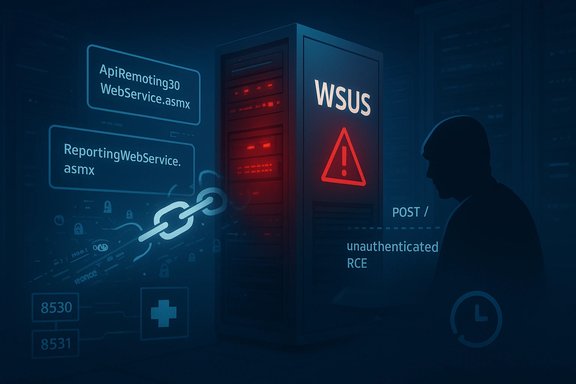
The exploit path observed in public analyses and vendor telemetry targets WSUS SOAP endpoints such as:- ApiRemoting30/WebService.asmx (ClientWebService)
- ReportingWebService/ReportingWebService.asmx (GetCookie/Reporting endpoints)
Timeline — disclosure, proof‑of‑concept, patching, and exploitation
- Initial reporting and Patch Tuesday fix: mid‑October 2025 — Microsoft issued a security update that attempted to address the finding, and vendor trackers began cataloging the defect.
- Public proof‑of‑concept (PoC) and independent technical analyses: mid to late October 2025 — multiple researchers published technical write‑ups demonstrating an unauthenticated RCE via the WSUS deserialization chain. Public PoCs materially increased exploitability risk.
- Out‑of‑band (OOB) cumulative update: October 23–24, 2025 — Microsoft released an emergency reissued cumulative update across affected Windows Server SKUs after research showed residual attack paths remained. These OOB packages are cumulative, include servicing‑stack updates (SSU) where required, and require a server reboot to complete remediation.
- Rapid weaponization and detection: within 24–72 hours after PoC and OOB release — multiple security vendors and national CERTs reported scanning and attempted exploitation against internet‑accessible WSUS instances; CISA added the WSUS CVE to the Known Exploited Vulnerabilities (KEV) catalog and issued urgent guidance. Reports of confirmed post‑exploit activity (w3wp.exe/wsusservice.exe spawning cmd.exe or PowerShell, file drops, and outbound exfiltration) followed.
Confirmed impact and why WSUS is a crown‑jewel target
- Unauthenticated network RCE — exploit requires no credentials and no user interaction, lowering the attack cost and increasing scale.
- High privilege context — WSUS server processes commonly run as SYSTEM; successful exploitation yields full host compromise.
- Trusted distribution channel — WSUS manages update metadata and payloads for clients; a malicious WSUS server can distribute code that endpoints accept as legitimate. That elevates the blast radius to potentially thousands of endpoints.
- Potential wormability — because the attack is network‑triggered and unauthenticated, attackers could conceivably automate lateral propagation between WSUS servers in poorly segmented environments. That theoretical worm risk contributed to Microsoft’s decision to publish an emergency OOB update.
Evidence of in‑the‑wild activity and independent corroboration
Multiple vendors and CERTs documented real‑world activity consistent with weaponization:- Scanning of default WSUS ports (8530/8531) and targeted POSTs to WSUS SOAP endpoints.
- Post‑exploit process trees showing w3wp.exe or wsusservice.exe spawning cmd.exe and PowerShell, often executing base64‑encoded scripts or downloading payloads using certutil, msiexec, or PowerShell remoting patterns.
- Public PoC code and technical write‑ups that made exploitation reproducible within hours of disclosure.
Indicators of Compromise (IoCs) and hunting signals
Immediate, high‑value detection signals recommended by incident responders include:- IIS logs showing POSTs to ApiRemoting30/WebService.asmx or ReportingWebService.asmx from unexpected external IPs.
- Unexpected child processes of WSUS parent processes (w3wp.exe or wsusservice.exe) — notably cmd.exe, powershell.exe, msiexec.exe, or rundll32.exe launched by WSUS.
- Base64 markers and BinaryFormatter artifacts in HTTP payloads (for example base64 prefix sequences commonly seen in serialized .NET blobs). Security investigators noted the binary marker pattern AAEAAAD/////AQAAAAAAAAAEAQAAAH9 in some observed payloads.
- Outbound connections to disposable webhook collectors, unusual HTTPS endpoints, or DNS C2 beaconing immediately following suspicious WSUS activity.
- Unexpected files dropped into ProgramData, %WINDIR%\Temp, or WSUS content directories; suspicious new services, scheduled tasks, or unsigned DLLs being loaded by WSUS processes.
Immediate remediation and hardening guidance (operational checklist)
Apply these steps in priority order — the first three items are emergency actions for the next 24–72 hours.- Identify WSUS hosts now.
- Query your inventory for the WSUS Server Role: Get‑WindowsFeature -Name UpdateServices, Server Manager role lists, or your CMDB. Prioritize hosts that expose ports 8530/8531 or replicate with other WSUS servers.
- Install Microsoft’s out‑of‑band (OOB) cumulative update for each affected Windows Server SKU and reboot.
- Microsoft released OOB packages on October 23–24, 2025; those KB numbers vary by SKU (examples referenced in vendor reporting include KB5070881, KB5070884 and similar OOB KBs — always confirm the exact KB for your SKU). These packages include required Servicing Stack Updates (SSU) and require a reboot to complete remediation.
- If you cannot patch immediately, enforce a short‑term mitigation:
- Disable the WSUS Server Role or
- Block inbound TCP 8530 and 8531 at the host firewall or network perimeter.
Both options stop WSUS functionality until the patch is applied and should not be considered long‑term solutions. - After patching, validate WSUS integrity:
- Check update catalogs and package hashes for unauthorized changes.
- Verify WSUS synchronization behavior; note Microsoft documented that synchronization error detail visibility may be reduced temporarily as part of the mitigation.
- Hunt for artifacts and contain potential compromise:
- Review IIS logs, Windows Event Logs, Sysmon (if deployed), and EDR alerts for the IoCs above.
- If compromise is confirmed, follow your incident response playbook: isolate the host, preserve forensic evidence (memory snapshot, WSUS DB backup), and plan rebuilds where necessary because WSUS can be used to distribute malicious packages.
- Coordinate remediation across replication/topology:
- WSUS servers often replicate; ensure every WSUS instance (upstream, replica, and downstream) is identified and patched. Unpatched replication partners can be used as a conduit for reinfection.
Detection, validation and response playbook (short form)
- Quarantine suspected WSUS hosts from admin networks and replication peers.
- Capture memory and disk images for forensic analysis and preserve IIS/WSUS logs.
- Search for suspicious child processes of w3wp.exe/wsusservice.exe and unusual network egress.
- If malicious packages or approvals are found in WSUS, assume downstream endpoints may be affected — plan an accelerated client‑side containment and remediation campaign.
- Rebuild compromised WSUS hosts from known good images after patching and validation; do not trust a compromised host to be fully remediated by in‑place cleanup.
Risk analysis and longer‑term lessons learned
Notable strengths in the response
- Microsoft’s decision to publish an out‑of‑band cumulative update (and to bundle the SSU with the LCU) reduced deployment complexity and helped administrators apply a single remedial package quickly.
- Rapid public reporting, vendor IoC publication, and national CERT advisories (CISA KEV listing) provided consistent guidance and a clear remediation timeline for high‑risk sectors.
Residual risks and operational pain points
- Functional tradeoffs: Microsoft temporarily removed some diagnostic WSUS sync error details as part of the mitigation; administrators should plan for reduced debugging surface while updates are deployed.
- Operational disruption: Disabling WSUS or blocking ports disrupts patch delivery and can create compliance drift; many organizations will need carefully coordinated maintenance windows to apply fixes without unpatching endpoints.
- Supply‑chain amplification: The fundamental problem is architectural: WSUS is a trusted, high‑privilege distribution point. Until architectural changes or stronger cryptographic validation are adopted across the update pipeline, compromise of that trust anchor remains an outsized risk.
Hardening recommendations for the medium term
- Remove or replace usage of legacy unsafe serializers (BinaryFormatter/SoapFormatter) in any custom .NET management code. Use modern, safe serializers with explicit type whitelists.
- Segment update infrastructure on dedicated management networks and apply strict firewall policies so only authorized admin hosts can reach WSUS management endpoints.
- Minimize WSUS privileges and harden the host: restrict accounts, apply strict ACLs to WSUS content directories, and enable tamper detection for update metadata.
- Consider moving to cloud or vendor‑managed update services (Windows Update for Business, Intune) where appropriate to reduce on‑prem attack surface — balancing control vs. operational requirements.
Verification, caveats and confidence
- Independent sources corroborate the attack class (unsafe deserialization), the attack surface (WSUS SOAP endpoints), and the remediation path (October 23–24, 2025 OOB cumulative updates). NVD, multiple security vendors, and national CERTs reported active exploitation or scanning shortly after PoC material became public. These independent confirmations raise the confidence level in the core technical details and active‑exploitation status.
- Some granular technical claims in early PoCs (for example, particular hardcoded keys, IV handling, or precise internal method names) vary between write‑ups. Use vendor KBs and authoritative MSRC entries for operational detection rules and patch mapping; treat single‑source technical artifacts as provisional until cross‑verified.
- If your environment shows any evidence of anomalous WSUS process behavior, proceed with containment and forensic capture before patching only if containment requires it — otherwise, patching and rebooting is the highest‑confidence mitigation and will block further exploitation attempts against the vulnerable code path.
Conclusion
The WSUS deserialization RCE event is a textbook example of how a single insecure design choice in a privileged, trusted service can produce catastrophic operational risk. The combination of unauthenticated, network‑accessible RCE in a trust anchor for updates, public proof‑of‑concept code, and confirmed exploitation attempts transformed a software bug into a high‑urgency national and industry response. Administrators must treat each WSUS host as a high‑priority remediation target: identify hosts, apply the correct out‑of‑band cumulative update and SSU prerequisites immediately, reboot to complete installation, and hunt for post‑exploit indicators across both WSUS servers and managed endpoints. After remediation, organizations should harden their update infrastructure, remove legacy unsafe serializers from code, and treat update servers as crown‑jewel assets that warrant the same protections as identity and certificate infrastructure. Every paragraph above is grounded in the vendor advisories, security vendor telemetry and public incident reporting that accompanied the WSUS emergency response. Confirm the CVE and KB mapping in your patch console before acting, and assume an exposed, unpatched WSUS server may already have been probed — prioritize containment, patching, and forensic investigation.Source: MSRC Security Update Guide - Microsoft Security Response Center
