

WWE 2K26’s second act for The Island arrives with a clearer identity, sharper multiplayer focus, and a handful of new systems that — on paper — fix many of the pain points that plagued the mode in WWE 2K25. The mode is no longer a single boss‑run for Roman Reigns; instead, a post‑Reigns power vacuum splits the Island into three rival Orders, new PvE Towers and Prestige progression give players repeatable goals, and multiplayer gets the long‑requested ability to tag up and climb seasonal leaderboards. Those are the headlines from 2K’s latest Ringside Report and the official store/support pages, and they point to a much more purposeful, online‑first design for The Island in 2026.
The Island debuted as an online hub in WWE 2K25 and arrived with ambition — a shared space where players could complete quests, buy cosmetics, and fight other players for rewards and status. It also arrived with controversy: heavy reliance on purchased currency, server and matchmaking instability, and content gating that left many players frustrated. Those issues became the central criticism of the 2K25 online experience. WWE 2K26’s development team has publicly framed the new Island as a corrective iteration: same core idea, but rebuilt with clearer progression systems, better multiplayer support, and more meaningful rewards.
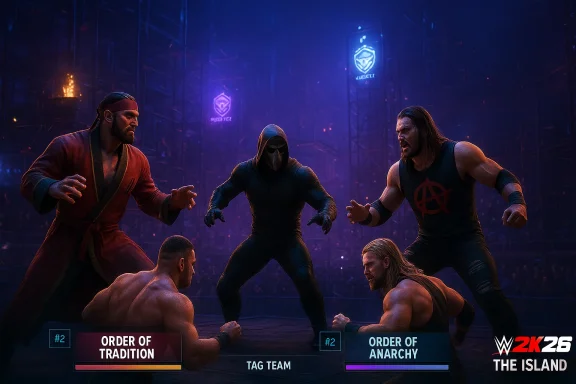
The new Island is being marketed as a multiplayer hub with a narrative spine. The mode’s story picks up after the events of 2K25: Roman Reigns is gone, and three factions — the Order of Tradition, Order of Shadows, and Order of Anarchy — now vie to control the Island of Relevancy. Each Order offers a different playstyle and ethos, and players pledge allegiance to one as they progress. The mode will be available across next‑gen consoles and, crucially for the first time, on PC at launch. Official documents and storefront pages confirm a March release window and detail the technical requirements for the PC debut.
That said, the mode’s success hinges on a few fast‑moving factors: the initial earn-to-price ratio for cosmetics and Prestige rewards, how 2K provisions servers for day‑one and seasonal peaks, and whether unlocks tilt the competitive balance. The community is understandably wary after 2K25’s controversies; 2K26’s Island can win trust with rapid, transparent changes — or it can lose it by preserving the same monetization incentives behind a new façade. The safer bet is cautious optimism: the design changes are clearly in the right direction, but the proof will arrive only after the mode endures real player traffic and the developer shows it can tune quickly and fairly.
If you plan to play The Island on day one, prepare your hardware checklist, set expectations around early matchmaking, and — most importantly — pay attention to how 2K balances rewards and purchases. The Island may finally become the living, social hub it promised to be; if it does, WWE 2K26 will have achieved something both fans and critics can applaud.
Source: Windows Central WWE 2K26's improvements for The Island make me want to play it this time
 Background / Overview
The Island debuted as an online hub in WWE 2K25 and arrived with ambition — a shared space where players could complete quests, buy cosmetics, and fight other players for rewards and status. It also arrived with controversy: heavy reliance on purchased currency, server and matchmaking instability, and content gating that left many players frustrated. Those issues became the central criticism of the 2K25 online experience. WWE 2K26’s development team has publicly framed the new Island as a corrective iteration: same core idea, but rebuilt with clearer progression systems, better multiplayer support, and more meaningful rewards.The new Island is being marketed as a multiplayer hub with a narrative spine. The mode’s story picks up after the events of 2K25: Roman Reigns is gone, and three factions — the Order of Tradition, Order of Shadows, and Order of Anarchy — now vie to control the Island of Relevancy. Each Order offers a different playstyle and ethos, and players pledge allegiance to one as they progress. The mode will be available across next‑gen consoles and, crucially for the first time, on PC at launch. Official documents and storefront pages confirm a March release window and detail the technical requirements for the PC debut.
What’s new in The Island: a feature rundown
WWE 2K26’s Ringside Report and accompanying materials list several visible changes and additions to The Island. The improvements cluster around four themes: narrative/faction structure, PvE content and rewards, multiplayer and matchmaking, and avatar/customization systems. Below I summarize the headline features and the evidence behind them.Three competitive Orders (factions)
- Order of Tradition (led by Cody Rhodes): represents classical wrestling values, honor, and the old‑school ethos.
- Order of Shadows (led by Rhea Ripley): a darker, supernatural wing for outcasts and “freaks,” thematically gothic and aggressive.
- Order of Anarchy (led by CM Punk): an anti‑establishment faction focused on chaos, promos, and breaking rules.
New PvE: Towers and Mega‑Challenges
Towers are a repeatable player‑vs‑environment gauntlet with arcade‑style, randomly generated match sequences. Completing Towers awards Order Reputation currency, used to unlock rewards tied to each faction. Towers also include Mega‑Challenge events that offer rarer loot for players who want a higher‑risk, higher‑reward track. Multiple press outlets and the trailer confirm Towers as a new, repeatable progression loop in The Island’s design — a direct answer to the single‑pass, chapter‑only feel many players complained about in 2K25.New arena: the Scrapyard
A new high‑intensity arena called the Scrapyard is part of the Island’s map. It’s built around verticality and environmental hazards: scaffolding, high platforms that can be used for brutal fall damage, and weaponry strewn about for more chaotic brawls. This design emphasizes vertical combat and environmental kills, which ties into the faction warfare theme centered on brutal control of territory. Trailer footage and multiple writeups highlight the Scrapyard as a marquee new battleground for Island fights.Tag teams, expanded PvP, and Seasonal Ranked Play
The Island now supports the new MyTAG feature, enabling two players to form a persistent tag team and progress together through the Island’s content and PvP. Additionally, Triple Threats, Fatal 4‑Ways, and 2v2 matches have been added to the Island’s match options. For competitive players, 2K is adding Seasonal Ranked Play — ranked ladders that reset each season and separate leaderboards for 1v1 and 2v2 formats. These changes markedly expand the multiplayer remit of The Island and give competitive players structured, repeatable goals to chase.Avatar upgrades and social features
Customization saw meaningful upgrades: a Photo Face import option for MySUPERSTAR avatars, new World Taunts for out‑of‑match emotes, and a Prestige System with four progression tiers that unlock power, badges, and rewards as player OVR increases. These features aim to make player identity more expressive in shared spaces and to provide visible markers of long‑term progression. The Photo Face tool, in particular, is being presented as a direct response to fan demand for better face creation and import workflows.Monetization and tiers
2K continues to position seasonal content through its broader Ringside Pass and season structure — the Island’s new Prestige tiers and reputation currency integrate into that ecosystem. Official pre‑order pages and storefront listings confirm seasonal tiers and in‑game purchases remain a systemic part of WWE 2K26’s long‑term plan. That’s worth reading closely: the mode’s persistence now has more explicit “earning vs. buying” pathways than the one‑time stories in other single‑player modes.Technical and platform notes — PC debut and system requirements
Two facts matter for Windows/PC players: The Island will be available on PC at launch, and WWE 2K26 raises the bar on minimum PC hardware.- The game releases in March 2026, with premium editions receiving early access in the first week of March and Standard editions following. Store pages and publisher announcements show a March 13, 2026 standard release with early access windows for premium editions. Steam’s regional unlock pages sometimes list March 12 — players should check their local storefront for exact timezone unlocks.
- Official support documentation and the Steam listing publish clear PC system requirements: a minimum of 16 GB RAM, recommended GPU classes starting at NVIDIA RTX 2060 / AMD RX 5700 (minimum), RTX 3060 / RX 6700 XT class recommended, and a 120 GB install footprint. The publisher also explicitly requires CPUs that support AVX2 and F16C instruction sets, which creates a hard runtime gating for some older processors. Those numbers have been reproduced across official support pages and independent storefronts.
Critical analysis — what 2K did right
- Purposeful progression and repeatability
- The addition of Towers, a Prestige layer, and faction reputation converts The Island from a one‑shot narrative gauntlet to a repeatable multiplayer loop. That’s the right design move if the team wants players to live inside the game’s online ecosystem for months instead of days. Towers create a predictable reward sink that designers can tune independently of PvP.
- Multiplayer parity and co‑op support
- MyTAG and new match types expand cooperative play and make the Island more social. Giving players the ability to form long‑term tag teams and compete in structured, ranked seasons addresses one of the biggest complaints from 2K25: The Island felt isolating and grindy. Competitive players now have a ladder and co‑op partners to chase.
- PC inclusion and explicit system targets
- Bringing The Island to PC and publishing precise system requirements is a win for transparency. The explicit AVX2/F16C note is blunt but useful: it helps players assess their hardware realistically rather than wonder why performance is poor. Publishing a 120 GB install expectation also removes uncertainty when players plan storage.
- Better avatar tools and visible identity
- Photo Face and World Taunts improve social identity inside the Island. These tools help reduce the visual monotony of shared online hubs where everyone previously looked generic. That matters in a mode that trades on social interaction and status.
Potential risks and remaining questions
- Monetization and cosmetic gating remain a significant risk
- The Island in 2K25 was criticized for gating desirable cosmetic and progression items behind purchased currency; 2K26’s seasonized economy and Ringside Pass indicate a similar live‑service posture. Unless 2K publishes clearer earn paths and significantly raises in‑mode rewards, players will perceive the remake as the same monetization engine wearing new paint. This is not speculative: community and press coverage of 2K25 repeatedly called out perceived pay‑to‑progress designs. Expect the community to watch early earn rates and in‑game pricing closely.
- Server capacity and matchmaking stability
- Rebooting The Island as an online hub increases dependence on stable servers. 2K25 experienced long matchmaking times, crashes, and other online fragilities that shaped first impressions of the mode. Adding Triple Threats, 4‑ways, and persistent tag teams increases matchmaking complexity. 2K must provision significantly more backend capacity and test edge cases to avoid repeating launch‑day frustration. Early hands‑on previews and media reporting are encouraging, but history suggests we should remain cautious until the first week of launch traffic passes.
- Balance between PvE reward loops and PvP fairness
- If Prestige tiers or statue‑like bonuses confer in‑match advantages, the mode risks trading fairness for grind. Towers awarding reputation and Prestige unlocking “more power” means the team must be explicit about what prestige unlocks actually change: are they purely cosmetic and meta progression, or do they alter in‑match performance? The line between meaningful rewards and pay‑to‑win is thin and will determine long‑term community sentiment. Trailer language is suggestive but not definitive; players should watch what the Prestige tiers unlock in live build notes and early patch documentation.
- Content depth and repeatability
- The move to random Towers and non‑linear faction storylines is smart, but it doesn’t automatically solve the “content depth” problem from 2K25. The Island was criticized for shallow quest systems once main chapters concluded. Towers and Mega‑Challenges add repeatable content, but their variety, reward cadence, and integration with social play will determine whether the mode remains engaging over months. Early previews suggest improvements, but live metrics will tell the long story.
Practical advice for players and IT pros
- PC players: verify AVX2/F16C support before purchase. If your CPU is older than mid‑2014 or lacks AVX2/F16C, you may not be able to run the game even with a modern GPU. Save yourself time by checking the publisher’s support page and the Steam system spec panel. Also expect a ~120 GB install.
- Console players: check early access windows for premium editions if you want the seven‑day jump. Some storefronts list slight date differences by timezone; confirm your platform’s unlock time in the store before planning late‑night sessions.
- Multiplayer teams: if you plan to play competitively on The Island, forming a MyTAG partner early will give you the best chance to climb seasonal leaderboards. Prioritize partners who match your preferred match types (1v1 vs. 2v2) and practice transitions for Triple Threat/Fatal 4‑Way dynamics before ranked matches begin.
- Watch earn rates on day one: monitor how Order Reputation, Prestige progression, and cosmetic pricing behave in initial patches. If wallets are being nudged too early, expect community backlash similar to 2K25’s. Community channels will highlight exploitative earn/gating practices quickly — use them for temperature checks.
How the changes reshape The Island’s role in WWE 2K26
WWE 2K26’s Island is clearly shifting from a one‑off narrative attraction to a live, competitive hub. That change is meaningful because it affects design priorities:- From narrative finale to ongoing campaign: factions and non‑linear progression mean players will live in the Island world rather than visit it once.
- From cosmetic showpiece to competitive arena: ranked seasons and MyTAG put PvP and ladder climbing front and center.
- From opaque monetization to experiment-ready economy: explicit Prestige tiers and Towers provide levers 2K can tune quickly post‑launch to respond to community feedback — for better or worse.
Final verdict — cautious optimism, with conditions
WWE 2K26’s retooled Island looks promising on paper: clearer narrative hooks through three Orders, repeatable PvE content via Towers, richer multiplayer with MyTAG and ranked seasons, and more expressive customization for player identity. The technical transparency for PC players is welcome, even if it forces upgrades for some users. Taken together, these changes are what many long‑time players requested after 2K25’s bumpy launch.That said, the mode’s success hinges on a few fast‑moving factors: the initial earn-to-price ratio for cosmetics and Prestige rewards, how 2K provisions servers for day‑one and seasonal peaks, and whether unlocks tilt the competitive balance. The community is understandably wary after 2K25’s controversies; 2K26’s Island can win trust with rapid, transparent changes — or it can lose it by preserving the same monetization incentives behind a new façade. The safer bet is cautious optimism: the design changes are clearly in the right direction, but the proof will arrive only after the mode endures real player traffic and the developer shows it can tune quickly and fairly.
If you plan to play The Island on day one, prepare your hardware checklist, set expectations around early matchmaking, and — most importantly — pay attention to how 2K balances rewards and purchases. The Island may finally become the living, social hub it promised to be; if it does, WWE 2K26 will have achieved something both fans and critics can applaud.
Source: Windows Central WWE 2K26's improvements for The Island make me want to play it this time
