

The X.Org Big Requests extension contains a subtle integer‑overflow bug that can be triggered by specially crafted request lengths, allowing an attacker with the right access to bypass the size check, cause out‑of‑‑bounds memory access and crashes, and in some configurations produce memory corruption — distributions and vendors have released patches and operators must prioritize updates and network hardening to remove exposure.
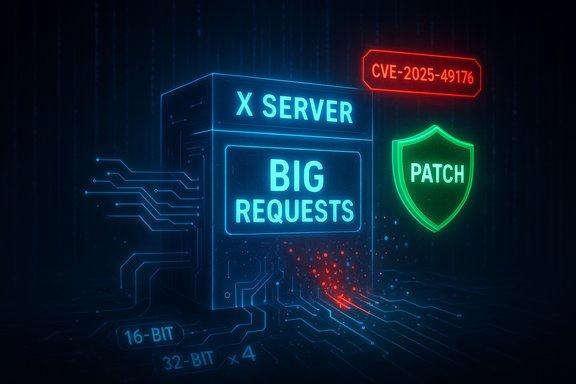
The X11 protocol originally limits request length to a 16‑bit field measured in 4‑byte units. The Big Requests extension (BIG‑REQUESTS) lets clients use an extended 32‑bit length field when the 16‑bit field is zero, enabling very large requests (useful for large image uploads, property changes, or lists of drawing points). The extension is widely implemented and, when enabled, Xlib or client stacks will transparently use the extended encoding so applications can send requests far beyond the 262,140‑byte core limit. CVE‑2025‑49176 is an integer‑overflow defect in the Big Requests implementation in several X server consumers (xorg‑server and Xwayland) and in TigerVNC components. The bug arises because the code multiplies the client‑supplied length by 4 (to convert 4‑byte units into bytes) before confirming the value does not exceed the configured maximum request size; that multiplication can wrap the integer value and cause the subsequent bounds check to be bypassed. In short: a wrapped length can look valid to the check but later be used to read or write past allocated buffers.
Source: MSRC Security Update Guide - Microsoft Security Response Center
 Background / Overview
The X11 protocol originally limits request length to a 16‑bit field measured in 4‑byte units. The Big Requests extension (BIG‑REQUESTS) lets clients use an extended 32‑bit length field when the 16‑bit field is zero, enabling very large requests (useful for large image uploads, property changes, or lists of drawing points). The extension is widely implemented and, when enabled, Xlib or client stacks will transparently use the extended encoding so applications can send requests far beyond the 262,140‑byte core limit. CVE‑2025‑49176 is an integer‑overflow defect in the Big Requests implementation in several X server consumers (xorg‑server and Xwayland) and in TigerVNC components. The bug arises because the code multiplies the client‑supplied length by 4 (to convert 4‑byte units into bytes) before confirming the value does not exceed the configured maximum request size; that multiplication can wrap the integer value and cause the subsequent bounds check to be bypassed. In short: a wrapped length can look valid to the check but later be used to read or write past allocated buffers. Technical anatomy — what exactly went wrong
How request lengths are encoded
- The X protocol encodes a request length in 16‑bit units (number of 4‑byte units).
- When BIG‑REQUESTS is used, a 32‑bit length follows the zero 16‑bit sentinel; the server then treats that 32‑bit value as the actual length in 4‑byte units. The implementation commonly converts that 32‑bit unit count into bytes by multiplying by 4.
The arithmetic mistake
- The vulnerable code multiplies the 32‑bit unit count by 4 using an integer type that cannot safely hold the product for large inputs.
- If an attacker supplies a deliberately large unit count, the multiplication can overflow and wrap to a small value (or zero), which then passes the “maximum allowed size” check.
- Later code uses the wrapped value to index or copy buffers, producing out‑of‑bounds accesses that can crash the server or corrupt memory.
Consequences in practice
- The primary realistic impact is availability: the X server process (Xorg / Xwayland / Xvnc) can crash, causing session loss, display service interruptions, or force container/VM reboots in some deployments.
- In some memory layouts and with careful manipulation, the condition may enable memory corruption, which raises integrity concerns and increases the theoretical risk of more serious exploitation chains. Multiple vendor assessments therefore treat integrity impact as a concern in addition to availability.
Who discovered and how it was fixed upstream
The issue was reported via coordinated disclosure (credited in public advisories) and fixed upstream in the xserver tree: upstream X.Org maintainers committed a surgical fix that corrects the arithmetic order and/or uses a sufficiently wide type to perform the multiplication safely before applying the maximum‑size check. Upstream releases incorporating the fix were published (xorg‑server 21.1.17 and a matching xwayland release noted in vendor trackers). Debian and other distributors recorded the upstream commit and applied backports to their packaged xorg‑server trees.Affected software and vendor response
Major distributions and vendor feeds published advisories mapping the defect to packaged releases; examples include Debian, Ubuntu, Red Hat (via errata), SUSE, Oracle/Oracle Linux, Amazon Linux ALAS, and others. Vendors produced fixed packages and security updates within days to weeks of disclosure — and many released backports for older stable branches. Administrators should consult their vendor’s security tracker and apply the specific fixed package for their release. Notable vendor evidence and status snapshots:- Debian’s security tracker maps fixed package versions and references the upstream commit used to remediate the bug. Debian also notes Xwayland is usually not run as root, which affects risk assessments for some environments.
- Ubuntu published fixes across supported releases (22.04, 24.04, 24.10, 25.04), listing fixed xorg packages in their security advisory.
- Amazon Linux ALAS entries list fixed tigervnc, xorg‑x11‑server and xwayland packages and assign a medium severity score for their images.
- SUSE, Oracle Linux, and Red Hat published errata and packages; SUSE’s bulletin includes the CVE among a set of X server fixes.
Severity, exploitability and attack surface — a nuanced picture
Multiple trackers assign a medium‑to‑high CVSS rating, but the attacker model differs slightly across vendor assessments:- NVD and several vendors assess a CVSS around 7.3 with an Attack Vector = Local / Low privileges required, because many X server operations require a local or authenticated client connection. This means an attacker typically needs the ability to create an X client or connect to an exposed X server instance.
- Some vendor advisories that include tigervnc in their product lists (for example Amazon Linux ALAS) note that remote VNC clients can reach the X protocol via Xvnc/TigerVNC. In configurations where the VNC/X server accepts unauthenticated or network clients, the practical attack vector can become remotely reachable — which elevates the operational urgency for network‑exposed systems. These assessments lead to slightly different vector assignments in vendor CVSS derivations. Operators should assume the worst‑case for exposed VNC/X services.
Practical detection and indicators
- Repeated crashes of X server processes (Xorg, Xwayland, Xvnc) around the time of suspicious client connections.
- Kernel or system logs showing segmentation faults or aborts originating from X server binaries; user session crashes and immediate restarts.
- In VNC server contexts, abrupt client disconnects accompanied by X server exit codes or coredumps.
- Distribution‑supplied advisory text and package changelogs (check dpkg/rpm metadata for patched version numbers). Debian and Ubuntu advisories show the fixed package versions and are good first sources for detection.
Mitigation and remediation guidance (step‑by‑step)
Apply the upstream or vendor fixes as the primary and definitive remediation. Follow this prioritized checklist:- Inventory
- Identify hosts that run X server, Xwayland, Xvnc, or TigerVNC. Check packages: xorg‑server, xorg‑x11‑server‑Xwayland, tigervnc, xorg‑server‑Xvfb/Xvnc. Use your package manager to list installed versions and compare to vendor fixed versions. Debian and Ubuntu trackers list the updated package versions.
- Patch
- Apply vendor security updates that include the backported fix and reboot or restart the X server processes as required by your distribution’s advisory. Vendors published errata and fixed packages (for example ALAS, SUSE, Oracle, Red Hat).
- Short‑term compensating controls (if you cannot immediately patch)
- Restrict access to X server / VNC endpoints with firewall rules (limit connections to trusted subnets and management hosts).
- Disable publicly facing VNC/X services or require authentication and encryption (tunnel VNC over SSH or VPN).
- For container/VM hosts, avoid exposing /dev/… or X sockets from the host into untrusted containers; disallow untrusted users from creating local X clients.
- If you run TigerVNC/Xvnc for remote desktop access, enforce strong authentication, limit client IP ranges, and consider temporarily stopping the service for high‑risk systems. Vendor advisories emphasize patching as the primary fix; network controls are stopgap measures.
- Verification
- After patching, verify the package version is the fixed one and confirm the X server no longer crashes when tested with normal client workflows.
- Reproduce routine operations (GUI apps, compositor actions, remote desktop sessions) in a test environment prior to rolling to production.
- Post‑remediation monitoring
- Monitor logs for unusual crashes or client behavior.
- Add detection rules for anomalous large request frames or repeated BigReq enable attempts if you have application‑level logging for X/VNC traffic.
Operational risk analysis — strengths, weaknesses, and long‑tail exposure
Strengths
- The upstream fix is small and targeted (an arithmetic reorder or safe type promotion), which makes it straightforward for vendors to backport into stable branches and for packagers to release updates quickly. Multiple vendors released patches in the same release window.
- The Big Requests protocol is documented and deterministic; the vulnerability is a classical integer‑overflow class (CWE‑190) where detection and mitigation are well understood.
Risks and limitations
- Distribution and vendor CVSS assessments and attack vector assignments differ slightly; some treat the vector as local while others flag network reachability for VNC/Xvnc deployments. This inconsistency can confuse triage. Operators must map the vulnerability to their deployment topology (local X server only vs network‑exposed VNC).
- Long‑tail systems — embedded appliances, old servers, or vendor appliances that bundle their own X server — can remain vulnerable for extended periods. These systems are often outside normal patch cycles and pose a significant residual risk. Vendor advisories show many product mappings across lifecycle branches, but appliances and custom images require manual inventory.
- While public PoCs for memory corruption exploitation were not widely published as of initial disclosure, the presence of a reliable out‑of‑bounds primitive in a widely used protocol makes the vulnerability interesting to attackers. Lack of a public exploit is not an adequate reason to delay patching.
What this means for administrators and developers
- For desktop and workstation users, this vulnerability is generally a stability and availability concern: untrusted local code or a compromised local account could crash the display server and force user reauthentication or reboot. User‑facing systems should receive updates in routine maintenance windows.
- For servers, CI runners, containers, or VDI endpoints that expose X or TigerVNC to untrusted tenants, the vulnerability is a higher priority: an attacker with the ability to connect as a client (even if authenticated) could attempt exploitation to cause service outages or gain an exploitation primitive. Prioritize patching and network hardening for multi‑tenant and remote‑access services.
- For developers of X clients or libraries: avoid assuming that lengths are bounded — always validate sizes and use safe arithmetic (promote to a wide integer type before multiplication, check for overflow, and enforce maximums before allocating memory). The upstream fix follows this pattern.
Checklist — immediate actions (compact)
- Identify hosts running xorg‑server, xorg‑x11‑server‑Xwayland, tigervnc/Xvnc. Use package manager queries and inventory tools.
- Install vendor patches (apply security updates published by Debian/Ubuntu/Red Hat/SUSE/ALAS/Oracle). Reboot or restart X server processes if required.
- If you cannot patch immediately, block external access to VNC/X ports with firewall rules and require authenticated, encrypted tunnels (SSH/VPN).
- Monitor logs for X server crashes, unexpected restarts or coredumps, and unusual large request patterns.
- Inventory long‑tail systems and third‑party appliances to confirm they are patched or isolated from untrusted networks.
Final assessment and recommendations
CVE‑2025‑49176 is a textbook example of how small arithmetic ordering errors in protocol parsing can have outsized operational impact. The defect is fixable — upstream commits were small and vendors delivered packaged updates quickly — but the practical danger lies in exposure: any server that accepts untrusted client requests (notably remote VNC/X services) must be treated as potentially exploitable until patched. The defensible, pragmatic posture is clear:- Prioritize applying vendor security updates to all systems that run X server, Xwayland or TigerVNC.
- Assume network‑exposed X/VNC services are high risk and temporarily isolate or harden them if you cannot patch immediately.
- Treat any X server crash correlated to untrusted client connections as an incident worthy of investigation and evidence capture (logs, core dumps, connection metadata).
Source: MSRC Security Update Guide - Microsoft Security Response Center
