

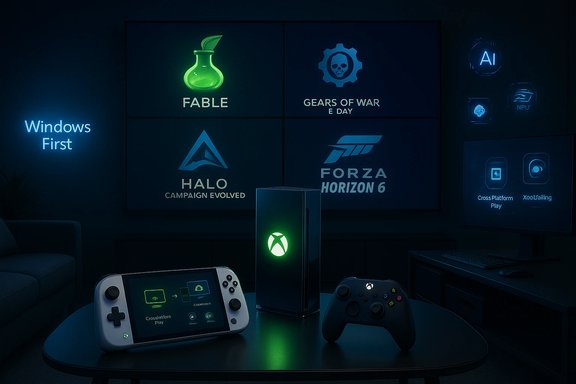
Xbox’s 25th anniversary arrives under heavy expectations: a blockbuster-first-party year, a pivot toward Windows-powered hardware, and a services strategy that needs to prove it can both make money and keep players happy. Microsoft enters 2026 with a stacked release calendar — Playground’s Fable, Gears of War: E‑Day, Halo: Campaign Evolved, and Forza Horizon 6 — but also with reputation, pricing, and hardware-headroom issues that could shape how successful that slate looks in the market. The stakes are high: Microsoft has signaled a long-term shift toward premium, Windows‑first devices co‑engineered with AMD while simultaneously managing the fallout from major Game Pass price increases and a falloff in console hardware revenue.
Microsoft closed 2025 with two contradictory narratives. On the content side, Xbox Game Studios shipped more first‑party titles than in previous cycles and Game Pass added headline releases that made the service feel essential to many players. On the corporate side, Microsoft’s aggressive use of AI in product messaging, high‑profile layoffs rumors and a divisive Game Pass pricing overhaul left a chunk of the community skeptical about long‑term direction and value. The Windows‑first strategy — tested publicly through the ASUS ROG Xbox Ally handhelds — points toward a future where Xbox hardware and Windows blur, but it also raises legitimate questions about pricing, certification, and a consistent living‑room experience.
Microsoft’s public commitments in 2025 are easy to enumerate: a multi‑year, co‑engineering partnership with AMD for next‑generation silicon; a fighter slate of high-profile first‑party games — internally known as the “four horsemen”; and the shipping of Xbox‑branded Windows handhelds (the ROG Xbox Ally family) that act as UX and policy testbeds for a more PC‑like console strategy.
The best case is straightforward: Microsoft uses 2026 to deliver — ship the four horsemen with polish, show a premium next‑gen device that justifies its price through tangible AI and performance features, and repair trust with stable pricing and communication. The worst case: the company overreaches on premium hardware pricing, alienates price‑sensitive players after the Game Pass hikes, and stumbles on the policy complexities of a Windows‑first living‑room device.
For players, the bottom line is simple: 2026 will be rich in content and experimentation, but it will also be a year when the gap between Microsoft’s ambitions and the practical realities of price, compatibility, and trust will be tested — repeatedly. Expect big reveals, real technical innovation, and some continued turbulence as Microsoft balances Windows openness, AMD partnership benefits, and the commercial necessity of a healthy, growing install base.
(Verifiable headline sources referenced inline include Microsoft’s AMD partnership announcement and investor filings, the ASUS press release for the ROG Xbox Ally, and major reporting on Game Pass pricing changes and Xbox revenue trends.
Source: Windows Central https://www.windowscentral.com/gami...-expect-from-team-green-this-year-and-beyond/
 Background / Overview
Microsoft closed 2025 with two contradictory narratives. On the content side, Xbox Game Studios shipped more first‑party titles than in previous cycles and Game Pass added headline releases that made the service feel essential to many players. On the corporate side, Microsoft’s aggressive use of AI in product messaging, high‑profile layoffs rumors and a divisive Game Pass pricing overhaul left a chunk of the community skeptical about long‑term direction and value. The Windows‑first strategy — tested publicly through the ASUS ROG Xbox Ally handhelds — points toward a future where Xbox hardware and Windows blur, but it also raises legitimate questions about pricing, certification, and a consistent living‑room experience.Microsoft’s public commitments in 2025 are easy to enumerate: a multi‑year, co‑engineering partnership with AMD for next‑generation silicon; a fighter slate of high-profile first‑party games — internally known as the “four horsemen”; and the shipping of Xbox‑branded Windows handhelds (the ROG Xbox Ally family) that act as UX and policy testbeds for a more PC‑like console strategy.
What Microsoft has formally announced — and what we can verify
AMD partnership and the “Windows‑first” roadmap
Microsoft publicly announced a strategic, multi‑year partnership with AMD to co‑engineer silicon across consoles, handhelds, PCs and cloud infrastructure. The stated goal is to enable high‑end graphics, on‑device AI capabilities, and deep platform continuity across devices. Microsoft framed the move as part of a broader push to make Windows the premier platform for gaming — and not to “lock” the next Xbox to a single storefront or device. Why this matters: co‑engineering silicon with AMD makes a Windows‑powered, console‑grade device technically plausible; it also signals Microsoft intends to differentiate future Xbox hardware with bigger APUs, NPUs for local AI features, and potentially higher memory budgets — all of which increase component costs. Multiple outlets corroborated the partnership and Microsoft’s positioning, reinforcing that this is a verified strategic pivot rather than mere rumor.ASUS ROG Xbox Ally — shipping hardware and the Full Screen Experience
ASUS and Xbox released the ROG Xbox Ally and ROG Xbox Ally X handhelds as retail products built on Windows 11 that default into a controller‑first Xbox Full Screen Experience (FSE). The Ally family demonstrates how a console‑style shell can sit on top of Windows 11 while giving users the option to access the full desktop if they want. The Ally X’s published specs and MSRPs place it firmly in the premium handheld category, and ASUS’s press materials list configurations, RAM, and battery capacity for both SKUs. These devices are not token experiments: they are shipping products that let Microsoft test memory‑hygiene tactics, per‑title handheld compatibility badges, and store aggregation features before bringing equivalent behaviors to living‑room devices. The Ally is therefore an important, verifiable proof‑of‑concept for the Windows‑first Xbox thesis.Game Pass pricing: a headline risk
Microsoft raised the price of its top Game Pass tier by 50%, moving Ultimate from $19.99 to $29.99 per month and reworking the tier names (Essential, Premium, Ultimate). The move was widely reported by major outlets and followed announced changes that added benefits — Ubisoft+ Classics, expanded cloud quality, and a new rewards program. The price change has been an immediate brand and PR pressure point for Xbox.Hardware and revenue reality
Microsoft’s quarterly filings show a sustained decline in Xbox hardware revenue. In FY25 Q4 Microsoft reported Xbox hardware revenue decreased by 25% year‑over‑year; more recent results showed another quarter with a roughly 29% reduction in hardware revenue as unit volumes softened. Those are Microsoft’s own, published figures and underline a hard business reality: console unit shipments are currently a material drag on gaming revenue despite growth in content and services.The games to watch: the four horsemen and beyond
The four horsemen: Fable, Gears of War: E‑Day, Halo: Campaign Evolved, Forza Horizon 6
Xbox’s marquee 2026 slate centers on four flagship pillars: Fable, Gears of War: E‑Day, Halo: Campaign Evolved, and Forza Horizon 6. Microsoft has signaled that these franchises will anchor the year and serve as the main public face of Xbox’s first‑party strength. The push to call these internally the “four horsemen” reflects intent to use heavyweight brands to reset the narrative around Xbox.- Fable: Playground Games’ reboot is now a 2026 title after a delay; official studio and publisher comments confirmed the slip to allow more development time. Expect a narrative‑driven, ForzaTech‑powered action RPG from a studio that has significant technical pedigree.
- Halo: Campaign Evolved: Halo Studios confirmed a ground‑up remake of Halo: Combat Evolved for 2026, specifically positioning it as a campaign‑focused remake with expanded co‑op but no competitive PvP at launch. The studio has emphasized polish and engine migration as the reason for concentrating on campaign and co‑op. This is an important product decision that alters expectations for Halo’s multiplayer future.
- Forza Horizon 6 and Gears of War: E‑Day: Both franchises are long‑standing pillars; Microsoft is expected to surface new looks and updates in developer showcases and at the Xbox Showcase cycle. Exact release windows and details will be confirmed at forthcoming events.
Bethesda, Obsidian, and the larger catalog
Microsoft’s Bethesda and Obsidian studios continue to be major content engines. Bethesda’s continued investment in franchises and potential remasters (e.g., Fallout 3 remaster rumors) is part of a broader strategy to mine legacy IP while delivering new projects; these are strongly signaled priorities but some specific claims — for example, certain remake timelines — remain speculative and should be treated cautiously until publishers provide official release dates. Obsidian has multiple projects in flight and the studio’s roster changes, including veteran hires, signal continued heavy investment.Strategy: why Windows beneath the console matters (and where it complicates things)
The plausible upside
- A Windows‑under‑the‑hood Xbox could allow native support for multiple PC storefronts, easing portability and developer support across PC and console. That makes Xbox a more flexible platform for developers and could improve discoverability for cross‑platform titles.
- Shared tooling and a single dev stack (Windows + DirectX + Xbox services) lowers porting costs and could shorten time‑to‑market for Xbox/PC cross‑releases.
- Co‑engineered AMD silicon with an NPU opens new on‑device AI features (upscaling, voice, in‑game assist), which might deliver tangible improvements in visual fidelity and UX.
The real risks and trade‑offs
- Price vs. scale: cramming higher RAM budgets, NPUs, and premium silicon into a living‑room device pushes MSRP up. Microsoft itself has signaled “premium” intentions; that strategy narrows the early install base and raises ROI pressure on first‑party studios.
- Certification and anti‑cheat: a Windows‑based console that allows third‑party stores and native installs increases the surface area for DRM and anti‑cheat friction, which could fragment the player experience title‑by‑title.
- Update cadence and reliability: Windows historically moves faster and more frequently than console OSes. Microsoft must design strict update channels and rollbacks to avoid destabilizing living‑room experiences for non‑technical consumers.
- Brand and trust: the Game Pass price increase and perceived corporate priorities (heavy AI rhetoric, layoffs rumors) have eroded goodwill — a fragile currency when asking consumers to pay more for hardware and services. These reputational effects can amplify product risks.
Services, Game Pass, and the consumer value equation
The Game Pass overhaul and top‑tier price hike are the most immediate consumer story. Microsoft repositioned its offerings into Essential, Premium and Ultimate, with Ultimate carrying a 50% monthly price increase alongside added benefits. The business logic is clear: extract more revenue per subscriber while bundling publisher services and cloud quality upgrades. The consumer logic is less straightforward: players who relied on Ultimate’s prior price point now face a much higher monthly cost, and the rhetorical framing of “more value” feels transactional when many customers see rising costs across games and hardware. Short‑term outcomes to watch:- Churn rates among price‑sensitive subscribers.
- Whether improved cloud access (including deals for Smart TVs and OEM partnerships) meaningfully offsets hardware price sensitivity. Microsoft’s cloud‑only expansion (e.g., Xbox App on Smart TV platforms) could be pivotal here for cost‑constrained players.
Hardware roadmap and OEM strategy
Microsoft’s pivot toward an ecosystem that includes first‑party consoles, OEM “Xbox” PCs and partner devices (like the ROG Xbox Ally) means a multi‑SKU future. Expect:- A high‑end, TV‑first console built around co‑engineered AMD silicon (the leaks often called it “Magnus”) aimed at performance and AI features.
- Continued OEM experimentation: more Xbox‑branded Windows devices from partners, and possibly an “Xbox” PC SKU for living‑room use-cases.
- Controller and accessory refreshes, including an Xbox Elite Controller Series 3 and direct‑to‑Wi‑Fi connectivity to improve cloud gaming latency.
Community, criticism, and corporate perception
A persistent theme in 2025–26 is a credibility problem. Players’ anger over pricing, AI feature rollouts, and mass corporate changes has left Xbox under a microscope. Phrases like “Microslop” have trended among frustrated communities as shorthand for heavy-handed AI integrations; that term speaks to broader skepticism rather than a single technical failure. The company will need consistent, player‑facing wins to repair trust: predictable updates, fewer surprise monetization moves, and a demonstrable commitment to the “console” crowd that values a frictionless living‑room experience.What to expect from events and the calendar
- January Developer Direct — tone setter: expect firm looks at the four horsemen, and likely more behind‑the‑scenes technical showcases for the Halo remake and Fable.
- GDC 2026 — deeper tooling and publisher economics signals (how Microsoft will modernize publishing and revenue splits for a Windows‑centric console).
- Xbox Showcase (June) — likely stage for 2027 teases and multiplatform reveals, plus updates on the next‑gen console roadmap and hardware cadence.
- BlizzCon 2026 and QuakeCon — Bethesda and Blizzard anniversary celebrations will be major content events; expect reveals for Diablo IV expansions, WoW content, and teasers for StarCraft and potential id Software projects. These will be closely watched for first‑party momentum.
Recommendations for gamers and buyers (practical takeaways)
- If you value a reliable, plug‑and‑play living‑room console: wait for official product reveals. Clarify whether a future device boots to a locked Xbox shell by default or presents a Windows desktop first — that default matters for nontechnical buyers.
- If you’re a PC owner with sizable Steam/Epic libraries: experiment with the Xbox Full Screen Experience on Windows handhelds or test aggregated Xbox PC app flows to see whether the UX meets your needs today.
- If you’re on the fence about Game Pass Ultimate after the price hike: audit how much value you actually extract. Day‑one releases and cloud quality improvements are real benefits, but they may not justify a 50% price increase for casual players.
- For creators and developers: watch Microsoft’s updated publishing rules and certification guidance closely. A Windows‑first console makes porting simpler, but anti‑cheat, DRM, and hardware variance still increase QA burden. Request clear matrices for anti‑cheat support and certification timelines.
Final assessment — opportunity with caveats
Xbox in 2026 is a study in contrasts. On one hand, Microsoft’s content pipeline and AMD partnership give the platform a genuine technical and creative runway: major IPs, a new silicon strategy, and a PC‑convergent approach that could lower friction for multi‑platform releases. On the other hand, price increases, hardware revenue decline, and trust erosion are real and measurable headwinds that make execution riskier.The best case is straightforward: Microsoft uses 2026 to deliver — ship the four horsemen with polish, show a premium next‑gen device that justifies its price through tangible AI and performance features, and repair trust with stable pricing and communication. The worst case: the company overreaches on premium hardware pricing, alienates price‑sensitive players after the Game Pass hikes, and stumbles on the policy complexities of a Windows‑first living‑room device.
For players, the bottom line is simple: 2026 will be rich in content and experimentation, but it will also be a year when the gap between Microsoft’s ambitions and the practical realities of price, compatibility, and trust will be tested — repeatedly. Expect big reveals, real technical innovation, and some continued turbulence as Microsoft balances Windows openness, AMD partnership benefits, and the commercial necessity of a healthy, growing install base.
(Verifiable headline sources referenced inline include Microsoft’s AMD partnership announcement and investor filings, the ASUS press release for the ROG Xbox Ally, and major reporting on Game Pass pricing changes and Xbox revenue trends.
Source: Windows Central https://www.windowscentral.com/gami...-expect-from-team-green-this-year-and-beyond/
