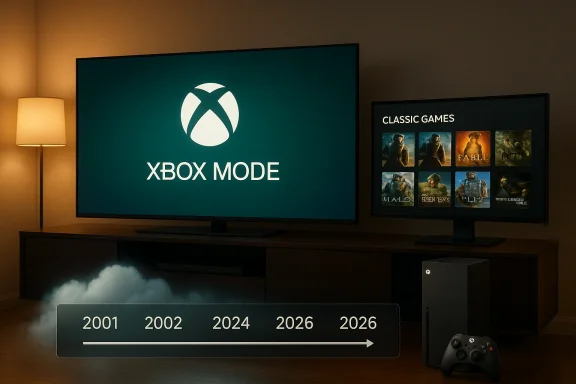
Microsoft's Xbox team quietly closed a chapter in 2021 when it said it had reached the practical limits of expanding the Backwards Compatibility catalog — and at GDC 2026 the team signaled that chapter is not finished: Xbox is bringing back its Backwards Compatibility efforts in some form this year, promising “new ways to play some of the most iconic games from our past” as part of its 25th‑anniversary plans.
For more than a decade, Xbox Backwards Compatibility has been one of Microsoft’s most consequential consumer initiatives: it allowed owners of original Xbox and Xbox 360 titles to play those games on Xbox One and later consoles, often with fidelity and enhancements that the original releases never had. The program began in earnest in 2015 and became a signature way for Xbox to promise continuity of ownership across generations.
That momentum paused after the November 2021 update in which Microsoft added a large final batch of titles and publicly stated the company had “reached the limit” on bringing additional games to the program because of legal, licensing and technical constraints. That announcement subtly but definitively put additions on hiatus—much to the disappointment of fans who continue to petition for classic titles.
In 2024 Microsoft quietly assembled a dedicated game preservation team tasked with “future‑proofing” Xbox's catalog and investigating how to keep older titles playable across changing hardware and software platforms — a structural decision that laid the groundwork for what Xbox teased at GDC 2026.
Jason Ronald, Xbox’s VP of Next Generation, explicitly referenced the game preservation team's long‑running work and used the anniversary window to promise a tangible return to backwards‑compatibility activity — though the announcement stopped short of naming specific titles or revealing mechanistic details about how Microsoft would deliver those “new ways to play.”
At the same GDC keynote Microsoft also confirmed plans to bring a rebranded Full Screen Experience — now called Xbox Mode — to Windows 11 PCs beginning in April 2026, and it sketched an ambitious roadmap for Project Helix, its next‑generation console platform, with alpha developer kits slated to ship to studios in 2027. Those two parallel tracks — deeper Windows integration and a new console architecture — are the practical context for why Xbox might be able to revive backwards compatibility in new forms.
Bringing those emulation capabilities onto Windows 11 — integrated with Xbox Mode — would not only widen the audience for classic Xbox titles but would also simplify preservation engineering. A single, cross‑platform emulation layer that runs on both Project Helix and on Windows 11 PCs could amortize development cost, make certifications more repeatable, and enable Microsoft to press compatibility gains across devices. Industry coverage and Microsoft’s own developer posts indicate the company is pivoting exactly toward that kind of platform convergence.
These problems are not theoretical: fans continue to call out specific, high‑profile absences (licensed music in sports and racing titles, bundled movie clips, or licensed characters) that make some games expensive or legally infeasible to re‑release. The practical implication is that even with renewed engineering effort, Microsoft will need to pick its battles and prioritize titles where the legal path is navigable.
Cross‑platform compatibility has benefits beyond convenience: it creates opportunities for single‑engineering paths (one emulator stack tested on Windows and Project Helix), unlocks Game Pass packaging strategies (bundle preserved classics into subscription tiers), and helps developers reuse tooling and certification processes. For preservation advocates, having classic Xbox titles playable on standard PCs is a meaningful expansion of access and redundancy against hardware obsolescence.
The practical risk is timing: while Helix dev kits arrive in 2027, the backwards compatibility announcements Xbox promised are slated for 2026’s anniversary window. That implies Microsoft is planning software‑first releases (Windows 11 + existing consoles + cloud), with Helix support arriving later. This sequencing is logical but also highlights that the initial wave of preserved experiences will likely be software and service releases rather than hardware‑dependent solutions.
That said, fans should be pragmatic. Legal and licensing constraints that forced the 2021 hiatus are real and complex, and they will shape which games come back and how. The likeliest outcome for 2026 is a curated, high‑profile set of preserved or remastered releases delivered across console, PC (via Xbox Mode), and cloud — a practical, incremental revival rather than a wholesale reopening of every missing title.
For players and preservation advocates, the promise is worth watching closely: if Microsoft pairs engineering rigor with legal pragmatism and transparent communication, this return of backwards compatibility could be a watershed moment for how modern platforms treat gaming history. The games themselves — those “iconic” titles Xbox name‑checked — will tell us whether this is a nostalgic headline or the start of a sustained, structural revival.
Source: Windows Central Microsoft's Xbox Backwards Compatibility program is coming back this year
 Background
For more than a decade, Xbox Backwards Compatibility has been one of Microsoft’s most consequential consumer initiatives: it allowed owners of original Xbox and Xbox 360 titles to play those games on Xbox One and later consoles, often with fidelity and enhancements that the original releases never had. The program began in earnest in 2015 and became a signature way for Xbox to promise continuity of ownership across generations.That momentum paused after the November 2021 update in which Microsoft added a large final batch of titles and publicly stated the company had “reached the limit” on bringing additional games to the program because of legal, licensing and technical constraints. That announcement subtly but definitively put additions on hiatus—much to the disappointment of fans who continue to petition for classic titles.
In 2024 Microsoft quietly assembled a dedicated game preservation team tasked with “future‑proofing” Xbox's catalog and investigating how to keep older titles playable across changing hardware and software platforms — a structural decision that laid the groundwork for what Xbox teased at GDC 2026.
What was announced at GDC 2026
During its GDC presentation, Xbox framed a broader platform pivot that touches hardware (Project Helix), platform UX (Xbox Mode on Windows 11) and preservation (the promise of renewed backwards compatibility activity). The messaging was deliberately high‑level: Xbox said it’s “committed to keeping games from four generations of Xbox playable for years to come” and that, later in 2026 and timed for its 25th anniversary, the company will be “rolling out new ways to play some of the most iconic games from our past.”Jason Ronald, Xbox’s VP of Next Generation, explicitly referenced the game preservation team's long‑running work and used the anniversary window to promise a tangible return to backwards‑compatibility activity — though the announcement stopped short of naming specific titles or revealing mechanistic details about how Microsoft would deliver those “new ways to play.”
At the same GDC keynote Microsoft also confirmed plans to bring a rebranded Full Screen Experience — now called Xbox Mode — to Windows 11 PCs beginning in April 2026, and it sketched an ambitious roadmap for Project Helix, its next‑generation console platform, with alpha developer kits slated to ship to studios in 2027. Those two parallel tracks — deeper Windows integration and a new console architecture — are the practical context for why Xbox might be able to revive backwards compatibility in new forms.
Why this matters now: technical and strategic context
1) The technical tailwinds
Modern Xbox backwards compatibility is not simply a matter of copying files; it relies heavily on custom emulation layers, binary compatibility strategies, and runtime translation to make legacy disc and digital images run on contemporary silicon. Microsoft’s internal emulation stack — built to support a huge swath of Xbox 360 and original Xbox titles on Xbox One and Series X|S — is the most mature, officially sanctioned approach the company controls. Job postings and Xbox’s public communications over the last two years repeatedly referenced investments in emulation and compatibility engineering, suggesting Microsoft has been building the technical muscle to try new approaches.Bringing those emulation capabilities onto Windows 11 — integrated with Xbox Mode — would not only widen the audience for classic Xbox titles but would also simplify preservation engineering. A single, cross‑platform emulation layer that runs on both Project Helix and on Windows 11 PCs could amortize development cost, make certifications more repeatable, and enable Microsoft to press compatibility gains across devices. Industry coverage and Microsoft’s own developer posts indicate the company is pivoting exactly toward that kind of platform convergence.
2) The strategic incentives
Microsoft’s broader strategy for Xbox in 2026 and beyond increasingly treats Xbox and Windows as parts of one continuum. Game Pass, Xbox Cloud Gaming, the Xbox PC app, and now Xbox Mode all point toward a unified play surface. Reviving backwards compatibility can be read as both a consumer goodwill move — reconnecting players with beloved franchises — and as a strategic asset that increases Game Pass value and helps differentiate Microsoft’s platform from competitors. The 25th‑anniversary timing is a natural, marketing‑savvy wina into broader platform momentum.What “coming back” could mean — practical scenarios
Microsoft’s phrasing at GDC was intentionally vague, and that ambiguity opens several technically distinct possibilities. Each carries different user benefits, development costs, and legal implications.A. Adding more original Xbox and Xbox 360 titles to the Backwards Compatibility catalog
This is the literal return of the previous program model: certify and publish native compatibility layers for specific legacy titles so they run on modern hardware with enhancements (Auto HDR, FPS boosts, higher resolutions). This is the clearest path from a consumer perspective, but it’s also the most politically fraught because many older games are entangled in third‑party licensing (music, middleware, IP) that previously blocked additions in 2021. Reopening this avenue would require significant legal work and renewed third‑party agreements.B. Re‑releases and remasters powered by preservation engineering
Rather than certifying raw legacy binaries, Microsoft could release curated remasters or “preserved editions” that are repackaged for modern platforms. These releases avoid many emulation pitfalls and can be an attractive middle ground for titles where licensing or technical debt make pure emulation unworkable. This model gives Microsoft more editorial control and provides a revenue path shared with IP holders. The trade‑off is authenticity — purists will rightly argue remasters are not the same as original experience preservation.C. Emulation-on‑Windows: Xbox Mode + cross‑platform emulation
One of the most consequential possibilities — and the one Xbox hinted at indirectly by announcing Xbox Mode for Windows 11 — is that Microsoft will extend its emulation stack to PCs. That would let Windows players access preserved titles directly without consoles, and it would mean Project Helix — designed to play both console and PC games — could ship with an ecosystem that already supports classic content. Microsoft’s November 2025 and subsequent Windows 11 updates demonstrate the company is already moving in this direction with the Full Screen Experience and Xbox app improvements.D. Cloud‑first preservation: stream legacy titles from the cloud
Another practical route is cloud delivery: Microsoft could host emulated or remastered legacy titles in the cloud and stream them to devices. This sidesteps some device‑level compatibility headaches but raises questions about digital ownership and ongoing subscription dependence. Xbox Cloud Gaming already provides a streaming surface for modern titles; extending it to legacy games i and minimizes the need to certify dozens of device configurations.Legal and licensing hurdles — the real limiter
Anyone who follows the history of Xbox backwards compatibility knows that the most stubborn obstacles aren’t technical but contractual. When Microsoft said in 2021 the company had reached the “limit” of adding new games, it explicitly cited licensing, legal and technical constraints — that wording is critical because it names the multiplicity of causes. Music licensing, expired IP agreements, defunct third‑party publishers, and region‑specific rights can turn a straightforward engineering job into a months‑long legal negotiation, or into a negotiated impossibility.These problems are not theoretical: fans continue to call out specific, high‑profile absences (licensed music in sports and racing titles, bundled movie clips, or licensed characters) that make some games expensive or legally infeasible to re‑release. The practical implication is that even with renewed engineering effort, Microsoft will need to pick its battles and prioritize titles where the legal path is navigable.
Preservation, emulation quality, and authenticity
Reintroducing backwards compatibility is more than making the game run; it’s about reproducing how the game felt and ensuring features like saves, online modes, and community add-ons continue to work or are adapted.- Emulation fidelity: Microsoft's internal emulation stack aims to reproduce hardware behavior, but emulators are not perfect. Fixes for timing, input latency, save compatibility, and hardware quirks are often laborious and game‑specific. The company’s hiring and public statements suggest teams have been working to raise fidelity and automate testing; those investments are essential if Microsoft intends to scale beyond a handful of title recoveries.
- Preserving online features: Multiplayer and online leaderboards pose special problems when the original servers have been shut down. Preservation can mean re‑hosting servers, building compatibility shims, or offering offline modes. Each choice changes how authentic the preserved experience will be.
- User expectations vs. practical fixes: Players often expect legacy titles to run flawlessly and to be enhanced (higher resolution, HDR, improved frame‑rates). When that isn’t possible due to licensing or technical constraints, communication is paramount: Microsoft should be explicit about the shape of the re‑released experience and the limits of what can be preserved.
Xbox Mode and the Windows convergence — why PC matters
Microsoft’s decision to push a console‑like Xbox Mode into Windows 11 is part of a broader strategy to collapse consumer friction between PC and console gaming. Xbox Mode offers a controller‑first, full‑screen shell that reduces desktop overhead and puts the Xbox app front and center — exactly the UX environment where legacy emulation and preserved titles would be discoverable and playable on PCs. That rollout begins in April 2026, which makes the timing of backwards compatibility announcements later in the year especially plausible.Cross‑platform compatibility has benefits beyond convenience: it creates opportunities for single‑engineering paths (one emulator stack tested on Windows and Project Helix), unlocks Game Pass packaging strategies (bundle preserved classics into subscription tiers), and helps developers reuse tooling and certification processes. For preservation advocates, having classic Xbox titles playable on standard PCs is a meaningful expansion of access and redundancy against hardware obsolescence.
Project Helix: the hardware angle
Project Helix — Microsoft’s next Xbox codename — was presented at GDC 2026 as a platform that intentionally blurs the line between PC and console. Microsoft said alpha developer kits will start shipping in 2027; if Helix uses an AMD‑based SoC and a more PC‑centric graphics stack (as Xbox described), it could simplify compatibility between console and Windows builds. That hardware roadmap is significant because it means the future Xbox might be designed from the start to run PC‑centric emulation and preservation tools alongside native console titles.The practical risk is timing: while Helix dev kits arrive in 2027, the backwards compatibility announcements Xbox promised are slated for 2026’s anniversary window. That implies Microsoft is planning software‑first releases (Windows 11 + existing consoles + cloud), with Helix support arriving later. This sequencing is logical but also highlights that the initial wave of preserved experiences will likely be software and service releases rather than hardware‑dependent solutions.
What fans spect in 2026
- Selective releases: Microsoft will most likely reveal a curated set of titles — iconic but legally tractable — rather than a comprehensive reopening of the entire library. Think high‑impact names and franchises where rights are clear or owned.
- Multiple delivery models: Expect a mix of native backwards‑compat additions, cloud streaming options, and potentially remastered or preserved editions for titles that cannot be delivered via pure emulation.
- Windows integration: Some preserved titles may appear first or simultaneously on Windows 11 through Xbox Mode or the Xbox PC app, widening discoverability. Xbox’s contemporaneous focus on Xbox Mode and PC tooling makes this a plausible, even likely, outcome.
- No guaranteed universal coverage: Even with renewed effort, many titles will remain out of reach due to licensing. Microsoft cannot and likely will not (legally or economically) relicense everything in a single year. Expect transparency about the limits.
Strengths, opportunities, and risks — a balanced assessment
Strengths
- Strategic alignment: Reviving backwards compatibility dovetails neatly with Microsoft’s Xbox + Windows strategy, Game Pass value proposition, and Project Helix roadmap. The synergy reduces per‑title effort and increases business value.
- Technical investment: Hiring and job listings show Xbox is investing in emulation and preservation engineering, which improves odds of repeatable, high‑quality compatibility work.
- Fan goodwill and retention: Delivering beloved classics (even a few marquee releases) would generate substantial goodwill and media attention for Xbox’s 25th anniversary.
Opportunities
- PC audience expansion: Making preserved Xbox titles available on Windows 11 via Xbox Mode could bring legacy content to a much larger audience than consoles alone.
- Preservation leadership: Microsoft can become a leader in commercial game preservation by combining legal, engineering and cloud strategies in ways other platform holders have not.
Risks and constraints
- Licensing bottlenecks: Legal and contractual rights are the single largest constraint; even with engineering resources, some high‑profile titles may be impossible to return. Microsoft must manage expectations carefully.
- Emulation quality and authenticity: If releases are perceived as buggy, incomplete, or heavily altered, the goodwill payoff could reverse into consumer frustration. QA and transparent communication are essential.
- Subscription vs ownership tension: Cloud or subscription‑first delivery models create questions about preservation versus access: streaming keeps games playable but doesn’t grant durable ownership, a sore point for many players.
How Microsoft should proceed (recommended approach)
- Prioritize a small set of iconic titles with clear legal paths for a high‑visibility 25th‑anniversary reveal.
- Simultaneously publish technical writeups and compatibility reports that explain what was preserved, what changed, and why — transparency builds trust.
- Make a subset of preserved titles available on Windows 11 via Xbox Mode, while offering console and cloud parity where possible.
- Offer a preservation roadmap and commitment — not a promise of universality — that sets realistic expectations and outlines next milestones (e.g., Helix support in 2027).
Conclusion
Xbox’s GDC 2026 messaging — a mix of architectural ambition, Windows integration, and preservation rhetoric — creates a credible opening for the Backwards Compatibility program to return in a meaningful way in 2026. The company’s pledge to roll out “new ways to play” classic titles during its 25th anniversary is not an empty gesture: it reflects years of internal investment in emulation and a strategically aligned platform vision that includes Xbox Mode on Windows 11 and Project Helix’s convergence ambitions.That said, fans should be pragmatic. Legal and licensing constraints that forced the 2021 hiatus are real and complex, and they will shape which games come back and how. The likeliest outcome for 2026 is a curated, high‑profile set of preserved or remastered releases delivered across console, PC (via Xbox Mode), and cloud — a practical, incremental revival rather than a wholesale reopening of every missing title.
For players and preservation advocates, the promise is worth watching closely: if Microsoft pairs engineering rigor with legal pragmatism and transparent communication, this return of backwards compatibility could be a watershed moment for how modern platforms treat gaming history. The games themselves — those “iconic” titles Xbox name‑checked — will tell us whether this is a nostalgic headline or the start of a sustained, structural revival.
Source: Windows Central Microsoft's Xbox Backwards Compatibility program is coming back this year