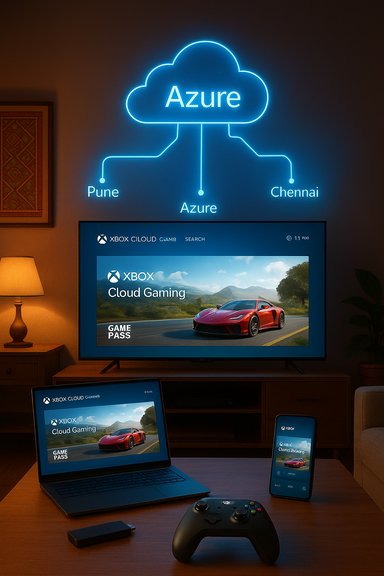
Microsoft’s Xbox Cloud Gaming has finally crossed a major milestone: after months of signals in the service code and scattered tests, cloud stacks tied to Xbox Cloud Gaming have been spotted and activated inside Microsoft’s Indian Azure regions — and public access is now rolling out for Indian players across web and supported apps.
Xbox Cloud Gaming (often called xCloud) lets subscribers stream Xbox titles from Microsoft’s Azure-backed servers to phones, tablets, PCs, TVs and other supported devices without owning an Xbox console. The service is bundled into Xbox Game Pass tiers and, over the last year, has been upgraded with higher-quality streaming tiers, a “Stream Your Own Game” option that streams eligible owned titles, and broader device integrations that include Samsung and LG smart TVs and a web-first experience at xbox.com/play. Microsoft has been iterating aggressively on the backend: moving to Series‑equivalent server blades, increasing bitrates, and introducing new quality tiers (including 1440p and “HQ” bitrate modes). Those infrastructure and encoding changes are the technical foundation that make a meaningful regional expansion — like an India launch — practical from a latency and user‑experience standpoint. The headline change for Indian gamers is straightforward: local Azure capacity in India (Central India / Pune and South India / Chennai) is now carrying Xbox Cloud Gaming stacks, reducing first‑hop latency for many Indian ISPs and making truly playable cloud sessions feasible for a much larger audience. Early reports and the first wave of hands‑on tests suggest substantially lower ping to cloud nodes for users close to these regions.
If you want to test the service right away, the simplest route is to sign in at xbox.com/play from a modern browser, try a free-to-play cloud title where available (Fortnite is often listed as a web-playable free title where supported), and compare latency to local nodes listed by diagnostics or community tools. Early adopters should document ISP, city, and device results: that data will be critical in the next 72 hours as Microsoft and ISPs observe real usage patterns and tune capacity.
Additional context for Windows Forum and technical readers: community tooling and threads tracking cloud nodes and quality — including Better XCloud diagnostics and forum threads discussing Indian rollout mechanics — are already populated with firsthand tests and step‑by‑step user notes that can help troubleshoot controller pairings, browser quirks, and Xbox app behaviors for cloud sessions in India. Those community logs are valuable for real‑world troubleshooting as the activation matures.
Source: Windows Central https://www.windowscentral.com/gami...e-gearing-up-for-an-official-launch-in-india/
 Background / Overview
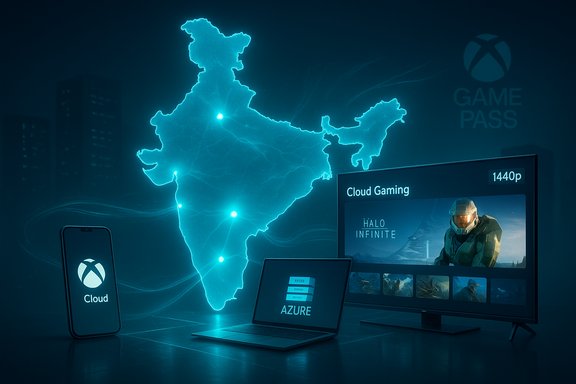
Xbox Cloud Gaming (often called xCloud) lets subscribers stream Xbox titles from Microsoft’s Azure-backed servers to phones, tablets, PCs, TVs and other supported devices without owning an Xbox console. The service is bundled into Xbox Game Pass tiers and, over the last year, has been upgraded with higher-quality streaming tiers, a “Stream Your Own Game” option that streams eligible owned titles, and broader device integrations that include Samsung and LG smart TVs and a web-first experience at xbox.com/play. Microsoft has been iterating aggressively on the backend: moving to Series‑equivalent server blades, increasing bitrates, and introducing new quality tiers (including 1440p and “HQ” bitrate modes). Those infrastructure and encoding changes are the technical foundation that make a meaningful regional expansion — like an India launch — practical from a latency and user‑experience standpoint. The headline change for Indian gamers is straightforward: local Azure capacity in India (Central India / Pune and South India / Chennai) is now carrying Xbox Cloud Gaming stacks, reducing first‑hop latency for many Indian ISPs and making truly playable cloud sessions feasible for a much larger audience. Early reports and the first wave of hands‑on tests suggest substantially lower ping to cloud nodes for users close to these regions. How we got here: the signals, the leak path, and confirmation
What was spotted in the wild
The rollout didn’t begin with a press release. Instead, the first public signs came from telemetry and tooling researchers and the Better XCloud community. The Better XCloud developer (red // Better xCloud) and other community sleuths flagged new Xbox Cloud Gaming stacks and quality modes appearing in Microsoft’s cloud configuration — a classic pattern for an imminent geographic expansion. Independent outlets picked up that signal and probed for practical signs of availability. Within hours of those observations, community users in India began reporting active nodes in Central and South India showing up in Better XCloud tooling and in live connection tests, and players shared screenshots and ping measurements showing single‑digit to low‑double‑digit ms to Chennai and Pune from some metro areas. Those community reports were immediately amplified by outlets covering the region and by Xbox‑focused sites reporting the new region as effectively live.Official confirmation and news coverage
Microsoft’s wider editorial channels (Xbox Wire) historically follow community detection with formal announcements; in this rollout, mainstream tech and gaming press in India (and international Xbox outlets) published practical how‑to articles within hours of the first user reports, confirming that Xbox Cloud Gaming was reachable through xbox.com/play and integrated apps in India. Indian tech publications also detailed local pricing parity and Game Pass plan availability tied to the new Essential/Premium/Ultimate lineup. Because this was a coordinated but quiet activation, early readers should treat the region activation as “live now” for many users while acknowledging that platform‑level announcements and localized marketing may follow over the next 24–72 hours.Why India matters (quick market context)
- India is one of the fastest‑growing gaming markets globally in terms of user growth and mobile adoption. The country’s gaming spend and player base make it a priority geography for cloud services that rely on scale.
- Microsoft has maintained multiple Azure regions in India for years (Central India — Pune; South India — Chennai; West India — Mumbai), giving the company the physical presence needed to run low‑latency game streaming. That infrastructure was essential to enabling this local launch.
- The timing dovetails with recent device and retail movements in India — notably the arrival of Windows handhelds tuned to Game Pass workflows (e.g., the ROG Xbox Ally family) — and with Samsung/LG smart TV integrations that ease discoverability of cloud play on living‑room screens. Coupling local servers with more retail devices makes cloud gaming a practical proposition for Indian households.
The technical picture: servers, regions, quality tiers
Where the servers sit
Microsoft’s Azure footprint in India includes Central India (Pune), South India (Chennai) and West India (Mumbai). The new Xbox Cloud Gaming nodes have been mapped to Central India and South India, reducing physical network distance for a large slice of the Indian population and delivering the single most important variable for playable cloud gaming: lower latency. Industry region lists and contemporary deployment signals confirm these region assignments.What’s changed on streaming quality
Over the past year Microsoft pushed higher bitrate and resolution modes into Xbox Cloud Gaming. One of the biggest end‑user upgrades was the introduction of 1440p streaming for higher tiers, alongside “HQ” bitrate modes for 720p/1080p that use much higher target bitrates than the legacy profiles. That shift narrows the perceptual gap with the highest‑end competitors by offering crisper visuals and fewer compression artifacts on larger screens. Not every title supports the boosted 1440p/“HQ” modes today, and Microsoft continues to gate those modes by device, network conditions, and subscription tier.Stream Your Own Game and catalog reach
Microsoft’s “Stream Your Own Game” feature (which allows eligible purchased titles to be streamed from Microsoft’s cloud where publisher permissions and technical compatibility allow) has expanded rapidly; published reporting has placed the number of eligible titles in the thousands, reflecting continued investment in making owned content available on the cloud surface. The practical upshot is more choice for Indian subscribers beyond the curated Game Pass catalog.What the launch means in practice for Indian players
Devices and where you can play
- Web browsers: xbox.com/play remains the primary cross‑platform entry point (works on modern Chromium/Safari browsers).
- Windows and handhelds: the Xbox PC app will surface cloud play where supported; recent handhelds marketed for Game Pass (like ROG Xbox Ally) are now being sold in India and are primed for cloud usage.
- Smart TVs and streaming sticks: Samsung and LG smart TV integrations — plus Amazon Fire TV support — make cloud play accessible on living-room screens without additional console hardware.
Pricing and plan fit
Local reporting rebroadcasts Microsoft’s tiering moves: Game Pass in India is available in the remapped tiers (Essential, Premium, Ultimate), with cloud streaming included according to the plan rules Microsoft has applied globally. Entry‑level and mid tiers (Essential/Premium) offer differing catalog sizes and quality ceilings, while Ultimate remains the flagship for the broadest catalog and the top bitrate/1440p experience where supported. Published regional pricing was reported as part of India coverage. Buyers should verify exact local prices inside the Microsoft/Xbox account portal at purchase because regional taxes, promotions, and retail bundles may change final costs.Network requirements and expectations
Practical network guidance mirrors Microsoft’s global recommendations: a stable connection is more important than headline Mbps. Typical guidance:- Baseline: 10 Mbps is workable for lower‑quality sessions.
- Recommended: 20–35 Mbps or higher for steady 1080p and the best possible HDR/1440p performance.
- Latency target: under roughly 50 ms to the cloud node for comfortable single‑player action; sub‑30 ms is ideal for competitive play.
Indian early testers report major reductions in geographic latency when connecting to Chennai and Pune nodes, which turns previously marginal experiences into playable sessions for many players. Expect variability by ISP, routing, home network quality, and Wi‑Fi environment.
Strengths of the rollout
- Lower latency for a huge potential player base: local nodes in Pune and Chennai materially reduce round‑trip time for many Indian cities, improving responsiveness and input feel.
- Device breadth: availability through the web, PC app, TV integrations, and new handhelds means fewer device barriers for Indian gamers who already rely on phones, laptops, and smart TVs.
- Strategic scale: India’s market size can make cloud gaming economically attractive, especially when paired with ad‑supported or lower‑price funnels Microsoft is reportedly testing globally. Those models can drive volume and monetization without requiring every user to buy a console.
Risks, limitations, and what to watch
Not every title or mode is equal yet
The highest‑quality 1440p/HQ modes and some “Stream Your Own Game” titles are gated by publisher permissions, encoding readiness, and device support. Expect a phased roll‑out of quality tiers and title compatibility rather than universal immediate parity with local console play.Pricing and packaging risks
Inside Xbox’s product roadmap there have been signals of pricing changes and new monetization models (including tests of ad‑supported free tiers and pricing tag updates discovered by tooling). Any region expansion raises the question of how Microsoft will localize prices and which benefits map to each tier across markets. Indian consumers should watch plan details closely — an expanded cloud footprint can be both a value opportunity and, eventually, a lever for price rebalancing.Network and last‑mile reality
Even with local Azure nodes, Indian last‑mile variability is real: wireless home networks, ISP peering, and congested Wi‑Fi can degrade the experience. Some early testers reported very low ping but still saw visual artifacts or intermittent stutter, underscoring that bandwidth alone is insufficient if path stability and jitter are poor. Home‑network tuning (Ethernet or high‑quality 5GHz Wi‑Fi, QoS if available) will matter for the best experience.Regulatory and data considerations
Any cross‑border expansion must navigate local policy, data residency, and potential telecom partnership rules. Microsoft already operates local Azure regions to address many of these concerns, but ongoing regulatory changes (for example, data localization or telecom policy shifts) can affect long‑term operations and costs.How to try it today: a short step‑by‑step checklist
- Sign into your Microsoft account and confirm your Game Pass tier (Essential/Premium/Ultimate) or check trial promotions.
- From a modern browser, visit xbox.com/play and sign in to see your available cloud‑playable catalog. The web app is the fastest way to start without any native app installs.
- Pair a controller (Xbox Wireless Controller is recommended) or use touch/mouse/keyboard where supported. For TVs, check the Xbox app or the preinstalled provider app on Samsung/LG devices.
- If you want to experiment with server selection or diagnostics, community tools like Better XCloud can show which edge nodes you’re reaching; use such tools with caution and understand they are third‑party utilities.
Competitive context: how this changes the cloud market in India
Microsoft’s local activation places Xbox Cloud Gaming head‑to‑head with regional and global cloud offerings that have been trying to carve India footholds — from NVIDIA GeForce Now to local telco or platform plays and Sony’s cloud efforts. Microsoft’s advantages are threefold: Azure’s existing local infrastructure, the bundled Game Pass catalog (including day‑one releases on top tiers), and broad device distribution through TV OEM partnerships and PC handhelds. NVIDIA remains a quality benchmark — especially on pure GPU horsepower and certain ultra‑high‑bitrate offerings — but Microsoft’s content library, deeper device partnerships, and now localized servers make Xbox Cloud Gaming the most convenient mass‑market entry point for many Indian players. The market is still nascent; user experience will continue to be differentiated by local ISP routing, device choices, and which titles each service supports.Editorial analysis: strategic upside and sticky challenges
The upside for Microsoft
- Rapid user acquisition: India offers an enormous user funnel for both subscription conversions and ad‑supported experimentation. A local footprint reduces friction for trial and conversion.
- Ecosystem leverage: Game Pass bundling and device partnerships (TVs and handhelds) create a virtuous loop — hardware sales, content engagement, and recurring revenue.
- Operational leverage: Local Azure regions let Microsoft amortize cloud costs across enterprise and consumer workloads, improving the long‑term unit economics of streaming.
The sticky challenges
- Price sensitivity: Indian consumers are highly price‑sensitive; Microsoft must balance monetization with local affordability if cloud gaming is to reach mainstream adoption beyond enthusiasts.
- Quality expectations vs. reality: Even with local nodes, the “cloud feels local” promise depends on consistent last‑mile quality; inconsistent experiences will sour perceptions faster than they are built.
- Content availability and publisher licensing: Stream Your Own Game and day‑one Game Pass access are huge draws, but publisher licensing or regional content restrictions can limit perceived value.
What to watch next
- Formal Microsoft/Xbox India communications: look for an official blog post from Xbox Wire or an Xbox India announcement that outlines regional launch timelines, retail demos, and formal pricing pages. Early pattern suggests an official announcement will follow community detections.
- Native app availability and mobile‑store friction: mobile ecosystems still impose limits (Apple/Google policies). Microsoft’s web approach works, but native app distribution would simplify adoption — watch whether Microsoft secures wider native app paths or relies on web experiences.
- Quality rollouts and title support: 1440p/HQ mode availability will expand over time, but early adopters should verify their favorite titles’ support before assuming a premium visual experience.
Final assessment
The activation of Xbox Cloud Gaming nodes in Pune and Chennai is a material step for the platform and for Indian gamers. It turns a long‑standing tease — “xCloud will come to India someday” — into an operational reality that genuinely improves latency and access for a broad swath of the country. Early reports show promising latency gains and playable sessions for many users, and Microsoft’s device ecosystem (web, PC app, TVs, and newly available Windows handhelds) provides a logical set of endpoints for adoption. That said, the rollout is not an instant panacea. Visual quality ceilings, title support, last‑mile variability, and pricing design will determine whether India becomes a growth engine for Xbox Cloud Gaming or a large experiment that requires continued engineering, retail, and commercial investment. The launch is strategically important and technically feasible today — but its long‑term success will depend on consistent quality, sensible local pricing, and clear communications from Microsoft as it folds India into its global cloud gaming footprint.If you want to test the service right away, the simplest route is to sign in at xbox.com/play from a modern browser, try a free-to-play cloud title where available (Fortnite is often listed as a web-playable free title where supported), and compare latency to local nodes listed by diagnostics or community tools. Early adopters should document ISP, city, and device results: that data will be critical in the next 72 hours as Microsoft and ISPs observe real usage patterns and tune capacity.
Additional context for Windows Forum and technical readers: community tooling and threads tracking cloud nodes and quality — including Better XCloud diagnostics and forum threads discussing Indian rollout mechanics — are already populated with firsthand tests and step‑by‑step user notes that can help troubleshoot controller pairings, browser quirks, and Xbox app behaviors for cloud sessions in India. Those community logs are valuable for real‑world troubleshooting as the activation matures.
Source: Windows Central https://www.windowscentral.com/gami...e-gearing-up-for-an-official-launch-in-india/