

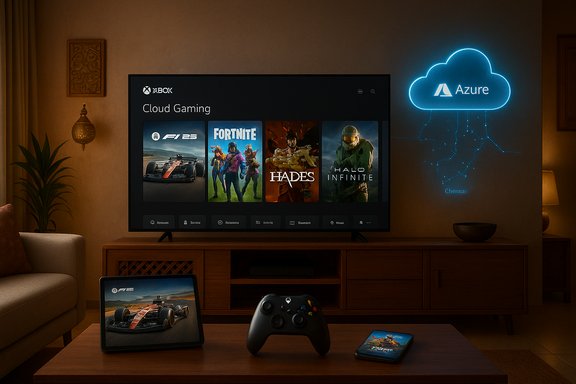
Microsoft has quietly flipped the switch on its global streaming strategy in one of the world’s fastest‑growing gaming markets: Xbox Cloud Gaming is now officially live in India, enabling players across the country to stream hundreds of console‑quality titles to devices they already own — from phones and PCs to select smart TVs and Amazon Fire TV hardware. The rollout brings local Azure capacity into play, expands the reach of Xbox Game Pass tiers in the region, and arrives alongside the service’s broader technical upgrade that adds an enhanced streaming tier capable of up to 1440p video and substantially higher bitrates for qualifying games and subscribers.
Xbox Cloud Gaming (the cloud‑streaming layer of Xbox Game Pass) has matured from a proof‑of‑concept to a global distribution channel for Xbox titles. Over the last several product cycles Microsoft consolidated cloud infrastructure onto Azure hardware roughly equivalent to Xbox Series X class machines, broadened device support (browsers, TVs, Fire TV, handhelds), and reworked Game Pass tiers to make streaming more widely available. Recent product changes removed the “beta” label from the cloud service and introduced a higher‑quality streaming tier — select games on certain devices can now reach 1440p with peak bitrates well above the service’s prior averages.
India’s inclusion in the rollout is more than a checkbox on a map. The service is now tied to local Azure regions (Central India / Pune and South India / Chennai), which reduces round‑trip latency for many players and ought to materially improve stream quality versus routing sessions internationally. Local infrastructure, broader device support (LG and Samsung smart TVs, Amazon Fire devices, modern phones and PCs), and the Game Pass tiering changes make cloud gaming a credible, low‑entry alternative for gamers who either can’t afford dedicated hardware or prefer a device‑agnostic play model.
Key items to watch in the coming months:
Source: SSBCrack News Xbox Cloud Gaming Launches in India - SSBCrack News
 Background / Overview
Xbox Cloud Gaming (the cloud‑streaming layer of Xbox Game Pass) has matured from a proof‑of‑concept to a global distribution channel for Xbox titles. Over the last several product cycles Microsoft consolidated cloud infrastructure onto Azure hardware roughly equivalent to Xbox Series X class machines, broadened device support (browsers, TVs, Fire TV, handhelds), and reworked Game Pass tiers to make streaming more widely available. Recent product changes removed the “beta” label from the cloud service and introduced a higher‑quality streaming tier — select games on certain devices can now reach 1440p with peak bitrates well above the service’s prior averages.India’s inclusion in the rollout is more than a checkbox on a map. The service is now tied to local Azure regions (Central India / Pune and South India / Chennai), which reduces round‑trip latency for many players and ought to materially improve stream quality versus routing sessions internationally. Local infrastructure, broader device support (LG and Samsung smart TVs, Amazon Fire devices, modern phones and PCs), and the Game Pass tiering changes make cloud gaming a credible, low‑entry alternative for gamers who either can’t afford dedicated hardware or prefer a device‑agnostic play model.
What Microsoft shipped in India — the essentials
Devices and access
- Supported devices include modern Windows PCs, Android and Apple mobile devices (via browser), Xbox consoles, select Samsung and LG smart TVs, and compatible Amazon Fire TV sticks and cubes.
- The easiest way to start is the browser portal (xbox.com/play) — no download required on most platforms, while smart TV owners can use the Xbox app where available.
- Controllers supported include the Xbox Wireless Controller plus many mainstream Bluetooth controllers (DualSense, DualShock 4, and several third‑party pads). Some titles also support keyboard + mouse when streamed to PC.
Game Pass tiers and cloud access
- Cloud access is integrated into the Game Pass lineup. The reworked tiers now offer cloud streaming across multiple level options: Essential, Premium, and Ultimate. Each tier differs in library size, day‑one access, and the streaming experience (Ultimate receives priority capacity and the best available streaming quality).
- The Ultimate tier benefits from the new higher‑quality streams for select games and devices, while the mid and entry tiers gain broader cloud access — an intentional move to democratize streaming access.
Local infrastructure and latency
- Local Xbox Cloud Gaming stacks are now operating on Azure capacity in India’s Central (Pune) and South (Chennai) regions. That local presence reduces network distance for domestic players and should lower latency and packet loss versus cross‑border routing. The practical upshot: faster session start times, improved responsiveness, and the potential to sustain higher resolutions with fewer artifacts for urban users connected to modern ISPs.
Streaming quality: 1440p and bitrates
- The service’s recent technical update introduces an enhanced quality tier: select titles, for select devices and for qualifying subscribers, can stream up to 1440p with burst bitrates that have been observed peaking near 27 Mbps. That’s a notable jump from the historical cloud‑streaming norms and reduces compression artifacts and motion blur in many scenes. That said, only a subset of the library and compatible endpoints support this profile today; the rollout will expand over time.
Why this matters for India’s gaming market
1) Accessibility at scale
India’s console and PC ownership numbers are growing, but hardware remains out of reach for many. Cloud gaming lowers the barrier to entry: an existing phone, TV or laptop plus a Game Pass subscription and a controller can replace the cost and upkeep of a new console or gaming PC.2) Localized performance
Having cloud stacks in Pune and Chennai matters. Local Azure regions can reduce latency by tens of milliseconds for many Indian players, which is crucial for interactive experiences. For players in major metros on wired or strong 5G connections, the cloud can now feel much closer to native play than it did when sessions were routed overseas.3) Broader device ecosystem
The addition of LG and Samsung smart TV apps and support for Amazon Fire devices brings console‑level games onto everyday living‑room screens without a console. For manufacturers and content partners, that expands install bases and time‑spent metrics; for Microsoft, it means more eyeballs on Game Pass subscriptions.4) Product prioritization and content reach
Cloud distribution allows Microsoft to present a large, curated library to new users with minimal friction. Game Pass as the gateway gives Microsoft flexibility to bundle day‑one releases (on Ultimate), retro and curated content, and new features like “Stream Your Own Game” where owned titles can be streamed from the cloud in supported cases.Technical reality check — what gamers need and what to expect
Minimum and recommended network guidance
- Microsoft’s public guidance and independent community testing converge on a practical baseline: 10 Mbps is a commonly cited minimum for cloud gaming to launch and play basic streams; 20 Mbps or more is recommended for a consistently smooth HD experience. For the new 1440p streams, you should expect to need sustained bandwidth well into the tens of megabits (mid‑20s Mbps or higher), and a low‑latency, low‑jitter path.
- Latency matters more than raw bandwidth. Even with high download speeds, high ping and packet loss produce input lag and stuttering. Aim for sub‑50 ms ping to cloud servers for the best reactive gameplay; local Azure stacks make that goal easier in many Indian cities.
Device, network and home setup best practices
- Prefer wired Ethernet for TVs and PCs whenever possible. For mobile and handheld play, use 5 GHz Wi‑Fi and be close to the router.
- Reduce competing traffic on the same household network during play (streaming video, large downloads, other game sessions). QoS on modern routers helps, as does upgrading to an ISP plan that doesn’t throttle during peak hours.
- Keep a modern browser or updated Xbox app; for iOS users, the browser/PWA route is the supported path given mobile store constraints.
Expectations around 1440p and “console parity”
- The new 1440p streams are a substantive step forward; testing shows visible improvements in clarity and texture fidelity versus the service’s previous high‑quality streams. However, 1440p availability is selective: not every game or device will get it immediately. Whether cloud streams surpass console remote‑play is situational — in some titles and scenes cloud bitrate and encoding can look cleaner than remote‑play from a Series X|S in a constrained home network, but interactive latency and control feel remain the decisive factors, where a local console typically has the edge.
The competitive landscape and regulatory reality
Head‑to‑head competition
- Xbox is competing in India not just with consoles but with other cloud platforms (notably NVIDIA GeForce Now and Sony’s cloud experiences). Each provider takes different design choices: one prioritizes raw resolution and GPU power, another focuses on exclusive catalog content or deeply integrated consoles. Microsoft’s strength is a broad first‑party catalog plus day‑one releases on the top Game Pass tier.
App stores and platform restrictions
- A lingering challenge is global app‑store policy. Apple and Google’s rules historically restricted cloud gaming access or forced developers into business models that make cloud apps harder to monetize. Microsoft’s route — web‑based Progressive Web Apps for iOS and direct app availability on many Android devices — sidesteps some of these issues, but regulatory and store policy friction remains a cross‑platform headache for cloud providers.
Pricing and community sentiment
- Game Pass tier changes and price adjustments in various markets during 2025 stirred backlash; delivering cloud access while raising subscription costs is a delicate balance. Indian pricing must remain sensitive to local purchasing power and competitors’ offers. Expect promotional pricing, regional bundles and retail code availability to shape adoption.
Risks and downside scenarios
1) Network variability across India
India is not uniform in broadband quality. Urban centers enjoy fast fixed‑line and competitive 5G, while many smaller towns and rural areas still face constrained bandwidth and higher latency. Cloud gaming’s user experience will therefore be uneven; early adoption will skew toward urban and suburban customers with modern ISPs and routers.2) Data caps and metered connections
Many Indian mobile plans and some fixed packages come with daily or monthly data caps or fair‑use throttles. Sustained cloud play, especially at high resolutions, consumes significant data — players should be mindful of their ISP plans and potential overage charges. This is a practical barrier to long sessions or heavy multiplayer use for many users.3) Launch teething issues and capacity constraints
A new market opening can create surges in demand. Even with local Azure presence, Microsoft must manage capacity, matchmaking queues, and peak load for popular titles. Expect short wait times or degraded streams in initial weeks as usage patterns ramp up.4) Pricing sensitivity and retention risk
If local pricing moves upward or if users feel day‑one exclusives justify higher Ultimate fees, churn risk increases. Microsoft will need to calibrate offers, bundles and local promotions carefully to retain price‑sensitive customers.5) Regulatory and content compliance
Operating in India brings distinct legal and cultural considerations: content regulation, data‑localization pressures and consumer protection rules. Microsoft’s local cloud presence helps with compliance, but ongoing regulation could affect feature sets or available games.What this launch means for players — practical checklist
- Verify your subscription: check whether your Game Pass tier includes cloud access (Essential, Premium, Ultimate have different benefits).
- Test your network: run a speedtest from the device you’ll play on; aim for 20+ Mbps and low latency for a stable HD experience.
- Prefer wired connections for TVs and PCs; use 5 GHz Wi‑Fi for mobile and handheld play.
- Pair a compatible controller (Xbox Wireless, DualSense, or other supported pads) and update firmware where applicable.
- Try xbox.com/play first to assess performance; smart TV users should check for the Xbox app in the LG/Samsung app catalog or on Fire TV devices.
- Monitor data usage if you’re on metered plans — streaming at higher resolutions can quickly use tens of gigabytes.
Broader industry and commercial implications
- For Microsoft, India is both a large addressable market and a testbed for cloud economics at scale. Local Azure investment signals long‑term commitment; success here could accelerate similar regional expansions and deepen publisher deals.
- For hardware partners (TV makers, device OEMs), Xbox Cloud Gaming creates value: smart TV owners get a new entertainment ecosystem without hardware upgrades. That helps drive premium TV sales and recurring engagement metrics.
- For telcos and ISPs, cloud gaming will be a traffic driver; carriers that provide gaming‑friendly plans and low‑latency routing will have a competitive edge. This may accelerate consumer demand for uncapped, higher‑quality broadband packages targeted at gamers.
- For Indian developers and publishers, better local cloud access could expand discoverability on Game Pass and open new monetization routes, but it also increases competition by lowering the friction for players to try big AAA titles.
Strengths and notable opportunities
- Immediate accessibility: Millions of devices can now serve as Xbox platforms without extra hardware purchase.
- Local Azure capacity: Real‑world latency improvements for Indian players are a meaningful technical advantage.
- Upsell pathway for Microsoft: Cloud streaming acts as a funnel into full Game Pass adoption and future services such as first‑party day‑one releases and in‑game revenue streams.
- TV as a growth channel: Smart TVs and Fire TV devices extend the living‑room play surface beyond consoles and PCs, reaching casual players and families.
Where caution is warranted
- Claims that cloud streams universally “surpass” local console remote play should be qualified — improvements are real but vary by title, network, and device. In fast competitive shooters and highly latency‑sensitive genres, local hardware still holds the advantage.
- Some promotional claims about a single Indian data center being “the most advanced” in the region are marketing language rather than independently verifiable technical benchmarks. Microsoft has publicly invested heavily in Indian Azure regions and availability zones, but phrasing like “most advanced” is relative and should be read as corporate positioning unless backed by objective third‑party audits.
- App store dynamics and local regulation could constrain the experience on certain mobile platforms — browser‑based PWAs remain the durable workaround, but they have limitations compared with native apps.
Final assessment — why this launch matters (and what to watch next)
Xbox Cloud Gaming’s arrival in India is a meaningful milestone for subscription‑first, platform‑agnostic gaming. It reduces hardware friction, ties into a deep content library, and leverages local cloud infrastructure to deliver a better interactive experience than earlier cross‑border streaming efforts. For players in urban India with modern broadband and a compatible controller, the service can deliver near‑console visuals and a low‑setup path into blockbuster titles. For Microsoft, it opens a major growth corridor for Game Pass and the broader Xbox ecosystem.Key items to watch in the coming months:
- How Microsoft scales capacity and which games adopt the 1440p enhanced stream profile.
- Whether local ISPs launch gamer‑friendly packages or partnership bundles to offset data concerns.
- How pricing, promotions and retail code availability shape adoption in price‑sensitive segments.
- Apple and Google policy changes (or the regulatory environment) that might affect app distribution and monetization in India.
Source: SSBCrack News Xbox Cloud Gaming Launches in India - SSBCrack News
