

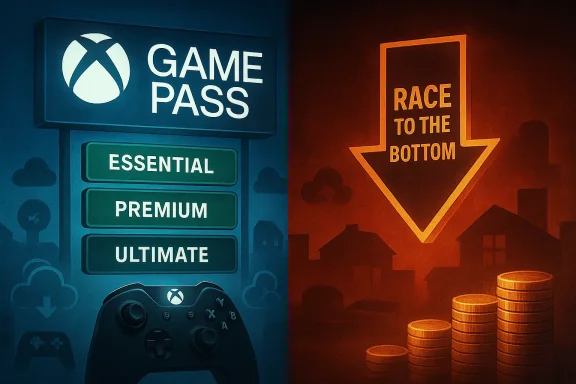
Microsoft’s reported interest in cheaper Xbox Game Pass tiers has reopened one of gaming’s most contentious pricing debates, and the timing could hardly be more sensitive. After a year of steep subscription hikes and a broader industry pullback on spending, Larian Studios publishing director Michael “Cromwelp” Douse is warning that “race to the bottom” pricing would only deepen the structural problems already facing subscriptions, studios, and the broader economics of game development. His comments arrive as Microsoft weighs lower-priced access paths for Game Pass, even as the service’s newer tier structure and prior price increases continue to reshape how players evaluate value.
Game Pass has spent the last several years evolving from a simple value proposition into a far more complex subscription stack. Microsoft’s October 1, 2025 revamp replaced the older Core and Standard structure with Essential, Premium, and Ultimate, while also raising prices on key tiers and folding in additional benefits such as Fortnite Crew and expanded cloud gaming features for the top plan. The company framed the changes as a way to deliver more value and flexibility, but for many users the headline was simple: the service got more expensive.
That rework was especially hard on the upper end of the market. Game Pass Ultimate jumped to $29.99 per month, up from $19.99, while PC Game Pass increased from $11.99 to $16.49. The lower tiers were less dramatic on paper — Essential stayed at $9.99 and Premium settled at $14.99 — but the overall message was unmistakable: Microsoft was no longer treating Game Pass as a bargain-basement subscription designed primarily to maximize raw sign-ups. Instead, it was positioning the service as a bundled premium ecosystem.
That shift matters because Game Pass has always sat at the center of a bigger strategic bet. Microsoft has spent years trying to prove that a subscription model can coexist with big-budget game development, day-one releases, cloud streaming, and platform growth. Critics have long argued that the math only works as long as subscriptions expand quickly and content remains abundant, cheap, and fresh. When user growth slows or content costs rise, the model becomes much more fragile.
Douse’s remarks tap directly into that fault line. The Larian executive’s argument is not simply that Xbox should never lower a price. Rather, he is saying that aggressively trying to win market share by undercutting value can be corrosive when studios are already under pressure from layoffs, rising budgets, and shrinking tolerance for risk. In other words, the industry’s economics may now be too unstable for another round of ultra-low subscription experiments.
Microsoft’s own messaging shows that it understands the tension. On one hand, the company has increased the value density of Game Pass by bundling more features into Ultimate and widening the appeal of its ecosystem. On the other hand, the growing price gap between tiers makes the top plan harder to justify for many households, especially those already facing tighter budgets. That is why lower-priced tiers sound attractive: they could restore accessibility without forcing Microsoft to undo its premium strategy.
Still, cheap and sustainable are not the same thing. Douse’s criticism suggests that Game Pass may already be straddling a difficult line between consumer friendliness and business viability. If Microsoft lowers the price too far, too broadly, or without removing enough cost from the package, it risks repeating the classic subscription trap: lots of users, weak margins, and pressure on studios to make content that is both abundant and inexpensive. That is where the phrase “race to the bottom” carries real weight.
The irony is that lower-priced tiers are not inherently anti-consumer or anti-developer. They can be useful when they are carefully segmented, clearly scoped, and designed to match actual usage patterns. The problem is when price cuts become a substitute for a coherent product strategy. In a market where blockbuster titles, live-service games, and subscription content all compete for the same attention and wallet share, pricing is no longer just a sales lever; it is a statement about the kind of ecosystem Microsoft wants Xbox to be.
His use of the phrase “trust is at an all time low” is also telling. Subscriptions only work when users believe the service will remain a good deal over time. The moment customers start to suspect that a service is becoming a vehicle for price hikes, content dilution, or feature creep, they become more cautious. That skepticism is especially strong in gaming, where players already have a well-developed instinct for waiting for sales, discounting, and bundle deals.
That point is especially relevant for story-driven and high-production games. These are not infinite-feed products. They require large, coordinated teams and long development windows, and they rarely scale like software tools or cloud services. If subscriptions push the market toward expectations of near-limitless content at bargain prices, the burden shifts to developers in ways that are difficult to absorb indefinitely.
The company also has to deal with a split user base. Console players, PC players, and cloud-first users do not all want the same bundle. A lower-priced tier could be a way to segment demand more cleanly: one audience wants day-one access and bundled perks, another wants a cheaper catalog-and-cloud path, and a third simply wants online play plus a back catalog. In that sense, cheaper tiers are as much about product-market fit as they are about price cuts.
The danger is that lower prices can train users to wait for discounts or settle for thinner offerings. That would be a problem if Microsoft begins using cheap tiers as a growth crutch instead of investing in stronger content economics. If the bottom of the stack gets too cheap, the whole pyramid starts to look unstable.
That perception matters because game development is already under strain. The past few years have seen mass layoffs, studio closures, project cancellations, and widespread scrutiny of whether blockbuster budgets can keep escalating. Douse’s argument that this is “the worst time” to make quality games cheaply is essentially a warning that the sector has lost the cushion it once relied on. Cheaper access for consumers can sound good until it becomes cheaper labor and thinner margins behind the scenes.
That is why “race to the bottom” is such a loaded phrase in this context. It implies a market where the lowest price wins even when the lowest price is not enough to sustain the ecosystem. In a healthy market, lower prices should be accompanied by lower costs or smarter packaging. In a distressed one, they can simply mask structural weakness.
But consumer value is not the same as consumer optimization. A service can feel better to an individual subscriber while becoming less sustainable overall. Microsoft has to decide whether it wants Game Pass to function like a mass-market utility, a premium gaming club, or a hybrid of both. The answer may be different for every tier, but it cannot be all three at once without tradeoffs.
There is also a fairness perception problem. Some users see Game Pass as an entertainment buffet; others see it as a way to access games they would never otherwise buy. Those two mental models respond differently to price changes. The more Microsoft leans into bundles, perks, and add-ons, the more the service risks feeling less like a straightforward gaming subscription and more like a constantly renegotiated package.
For Sony, the lesson is that premium content still sells when the value story is coherent. For Nintendo, the lesson is that a curated ecosystem can thrive without forcing a subscription into the center of the experience. For Steam and the broader PC market, the lesson is that ownership still has a strong psychological advantage when consumers become skeptical of fluctuating access models.
The broader competitive issue is that Microsoft is trying to make Xbox into a service ecosystem, not just a console brand. That means pricing decisions have to support not just subscriptions, but also hardware, cloud gaming, PC integration, and long-term platform loyalty. A mistake at the subscription layer can ripple outward through every other part of the business.
Microsoft is not the only company wrestling with this. Across the entertainment stack, subscriptions are becoming more tiered, more bundled, and more expensive. The pattern is familiar: once a company proves that a low-friction subscription can attract users, it often discovers that the economics only work if it steadily increases monetization per user. Game Pass is simply one of the clearest examples of that pattern in gaming.
That is why Douse’s “golden toilet” remark is more than a joke. It captures the idea that some desirable outcomes are financially incompatible with the conditions needed to sustain them. Everyone wants the premium experience, the low price, and the healthy studio economy. The problem is that all three are not always available at once.
The more interesting question is whether Microsoft believes the market has room for a more modular Xbox subscription stack. That could mean a stripped-down cloud plan, a PC-focused bargain tier, or an ad-supported entry point that trades convenience for a lower monthly cost. Each of those paths could work, but only if Microsoft resists the temptation to market all of them as the same thing.
Source: Windows Central https://www.windowscentral.com/gami...box-game-pass-tiers-microsoft-is-considering/
 Background
Game Pass has spent the last several years evolving from a simple value proposition into a far more complex subscription stack. Microsoft’s October 1, 2025 revamp replaced the older Core and Standard structure with Essential, Premium, and Ultimate, while also raising prices on key tiers and folding in additional benefits such as Fortnite Crew and expanded cloud gaming features for the top plan. The company framed the changes as a way to deliver more value and flexibility, but for many users the headline was simple: the service got more expensive.That rework was especially hard on the upper end of the market. Game Pass Ultimate jumped to $29.99 per month, up from $19.99, while PC Game Pass increased from $11.99 to $16.49. The lower tiers were less dramatic on paper — Essential stayed at $9.99 and Premium settled at $14.99 — but the overall message was unmistakable: Microsoft was no longer treating Game Pass as a bargain-basement subscription designed primarily to maximize raw sign-ups. Instead, it was positioning the service as a bundled premium ecosystem.
That shift matters because Game Pass has always sat at the center of a bigger strategic bet. Microsoft has spent years trying to prove that a subscription model can coexist with big-budget game development, day-one releases, cloud streaming, and platform growth. Critics have long argued that the math only works as long as subscriptions expand quickly and content remains abundant, cheap, and fresh. When user growth slows or content costs rise, the model becomes much more fragile.
Douse’s remarks tap directly into that fault line. The Larian executive’s argument is not simply that Xbox should never lower a price. Rather, he is saying that aggressively trying to win market share by undercutting value can be corrosive when studios are already under pressure from layoffs, rising budgets, and shrinking tolerance for risk. In other words, the industry’s economics may now be too unstable for another round of ultra-low subscription experiments.
Overview
The current debate is about more than one subscription service. It reflects a larger reset in how the game business thinks about growth. For years, the dominant logic across streaming, gaming, and software was to subsidize adoption first and worry about monetization later. That approach worked when capital was cheap, user growth was fast, and investors rewarded scale over discipline. Those assumptions are now weaker.Microsoft’s own messaging shows that it understands the tension. On one hand, the company has increased the value density of Game Pass by bundling more features into Ultimate and widening the appeal of its ecosystem. On the other hand, the growing price gap between tiers makes the top plan harder to justify for many households, especially those already facing tighter budgets. That is why lower-priced tiers sound attractive: they could restore accessibility without forcing Microsoft to undo its premium strategy.
Still, cheap and sustainable are not the same thing. Douse’s criticism suggests that Game Pass may already be straddling a difficult line between consumer friendliness and business viability. If Microsoft lowers the price too far, too broadly, or without removing enough cost from the package, it risks repeating the classic subscription trap: lots of users, weak margins, and pressure on studios to make content that is both abundant and inexpensive. That is where the phrase “race to the bottom” carries real weight.
The irony is that lower-priced tiers are not inherently anti-consumer or anti-developer. They can be useful when they are carefully segmented, clearly scoped, and designed to match actual usage patterns. The problem is when price cuts become a substitute for a coherent product strategy. In a market where blockbuster titles, live-service games, and subscription content all compete for the same attention and wallet share, pricing is no longer just a sales lever; it is a statement about the kind of ecosystem Microsoft wants Xbox to be.
Why Douse’s Warning Landed So Hard
Douse’s comments resonated because they were aimed at a real discomfort in modern gaming: the industry often asks players to pay less while asking studios to produce more. That gap between consumer expectations and production reality has widened sharply in the last several years. Bigger teams, longer timelines, more QA, higher visual fidelity, and expanded live-service operations all drive costs upward, while pricing pressure keeps many publishers hesitant to raise standard game MSRPs much further.His use of the phrase “trust is at an all time low” is also telling. Subscriptions only work when users believe the service will remain a good deal over time. The moment customers start to suspect that a service is becoming a vehicle for price hikes, content dilution, or feature creep, they become more cautious. That skepticism is especially strong in gaming, where players already have a well-developed instinct for waiting for sales, discounting, and bundle deals.
The Cost of Cheap Content
There is a difference between accessibility and undervaluation. A cheaper tier can expand reach, but it can also create the impression that premium games are commodities rather than expensive creative works. When an executive like Douse argues against aggressive price cuts, he is not defending only studio budgets; he is defending the idea that quality content still needs room to breathe financially.That point is especially relevant for story-driven and high-production games. These are not infinite-feed products. They require large, coordinated teams and long development windows, and they rarely scale like software tools or cloud services. If subscriptions push the market toward expectations of near-limitless content at bargain prices, the burden shifts to developers in ways that are difficult to absorb indefinitely.
- Lower prices can widen reach, but they do not automatically improve economics.
- Premium games are expensive to build, and that cost does not disappear because a subscription exists.
- Trust matters in subscription services because users judge both value and stability.
- Creative ambition is fragile when budget pressure becomes the defining constraint.
- Consumer access and developer sustainability are not the same problem, even if they overlap.
What Microsoft Is Actually Trying to Solve
Microsoft’s reported interest in cheaper tiers should be viewed as a response to pressure from below. The post-hike backlash showed that there is a ceiling to how much value even a very feature-rich subscription can extract before users start re-evaluating whether they need it at all. That matters because subscription fatigue is real, especially in households already juggling video, music, cloud storage, and software subscriptions.The company also has to deal with a split user base. Console players, PC players, and cloud-first users do not all want the same bundle. A lower-priced tier could be a way to segment demand more cleanly: one audience wants day-one access and bundled perks, another wants a cheaper catalog-and-cloud path, and a third simply wants online play plus a back catalog. In that sense, cheaper tiers are as much about product-market fit as they are about price cuts.
Tiering as a Business Tool
Tiering works when each step up the ladder has a clear job. Essential covers the basic access case. Premium covers the value-conscious enthusiast. Ultimate is supposed to justify itself with the richest bundle and the best access. If Microsoft adds another lower-priced layer, it needs to avoid cannibalizing the very people who currently sustain the top end of the business.The danger is that lower prices can train users to wait for discounts or settle for thinner offerings. That would be a problem if Microsoft begins using cheap tiers as a growth crutch instead of investing in stronger content economics. If the bottom of the stack gets too cheap, the whole pyramid starts to look unstable.
- Segmentation can be healthy when it matches real usage patterns.
- Cannibalization is the core risk of adding cheaper access.
- Top-tier value must stay compelling or the service loses its anchor.
- Subscription fatigue is an external constraint Microsoft cannot ignore.
- Simple pricing can be better than clever pricing if consumers understand it immediately.
The Developer Economics Problem
Douse’s most pointed criticism is not about Microsoft alone. It is about an industry model in which content is expected to subsidize platform growth while the costs of making that content continue rising. That is an uncomfortable reality for publishers, studios, and platform holders alike. If Microsoft pushes Game Pass too far toward bargain pricing, developers may conclude that the service rewards volume over value.That perception matters because game development is already under strain. The past few years have seen mass layoffs, studio closures, project cancellations, and widespread scrutiny of whether blockbuster budgets can keep escalating. Douse’s argument that this is “the worst time” to make quality games cheaply is essentially a warning that the sector has lost the cushion it once relied on. Cheaper access for consumers can sound good until it becomes cheaper labor and thinner margins behind the scenes.
Why Subscription Models Stress Studios
A subscription model does not eliminate content cost; it redistributes it. Instead of a one-time purchase, revenue arrives through recurring fees, and that only works when subscriber counts and retention hold up. If either side weakens, studios can end up carrying the uncertainty while platform owners absorb the branding upside.That is why “race to the bottom” is such a loaded phrase in this context. It implies a market where the lowest price wins even when the lowest price is not enough to sustain the ecosystem. In a healthy market, lower prices should be accompanied by lower costs or smarter packaging. In a distressed one, they can simply mask structural weakness.
- Recurring revenue does not erase development expenses.
- Subscriber growth can hide weak unit economics for a while.
- Studios bear risk when platforms prioritize scale over sustainability.
- Blockbuster production needs predictable returns, not just exposure.
- Cheaper access can unintentionally devalue premium creative work.
Consumer Value Versus Market Discipline
The consumer argument for a cheaper tier is easy to understand. At $29.99 a month, Ultimate is expensive enough that many players can justify it only if they use Game Pass heavily and consistently. A lower-cost option could bring back lapsed users, attract younger players, or serve households that only want selective access rather than a broad premium bundle. That is a straightforward value proposition.But consumer value is not the same as consumer optimization. A service can feel better to an individual subscriber while becoming less sustainable overall. Microsoft has to decide whether it wants Game Pass to function like a mass-market utility, a premium gaming club, or a hybrid of both. The answer may be different for every tier, but it cannot be all three at once without tradeoffs.
The Psychology of Price Anchoring
Price anchoring is powerful in subscriptions. Once players see a premium tier at nearly $30, the lower tiers can start to look more attractive even if they have not changed in substance. That can help Microsoft sell entry-level plans, but it can also make the service feel fragmented and harder to understand.There is also a fairness perception problem. Some users see Game Pass as an entertainment buffet; others see it as a way to access games they would never otherwise buy. Those two mental models respond differently to price changes. The more Microsoft leans into bundles, perks, and add-ons, the more the service risks feeling less like a straightforward gaming subscription and more like a constantly renegotiated package.
- Ultimate’s current price makes value scrutiny unavoidable.
- Lower tiers can re-open the door for budget-conscious players.
- Complex bundles can frustrate users as much as they entice them.
- Price anchoring can work in Microsoft’s favor, but only temporarily.
- A cheaper plan is not always a better plan if the catalog is too constrained.
How Rivals Should Read This Debate
Sony, Nintendo, Steam, and even PC storefront competitors should view this debate as evidence that the subscription battle is entering a more mature phase. Early subscription growth often comes from novelty and generous economics. Mature growth, by contrast, requires discipline, differentiation, and a very clear answer to why a user should pay monthly instead of buying or waiting for sales.For Sony, the lesson is that premium content still sells when the value story is coherent. For Nintendo, the lesson is that a curated ecosystem can thrive without forcing a subscription into the center of the experience. For Steam and the broader PC market, the lesson is that ownership still has a strong psychological advantage when consumers become skeptical of fluctuating access models.
Competitive Implications for Microsoft
If Microsoft lowers prices again, even selectively, rivals may read it as an admission that the current structure is too aggressive for its own good. But the opposite reading is also possible: lower tiers could be a strategic way to defend share against fatigue, churn, and price comparison across multiple entertainment services. The same move can look defensive or opportunistic depending on the lens.The broader competitive issue is that Microsoft is trying to make Xbox into a service ecosystem, not just a console brand. That means pricing decisions have to support not just subscriptions, but also hardware, cloud gaming, PC integration, and long-term platform loyalty. A mistake at the subscription layer can ripple outward through every other part of the business.
- Rivals will watch for churn signals if Microsoft adjusts prices again.
- PC ownership remains a strong counterweight to subscription pressure.
- Curated ecosystems can outperform bundles when the value proposition is clear.
- Price cuts can be tactical, but they can also signal strategic anxiety.
- Xbox’s identity now depends on more than Game Pass alone.
The Broader Industry Context
Douse’s warning lands because it aligns with a bigger industry mood: skepticism toward growth-at-all-costs strategies. In gaming, tech, and media alike, the cheap-money era has ended, and companies are being forced to justify pricing with hard economics rather than growth narratives. That shift affects everyone from platform operators to independent studios.Microsoft is not the only company wrestling with this. Across the entertainment stack, subscriptions are becoming more tiered, more bundled, and more expensive. The pattern is familiar: once a company proves that a low-friction subscription can attract users, it often discovers that the economics only work if it steadily increases monetization per user. Game Pass is simply one of the clearest examples of that pattern in gaming.
Why This Debate Is Bigger Than Xbox
What makes the Xbox conversation important is that it touches both sides of the industry ledger. Consumers want lower monthly bills. Developers want better compensation and longer runway. Platform holders want retention, margin, and strategic control. Any pricing model that ignores one of those three pressures is likely to fail eventually.That is why Douse’s “golden toilet” remark is more than a joke. It captures the idea that some desirable outcomes are financially incompatible with the conditions needed to sustain them. Everyone wants the premium experience, the low price, and the healthy studio economy. The problem is that all three are not always available at once.
- The low-cost subscription era is fading across entertainment.
- Higher prices are often a symptom of tighter capital discipline.
- Gaming is especially exposed because content costs are so visible.
- Every stakeholder wants a different optimal price point.
- The business model must now survive without constant growth subsidies.
Strengths and Opportunities
The upside for Microsoft is that it still has a rare combination of scale, brand recognition, platform reach, and content leverage. If the company prices the service intelligently, it can use lower tiers to widen the funnel without necessarily destroying the premium end of the business. The key is to make each tier feel purposeful rather than merely cheaper.- Broader accessibility for budget-conscious players.
- Better segmentation across console, PC, and cloud audiences.
- More flexible entry points for lapsed or casual subscribers.
- Potential churn reduction if users can downgrade instead of cancel.
- Stronger ecosystem lock-in when plans are tuned to real usage.
- Room for experimentation with ad-supported or feature-limited access.
- A clearer ladder from casual access to premium, all-in value.
Risks and Concerns
The main risk is that lower-priced tiers could become a short-term growth fix that undermines the long-term economics of Game Pass. If the pricing story becomes too complicated or the content mix too thin, Microsoft may end up with more subscribers but less loyalty, while developers face greater pressure to produce high-quality content under increasingly difficult conditions.- Margin compression if price cuts are not offset elsewhere.
- Developer distrust if cheaper access is seen as devaluing games.
- Cannibalization of higher tiers through aggressive discounting.
- Pricing confusion if the plan stack becomes too hard to explain.
- Content strain if subscriptions outgrow the business model.
- Subscriber churn if users subscribe only for promotions.
- Market signaling problems if cuts are read as desperation rather than strategy.
Looking Ahead
What happens next will depend on whether Microsoft is trying to broaden Game Pass or rescue it from its own premium turn. A genuinely smart lower-priced tier would need clear boundaries, obvious tradeoffs, and a business case that does not rely on studios absorbing the hidden costs. If Microsoft instead chases volume for its own sake, Douse’s warning will look prescient rather than pessimistic.The more interesting question is whether Microsoft believes the market has room for a more modular Xbox subscription stack. That could mean a stripped-down cloud plan, a PC-focused bargain tier, or an ad-supported entry point that trades convenience for a lower monthly cost. Each of those paths could work, but only if Microsoft resists the temptation to market all of them as the same thing.
- Watch for clearer tier definitions and whether Microsoft narrows feature overlap.
- Watch for changes to cloud gaming access, especially if lower-cost plans emerge.
- Watch for developer reactions, because publisher confidence will matter.
- Watch for promotional pricing, which may hint at testing rather than a permanent cut.
- Watch for messaging around value, since Microsoft must justify any new tier instantly.
Source: Windows Central https://www.windowscentral.com/gami...box-game-pass-tiers-microsoft-is-considering/
Last edited:
