

Xbox is quietly testing what could become one of the most consequential changes to Game Pass since Microsoft split the service into new tiers last year. A new codenamed plan, “Triton,” appears to be surfacing in Microsoft’s public Game Pass backend, and early evidence suggests it would include only first-party Xbox games for now rather than the broader mix found in Essential, Premium, or Ultimate. That makes the rumor easy to dismiss as just another backend experiment, but it is more interesting than that: it points to Microsoft probing a slimmer, lower-friction subscription model at a moment when the company is already reshaping Xbox around first-party content, platform convergence, and a more explicit value ladder. soft’s Game Pass strategy has changed more in the last 18 months than in the previous several years combined. In October 2025, Xbox introduced the current three-plan structure — Essential, Premium, and Ultimate — and used that reset to bundle in more benefits, including day-one games, Fortnite Crew, Ubisoft+ Classics, improved cloud quality, and Rewards features for the higher tiers. The message was clear: Game Pass was no longer one product with a few add-ons, but a tiered ecosystem designed to sort players by usage, platform, and willingness to pay.
That restructuring mattered because Microsoft had already been pushing the service in two different directions at once. On one hand, Game Pass became more premium, more feature-rich, and more tightly associated with the most expensive plan. On the other hand, Microsoft repeatedly emphasized access, convenience, and breadth, especially as the Xbox PC app grew into a broader launcher and library hub. The tension between those goals — maximize revenue while keeping the brand synonymous with value — is exactly where a first-party-only tier starts to make sense.
The new Triton discussion also lands against a backdrop of ongoing rumors that Microsoft wants to evolve Game Pass rather than simply raise prices forever. Windows Central’s reporting has already pointed to a possible future where Microsoft consolidates or reshapes lower-cost PC access, and the broader trend across Xbox is unmistakable: more bundles, more segmentation, more curation, and more emphasis on what each subscriptiopposed to do. Triton fits that pattern neatly, even if the codename itself may never become a consumer-facing brand.
There is also a historical precedent for Microsoft using first-party content as the anchor for subscription strategy. Xbox has long treated its own studios as the ballast that gives Game Pass identity. The service’s most persuasive marketing has almost always been built around Microsoft’s own franchises — Halo, Forza, Gears, Fallout, Hellblade, and now newer additions like Fable and South of Midnight. A tier built only around Xbox Studios would not be a radical departure from that logic; it would simply formalize it.
The timing is what makes the rumor notable. Microsoft is already moving the Xbox ecosystem closer to a platform model that spans console, PC, cloud, and even Windows 11’s evolving game-centric interface. In that context, a lighter Game Pass tproduct: one that lowers the entry price while preserving the upside of first-party loyalty. The real question is whether that bridge leads players upward or merely teaches them to buy less.
The strongest reading of the backend evidence is that Triton is not a replacement for current Game Pass tiers, but a test of a narrower subscription offer. According to the leaked catalog data highlighted in the Windows Central piece, the available games are all Microsoft-owned or Microsoft-published, including DOOM Eternal, Fallout 4, Gears 5, Halode, Ori and the Blind Forest, Psychonauts, State of Decay 2, and The Elder Scrolls Online. That is a very specific curation pattern, not an accidental library snapshot.
The inclusion list matters because it looks less like a general “mini Game Pass” and more like a first-party showcase. It appears to be built around recognizable, evergreen titles that have already done most of their commercial heavy lifting. That kind of catalog is ideal for a lse the economics are friendlier than day-one third-party deals, while the perceived value remains strong enough to sell the idea to casual buyers.
It also gives Xbox a way to segment users more cleanly. Players who mostly want Halo, Forza, Gears, and other first-party staples could land in a cheaper lane. Players who want day-one third-party releases, cloud perks, Ubisoft+ Classics, and Fortnite Crew would still have a reason to climb the ladder. That kind of segmentation is very Microsoft: broad enough for mass market appeal, but precise enough to drive upsell.
There is a subtler benefit too. First-party content can be used as the “entry drug” for the wider Xbox platform. If the lower tier works, Microsoft can slowly expose users to the rest of the ecosystem — cloud streaming, PC installs, cross-device play, and perhaps future bundled services. The first-month price matters, but so does the long-term habit formation.
That matters because Microsoft has been steadily trying to solve two different problems at once. It wants to keep Game Pass attractive for subscription-heavy enthusiasts, but it also wants a credible low-cost route for players who do not need everything. A first-party-only tier would be a classic “good, better, best” play, especially if it can be marketed as the easiest way to play Xbox exclusives without paying for extras you do not use.
Yet Microsoft may already have accepted that trade-off. The company has moved from a one-size-fits-all product into a platform with different consumer archetypes in mind. Essential, Premium, and Ultimate are evidence of that. Triton would simply make the ecosystem even more explicit: first-party only at one price point, broader access at another, and all-in features at the top.
The bigger strategic point is that Microsoft seems to be betting that subscription fatigue is better handled by segmentation than by simplification alone. Rather than shrinking Game Pass back into a single plan, Xbox appears to be expanding the menu so players can self-select. That is a meaningful shift in how the company thinks about customer retention.
This is also the safest way to experiment with a cheaper tier. If Microsoft tried to include broad third-party releases at a lower price, it would immediately run into licensing pressure and margin erosion. By contrast, first-party titles give Xbox maximum control over timing, placement, and pricing. They also let Micrpetite without exposing partners to a devaluation of their content.
The leaked Triton list reads like an intentional blend of blockbuster, prestige, and replayable catalog titles. Halo 5: Guardians and Gears 5 provide the brand recognition. Hellblade and Ori and the Blind Forest provide p and The Elder Scrolls Online provide long-tail engagement. That mix suggests Microsoft understands that a lower-priced tier still needs emotional hooks, not just technical eligibility.
It also shows why a first-party-only offer is useful in the current market. Players are increasingly price-sensitive, but they are not necessarily allergic to subscriptions. They are allergic to subscriptions that feel bloated. By stripping out third-party extras, Microsoft may be trying to present Game Pass as a cleaner, more understandable product. If it works, that could be a smart reset. If it does not, it risks looking like a downgraded version of something players already pay for.
But a cheaper tier always comes with a trade-off, and in this case the trade-off is breadth. If Triton excludes third-party day-one games, cloud features, or bundled subscriptions, it may be less a “new version of Game Pass” than a deliberately constrained sampler. That is not necessarily bad, but it does mean the name could matter less than the fine print.
The least obvious winners are the power users who already treat Game Pass as a rotating entertainment stack. They value inclusion, not just cost. If Triton becomes the marketing focus, those players may worry that Microsoft is optimizing for the most basic audience while nudging everyone else into pricier tiers. That suspicion would be understandable.
One of the more interesting consumer questions is whether a first-party tier would make Game Pass feel more affordable or more fragmented. The answer depends on how Microsoft positions it. If it is clearly framed as a “Microsoft games only” option, players may appreciate the honesty. If it is presented as a bargain version of the full service, disappointment could follow quickly.
At the platform level, a first-party-only tier reinforces Microsoft’s control over the most valuable part of its gaming stack: its own intellectual property. That matters because Microsoft is now trying to make Xbox feel consistent across console, PC, cloud, and future Windows gaming interfaces. A compact entry tier gives the company a clean story to tell across all of those surfaces.
There is also an important hardware angle. Microsoft is clearly thinking about the future of Xbox as something more integrated, more services-driven, and more device-agnostic. A tier like Triton could help onboard users into that future without forcing them to commit to the full premium bundle immediately. That is a classic platform strategy: lower the barrier, then deepen engagement later.
For partners, the implications are mixed. On one hand, a slimmer lower tier could keep more users inside Xbox’s orbit. On the other, it could encourage Microsoft to concentrate the most visible marketing around its own studios, leaving third-party publishers to fight harder for attention in the premium tiers. That is not necessarily hostile, but it is certainly more self-interested.
For Sony, the challenge would not be that Microsoft is adding one more tier. It would be that Microsoft is building a more granular pricing ladder around exclusives. That could make Xbox look more flexible to value-minded buyers, especially if td aggressively enough to feel like a no-brainer. Sony’s own service strategy has historically emphasized catalog breadth and ecosystem stability rather than subscription segmentation for every use case.
That raises the stakes for Steam, Epic Games Store, and other PC storefronts, though not in a direct head-to-head way. The more Microsoft turns its own catalog into a recurring subscription value proposition, the less it depends on one-off store purchases. In subscription economics, habit beats impulse, and Xbox knows it. ([windowwww.windowscentral.com/all-microsoft-studios-games-will-launch-xbox-game-pass-moving-forward)
The competitive danger for Microsoft is overconfidence. If Triton is priced too high, it looks redundant. If it is priced too low, it may cannibalize higher tiers without growing the total base enough to compensate. Either outcome would invite scrutiny from rivals and analysts alike.
That selection suggests Microsoft wants Triton to feel like a meaningful Xbox identity package, not a clearance bin. DOOM Eternal, Fallout 4, Gears 5, and Halo 5 signal action and legacy. Ori and the Blind Forest and Psychonauts add artistic credibility. The Elder Scrolls Online and State of Decay 2 help with longevity and repeat engagement.
There is also a retention logic here. Games like Fallout 76 and The Elder Scrolls Online can hold attention for months, making them excellent anchors for a subscription that wants recurring usage rather than one-and-done playthroughs. That kind of catalog supports the service part of Game Pass, not just the discount part.
It is worth noting that a first-party list also reduces risk from licensing churn. Third-party rotations create excitement, but they also create churn and uncertainty. A Microsoft-owned tier avoids that problem, because the company can keep the catalog stable for longer without negotiating every renewal of public drama.
The company’s current tiering already implies a careful balancing act. Ultimate is the place for maximum benefits, Premium is the broader mid-tier, and Essential is the entry level. Triton would have to slot into that structure without undermining the logic of the existing plans. That is harder than it sounds, especially when subscribers are already trained to scrutinize what each tier includes.
It would also need to avoid stepping on the toes of promotions and bundles that Microsoft already uses to push higher tiers. If a first-party-only plan is too attractive, it could reduce conversion into Ultimate. If it is too expensive, it becomes redundant. Microsoft’s challenge is to hit the sweet spot where Triton expands the funnel without breaking the funnel itself.
The pricing puzzle gets even more complicated if Microsoft continues to experiment with other bundle ideas. Windows Central’s reporting has already mentioned suggestions about evolving Game Pass alongside broader subscription packages, and the company’s ongoing service strategy suggests it is not afraid of complexity. The question is not whether Microsoft likes experiments. It is whether consumers will tolerate the experiment tax.
That broader shift is visible everywhere. The Xbox PC app is becoming a more capable library surface. Game Pass tiers are becoming more explicit. Windows 11 gaming is becoming more console-like. First-party hardware plans are being discussed in a way that suggests Microsoft sees its future as hybrid, not purely box-based. Triton fits that direction because it gives Microsoft yet another lever to pull across the ecosystem.
It also explains why Microsoft keeps leaning into its own content pipeline. A company that wants to own the user relationship needs a steady supply of recognizable, exclusive, recurring value. First-party games are that supply. Triton would simply package them in a way that looks more accessible to hesitant buyers.
The likely long-term outcome is not that Triton becomes the dominant Game Pass plan. More likely, it becomes one more tool in a broader conversion machine. That may sound less exciting, but it is how modern platform businesses win: not by one dramatic leap, but by stacking enough small advantages that the ecosystem becomes hard to leave.
It may also help Microsoft sharpen the Xbox brand at a time when the company is trying to make gaming feel unified across console, PC, cloud, and Windows. A smaller tier built around Microsoft-owned franchises can act as a familiar on-ramp. If Microsoft plays it correctly, Triton could become a high-conversion entry product rather than a bargain-bin fallback.
There is also a real possibility of cannibalization. A first-party-only tier could attract users who might otherwise have chosen Premium or Ultimate, especially if the price is aggressive. That might boost headline subscriber numbers while weakening average revenue per user, which is not always the outcome Microsoft wants.
The broader lesson is that Xbox is still actively searching for the right shape of Game Pass in 2026. Microsoft wants the service to be more profitable, more understandable, and more tightly aligned with the company’s first-party business. Triton could be one answer to that puzzle, but it is unlikely to be the last.
What to watch next:
Source: Windows Central Xbox is testing a new Game Pass tier called “Triton” with only first‑party games
That restructuring mattered because Microsoft had already been pushing the service in two different directions at once. On one hand, Game Pass became more premium, more feature-rich, and more tightly associated with the most expensive plan. On the other hand, Microsoft repeatedly emphasized access, convenience, and breadth, especially as the Xbox PC app grew into a broader launcher and library hub. The tension between those goals — maximize revenue while keeping the brand synonymous with value — is exactly where a first-party-only tier starts to make sense.
The new Triton discussion also lands against a backdrop of ongoing rumors that Microsoft wants to evolve Game Pass rather than simply raise prices forever. Windows Central’s reporting has already pointed to a possible future where Microsoft consolidates or reshapes lower-cost PC access, and the broader trend across Xbox is unmistakable: more bundles, more segmentation, more curation, and more emphasis on what each subscriptiopposed to do. Triton fits that pattern neatly, even if the codename itself may never become a consumer-facing brand.
There is also a historical precedent for Microsoft using first-party content as the anchor for subscription strategy. Xbox has long treated its own studios as the ballast that gives Game Pass identity. The service’s most persuasive marketing has almost always been built around Microsoft’s own franchises — Halo, Forza, Gears, Fallout, Hellblade, and now newer additions like Fable and South of Midnight. A tier built only around Xbox Studios would not be a radical departure from that logic; it would simply formalize it.
The timing is what makes the rumor notable. Microsoft is already moving the Xbox ecosystem closer to a platform model that spans console, PC, cloud, and even Windows 11’s evolving game-centric interface. In that context, a lighter Game Pass tproduct: one that lowers the entry price while preserving the upside of first-party loyalty. The real question is whether that bridge leads players upward or merely teaches them to buy less.
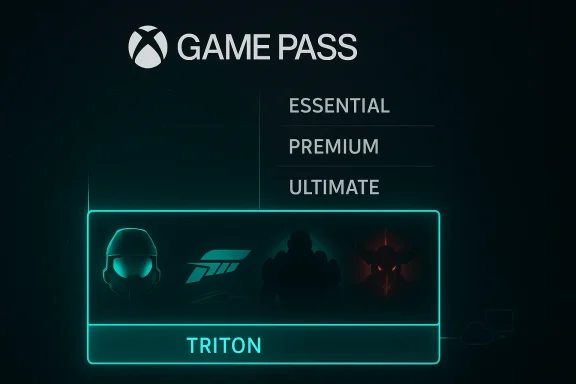 What Triton Appears to Be
The strongest reading of the backend evidence is that Triton is not a replacement for current Game Pass tiers, but a test of a narrower subscription offer. According to the leaked catalog data highlighted in the Windows Central piece, the available games are all Microsoft-owned or Microsoft-published, including DOOM Eternal, Fallout 4, Gears 5, Halode, Ori and the Blind Forest, Psychonauts, State of Decay 2, and The Elder Scrolls Online. That is a very specific curation pattern, not an accidental library snapshot.The inclusion list matters because it looks less like a general “mini Game Pass” and more like a first-party showcase. It appears to be built around recognizable, evergreen titles that have already done most of their commercial heavy lifting. That kind of catalog is ideal for a lse the economics are friendlier than day-one third-party deals, while the perceived value remains strong enough to sell the idea to casual buyers.
Why a first-party-only tier is attractive
A subscription that excludes expensive third-party licensing could give Microsoft more pricing flexibility. It also lets Xbox keep its brand promise centered on its own ecosystem rather than the unpredictable cadence of outside publishers. In plain English, Microsoft could offer a cheaper plan without having to dilute the premium value of Ultimate.It also gives Xbox a way to segment users more cleanly. Players who mostly want Halo, Forza, Gears, and other first-party staples could land in a cheaper lane. Players who want day-one third-party releases, cloud perks, Ubisoft+ Classics, and Fortnite Crew would still have a reason to climb the ladder. That kind of segmentation is very Microsoft: broad enough for mass market appeal, but precise enough to drive upsell.
There is a subtler benefit too. First-party content can be used as the “entry drug” for the wider Xbox platform. If the lower tier works, Microsoft can slowly expose users to the rest of the ecosystem — cloud streaming, PC installs, cross-device play, and perhaps future bundled services. The first-month price matters, but so does the long-term habit formation.
How This Fits Microsoft’s Current Game Pass Strategy
Triton would not arrive in isolation. It would be part of a broader march toward a more modular Xbox business. The October 2025 Game Pass refresh already proved that Microsoft is willing to repackage the service into sharper tiers instead of leaving everything lumped together under one premium umbrella. The new structure created a much clearer ladder, and Triton would simply add another rung.That matters because Microsoft has been steadily trying to solve two different problems at once. It wants to keep Game Pass attractive for subscription-heavy enthusiasts, but it also wants a credible low-cost route for players who do not need everything. A first-party-only tier would be a classic “good, better, best” play, especially if it can be marketed as the easiest way to play Xbox exclusives without paying for extras you do not use.
The value ladder problem
The risk for Microsoft is that too many tiers can make Game Pass feel like a utility bill instead of a simple entertainment subscription. The more options Xbox creates, the more customers have to compare features, restrictions, and hidden trade-offs. That may be good for monetization models, but it is not always good for clarity.Yet Microsoft may already have accepted that trade-off. The company has moved from a one-size-fits-all product into a platform with different consumer archetypes in mind. Essential, Premium, and Ultimate are evidence of that. Triton would simply make the ecosystem even more explicit: first-party only at one price point, broader access at another, and all-in features at the top.
The bigger strategic point is that Microsoft seems to be betting that subscription fatigue is better handled by segmentation than by simplification alone. Rather than shrinking Game Pass back into a single plan, Xbox appears to be expanding the menu so players can self-select. That is a meaningful shift in how the company thinks about customer retention.
Why First-Party Only Is Not an Accident
If Triton is real, the decision to limit it to first-party titles is probably the core of the design, not a temporary placeholder. Microsoft’s own catalog has become the centerpiece of its brand identity, especially as the company balances console, PC, and cloud. A lower-cost tier built around that catalog would let Xbox monetize the identity it already owns.This is also the safest way to experiment with a cheaper tier. If Microsoft tried to include broad third-party releases at a lower price, it would immediately run into licensing pressure and margin erosion. By contrast, first-party titles give Xbox maximum control over timing, placement, and pricing. They also let Micrpetite without exposing partners to a devaluation of their content.
Microsoft’s own catalog is the product
One overlooked aspect of Game Pass is that Microsoft increasingly treats its studios as the platform’s backbone. That is why older first-party games remain strategically important even when they are not headline launches. They keep the lower and mid-tier subscriptions looking alive, not empty.The leaked Triton list reads like an intentional blend of blockbuster, prestige, and replayable catalog titles. Halo 5: Guardians and Gears 5 provide the brand recognition. Hellblade and Ori and the Blind Forest provide p and The Elder Scrolls Online provide long-tail engagement. That mix suggests Microsoft understands that a lower-priced tier still needs emotional hooks, not just technical eligibility.
It also shows why a first-party-only offer is useful in the current market. Players are increasingly price-sensitive, but they are not necessarily allergic to subscriptions. They are allergic to subscriptions that feel bloated. By stripping out third-party extras, Microsoft may be trying to present Game Pass as a cleaner, more understandable product. If it works, that could be a smart reset. If it does not, it risks looking like a downgraded version of something players already pay for.
Consumer Impact: Cheaper Access, but Fewer Perks
For consumers, Triton’s biggest appeal is obvious: a lower entry price into the Xbox ecosystem. That matters most for players who mainly want Microsoft’s own games and do not care about cross-publisher catalog breadth, cloud benefits, or premium extras. A smaller bill for the same family of franchises would be an easy sell.But a cheaper tier always comes with a trade-off, and in this case the trade-off is breadth. If Triton excludes third-party day-one games, cloud features, or bundled subscriptions, it may be less a “new version of Game Pass” than a deliberately constrained sampler. That is not necessarily bad, but it does mean the name could matter less than the fine print.
Who benefits most
The most obvious winners would be casual Xbox fans, budget-conscious households, and players who mostly stick to Microsoft franchises. For them, a leaner plan could feel like a fairer deal than Ultimate. The same is probably true for lapsed players who only resubscribe when a specific first-party release lands.The least obvious winners are the power users who already treat Game Pass as a rotating entertainment stack. They value inclusion, not just cost. If Triton becomes the marketing focus, those players may worry that Microsoft is optimizing for the most basic audience while nudging everyone else into pricier tiers. That suspicion would be understandable.
One of the more interesting consumer questions is whether a first-party tier would make Game Pass feel more affordable or more fragmented. The answer depends on how Microsoft positions it. If it is clearly framed as a “Microsoft games only” option, players may appreciate the honesty. If it is presented as a bargain version of the full service, disappointment could follow quickly.
Enterprise and Ecosystem Implications
Game Pass is a consumer subscription, but its effects ripple far beyond consumers. Microsoft’s gaming business increasingly operates like a platform strategy, and every subscription tweak influences hardware, storefront, cloud, and even Windows integration. Triton would therefore be as much an ecosystem move as a pricing experiment.At the platform level, a first-party-only tier reinforces Microsoft’s control over the most valuable part of its gaming stack: its own intellectual property. That matters because Microsoft is now trying to make Xbox feel consistent across console, PC, cloud, and future Windows gaming interfaces. A compact entry tier gives the company a clean story to tell across all of those surfaces.
Platform alignment and hardware strategy
This is especially relevant as Microsoft pushes Xbox and Windows closer together. The company has been investing in a more console-like Windows gaming experience, and the Xbox PC app is increasingly acting as a hub rather than just a launcher. In that context, a first-party tier could function as a gateway into Microsoft’s broader gaming platform architecture.There is also an important hardware angle. Microsoft is clearly thinking about the future of Xbox as something more integrated, more services-driven, and more device-agnostic. A tier like Triton could help onboard users into that future without forcing them to commit to the full premium bundle immediately. That is a classic platform strategy: lower the barrier, then deepen engagement later.
For partners, the implications are mixed. On one hand, a slimmer lower tier could keep more users inside Xbox’s orbit. On the other, it could encourage Microsoft to concentrate the most visible marketing around its own studios, leaving third-party publishers to fight harder for attention in the premium tiers. That is not necessarily hostile, but it is certainly more self-interested.
Market Pressure and Competitive Positioning
If Triton becomes real, it will also reshape the competitive narrative around subscription gaming. Sony, Nintendo, and the broader PC ecosystem all evaluate Xbox partly through the lens of how aggressively Microsoft uses subscriptions to influence buying behavior. A first-party-only tier would sharpen that influence.For Sony, the challenge would not be that Microsoft is adding one more tier. It would be that Microsoft is building a more granular pricing ladder around exclusives. That could make Xbox look more flexible to value-minded buyers, especially if td aggressively enough to feel like a no-brainer. Sony’s own service strategy has historically emphasized catalog breadth and ecosystem stability rather than subscription segmentation for every use case.
The PC angle is equally important
On PC, Microsoft already occupies a unique positionthe storefront relationship and a large share of the relevant first-party content. A cheaper first-party plan could become a surprisingly strong on-ramp for Windows users who are not interested in a full Ultimate subscription. That would be especially true if the Xbox app keeps evolving into a one-stop gaming hub.That raises the stakes for Steam, Epic Games Store, and other PC storefronts, though not in a direct head-to-head way. The more Microsoft turns its own catalog into a recurring subscription value proposition, the less it depends on one-off store purchases. In subscription economics, habit beats impulse, and Xbox knows it. ([windowwww.windowscentral.com/all-microsoft-studios-games-will-launch-xbox-game-pass-moving-forward)
The competitive danger for Microsoft is overconfidence. If Triton is priced too high, it looks redundant. If it is priced too low, it may cannibalize higher tiers without growing the total base enough to compensate. Either outcome would invite scrutiny from rivals and analysts alike.
What the Library Tells Us
The leaked catalog list is the most revealing clue in the whole story because it shows how Microsoft may be thinking about product design, not just pricing. The titles are not random. They are proven franchises with cultural memory, long engagement tails, and broad appeal across different age groups and gaming tastes.That selection suggests Microsoft wants Triton to feel like a meaningful Xbox identity package, not a clearance bin. DOOM Eternal, Fallout 4, Gears 5, and Halo 5 signal action and legacy. Ori and the Blind Forest and Psychonauts add artistic credibility. The Elder Scrolls Online and State of Decay 2 help with longevity and repeat engagement.
Catalog design as marketing
A first-party-only tier lives or dies by whether it can make users feel they are getting something substantial, not stripped down. Microsoft seems to understand that the answer is not necessarily “more games,” but “better-fit games.” A curated Microsoft-owned catalog can look surprisingly generous if the lineup is familiar and useful.There is also a retention logic here. Games like Fallout 76 and The Elder Scrolls Online can hold attention for months, making them excellent anchors for a subscription that wants recurring usage rather than one-and-done playthroughs. That kind of catalog supports the service part of Game Pass, not just the discount part.
It is worth noting that a first-party list also reduces risk from licensing churn. Third-party rotations create excitement, but they also create churn and uncertainty. A Microsoft-owned tier avoids that problem, because the company can keep the catalog stable for longer without negotiating every renewal of public drama.
The Pricing Puzzle
Pricing will determine whether Triton is clever or confusing. If Microsoft positions it as the obvious budget-friendly path to Xbox exclusives, it could broaden the audience substantially. If it lands too close to Premium or Ultimate, the value proposition collapses almost instantly.The company’s current tiering already implies a careful balancing act. Ultimate is the place for maximum benefits, Premium is the broader mid-tier, and Essential is the entry level. Triton would have to slot into that structure without undermining the logic of the existing plans. That is harder than it sounds, especially when subscribers are already trained to scrutinize what each tier includes.
What an effective price would need to do
To succeed, Triton would need to feel like a true bargain rather than a stripped-down compromise. That means Microsoft would probably have to keep the price gap meaningful enough to justify the missing features. In subscription terms, the perceived savings must exceed the perceived loss.It would also need to avoid stepping on the toes of promotions and bundles that Microsoft already uses to push higher tiers. If a first-party-only plan is too attractive, it could reduce conversion into Ultimate. If it is too expensive, it becomes redundant. Microsoft’s challenge is to hit the sweet spot where Triton expands the funnel without breaking the funnel itself.
The pricing puzzle gets even more complicated if Microsoft continues to experiment with other bundle ideas. Windows Central’s reporting has already mentioned suggestions about evolving Game Pass alongside broader subscription packages, and the company’s ongoing service strategy suggests it is not afraid of complexity. The question is not whether Microsoft likes experiments. It is whether consumers will tolerate the experiment tax.
The Bigger Xbox Direction
Triton, if it ships, would be best understood as a symptom of Xbox’s wider reinvention. Microsoft is no longer treating Xbox as a single console product supported by a subscription. It is treating Xbox as a multi-surface gaming platform with hardware, software, cloud, and content all feeding one another.That broader shift is visible everywhere. The Xbox PC app is becoming a more capable library surface. Game Pass tiers are becoming more explicit. Windows 11 gaming is becoming more console-like. First-party hardware plans are being discussed in a way that suggests Microsoft sees its future as hybrid, not purely box-based. Triton fits that direction because it gives Microsoft yet another lever to pull across the ecosystem.
What this says about Xbox identity
Xbox’s identity used to revolve around the console first and the service second. Now the order may be reversing. The service is increasingly what defines how players enter the ecosystem, while the hardware becomes one of several ways to stay inside it. That is a profound shift, and a first-party-only subscription is exactly the kind of instrument a service-first platform would use.It also explains why Microsoft keeps leaning into its own content pipeline. A company that wants to own the user relationship needs a steady supply of recognizable, exclusive, recurring value. First-party games are that supply. Triton would simply package them in a way that looks more accessible to hesitant buyers.
The likely long-term outcome is not that Triton becomes the dominant Game Pass plan. More likely, it becomes one more tool in a broader conversion machine. That may sound less exciting, but it is how modern platform businesses win: not by one dramatic leap, but by stacking enough small advantages that the ecosystem becomes hard to leave.
Strengths and Opportunities
Triton’s biggest strength is that it aligns neatly with Microsoft’s own assets. A first-party-only tier is easier to price, easier to explain, and easier to control than a broad all-you-can-eat subscription that depends heavily on outside licensing. It also gives Xbox a clean way to serve budget-minded players without devaluing Ultimate, which remains the premium showcase for the broader Game Pass ecosystem.It may also help Microsoft sharpen the Xbox brand at a time when the company is trying to make gaming feel unified across console, PC, cloud, and Windows. A smaller tier built around Microsoft-owned franchises can act as a familiar on-ramp. If Microsoft plays it correctly, Triton could become a high-conversion entry product rather than a bargain-bin fallback.
- It could lower the entry price for casual Xbox users.
- It gives Microsoft a cheaper way to monetize first-party back catalog.
- It may reduce pressure on Ultimate by creating a better entry ladder.
- It can function as a bridge into the broader Xbox platform.
- It simplifies licensing risk by relying on Microsoft-owned content.
- It gives Xbox a cleaner marketing story around exclusives.
- It could improve retention among fans of legacy Xbox franchises.
Risks and Concerns
The biggest risk is fragmentation. Game Pass is already a tiered product, and every new branch increases the chance of confusion. If Triton is not positioned with absolute clarity, players may struggle to understand why it exists, what it excludes, and why they should choose it over the plans already on the shelf.There is also a real possibility of cannibalization. A first-party-only tier could attract users who might otherwise have chosen Premium or Ultimate, especially if the price is aggressive. That might boost headline subscriber numbers while weakening average revenue per user, which is not always the outcome Microsoft wants.
- It could confuse buyers with yet another Game Pass label.
- It may cannibalize higher-tier subscriptions.
- It could feel too limited if marketed as a “full” Game Pass alternative.
- It risks making third-party content seem less central to Xbox.
- It may encourage price sensitivity rather than loyalty.
- It could complicate Microsoft’s broader tiering strategy.
- It may invite skepticism if the catalog looks like an old-games bundle instead of a living service.
Looking Ahead
The next phase of this story will depend on whether Triton moves from backend artifact to visible test build. If it does, the details will matter enormously: price, included platforms, cloud access, and whether Microsoft frames it as a new family of access rather than just a stripped-down plan. Until then, the codename itself is less important than what it reveals about Microsoft’s thinking.The broader lesson is that Xbox is still actively searching for the right shape of Game Pass in 2026. Microsoft wants the service to be more profitable, more understandable, and more tightly aligned with the company’s first-party business. Triton could be one answer to that puzzle, but it is unlikely to be the last.
What to watch next:
- Whether the Triton codename appears in an actual public Xbox Insider build.
- Whether Microsoft adds cloud streaming or keeps the tier local-only.
- Whether the plan is priced closer to Essential or Premium.
- Whether the library expands beyond first-party titles over time.
- Whether Microsoft markets it as a temporary test or a permanent plan.
- Whether the move triggers changes to current Game Pass naming or benefits.
Source: Windows Central Xbox is testing a new Game Pass tier called “Triton” with only first‑party games
