

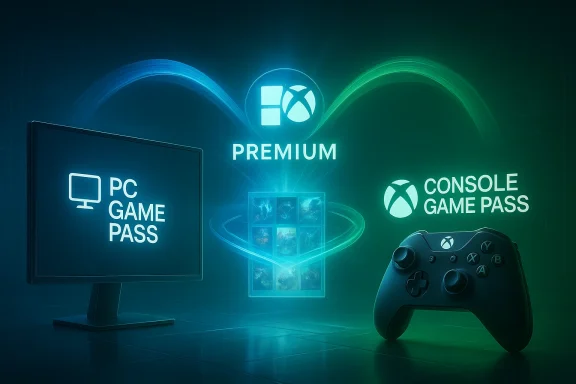
Microsoft’s subscription experiment keeps evolving: multiple industry reports now say Microsoft is considering consolidating its PC-only Game Pass tier into a broader Xbox Game Pass premium tier — a move that would simplify the lineup for many customers but risks shrinking the low-cost option that has become the refuge for price‑sensitive PC players. Early signals come from TechPowerUp’s reporting and corroborating coverage across outlets, and they arrive against the backdrop of last year’s sweeping Game Pass restructuring and price increases. ]
Microsoft’s Game Pass family is already complex: historically there have been multiple tiers — Game Pass Essential (Core), Game Pass Premium (Console/Standard), PC Game Pass, and Game Pass Ultimate — with varying degrees of game access, cloud streaming, and perks. In late 2025 Microsoft reworked these tiers and raised headline prices: Game Pass Ultimate was repositioned at roughly $29.99/month, while PC Game Pass rose to around $16.49/month, among other shifts intended to add publisher bundles and cloud improvements. Those changes reshaped subscriber behavior and set the stage for another wave of rethinking.
The recent rumor — reported by several outletechPowerUp’s piece on the topic — is straightforward on its face: Microsoft may fold PC Game Pass into a non‑Ultimate console tier (often referenced as Premium) or consolidate PC entitlements under a single unified subscription SKU, effectively reducing the number of distinct PC‑only offerings. Multiple outlets have picked up the same signal, and industry insiders appear to treat it as a plausible next step rather than wild speculation.
Two factors shape likelihood and timing:
Key risks and tradeoffs:
But the move is risky. Microsoft must balance revenue optimization with the real risk of subscriber churn and partner pushback. Price‑sensitive PC players are a sizable cohort, and removing their lower titles without a compelling compensatory value will hurt long‑term trust. Technical and regulatory complexities further complicate any rapid rollout. The sensible path for Microsoft would be a phased migration with generous migration pricing, well‑documented entitlements, and clear technical guidance for developers — anything less invites reputational and commercial pain.
For now, treat the consolidation as a likely industry pivot rather than finished product: prepare, stay informed via official Xbox channels, and consider short‑term steps (prepaid stacking and account housekeeping) if you want to lock in current pricing or protect specific library access. Microsoft’s decision will shape the economics of PC gaming for years; when it finally announces the details, the next debate won’t be about whether consolidation was sensible — it will be about whether Microsoft did right by the millions of PC players who made Game Pass a success.
Source: TechPowerUp Xbox Game Pass and PC Game Pass Could Merge Into a Single Subscription | TechPowerUp}
 Background / Overview
Microsoft’s Game Pass family is already complex: historically there have been multiple tiers — Game Pass Essential (Core), Game Pass Premium (Console/Standard), PC Game Pass, and Game Pass Ultimate — with varying degrees of game access, cloud streaming, and perks. In late 2025 Microsoft reworked these tiers and raised headline prices: Game Pass Ultimate was repositioned at roughly $29.99/month, while PC Game Pass rose to around $16.49/month, among other shifts intended to add publisher bundles and cloud improvements. Those changes reshaped subscriber behavior and set the stage for another wave of rethinking. The recent rumor — reported by several outletechPowerUp’s piece on the topic — is straightforward on its face: Microsoft may fold PC Game Pass into a non‑Ultimate console tier (often referenced as Premium) or consolidate PC entitlements under a single unified subscription SKU, effectively reducing the number of distinct PC‑only offerings. Multiple outlets have picked up the same signal, and industry insiders appear to treat it as a plausible next step rather than wild speculation.
What the reports actually claim
The core rumor
- Several recent reports claim Microsoft is “exploring” or “planning” to merge the standalone PC Game Pass product with the broader Game Pass premium tier so that PC gamers become part of a consolidated premium offering rather than a separate, lower‑cost plan. These discussions have surfaced in reporting by industry outlets and in analysis threads preserved in industry roundups.
What would change for subscribers
- If true, the most immediate consumer impact would be the disappearance (or rebranding) of the cheaper PC‑only tier that currently provides many PC players day‑one access at a lower monthly price.
- The consolidated tier would likely harmonize entitlements (library sity releases, Ubisoft/EA additions, and cloud streaming perks), but which features move where — and for which price — remains the central unknown. Several reports explicitly caution that Microsoft has not confirmed details and that internal plans may shift.
The corroborating signals
- The rumor fits a pattern: Microsoft has already tightened the interplay between Xbox and PC ecosystems (e.g., expanding the Xbox PC app’s lding Play Anywhere support for select titles, and bundling third‑party services into some tiers). That platform convergence makes a subscription consolidation operationally feasible and commercially attractive.
Timeline and likelihood: measured expectations
No public Microsoft announcement confirms a PC Game Pass shutdown or immediate consolidation. The industry chatter suggests this is a plannild unfold over the next 12–24 months if Microsoft decides the advantages outweigh the churn risk.Two factors shape likelihood and timing:
- Product rework and validation cycles take time. Microsoft recently completed a major tier overhaul; another big shift would likely need careful telemetry and a staged rollout to minimize backlash. Internal tests and Xbox Insider feedback commonly precede full rollouts.
- Financial imperative versus churn risk. The 2025 price changes produced subscriber churn, and Microsoft will be sensitive to any further moves that might push unhappy customers to cancel. That means if a merger happens, Microsoft will likely either sweeten the consolidated tier with compensating features or offer migration discounts to soften the blow. Market reporting suggests 2026–2027 as the plausible window for any major transition rather than an immediate change.
Why Microsoft might do this (strategic logic)
Bringing PC Game Pass into a single premium tier is not just a simplification exercise — it’s a strategic lever across several axes.- Unified marketing and product messaging: A single premium product simplifies the value proposition for consumers and reduces confusion about which tier provides which benefits.
- Revenue optimization: Consolidation allows Microsoft to rationalize entitlement boundaries and nudge more users toward higher‑value tiers, helping to recapture average revenue per user (ARPU) lost after the 2025 price adjustments. Industry reporting suggests Microsoft is actively exploring revenue levers to justify the higher Ultimate price.
- Cross‑platform parity: With Microsoft pushing Windows as a first‑class living‑room platform (and integrating PC/console discovery), a single subscription would match a single ecosystem experience — one account, one library surface, fewer exceptions. That product simplicity is attractive from an engineering and UX perspective.
- Bundling power: Microsoft is leaning into third‑party bundles (EA Play, Ubisoft+ Classics, Fortnite Crew perks), and a single premium tier makes negotiating and showcasing those bundles more straightforward from a marketing and legal perspective.
What consumers stand to gain
If executed well, consolidation could yield tangible benefits:- Less fragmentation: A single, clearly defined premium offering reduces confusion about which tier includes day‑one releases, cloud play, or third‑party bundles.
- Simpler library management: Unified entitlements across console and PC reduce edge cases around cross‑play and storefronts, making it easier to locate and play your games across devices.
- Potential improved cloud parity: Consolidation could let Microsoftd streaming improvements (e.g., the stepped‑up 1440p cloud ceiling Microsoft has been rolling out) to more subscribers.
What’s at risk — and why many PC players are worried
The worry is simple: the disappearance of a lower‑cost PC Game Pass option would make day‑one access more expensive for many PC gamers who primarily play on one device, forcing price‑sensitive users to pay up, downgrade, or cancel.Key risks and tradeoffs:
- Price sensitivity and churn: The 2025 price hike for Ultimate provoked measurable churn; removing a cheaper PC tier risks repeating that effect unless Microsoft offsets the change with betttransition pricing.
- Perceived fairness: PC players who have long enjoyed a low‑cost route to day‑one first‑party titles will see consolidation as erosion of negotiated expectations between dend players.
- Publisher and partner pushback: Not all publishers want to be subsumed into wider subscription economics. If Game Pass becomes the default premium for both console and PC, publishers may re‑negotiate revenue models for participation. There’s a long tail of contractual complexity behind what loochange.
- Competitive dynamics: Platforms like Steam, Epic, GOG and even Sony’s revamped subscription offers will react to any Microsoft consolidation. Microsoft risks accelerating alternative ecosystem investments if partners or players feel boxed in.
Developer, publisher and store implications
A merged subscription structure has nontrivial downstream effects for content creators and storefronts.- Revenue allocation complexitrequire transparent, predictable methods for compensating studios. A single tier with larger headcount may change how Game Pass payout pools are distributed, potentially favoring big live‑service titles or first‑party anchor releases. That can squeeze small indies unless Microsoft articulates safeguards.M friction: If Microsoft doubles down on Windows‑based consoles or larger PC parity, anti‑cheat systems that rely on kernel‑level drivers may complicate interoperability across storefronts and modes (console shell vs. technical gatekeeping and nuanced launch paths for multiplayer or anti‑cheat‑dependent titles.
- Storefront relationships: Microsoft’s Xbox PC app has been consolidating discovery across Steam, Battle.net, and Epic; merging subscriptions increases the importance of cross‑store entitlements and handoffs. Publishers and other stores will demand clear rules for DLC, cross‑purchases, and revenue splits.
Technical challenges Microsoft must solve
Building a single premium product across PC and console is conceptually simple but operationally messy. These are the engineering and operational headaches that await.- Update and driver management: A Windows‑based livres an update model that avoids breaking console stability while keeping Windows secure and up to date. Microsoft will have to decide between a bespoke, slower console update cadence or a tightly curated Windows channel for console SKUs.
- Certification and UX parity: Desktop apps assume mouse/keyboard and dense UIs. Microsoft would need a “TV mode” or translation layer to ensure consistent controller experiences and consistent quality across the catalog. Without that, fragmentation and poor UX will undermine any subscription benefits.
- Cheating and security: Opening the OS increases attack surface for cheating tools and mod exploits. Microsoft must reconcile openness with competitive integrity in online games — a complex socio‑technical problem.
Regulatory and antitrust considerations
Microsoft’s aggressive bundling and vertical integration in gaming has previously attracted regulatory scrutiny (notably during its Activision Blizzard acquisition review). Any move that further consolidates platform control — especially when paired with hardware or cloud moves — will invite reneitrust lens: Regulators scrutinize bundling strategies that could foreclose competition. If Microsoft’s consolidation materially raises rivals’ costs or limits alternative storefront competitiveness, regulators will ask questions. Publicly documented concerns in the past show this is not a theoretical risk.- Partner politics: Big publishers and platform partners will monitor how the consolidation affects their distribution economics; contentious negotiations could slow or alter implementation plans.
How to prepare: practical advice for players and admins
If you rely on Game Pass (Ultimate or PC), these steps help you protect value and avoid surprises.- Audit entitlements now. Check which games you access via PC Game Pass, Ultimate, or other tiers and note any titles you’d want to keep if they left the service.
- Consider prepaid stacking. If you want to lock in current pricing, buying ponth bundles) can preserve the existing rate for the duration of that time in many regions. Several outlets recommended this tactic during the 2025 price shift.
- Link and consolidate accounts. Make sure your Xbox, Microsoft Store, and third‑party storefront accounts are linked where possible to avoid losing progress or purchases in any migration. File notes indicate Microsoft normalizes entitlements when benefits merge (e.g., Fortnite Crew into Ultimatal channels. Microsoft’s Xbox Wire and official store pages will publish authoritative SKU and entitlement details; rumor signals can evolve quickly.
- For developers and studios: preserve alternative revenue channels. Don’t rely solely on subscription revenue; maintain retail/LP/packaged editions and direct‑sale options if possible.
Editorial assessment: pros, cons, and final read
Consolidating PC Game Pass into a unified premium tier is a logical next step for Microsoft’s long game: it simplifies product engineering, aligns bundles and benefits, and positions Microsoft to extract higher ARPU across a unified Xbox/Windows ecosystem. The company has made multiple moves in this direction already — from integrating PC storefront discovery into the Xbox app to expanding Play Anywhere and folding third‑party benefits into tiers — and the current rumor fits that trajectory.But the move is risky. Microsoft must balance revenue optimization with the real risk of subscriber churn and partner pushback. Price‑sensitive PC players are a sizable cohort, and removing their lower titles without a compelling compensatory value will hurt long‑term trust. Technical and regulatory complexities further complicate any rapid rollout. The sensible path for Microsoft would be a phased migration with generous migration pricing, well‑documented entitlements, and clear technical guidance for developers — anything less invites reputational and commercial pain.
Conclusion
The prospect of a consolidated Game Pass subscription that folds PC Game Pass into a broader premium tier is credible and aligned with Microsoft’s service‑first strategy, but it is not yet confirmed. Industry coverage has converged on this possibility, and the signals make sense among Microsoft’s recent moves to blur the lines between PC and console experiences. Yet many details matter — the final price, the migration mechanics, day‑one entitlements, and anti‑cheat/storefront arrangements — and those are the levers that will determine whether the change will be welcomed or resisted.For now, treat the consolidation as a likely industry pivot rather than finished product: prepare, stay informed via official Xbox channels, and consider short‑term steps (prepaid stacking and account housekeeping) if you want to lock in current pricing or protect specific library access. Microsoft’s decision will shape the economics of PC gaming for years; when it finally announces the details, the next debate won’t be about whether consolidation was sensible — it will be about whether Microsoft did right by the millions of PC players who made Game Pass a success.
Source: TechPowerUp Xbox Game Pass and PC Game Pass Could Merge Into a Single Subscription | TechPowerUp}
