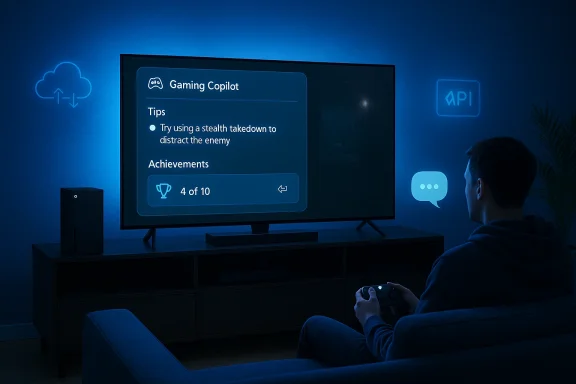
Microsoft will bring its Gaming Copilot AI assistant to current‑generation Xbox consoles later in 2026, turning an experimental, PC‑ and mobile‑first feature into a living‑room, controller‑first experience that promises contextual coaching, installation help, and discovery — an announcement confirmed at the Game Developers Conference and amplified across Xbox channels. ttps://www.gamesradar.com/games/xbox-just-revealed-gaming-copilot-is-coming-to-current-generation-consoles-later-this-year/)
Microsoft’s Gaming Copilot began life as a Windows Game Bar feature and mobile companion: an overlay‑style assistant that can read gameplay context, suggest strategies, fetch achievement steps, manage installations, and answer player questions in natural language. The feature was publicly previewed in 2025 and expanded through the Xbox mobile app and select handheld partners before the console announcement.
At GDC 2026, Xbox representatives — including Sonali Yadav, Xbox’s gaming AI partner group product manager — said the company will ship Gaming Copilot to “current‑generation consoles” later in the year, a phrase the company used instead of naming a specific SKU; in context and follow‑up reporting this has been interpreted as a Series X|S rollout in 2026. Community coverage and internal forum reporting of the announcement recorded the same phrasing and the conclusion that the Series X and Series S are the target consoles for this immediate rollout.
At the same GDC sessions Microsoft revealed more about the company’s mid‑term console roadmap — notably Project Helix, the codename for the next‑generation Xbox hardware. Microsoft confirmed alpha developer kits for Project Helix will be distributed beginning in 2027, making it highly unlikely Helix will be the vehicle for Gaming Copilot’s 2026 console debut; that timing reinforces the expectation that Copilot will appear on Xbox Series X|S first.
This sequencing matters: Copilot on existing hardware will test user adoption, developer integration patterns, and policy frameworks before being rolled into a new har may have different on‑device capabilities (neural processors, NPU acceleration) and tighter PC‑console convergence. The rollout plan effectively makes Series X|S the Copilot pilot fleet for living‑room gaming.
The immediate console rollout likely targets Xbox Series X and Series S in 2026, with Project Helix arriving into developers’ hands in 2027 and carrying the potential for deeper, hardware‑accelerated Copilot features later on. Players, developers, and platform regulators should expect a phased rollout: early experimentation on current hardware, iterative product governance, and a Helix‑era refinement once new silicon and developer ecosystems are mature.
Microsoft’s approach will determine whether Copilot becomes an empowering, accessible sidekick that respects player choice, or a controversial layer that prompts pushback from gamers and creators. For now, the smart play for Microsoft is clear: move fast in capability, but move responsibly in policy.
Source: Outlook Respawn Microsoft Brings Gaming Copilot AI to Consoles | Outlook Respawn
 Background / Overview
Microsoft’s Gaming Copilot began life as a Windows Game Bar feature and mobile companion: an overlay‑style assistant that can read gameplay context, suggest strategies, fetch achievement steps, manage installations, and answer player questions in natural language. The feature was publicly previewed in 2025 and expanded through the Xbox mobile app and select handheld partners before the console announcement.At GDC 2026, Xbox representatives — including Sonali Yadav, Xbox’s gaming AI partner group product manager — said the company will ship Gaming Copilot to “current‑generation consoles” later in the year, a phrase the company used instead of naming a specific SKU; in context and follow‑up reporting this has been interpreted as a Series X|S rollout in 2026. Community coverage and internal forum reporting of the announcement recorded the same phrasing and the conclusion that the Series X and Series S are the target consoles for this immediate rollout.
At the same GDC sessions Microsoft revealed more about the company’s mid‑term console roadmap — notably Project Helix, the codename for the next‑generation Xbox hardware. Microsoft confirmed alpha developer kits for Project Helix will be distributed beginning in 2027, making it highly unlikely Helix will be the vehicle for Gaming Copilot’s 2026 console debut; that timing reinforces the expectation that Copilot will appear on Xbox Series X|S first.
What Gaming Copilot on Xbox consoles will look like
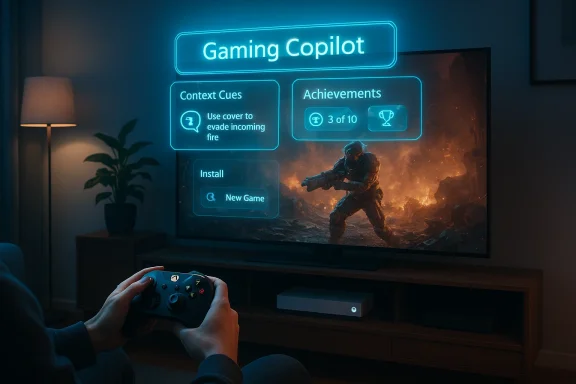
Microsoft has positioned Gaming Copilot as an in‑play, context‑aware assistant rather than a separate utility. Early public features and company statements outline the kinds of functionality Xbox players should expect when the console rollout arrives:- Real‑time, context‑aware help — Copilot can answer in‑game questions by inspecting the current screen or game state, suggesting next moves or strategies.
- Achievement and progress assistance — players can ask how to unlock achievements, find collectibles, or get hints without leaving the game.
- Installation and session management — voice or chat commands to install, update, or launch games; resume saved sessions and surface relevant content.
- Personalized recommendations — game suggestions, curated lists, and discovery features based on play history and preferences.
- Overlay and voice UI — an overlay or full‑screen experience that can be summoned with controller or voice input, designed to avoid interrupting gameplay.
Why this matters: strategic and product implications
Bringing an AI assistant natively to consoles is a strategic inflection point for both Microsoft and the wider games industry. The move reflects several layered objectives:- Platform stickiness and discovery: Copilot lowers friction between wanting to play and actually playing, which can increase time‑spent and Game Pass engagement by making it faster to find and start games.
- Cross‑surface consistency: Microsoft’s Copilot branding now spans Windows, cloud, mobile, handhelds, and consoles — a unified AI layer that can personalize experiences and telemetry across devices.
- Developer opportunity and cost: in‑game Copilot features can be a boon for player retention, but they also create an expectation that games expose metadata, hooks, or state to system services — which may require additional development work and new GDK guidance.
- Competitive positioning: integrating robust AI into the console UX differentiates Xbox in the console conversation and aligns with Microsoft’s broader push to bake AI into consumer products.
Technical realities and unknowns
The practical experience of Gaming Copilot depends on several technical choices Microsoft hasn’t publicly settled s and analysts have cataloged both the announced features and the open technical questions:- Where inference runs: Microsoft has not publicly confirmed whether Copilot’s language and vision inference will run entirely in the cloud, partially on Azure edge nodes, or in a hybrid model with some on‑device processing. Several outlets and hands‑on reviews note thaed silent on this point. That ambiguity has practical effects: on‑device inference would minimize latency and reduce cloud costs, while cloud inference can offer larger models and more frequent updates.
- Network dependence and performance: if Copilot relies on cloud inference, quality of service will be tied to network performance; Microsoft’s Game Bar and Cloud Gaming widgets already surface network metrics and the platform has moved to improve cloud streaming quality, but console players with constrained or variable connections could see degraded or inconsistent Copilot responsiveness.
- Anti‑cheat and competitive integrity: overlay‑style assistants that can analyze screen state and provide hints raise immediate questions for competitive multiplayer and e‑sports. Microsoft will need explicit guardrails in how Copilot interacts with multiplayer matches and ranked ladders to prevent unfair assistance. Xbox leadership has publicly stated they intend not to let AI “turn games into soulless AI slop,” but the specifics of anti‑cheat integration remain to be published.
- Platform APIs and developer control: for Copilot to offer precise, context‑sensitive help, games may need to opt into exposing descriptive telemetry or developer‑facing metadata. Microsoft’s relationships with developers — and the guardrails for what information Copilot may read — will shape how capable and accurate the assistant can be.
Strengths and immediate benefits
- Faster player onboarding and retention. New or returning players benefit from instant, contextual guidance — less time spent alt‑tabbing to walkthroughs and more time playing. Early hands‑on reporting praised Copilot’s ability to reduce friction on PC and mobile.
- Improved discoverability and monetization potential. Copilot’s recommendations tied to Game Pass and store content can steer players toward underplayed titles or curated collectiolayers find value and Microsoft deepen engagement.
- Accessibility gains. Voice and natural‑language help can make games more accessible to players who struggle with traditional menulot can act as an assistive layer for cognitive and motor accessibility. The overlay/voice model reduces reliance on text‑heavy menus.
- Cross‑device continuity. With Copilot available across PC, mobile, handheld, and now consoles, player histories and preferences can follow users — a consistent, personalized layer that benefits multi‑device players.
Risks, trade‑offs, and areas of concern
- Privacy and telemetry: several early reports and community threads flagged concerns that Copilot might capture gameplay or account data and send it to Microsoft for analysis or training. Microsoft and Xbox messaging emphasize opt‑in settings and privacy controls, but the precise data retention and processing model is still opaque in public documentation. Until Microsoft clarifies what is processed locally versus in the cloud, and what is used for model training, privacy advocates and some players will remain skeptical.
- Performance overhead and system impact: on PC, some users reported that enabling Copilot affected game performance; whether the console implementation will be fully optimized to avoid FPS or latency regression remains to be seen. If Copilot requires background capture or significant processing, carefully for console hardware.
- Cheating and competitive fairness: an assistant that can parse screen state and suggest optimal actions is a potential vector for unfair advantage. Microsoft will need granular rules (e.g., disabled in ranked matches, limited to single‑player content) and anti‑cheat integrations to prevent erosion of competitive integrity. Xbox has publicly acknowledged the need for guardrails, but the community will demand transparent, enforceable policies.
- Developer control and creativity: Copilot’s advice could encourage shallow play‑throughs or shortcut discovery if it is allowed to reveal step‑by‑step solutions for narrative or puzzle design. Studios that want players to discover content organically might object to system‑level hints, putting Microsoft in the middle of design philosophy debates.
- Regulatory and liability questions: as AI assistants move from optional extras to platform‑level features, platforms will face more scrutiny about misinformation, liability for bad advice (e.g., incorrect walkthroughs that cause players to lose progress), and regional regulation. Microsoft will need clear terms of use and a path for dispute resolution.
How developers and studios should prepare
Developers will face practical questions if they want their games to work well with Copilot. Here are immediate, pragmatic steps studios should take:- Audit exposed telemetry and state: review which pieces of game state and metadata are safe and useful to surface to system services while protecting design intent and competitive fairness.
- Decide opt‑in policies: explicitly define whether the game exposes contextual hints, achievements breakdowns, or map coordinates to Copilot and provide mechanisms for players to opt out.
- Test ns: work with platform teams to ensure Copilot doesn’t bypass anti‑cheat protections or create exploitable information channels.
- Design for layered hints: if you provide Copilot‑specific hints, design them to degrade gracefully — from gentle nudges to full solutions based on player preference.
- Collaborate with platform teams: engage early with Microsoft’s GDK and Copilot guidance to avoid late integration costs as Microsoft surfaces APIs and best practices.
Privacy, transparency, and governance — what we still need from Microsoft
Microsoft has emphasized user control in marketing messages, but the gaming community and privacy watchdogs will want clear, machine‑readable guarantees:- A simple, discoverable privacy control on consoles that explains exactly what Copilot accesses, where inference runs, what is retained, and whether player data is used for model training. Early reporting shows this area remains insufficiently specified publicly.
- Fine‑grained opt‑outs for game capture, account telemetry, and cross‑device personalization. Players who value privacy should be able to use their consoles without contributing usage data.
- Public anti‑cheat and fairness policy that names modes where Copilot is disabled (e.g., ranked play), clarifies permitted uses in spectator and coaching contexts, and explains developer controls.
- A transparency report that periodically states what types of data were used to improve Copilot, including whether any gameplay footage was used for model training and how long that data was retained.
Where Copilot fits in Microsoft’s longer roadmap: Helix and beyond
Project Helix represents Microsoft’s next hardware pivot; alpha developer kits begin in 2027, which positions Helix for a commercial window after that year. Because Microsoft explicitly said Copilot will appear on “current‑generation consoles” in 2026, the logical interpretation is that Copilot lands on Xbox Series X and Series S first, with Helix receiving the feature as part of the broader, cross‑generation Copilot integration once developer kits and commercial silicon are available.This sequencing matters: Copilot on existing hardware will test user adoption, developer integration patterns, and policy frameworks before being rolled into a new har may have different on‑device capabilities (neural processors, NPU acceleration) and tighter PC‑console convergence. The rollout plan effectively makes Series X|S the Copilot pilot fleet for living‑room gaming.
Scenario analysis: three plausible futures
- Measured rollout with strict guardrails (probable near term): Microsoft ships Copilot on Series X|S with conservative defaults — opt‑in, disabled in ranked/competitive modes, and with clear privacy toggles. The feature improves discoverability and accessibility while limiting friction with developers and regulators.
- Aggressive platform‑first push (riskier): Microsoft integrates Copilot deeply into Xbox UI and Game Pass flows with strong recommendation hooks and system‑level game metadata access. This increases platform engagement and revenue but raises developer resistance and regulatory attention over data and fairness.
- Slow, hybrid migration guided by Helix hardware: Microsoft uses the Series X|S rollout to validate features, then accelerates capabilities on Project Helix hardware (e.g., on‑device NPU inference) to reduce latency and privacy concerns. That path mitigates performance and privacy issues but stretches the timeline for Helix‑specific capabilities.
Practical advice for players today
- Try the mobile or PC preview first if you want to test Copilot’s capabilities and limits; that’s where the feature has already been widely available.
- Watch for privacy settings on the console when Copilot arrives: read the permission prompts and default toggles carefully before enabling screen capture or cross‑device personalization.
- Competitive players should wait for official guidance on Copilot’s availability in ranked modes; do not assume system assistants are permitted in competitive play until Microsoft clarifies anti‑cheat policies.
Conclusion — a cautious optimism
Microsoft’s decision to expand Gaming Copilot onto Xbox consoles is a natural next step for a company that has made Copilot a cross‑product pillar. The promise is tangible: faster onboarding, richer accessibility, and more fluid cross‑device experiences for players. Yet the technical and ethical knot is real — privacy, performance, competitive fairness, and developer autonomy are all unresolved questions that Microsoft must answer with concrete controls, transparent documentation, and strong anti‑abuse measures.The immediate console rollout likely targets Xbox Series X and Series S in 2026, with Project Helix arriving into developers’ hands in 2027 and carrying the potential for deeper, hardware‑accelerated Copilot features later on. Players, developers, and platform regulators should expect a phased rollout: early experimentation on current hardware, iterative product governance, and a Helix‑era refinement once new silicon and developer ecosystems are mature.
Microsoft’s approach will determine whether Copilot becomes an empowering, accessible sidekick that respects player choice, or a controversial layer that prompts pushback from gamers and creators. For now, the smart play for Microsoft is clear: move fast in capability, but move responsibly in policy.
Source: Outlook Respawn Microsoft Brings Gaming Copilot AI to Consoles | Outlook Respawn