

Microsoft’s old Xbox patent for helpers that can “take over” your game has exploded into a viral conversation this week — and much of the heat comes from a simple mismatch between timing, technical detail, and internet instinct. The filing, officially titled State Management for Video Game Help Sessions, was filed in 2024 and only published as an application in early 2026; it describes an optional cloud-based workflow where a saved game state can be handed to a human or AI “helper” who plays the troublesome section for you and returns an updated state to your session. The public reaction — amplified by the recent leadership change at Xbox and a headline-hungry news cycle — has turned an assistive design into a boogeyman for some players, even as the core concept is one of the more straightforward and historically familiar ways to make games more accessible.
Video game assistance is not new. Players have always relied on guides, hotlines, walkthroughs, and friends; Nintendo’s “Power Line” tips service is the canonical early example of commercial assistance for stuck players. The patent in question formalizes a cloud-native, stateful implementation of that long-standing idea: detect when a player is struggling, offer a help session, snapshot the game, spin up a cloud session, route inputs from a helper (human or machine) into that cloud session, and then present the updated state back to the original player for acceptance or rejection. That workflow aims to let help happen without forcing players to exit the game and alt‑tab into a video or forum.
The filing explicitly mentions machine learning for detecting when help should be offered and for tuning how intrusive that offer is. It also notes explicit safety valves: the original player can take back control at any time, and can choose whether to accept the updated game state at the end of the help session. Those mechanics are central to how this design tries to balance assistance and player agency.
This week’s coverage framed the patent alongside two contemporaneous industry signals: Microsoft’s leadership transition at Gaming (Phil Spencer’s retirement and Asha Sharma’s elevation) and a parallel Sony patent for an “AI generated ghost player” that can demonstratively or actively show the solution to a stuck player. The timing and proximity of these stories has made the conversation noisier than the underlying technical documents alone would justify.
That said, patents are also directional signals: they reveal what problems a company thinks are worth solving. Microsoft’s patent underscores an interest in cloud state orchestration, helper identity, and ML-driven UX — all elements consistent with broader Copilot and cloud gaming strategies. Interpreting a patent as a definitive roadmap is a mistake, but treating it as evidence of intent to explore that space is reasonable.
Taken together, Microsoft’s and Sony’s filings suggest two complementary pathways:
If Microsoft, Sony, or any other platform pursue these systems, the real debate won’t be about whether the idea is technically possible — it clearly is — but about the choices made in shipping it: defaults, transparency, access, and the rights of players to accept or reject assistance. Those policy choices will determine whether helpers become a gentle accessibility lifeline or a source of friction and mistrust. For now, what we have is an interesting patent and an overdue conversation about how to design assistance that respects players, creators, and competition alike.
Source: Windows Central An old Xbox AI patent from Microsoft is going viral for the wrong reasons
 Background / Overview
Video game assistance is not new. Players have always relied on guides, hotlines, walkthroughs, and friends; Nintendo’s “Power Line” tips service is the canonical early example of commercial assistance for stuck players. The patent in question formalizes a cloud-native, stateful implementation of that long-standing idea: detect when a player is struggling, offer a help session, snapshot the game, spin up a cloud session, route inputs from a helper (human or machine) into that cloud session, and then present the updated state back to the original player for acceptance or rejection. That workflow aims to let help happen without forcing players to exit the game and alt‑tab into a video or forum.The filing explicitly mentions machine learning for detecting when help should be offered and for tuning how intrusive that offer is. It also notes explicit safety valves: the original player can take back control at any time, and can choose whether to accept the updated game state at the end of the help session. Those mechanics are central to how this design tries to balance assistance and player agency.
This week’s coverage framed the patent alongside two contemporaneous industry signals: Microsoft’s leadership transition at Gaming (Phil Spencer’s retirement and Asha Sharma’s elevation) and a parallel Sony patent for an “AI generated ghost player” that can demonstratively or actively show the solution to a stuck player. The timing and proximity of these stories has made the conversation noisier than the underlying technical documents alone would justify.
How the Microsoft system would work (technical summary)
The mechanics, explained simply
- The system monitors a live session and detects a “help trigger” — repeated failures or an embedding-based similarity to previously flagged trouble states.
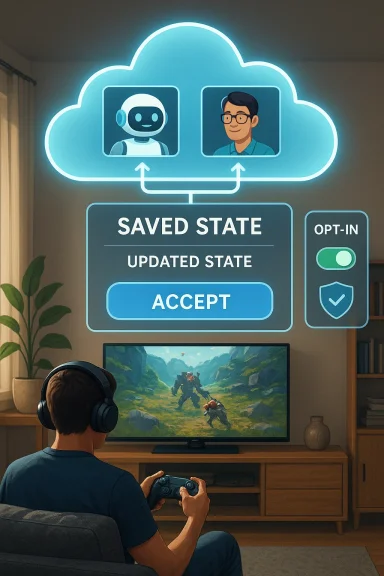
- If the player opts in, the system saves a current game state (a “help session starting state”) and loads it into a cloud-hosted help session.
- A helper (a verified human player or an AI agent) connects to that cloud session and supplies inputs. The cloud session streams video back to the helper and streams helper inputs into the help session process.
- When the helper reaches a satisfactory result, the session produces an “updated help session state.” The original player can accept that new state (resume from the solved point) or reject it (revert to the saved starting state).
- The system logs and rates helpers, and machine learning components decide when to offer help and how long to keep suggesting it.
Notable design choices called out by the filing
- Cloud execution. The help session is often a streaming instance, meaning the helper doesn’t directly control the player’s local console — they play a server-side copy that starts from the same saved state.
- Two-way visibility and rollback. The original player can watch, interrupt, and either accept the refined state or discard it.
- ML-driven triggering. Help offers can be gated by models trained to detect repeated failures or patterns that historically indicate a player is stuck.
- Helper identity and reputation. The patent contemplates a system of helper discovery and ranking: names, ratings, and availability windows are surfaced to the player.
Why the patent went viral — and why context matters
There are three reasons the story blew up:- Leadership optics. Microsoft’s pivot to broader AI investments and the appointment of a CoreAI exec, Asha Sharma, to the helm of Microsoft Gaming created a narrative frame. Many readers conflated “AI-forward leadership” with “instant, mandatory AI in games,” which oversimplifies both corporate transitions and what patents represent. The leadership change is real, but the patent predates Sharma’s promotion and was filed while different leaders still oversaw Xbox product strategy.
- The word take over. Short headlines that say “AI will take over your game” are attention-grabbing — but the patent’s concept is a controlled, opt-in handoff with undo semantics, not a system that seizes gameplay when you aren’t looking. That difference matters to people who value eventual victory through their own effort.
- Convergent patents. Sony’s own AI Generated Ghost Player filing — which describes a ghost that can demonstrate or enact solutions for stuck players — gave journalists a second example to frame the trend. The presence of similar patents across companies makes the idea feel inevitable, even if implementation details will determine impact.
The potential benefits: accessibility, retention, and discovery
When stripped of headline hyperbole, the concept offers several clear advantages:- Accessibility: Players with motor or cognitive impairments, vision limitations, or other accessibility needs could rely on helpers to bypass precision or reflex challenges while still experiencing a game’s story and content in a way they control. This extends playability for audiences who are often left out by strict mechanical difficulty. The design’s snapshot-and-accept model preserves agency: you can accept the assisted result or keep playing to challenge yourself.
- Player retention: Frustration is a measurable cause of churn. If a player is stuck for hours and abandons a title, both enjoyment and commercial metrics suffer. An optional and unobtrusive help flow could keep players engaged, reduce refunds or returns, and help games retain a broader audience.
- Learning and coaching: Human helpers and explainable AI agents can act as tutors. Watching a helper’s tactics — or receiving a short text-based explanation while they play — can teach strategy without requiring players to watch long, out-of-context YouTube videos.
- New service models: For publishers, verified helper networks (volunteer, paid, or subscription-based) create low-friction support channels. Done ethically, these can be a value-add for premium subscribers or accessibility-conscious player segments.
Real and material risks — technical, ethical, and commercial
Every emergent platform feature carries downside risk. This patent raises several:- Privacy and data collection. Implementing this system at scale requires snapshots of live game state, streaming video of in-session play, and helper metadata. That data flow touches personally identifiable information in some genres (player names, chat, potentially voice comms) and will need strong access controls and clear consent boundaries. Regulators and privacy-conscious players will expect precise opt-in settings.
- Account security and abuse surface. While cloud-based instances reduce local compromise risk, a social engineering attack or compromised helper account could still be used to manipulate a player’s experience, push unwanted content, or harvest info in ways that are harmful. Helper verification, MFA, and rate limits are essential.
- Competitive fairness and achievements. Single-player experiences are one thing; multiplayer and achievement-granting scenarios are different. If an assisted session leads to progress that confers achievements, leaderboards, or unlocks in competitive settings, developers will balk. Implementations must clearly separate assisted progress from competitive adjudications, or require explicit gating by studios.
- Monetization pressure and temptation to nudge. The patent mentions ML-driven triggers for offering help, which implies UI presentations and timing heuristics. If those heuristics are tuned to maximize engagement or microtransactions, players could feel aggressively nudged toward paid assistance. The line between helpful and coercive UI is thin, and companies should prioritize user choice.
- Creative integrity and authorial intent. Some designers and players value friction and discovery as core to a title’s identity. Tools that make “skipping” too easy can dilute the intended experience — which is why many critics argue for studio control over if/when such assistance is available for a particular title.
- Technical complexity and latency. For twitchy action games, a cloud helper must contend with input latency, desynchronization, and state mapping across hardware revisions. Not all titles will play well in a streamed helper environment, and the engineering costs could be prohibitive to deliver a seamless experience.
What the patent doesn’t mean (and what it does)
Patents are legal claims on an idea or approach — they rarely indicate imminent product launches. Microsoft’s filing does not prove Microsoft will ship this exact system, nor that it will be mandatory, nor that it reflects the priorities of the new head of Microsoft Gaming. In practice, patent filings often document research directions or protect engineering approaches that may never be commercialized in full.That said, patents are also directional signals: they reveal what problems a company thinks are worth solving. Microsoft’s patent underscores an interest in cloud state orchestration, helper identity, and ML-driven UX — all elements consistent with broader Copilot and cloud gaming strategies. Interpreting a patent as a definitive roadmap is a mistake, but treating it as evidence of intent to explore that space is reasonable.
Sony’s ghost player: a parallel approach
Sony’s AI Generated Ghost Player patent describes a related but distinct approach: generating a “ghost” — effectively an AI-controlled representation of a competent playthrough — that can either demonstrate a solution or actively execute it for the player. Sony’s text references using large swathes of gameplay footage (YouTube, Twitch, internal telemetry) to build an assistance model and contemplates varying levels of help, including a “Complete Mode.” That filing shows the industry’s convergent interest in integrating AI helpers directly into gameplay.Taken together, Microsoft’s and Sony’s filings suggest two complementary pathways:
- Microsoft’s approach emphasizes stateful cloud sessions with human-or-AI helpers that operate in separate instances.
- Sony’s ghost is more of an in-game overlay or actor that demonstrates or executes behavior derived from prior play data.
Practical recommendations: how to build this responsibly
If a platform or developer decides to ship helper functionality, the following design principles will minimize harm and maximize value:- Make it fully opt-in by default with a clear always-off choice in privacy settings.
- Preserve agency: always allow instantaneous player takeover and the ability to reject the updated state.
- Separate single-player assists from multiplayer and achievement systems. Assisted progress should not confer competitive advantages or leaderboard placement without explicit studio policies.
- Transparent ML: explain why help was suggested, and offer a simple “don’t suggest this again for this game” control.
- Vet and verify human helpers; treat helper accounts like any other paid or public-facing moderation role (background, ratings, dispute resolution).
- Provide a non-monetized baseline for accessibility needs. If paid helpers exist, make essential accessibility assistance available through non-commercial channels or as part of platform accessibility commitments.
- Limit data retention and implement end-to-end auditing for abuse reports. Make opt-in logs accessible to the assisted player.
- Offer developer controls to opt-out or customize the assistance model for their game’s design intent (for example, museums, speedrun‑mode exclusions, or narrative events).
Developer and studio considerations
Game studios will be the gatekeepers for whether this tech becomes widespread. They care about:- Preserving design intent. Some titles explicitly trade accessibility for satisfaction — think of certain brutal ARPGs — and studios may choose to opt out.
- Monetization and brand integrity. Studios will evaluate whether this assistance harms long-term engagement or cannibalizes longer campaigns and DLC.
- Technical integration. Not all engines, save systems, or multiplayer architectures can map cleanly to cloud snapshot-and-resume semantics. Studios may need middleware or engine plugins to support safe state transfer.
- Anti-cheat. For online competitive titles, any form of remote control introduces cheating risk. Dedicated anti-cheat rules and assisted-progress exclusions will be necessary.
Community reaction — reasoned critique and noisy misreading
Forums and comment sections show a mix of reactions: accessibility advocates and players who dislike grind welcome the idea; purists and achievement-focused players are wary; privacy hawks and security-conscious users raise procedural objections. Many of the loudest takes, however, conflate the patent with an immediate shift in Xbox policy under new leadership. That narrative gained fuel from the timing of Phil Spencer’s retirement and Asha Sharma’s appointment, but the patent itself predates that leadership move. The result is a conversation inflated by context and compressed timelines.What to watch next
- Platform policy statements. Will Microsoft or Sony publish a policy about assisted play and achievements? Clear rules will blunt alarmist narratives.
- Developer responses. Which studios opt in and which explicitly refuse? Studio choices will reveal whether the concept is a niche accessibility tool or broader commerce play.
- Pilot programs and age gating. Practical rollouts will likely be limited pilots (insider programs, beta testers) and strong age or parental controls.
- Regulatory interest. Privacy and consumer protection agencies will monitor data use and monetization practices. If helpers use scraped public video data (as Sony’s filing contemplates), copyright and dataset provenance debates will appear.
Conclusion: neither apocalypse nor utopia — a design problem to be solved
The patent that went viral is not a manifesto to replace player skill with corporate AI; it’s a technical blueprint for an assistive system that — if implemented with the right guardrails — could expand accessibility and reduce frustration without robbing players of agency. Its publication amid corporate leadership changes and industry-wide patenting on related ideas made it ripe for misinterpretation. The responsible path forward requires clear opt-in design, studio control, privacy-first data handling, and firm separation between assisted and competitive progress.If Microsoft, Sony, or any other platform pursue these systems, the real debate won’t be about whether the idea is technically possible — it clearly is — but about the choices made in shipping it: defaults, transparency, access, and the rights of players to accept or reject assistance. Those policy choices will determine whether helpers become a gentle accessibility lifeline or a source of friction and mistrust. For now, what we have is an interesting patent and an overdue conversation about how to design assistance that respects players, creators, and competition alike.
Source: Windows Central An old Xbox AI patent from Microsoft is going viral for the wrong reasons
