

Microsoft’s October roll-up for Xbox and PC brings a rare combination of hardware-ready system features, cloud expansions, and platform-side refinements that promise faster first‑play launches, better cloud reach, and a more handheld‑friendly Windows experience — but the real impact will depend on developer adoption, OEM driver quality, and how Microsoft handles privacy and anti‑cheat complexity.
Microsoft’s monthly Xbox updates have evolved beyond simple dashboard tweaks into a coordinated cross‑platform push: tighter Xbox–Windows integration, targeted optimizations for new handheld hardware, and steady expansion of cloud features. This October wave centers on three headlines: Advanced Shader Delivery (shader preloading and new DirectX-side tooling), the retail launch of the ROG Xbox Ally family (hardware tuned for the new features), and broader cloud and PC app adjustments that Microsoft and partners say will reduce wait times and improve battery and bandwidth behavior. Early partner documentation and OEM press releases show the features shipped to consumer devices (notably ASUS’s ROG Xbox Ally and Ally X) while Xbox’s own posts outline the cloud and service expansions.
Key specs (manufacturer published):
However, the strategy also leans heavily on ecosystem coordination: studios must publish shader artifacts or accept partial benefits; OEMs must ship consistent driver stacks; and Microsoft must balance user privacy and anti‑cheat realities while expanding aggregation and cloud features. Early indicators are positive — validated hardware, clear marketing around Advanced Shader Delivery, and steady cloud catalog growth — but skeptics should treat headline speed claims and catalog counts as transient snapshots until independent testing and official cumulative metrics appear.
Caveat: a meaningful portion of the headline benefits depends on continued partner adoption, driver maturity, and clear telemetry practices. The early launch signals — corroborated by ASUS press materials, Xbox Wire updates, and third‑party reporting — are credible and promising, but real‑world performance will be revealed through independent testing, title‑by‑title validation, and the months of post‑launch patches that typically follow a major OEM/software coordination effort.
Source: Windows Report Xbox October 2025 Update: Faster Downloads, Advanced Shader Delivery & More
 Background
Microsoft’s monthly Xbox updates have evolved beyond simple dashboard tweaks into a coordinated cross‑platform push: tighter Xbox–Windows integration, targeted optimizations for new handheld hardware, and steady expansion of cloud features. This October wave centers on three headlines: Advanced Shader Delivery (shader preloading and new DirectX-side tooling), the retail launch of the ROG Xbox Ally family (hardware tuned for the new features), and broader cloud and PC app adjustments that Microsoft and partners say will reduce wait times and improve battery and bandwidth behavior. Early partner documentation and OEM press releases show the features shipped to consumer devices (notably ASUS’s ROG Xbox Ally and Ally X) while Xbox’s own posts outline the cloud and service expansions. What’s in this update — the short version
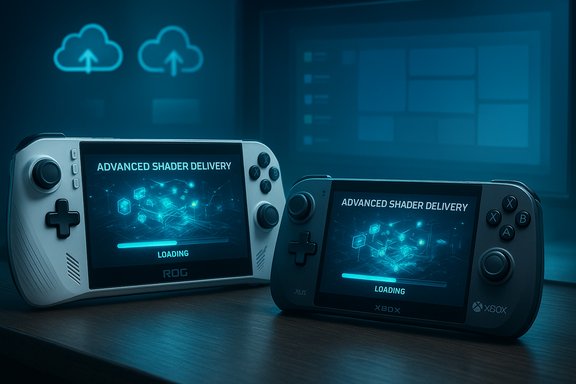
- Advanced Shader Delivery: Preloads game shaders during download so supported titles can launch far faster on first run, with Microsoft and partners citing up to 10× faster first launches in some cases. The system intends to reduce CPU/GPU stalls and conserve battery during first runs.
- ROG Xbox Ally and ROG Xbox Ally X: Hardware shipping October 16, 2025, co‑developed with Xbox and designed to expose the handheldized Xbox UI on Windows 11 with tighter driver and NPU support on Ally X. Specs and marketing materials explicitly reference Advanced Shader Delivery and future NPU‑driven features like Automatic Super Resolution (Auto SR).
- Xbox PC app & cloud growth: The Xbox app and cloud teams are expanding “Stream Your Own Game” and adding input and streaming compatibility across more titles and platforms; Xbox Wire shows the cloud playable collection has grown rapidly through 2025, and the Stream Your Own Game program has expanded from dozens to hundreds of titles this year.
- Input and touch support: Microsoft reports wider wired USB mouse and keyboard support for streaming on cloud devices, plus hundreds of games with touch or mouse/keyboard support in cloud play — a tally that continues to rise as more titles are validated. (Note: exact counts quoted in reports should be treated as rolling numbers.
Overview: Why this update matters
For years, first‑run shader compilation has been the invisible friction that turns “download complete” into “unplayable for 10–20 minutes.” By shifting shader delivery earlier in the pipeline, Microsoft is attacking that friction point directly. The approach matters for three audiences:- Handheld users care about first play responsiveness and battery life; precompiled shaders reduce CPU/GPU spikes that trigger thermal management and battery drain.
- Cloud and streaming users benefit because server‑side shader preparation removes client‑side stalls on devices with limited local compiling resources.
- Developers and engine teams get an opportunity to smooth launch experiences without shipping heavy local shader caches or forcing large post‑install background compilations.
Advanced Shader Delivery — a technical deep dive
What it does
Advanced Shader Delivery changes when and where shader compilation happens:- Instead of compiling platform‑specific shaders during the player’s first run, shaders are precompiled and delivered as part of the download or as an adjacent package.
- The Xbox/DirectX tooling can ship a precompiled shader blob (or a GPU/driver‑tailored package) so the client performs minimal or no runtime compilation on first launch.
- Local compilation remains a fallback; the system is additive and aims to reduce the worst‑case stalls without forcing developers to rework their engines.
Why the gains aren’t uniform
- Shader workloads differ dramatically by engine, rendering path, and how a title partitions shaders across assets and quality levels.
- Some games ship thousands of shader permutations; precompiling all permutations for every possible GPU/driver combination is impractical. The pragmatic approach precompiles common permutations and relies on dynamic fallbacks.
- Driver changes or GPU updates can invalidate certain compiled blobs; Microsoft’s tooling tries to address this by versioning shader stores and using robust fallback compilation.
Developer impact and adoption
- No forced API changes — the system is designed to work with existing titles, though deeper engine integration (patching build pipelines and publishing shader caches) will yield the best results.
- Studios that ship larger, shader‑heavy titles (ray‑tracing, highly variable materials) stand to benefit most, but those same titles are the hardest to fully precompile.
- Smaller studios can adopt the feature without major rework, but expect incremental rollout: Microsoft and partners are onboarding supported titles gradually.
Supported games (current snapshot)
Several outlets and platform posts list early supported titles for Advanced Shader Delivery; the roster is growing and is managed on the Xbox side. The pool of titles called out in early announcements includes large AAA and remaster projects that traditionally suffer long first‑run waits. Because lists change as Microsoft validates more titles, expect additions over time. (The initial published lists and aggregated reporting highlight dozens of supported games — this list is illustrative rather than exhaustive.- Ark: Survival Ascended
- Avowed
- Call of Duty: Black Ops 6
- Control
- Dead Island 2
- Deep Rock Galactic
- Forza Horizon 5
- Forza Motorsport
- Grand Theft Auto V (Enhanced)
- Metro Exodus
- Microsoft Flight Simulator 2024
- Monster Hunter Rise
- Persona 3 Reload
- Resident Evil 2 (2019) / Resident Evil 3
- S.T.A.L.K.E.R. 2: Heart of Chornobyl
- Sea of Thieves
- The Elder Scrolls: Oblivion Remaster
- The Outer Worlds 2
- Hogwarts Legacy
- (and others as the program expands)
ROG Xbox Ally & Ally X — hardware and why it matters
The devices
ASUS’s ROG Xbox Ally and ROG Xbox Ally X are the first retail handhelds co‑designed to surface the Xbox full‑screen experience on Windows and to maximize the new shader and NPU features.Key specs (manufacturer published):
- ROG Xbox Ally
- AMD Ryzen Z2 A (Zen‑based APU), 16GB LPDDR5X‑6400, 512GB M.2 2280 SSD, 60Wh battery, Windows 11 Home.
- ROG Xbox Ally X
- AMD Ryzen AI Z2 Extreme (Zen 5 APU + integrated NPU), up to 24GB LPDDR5X‑8000, 1TB M.2 2280 SSD, 80Wh battery, built‑in NPU marketed at vendor TOPS figures in ASUS materials, Windows 11 Home. The Ally X is explicitly positioned to unlock Auto SR and future AI features.
What the hardware tie‑in accomplishes
- Validated drivers and firmware reduce the fragmentation that undermines repeatable performance on Windows handhelds.
- The Ally X’s NPU enables system‑level AI tools such as Auto SR (system upscaling) and future highlight‑generation features; these are hardware‑dependent and will not be available on devices without similar NPUs.
- By shipping hardware and software in a coordinated way, Microsoft and ASUS reduce the “works sometimes” problem that plagues community ports and unofficial tweaks.
Xbox PC app, downloads, and bandwidth improvements — what’s verified
Multiple community and platform reports indicate the Xbox app and associated delivery systems are changing to make downloads less painful — smarter concurrency, better bandwidth usage, and prefetching of game modules. Xbox’s incremental updates over 2025 expanded cloud tooling and introduced Store and app improvements that try to use connections more effectively. Xbox Wire and other official posts show the cloud and app teams are actively adding features (streaming growth, app improvements, etc., but a detailed, official engineering breakdown of a new “download engine” with quantified speed gains is not clearly documented in public Microsoft engineering notes at the time of publication. Practical takeaways:- Users should expect incremental improvements to download reliability and responsiveness in the Xbox app; Xbox has prioritized smoothing the experience for larger titles and cloud‑first workflows.
- Community testing and anecdotal reports still play a role — some users saw big speed improvements after changing local Delivery Optimization or Store download behaviors, and Microsoft has been iterating on these systems. Treat claims of fixed percentage speed gains cautiously until Microsoft publishes the engineering notes.
Cloud, streaming, and input expansions
Stream Your Own Game — the growth story
“Stream Your Own Game” has been rolled out progressively through 2024–2025. Microsoft initially launched a small catalog and has steadily expanded the number of cloud‑playable owned titles. Xbox Wire’s published updates document meaningful growth (from dozens to hundreds of streamable titles), and third‑party trackers and game outlets have repeatedly covered major catalog additions. As of late summer and early fall 2025, Xbox Wire reported hundreds of titles available to stream from a user’s owned library; other outlets and trackers put the number higher depending on timing and regional availability. This is a fast‑moving stat; treat any specific count as a snapshot that may have increased since publication.Input and cloud control support
Microsoft continues to extend cloud input options:- Wired USB mouse and keyboard support has been added across more cloud‑playable titles and devices, making the cloud more viable for strategy and simulation games that prefer precise pointer input.
- Touch controls and cloud pad mapping have grown into the hundreds of titles as Microsoft validates schemes for mobile and handheld devices.
Console and Game Hubs changes
Xbox is also iterating on Game Hubs and console UX:- New Game Hubs modules surface developer updates and in‑game Game Pass perks in a more prominent way, intended to make developer messages and Game Pass rewards easier to find for players.
- Aggregation of storefront metadata and push notifications (wish list, deal alerts, Game Pass perks) is increasingly built into the Xbox PC app and mobile experience, supporting the “one place to find all my games” narrative that Microsoft has emphasized.
Strengths: what Microsoft got right
- Tackling shader stalls at the pipeline level addresses a fundamental friction point that has annoyed PC and handheld players for years. Shipping a precompiled delivery system is a practical way to reduce first‑run waits.
- Hardware + software co‑design (ASUS + Xbox) reduces the practical risk of driver fragmentation and gives Microsoft a repeatable reference platform for handheld behavior. That makes the claimed improvements more achievable in retail devices than through community hacks.
- Cloud growth and streaming flexibility expand options for players who want to play without downloading or whose local storage is constrained. Rapid additions to “Stream Your Own Game” demonstrate meaningful momentum.
- Controller-first UX and Game Bar improvements make handheld Windows devices more approachable for console-centric users; the Xbox full‑screen experience lowers the barrier for non‑PC gamers.
Risks and limitations — what to watch closely
- Developer adoption is the gating factor
Advanced Shader Delivery helps without forcing engine rewrites, but the biggest wins require developer cooperation to publish shader outputs and to test them. Expect uneven adoption initially; the largest, most shader‑heavy titles also present the hardest technical work. - Driver fragmentation and rollback complexity
Precompiled shader blobs are tied to specific driver and GPU profiles. Frequent driver updates, unusual system configurations, or long‑tail hardware can produce mismatches that fall back to local compile — potentially negating some benefits unless Microsoft’s tooling handles versioning and fallbacks cleanly. - Privacy and telemetry questions
Aggregating libraries, scanning installed launchers, and prefetching shader data all involve metadata collection and background activity. Microsoft offers toggles and controls, but enterprise and privacy‑conscious users should request clear telemetry manifests and retention policies before enabling broader aggregation features. - Anti‑cheat and DRM complexity
Many competitive titles require native launchers and kernel drivers for anti‑cheat systems; aggregated launching and cloud streaming don’t remove those constraints. Users should test playflows for competitive or sanctioned multiplayer titles before relying on cloud streaming or aggregated launches. - Marketing vs. measured gains
“Up to 10× faster” is a headline figure: it can be true for specific shader‑heavy launch paths and measured scenarios, but it is not a guarantee for every title or system configuration. Independent benchmarking will be needed to understand typical real‑world improvements.
Practical guidance for gamers and IT pros
- If buying a handheld and responsiveness matters, prefer validated devices (ROG Xbox Ally series on launch) because integrated drivers and OEM images reduce the guesswork.
- For PC users worried about downloads: try pausing/resuming downloads in the Xbox app and, where appropriate, briefly using the Microsoft Store download path — community troubleshooting has shown this can change observed throughput in some cases, but this remains a pragmatic workaround rather than an official fix. Check Delivery Optimization settings if downloads stall.
- Developers and studios should evaluate shader packaging and build‑pipeline hooks now; early adopters will get the best player experience on handheld and cloud devices.
- Privacy‑sensitive users and admins should audit the Xbox PC app’s aggregation features and cloud scanning toggles before enabling cross‑store library collection on managed devices.
Final analysis — where this fits in the ecosystem
Microsoft’s October update and the Ally launch together represent a pragmatic strategy: solve concrete UX pain points (shader stalls, clunky downloads, and inconsistent handheld experiences) by combining platform tooling, OEM reference hardware, and cloud orchestration. That three‑pronged approach is the most likely path to wide, repeatable gains because it addresses software, hardware, and service layers simultaneously.However, the strategy also leans heavily on ecosystem coordination: studios must publish shader artifacts or accept partial benefits; OEMs must ship consistent driver stacks; and Microsoft must balance user privacy and anti‑cheat realities while expanding aggregation and cloud features. Early indicators are positive — validated hardware, clear marketing around Advanced Shader Delivery, and steady cloud catalog growth — but skeptics should treat headline speed claims and catalog counts as transient snapshots until independent testing and official cumulative metrics appear.
Conclusion
The October update is one of Xbox’s most cohesive monthly releases in recent memory: a mix of platform engineering (Advanced Shader Delivery), hardware deployment (ROG Xbox Ally line), and cloud ecosystem expansion (Stream Your Own Game and input support). For players, the practical upside is lower friction: shorter waits to play, better battery behavior on handhelds, and more cloud options. For developers and infrastructure teams, it’s a call to action to embrace new pipelines and validate shaders and streaming behavior.Caveat: a meaningful portion of the headline benefits depends on continued partner adoption, driver maturity, and clear telemetry practices. The early launch signals — corroborated by ASUS press materials, Xbox Wire updates, and third‑party reporting — are credible and promising, but real‑world performance will be revealed through independent testing, title‑by‑title validation, and the months of post‑launch patches that typically follow a major OEM/software coordination effort.
Source: Windows Report Xbox October 2025 Update: Faster Downloads, Advanced Shader Delivery & More
