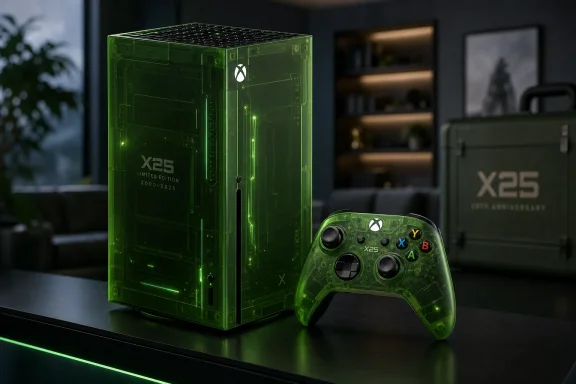
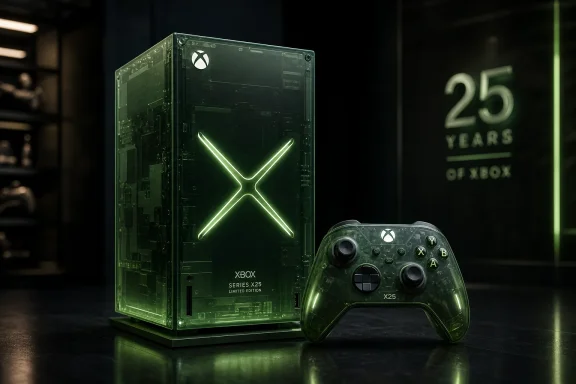
Microsoft announced the Xbox Series X25 Limited Edition and Xbox Wireless Controller X25 Special Edition on June 7, 2026, ahead of Xbox’s November 15 twenty-fifth anniversary, bringing a translucent green 1TB Series X bundle and matching controller to select markets this November. The machine is not a new console generation, and Microsoft is not pretending otherwise. It is a nostalgia device with a very specific job: make Xbox feel like a hardware brand again at a moment when much of Microsoft’s gaming strategy has moved beyond the box. That tension is what makes the X25 more interesting than another collector’s shell.
The Xbox Series X25 is, technically, the easiest kind of hardware announcement to understand. Under the translucent green casing sits a standard Xbox Series X with 1TB of storage. Microsoft has not announced a new chipset, a revised performance target, a larger SSD, a disc-drive shake-up, or a fresh console OS story around it.
That restraint matters. The X25 is not an answer to PlayStation, PC handhelds, cloud gaming, or the next Xbox architecture. It is an anniversary edition of an existing machine, framed around the visual language of the original Xbox era: translucent plastic, green lighting, and a controller designed to make longtime players remember when Microsoft’s console ambitions still felt improbable.
The smart part is that Microsoft chose the right memory. The original Xbox was never subtle. It was large, loud, oddly American, and aggressively unlike the Japanese consoles that defined the market around it. Translucent green is not merely a colorway; it is shorthand for the period when consumer electronics could look like toys, appliances, and sci-fi props at the same time.
That makes the Series X25 a better anniversary product than a logo badge or a dashboard theme. It turns the Series X’s austere tower into something closer to a display piece. For a company that has spent years telling players that Xbox is wherever the games are, the X25 is a reminder that a physical Xbox can still carry emotional weight.
Instead, the X25 tries to win by being desirable. The translucent green chassis reaches back to the original Xbox and the early-2000s fascination with visible innards, when game hardware wanted to look engineered rather than invisible. It is the opposite of the living-room minimalism that has dominated console design for years.
That is why the illuminated green X logo is a small but meaningful flourish. The regular Series X is almost deliberately anonymous, a black rectangular monolith that works best when it disappears beside a television or monitor. The X25 wants to be seen when it powers on.
The controller follows the same logic. The Xbox Wireless Controller X25 Special Edition keeps the modern pad’s familiar ergonomics but wears the anniversary treatment more loudly, with translucent green plastic and traditional ABXY colors. It is not a return to the infamous “Duke” controller in size or shape, thankfully, but it borrows just enough from that era to make the callback legible.
For collectors, that balance is the whole point. Nobody needs a 1TB Series X in 2026 because it is translucent. Some players will want one because it turns a mass-market console into an object with a date, a story, and a shelf-life.
That broader strategy may be rational, even inevitable. Microsoft owns a huge gaming portfolio, and the old console-war model looks less useful when development costs keep rising and players expect their libraries to travel across devices. But the emotional core of Xbox was built on hardware. The box mattered because it created the room in which the community gathered.
The Series X25 is therefore a symbolic counterweight to Microsoft’s own rhetoric. It says, in effect, that the console still matters — not necessarily as the only place to play, but as the artifact that gives the brand a center of gravity. That is a subtle but important distinction.
For WindowsForum readers, the PC angle is impossible to ignore. Microsoft has spent years trying to make Xbox and Windows feel like parts of the same gaming continuum. Yet the strongest anniversary image it can offer is not a launcher, a subscription tier, or a cloud endpoint. It is a green plastic console.
That does not undermine the strategy, but it does expose the branding problem. Services scale; boxes create memories. Microsoft needs both.
The console will be sold as a limited-edition collection with the matching controller in select markets this November. The controller will also be available separately, which is the right move. Many Xbox owners already have a Series X, and asking them to buy a whole second console for a shell swap would limit the anniversary celebration to collectors with deep pockets.
Still, “limited edition” is a loaded phrase in gaming hardware. Scarcity can make an object special, but it can also make a launch feel cynical if ordinary fans never see stock at ordinary prices. Microsoft knows this history. Every major console maker does.
The X25’s success will depend less on how loudly the internet praises its reveal photos and more on whether players can actually buy it. A nostalgic anniversary product that vanishes into bot carts would send exactly the wrong message. The point of a 25th birthday is inclusion, not a checkout-page blood sport.
Microsoft’s decision to hold back pricing also leaves room for suspicion. If the X25 lands too far above the standard Series X, the translucent shell becomes a tax on nostalgia. If it is priced close to existing hardware, the product becomes an easy collector’s recommendation and a cleaner celebration of the brand.
A larger SSD would have made the X25 feel like a more substantial anniversary edition rather than a design variant. Microsoft has already sold higher-capacity special Xbox hardware in the Series era, so the choice to keep this machine at 1TB is not technically surprising. It is simply a missed opportunity for anyone hoping the anniversary unit would be the “best” Series X configuration.
That distinction will matter to enthusiasts. A collector may value the shell above the drive. A practical buyer who still has not upgraded from Xbox One may look at the same product and wonder whether a standard Series X bundle, a higher-capacity model, or even a gaming PC offers better value.
Microsoft appears to be betting that the X25 is not primarily a rational upgrade. It is a commemorative object. The risk is that, in a market where console hardware sales have been under pressure and players are more cost-conscious, commemorative objects still have to justify their place in the cart.
The controller has an easier path. A special-edition gamepad can be collectible, usable, and relatively attainable all at once. If Microsoft manages supply well, the X25 controller may become the real mass-market anniversary item, while the console serves as the halo piece.
That is why the translucent green callback lands. It is not nostalgia for a perfected past. It is nostalgia for a moment when Microsoft was visibly trying to force its way into a market that did not need it, and somehow managed to make itself necessary.
The Xbox 360 refined that argument into a cultural phenomenon. Xbox Live became the template for modern console networking, achievements reshaped player identity, and the platform briefly looked like the future of living-room gaming. The original Xbox, by contrast, was the prototype with sharp edges.
The Series X25 draws from that prototype because the modern Xbox brand could use some of that edge. Today’s Xbox is powerful, sophisticated, and strategically diffuse. It is also harder to describe in one sentence than it used to be.
A translucent green tower cannot solve that. But it can remind players of the time when Xbox had a simpler proposition: here is a machine, here are the games, here is the network, and here is why it is different.
That is sensible. A special-edition Series X has limited strategic value if it is presented as the main event. Its job is to punctuate the anniversary, create social-media heat, and give the showcase a tangible object for fans to discuss after the trailers end.
The risk is that hardware enthusiasts will read too much into it. The name “Series X25” sounds grander than the actual product. It could be mistaken by casual observers for a mid-generation refresh or a new model tier, even though Microsoft’s announcement makes clear that this is the familiar Series X in anniversary clothing.
That confusion is manageable if Microsoft’s retail messaging is clean. It needs to be explicit about storage, performance, and bundle contents. Limited editions thrive when buyers know exactly what they are getting; they sour when branding does more work than disclosure.
The best-case version of the X25 launch is simple: clear preorder windows, fair anti-scalping measures, transparent regional availability, and enough controller stock to let ordinary fans participate. The worst-case version is equally simple: mystery pricing, scarce inventory, and “select markets” doing a lot of unpleasant work.
That is not hypocrisy. It is the central tension of modern platform strategy. Windows gives Xbox reach, flexibility, and a route into handheld PCs, game stores, mods, and high-end hardware. The console gives Xbox coherence.
The Series X25 is coherence in plastic form. It says there is still a canonical Xbox object, even if Microsoft’s business increasingly depends on players who never buy one. That matters because brands without centerpieces can become abstractions.
There is also a practical lesson here for Microsoft’s Windows gaming ambitions. PC gaming has power and variety, but it rarely has the uniformity that makes console nostalgia easy. Nobody remembers “the 2001 Windows gaming PC” as a single object. Millions remember the original Xbox.
If Microsoft wants Windows and Xbox to merge more deeply, it will need to preserve the emotional clarity that consoles provide. The answer may not always be a box under the television, but it has to be something more concrete than a subscription logo.
There is nothing wrong with that. Gaming history is material history, and hardware variants tell part of it. The translucent green X25 will likely photograph well, display well, and age as a recognizable marker of the Xbox 25th anniversary.
But collector demand can distort a product’s public meaning. If the X25 becomes primarily a resale-market trophy, the anniversary message narrows. It becomes less about the millions of players who grew up with Xbox and more about the smaller group able to secure limited hardware on day one.
That is why the standalone controller is important. It gives Microsoft a pressure valve. Even if the console bundle is scarce, the controller can keep the celebration from feeling locked behind a full hardware purchase.
The company should lean into that accessibility. Anniversary wallpapers are a nice free gesture, but the controller is the practical bridge between nostalgia and everyday use. It lets a Series S owner, a PC player, or a current Series X owner buy into the moment without replacing a working console.
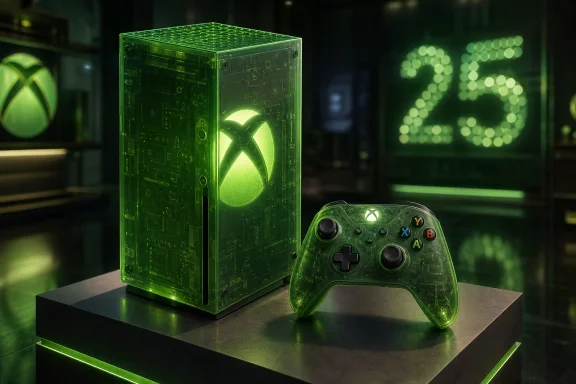
The Series X25 is that symbol. It compresses 25 years of brand history into one image: green plastic, a glowing X, and a controller that nods to the past without forcing players to relive the ergonomics of 2001. It is sentimental, calculated, and probably effective.
It also quietly admits that hardware remains part of Xbox’s legitimacy. Game Pass may be the business engine. Windows may be the strategic bridge. Cloud may be the long-term optionality. But the console is still the object that makes the brand feel like more than a distribution network.
That is why this announcement deserves more attention than a routine limited-edition SKU. It arrives when Microsoft is trying to stretch Xbox across platforms without snapping the identity that made people care in the first place. The X25 does not answer every question about Xbox’s future, but it does reveal what Microsoft thinks is worth preserving.
 Microsoft Sells the Memory of a Console, Not a New Console
The Xbox Series X25 is, technically, the easiest kind of hardware announcement to understand. Under the translucent green casing sits a standard Xbox Series X with 1TB of storage. Microsoft has not announced a new chipset, a revised performance target, a larger SSD, a disc-drive shake-up, or a fresh console OS story around it.That restraint matters. The X25 is not an answer to PlayStation, PC handhelds, cloud gaming, or the next Xbox architecture. It is an anniversary edition of an existing machine, framed around the visual language of the original Xbox era: translucent plastic, green lighting, and a controller designed to make longtime players remember when Microsoft’s console ambitions still felt improbable.
The smart part is that Microsoft chose the right memory. The original Xbox was never subtle. It was large, loud, oddly American, and aggressively unlike the Japanese consoles that defined the market around it. Translucent green is not merely a colorway; it is shorthand for the period when consumer electronics could look like toys, appliances, and sci-fi props at the same time.
That makes the Series X25 a better anniversary product than a logo badge or a dashboard theme. It turns the Series X’s austere tower into something closer to a display piece. For a company that has spent years telling players that Xbox is wherever the games are, the X25 is a reminder that a physical Xbox can still carry emotional weight.
The Translucent Shell Is Doing More Work Than the Spec Sheet
There is a reason the announcement copy leans on the case, the glow, and the “hidden surprises” rather than teraflops. The Series X is mature hardware. Its performance profile is known, its compromises are known, and its library is no longer a mystery. A limited edition arriving six years into a console generation cannot win by pretending to be revolutionary.Instead, the X25 tries to win by being desirable. The translucent green chassis reaches back to the original Xbox and the early-2000s fascination with visible innards, when game hardware wanted to look engineered rather than invisible. It is the opposite of the living-room minimalism that has dominated console design for years.
That is why the illuminated green X logo is a small but meaningful flourish. The regular Series X is almost deliberately anonymous, a black rectangular monolith that works best when it disappears beside a television or monitor. The X25 wants to be seen when it powers on.
The controller follows the same logic. The Xbox Wireless Controller X25 Special Edition keeps the modern pad’s familiar ergonomics but wears the anniversary treatment more loudly, with translucent green plastic and traditional ABXY colors. It is not a return to the infamous “Duke” controller in size or shape, thankfully, but it borrows just enough from that era to make the callback legible.
For collectors, that balance is the whole point. Nobody needs a 1TB Series X in 2026 because it is translucent. Some players will want one because it turns a mass-market console into an object with a date, a story, and a shelf-life.
Xbox’s 25th Anniversary Arrives at an Awkward Moment
The timing gives the X25 its charge. Microsoft is celebrating 25 years of Xbox while continuing to blur what Xbox means. The brand now spans consoles, Windows PCs, Game Pass, cloud streaming, first-party games on rival platforms, and an increasingly platform-agnostic publishing business.That broader strategy may be rational, even inevitable. Microsoft owns a huge gaming portfolio, and the old console-war model looks less useful when development costs keep rising and players expect their libraries to travel across devices. But the emotional core of Xbox was built on hardware. The box mattered because it created the room in which the community gathered.
The Series X25 is therefore a symbolic counterweight to Microsoft’s own rhetoric. It says, in effect, that the console still matters — not necessarily as the only place to play, but as the artifact that gives the brand a center of gravity. That is a subtle but important distinction.
For WindowsForum readers, the PC angle is impossible to ignore. Microsoft has spent years trying to make Xbox and Windows feel like parts of the same gaming continuum. Yet the strongest anniversary image it can offer is not a launcher, a subscription tier, or a cloud endpoint. It is a green plastic console.
That does not undermine the strategy, but it does expose the branding problem. Services scale; boxes create memories. Microsoft needs both.
Limited Edition Hardware Is a Test of Trust
The unanswered questions are not cosmetic. Microsoft has not yet disclosed pricing, exact market availability, preorder timing, or production volume. Those details will determine whether the X25 becomes a goodwill machine or another limited-edition scramble dominated by resellers.The console will be sold as a limited-edition collection with the matching controller in select markets this November. The controller will also be available separately, which is the right move. Many Xbox owners already have a Series X, and asking them to buy a whole second console for a shell swap would limit the anniversary celebration to collectors with deep pockets.
Still, “limited edition” is a loaded phrase in gaming hardware. Scarcity can make an object special, but it can also make a launch feel cynical if ordinary fans never see stock at ordinary prices. Microsoft knows this history. Every major console maker does.
The X25’s success will depend less on how loudly the internet praises its reveal photos and more on whether players can actually buy it. A nostalgic anniversary product that vanishes into bot carts would send exactly the wrong message. The point of a 25th birthday is inclusion, not a checkout-page blood sport.
Microsoft’s decision to hold back pricing also leaves room for suspicion. If the X25 lands too far above the standard Series X, the translucent shell becomes a tax on nostalgia. If it is priced close to existing hardware, the product becomes an easy collector’s recommendation and a cleaner celebration of the brand.
The 1TB Choice Keeps the Anniversary Grounded, but Also Conservative
The X25’s 1TB storage configuration is defensible because it keeps the product aligned with the familiar Series X baseline. It also makes the console feel oddly conservative in 2026. Modern blockbuster games can consume enormous chunks of internal storage, and Xbox’s expansion ecosystem has never been confused with impulse-buy cheap.A larger SSD would have made the X25 feel like a more substantial anniversary edition rather than a design variant. Microsoft has already sold higher-capacity special Xbox hardware in the Series era, so the choice to keep this machine at 1TB is not technically surprising. It is simply a missed opportunity for anyone hoping the anniversary unit would be the “best” Series X configuration.
That distinction will matter to enthusiasts. A collector may value the shell above the drive. A practical buyer who still has not upgraded from Xbox One may look at the same product and wonder whether a standard Series X bundle, a higher-capacity model, or even a gaming PC offers better value.
Microsoft appears to be betting that the X25 is not primarily a rational upgrade. It is a commemorative object. The risk is that, in a market where console hardware sales have been under pressure and players are more cost-conscious, commemorative objects still have to justify their place in the cart.
The controller has an easier path. A special-edition gamepad can be collectible, usable, and relatively attainable all at once. If Microsoft manages supply well, the X25 controller may become the real mass-market anniversary item, while the console serves as the halo piece.
Nostalgia Works Because the Original Xbox Still Feels Unfinished
The first Xbox occupies a strange place in gaming memory. It was not Microsoft’s most successful console, nor its most elegant. It was the opening argument for everything Xbox would later become: hard-drive-first console design, integrated online services, Western shooter dominance, and a controller layout that became a durable industry standard.That is why the translucent green callback lands. It is not nostalgia for a perfected past. It is nostalgia for a moment when Microsoft was visibly trying to force its way into a market that did not need it, and somehow managed to make itself necessary.
The Xbox 360 refined that argument into a cultural phenomenon. Xbox Live became the template for modern console networking, achievements reshaped player identity, and the platform briefly looked like the future of living-room gaming. The original Xbox, by contrast, was the prototype with sharp edges.
The Series X25 draws from that prototype because the modern Xbox brand could use some of that edge. Today’s Xbox is powerful, sophisticated, and strategically diffuse. It is also harder to describe in one sentence than it used to be.
A translucent green tower cannot solve that. But it can remind players of the time when Xbox had a simpler proposition: here is a machine, here are the games, here is the network, and here is why it is different.
The Showcase Framing Matters as Much as the Product
Microsoft revealed the X25 during the Xbox Games Showcase 2026, not as a standalone hardware event. That placement tells us how the company wants the console understood. The anniversary hardware is part of a broader content story, not a pivot away from the games-and-services strategy.That is sensible. A special-edition Series X has limited strategic value if it is presented as the main event. Its job is to punctuate the anniversary, create social-media heat, and give the showcase a tangible object for fans to discuss after the trailers end.
The risk is that hardware enthusiasts will read too much into it. The name “Series X25” sounds grander than the actual product. It could be mistaken by casual observers for a mid-generation refresh or a new model tier, even though Microsoft’s announcement makes clear that this is the familiar Series X in anniversary clothing.
That confusion is manageable if Microsoft’s retail messaging is clean. It needs to be explicit about storage, performance, and bundle contents. Limited editions thrive when buyers know exactly what they are getting; they sour when branding does more work than disclosure.
The best-case version of the X25 launch is simple: clear preorder windows, fair anti-scalping measures, transparent regional availability, and enough controller stock to let ordinary fans participate. The worst-case version is equally simple: mystery pricing, scarce inventory, and “select markets” doing a lot of unpleasant work.
Windows, Xbox, and the Problem of the Beautiful Box
For a Windows-centered audience, the X25 also highlights Microsoft’s unresolved hardware identity. On one side, Xbox is increasingly a software ecosystem that belongs on Windows as much as it belongs under a TV. On the other, Microsoft still reaches for dedicated console hardware when it wants to make fans feel something.That is not hypocrisy. It is the central tension of modern platform strategy. Windows gives Xbox reach, flexibility, and a route into handheld PCs, game stores, mods, and high-end hardware. The console gives Xbox coherence.
The Series X25 is coherence in plastic form. It says there is still a canonical Xbox object, even if Microsoft’s business increasingly depends on players who never buy one. That matters because brands without centerpieces can become abstractions.
There is also a practical lesson here for Microsoft’s Windows gaming ambitions. PC gaming has power and variety, but it rarely has the uniformity that makes console nostalgia easy. Nobody remembers “the 2001 Windows gaming PC” as a single object. Millions remember the original Xbox.
If Microsoft wants Windows and Xbox to merge more deeply, it will need to preserve the emotional clarity that consoles provide. The answer may not always be a box under the television, but it has to be something more concrete than a subscription logo.
Collectors Will Decide Whether This Is a Celebration or a Commodity
The X25 is almost engineered for the collector economy. It has a dated anniversary hook, a distinctive shell, a matching accessory, limited availability, and an obvious connection to the brand’s origin story. That combination will make it attractive to the same buyers who keep sealed controllers, console variants, and launch editions in circulation for years.There is nothing wrong with that. Gaming history is material history, and hardware variants tell part of it. The translucent green X25 will likely photograph well, display well, and age as a recognizable marker of the Xbox 25th anniversary.
But collector demand can distort a product’s public meaning. If the X25 becomes primarily a resale-market trophy, the anniversary message narrows. It becomes less about the millions of players who grew up with Xbox and more about the smaller group able to secure limited hardware on day one.
That is why the standalone controller is important. It gives Microsoft a pressure valve. Even if the console bundle is scarce, the controller can keep the celebration from feeling locked behind a full hardware purchase.
The company should lean into that accessibility. Anniversary wallpapers are a nice free gesture, but the controller is the practical bridge between nostalgia and everyday use. It lets a Series S owner, a PC player, or a current Series X owner buy into the moment without replacing a working console.
The Anniversary Console Says the Quiet Part Out Loud
Microsoft’s most revealing choice is not the translucent case. It is that the company made an anniversary console at all. After years of arguing that Xbox is an ecosystem, Microsoft still understands that ecosystems need symbols.The Series X25 is that symbol. It compresses 25 years of brand history into one image: green plastic, a glowing X, and a controller that nods to the past without forcing players to relive the ergonomics of 2001. It is sentimental, calculated, and probably effective.
It also quietly admits that hardware remains part of Xbox’s legitimacy. Game Pass may be the business engine. Windows may be the strategic bridge. Cloud may be the long-term optionality. But the console is still the object that makes the brand feel like more than a distribution network.
That is why this announcement deserves more attention than a routine limited-edition SKU. It arrives when Microsoft is trying to stretch Xbox across platforms without snapping the identity that made people care in the first place. The X25 does not answer every question about Xbox’s future, but it does reveal what Microsoft thinks is worth preserving.
The Green Box Leaves Buyers With a Short Checklist
The Xbox Series X25 is best understood as a collector-focused anniversary edition, not a hardware refresh. Anyone considering it should judge Microsoft’s next round of details with that in mind, because the missing commercial information matters more than the already-confirmed design.- The Xbox Series X25 Limited Edition uses the existing Series X hardware profile with 1TB of storage.
- The console and matching controller are scheduled to arrive as a limited-edition collection in select markets in November 2026.
- The Xbox Wireless Controller X25 Special Edition will also be sold separately.
- Microsoft has not yet announced pricing, preorder timing, production volume, or a full regional rollout.
- The translucent green design, illuminated Xbox logo, and traditional ABXY colors are the main reasons to care about this release.
- Buyers who already own a Series X should treat the console as a collectible, while the standalone controller is likely to be the more practical anniversary purchase.
References
- Primary source: GSMArena.com
Published: 2026-06-08T17:10:07.612201
Microsoft unveils Xbox Series X25 Limited Edition and X25 controller for the 25th anniversary - GSMArena.com news
Microsoft unveils Xbox Series X25 Limited Edition and X25 controller for the 25th anniversary - GSMArena.com newsm.gsmarena.com
- Related coverage: techradar.com
This new limited edition Series X looks like the ultimate machine for Xbox lovers | TechRadar
Mean green gaming machinewww.techradar.com - Related coverage: t3.com
New Xbox console announced during the Games Showcase after all | T3
Xbox is celebrating its 25th anniversary with new, special edition hardwarewww.t3.com - Related coverage: windowscentral.com
Everything announced at Xbox Games Showcase 2026 and Gears of War: E-Day Direct — Xbox Game Pass, PC, Play Anywhere, and more | Windows Central
Need a recap for the Xbox Games Showcase 2026? Don't worry, we've got you covered here.www.windowscentral.com - Related coverage: techspot.com
Microsoft's 25th-anniversary Xbox Series X is translucent green and full of nostalgia | TechSpot
Inside, the console offers the same performance profile as the standard Series X. But the semi-transparent green finish is an explicit nod to the first-generation machine, a...www.techspot.com - Related coverage: gematsu.com
Xbox Series X25 Limited Edition console and Xbox Controller X25 Special Edition announced - Gematsu
Xbox has announced the Xbox Series X25 Limited Edition console and Xbox Controller X25 Special Edition, inspired by the design of the original Xbox in…www.gematsu.com
- Related coverage: news.xbox.com
XBOX Games Showcase 2026 Recap: The Return of Exclusives, World Premieres, and Anniversary Hardware - XBOX Wire
XBOX Game Showcase 2026 just concluded. Find out everything announced - from the return of exclusives, to anniversary hardware, to games from XBOX and our partners – inside.news.xbox.com - Related coverage: xbox.com
XBOX 25th Anniversary: Celebrate 25 Years of Play with XBOX | XBOX
Welcome to the XBOX 25th anniversary celebration. Thank you for playing with XBOX. Explore XBOX 25th anniversary exclusive experiences, products, news, & more.www.xbox.com - Related coverage: gizbot.com
Xbox Series X25 Limited Edition Console and Controller Announced to Commemorate 25th Anniversary - Gizbot News
Explore the Xbox 25th Anniversary Collection featuring the Series X25 Limited Edition with translucent OG Green shell and the X25 Special Edition Controller, combining nostalgia with core performance.www.gizbot.com - Related coverage: gameinformer.com
The Xbox Series X25 Limited Edition Console Celebrates The Original 2002 Console
The Xbox Series X25 Limited Edition console celebrates 25 years of Xbox.gameinformer.com - Related coverage: digitaltrends.com
Xbox is celebrating 25 years with a translucent green special edition Series X console - Digital Trends
Microsoft has unveiled the limited-edition Xbox Series X25 and matching controller, celebrating Xbox’s 25th anniversary with a nostalgic translucent green retro-inspired design.www.digitaltrends.com - Related coverage: purexbox.com
- Related coverage: beebom.com
Xbox Announces Retro Green 25 Year Anniversary Series X Console and Controller | Beebom
Microsoft unveils the Xbox Series X25 and retro green controller to celebrate Xbox's 25th anniversary, launching this November.beebom.com - Related coverage: hypebeast.com
Microsoft Celebrates 25 Years of the Xbox With the Translucent Xbox Series X25
Microsoft’s Xbox Series X25 Limited Edition and matching controller revive the original translucent green look ahead of the November 2026 launch. hypebeast.com
- Related coverage: los40.com
Microsoft el 25 aniversario de XBOX presentando una nueva consola y un aluvión de juegos | Videojuegos | LOS40
El Xbox Games Showcase ha dejado muchos títulos importantes y una máquina que para algunos será muy especial.los40.com - Official source: download.microsoft.com
- Official source: regcdn.event.microsoft.com
- Related coverage: akamai.eprizecdn.net