
Microsoft’s Xbox division is reportedly preparing to close or spin off multiple first-party studios, including Ninja Theory, Double Fine Productions, and Compulsion Games, after a June 2026 profitability review under new Xbox chief Asha Sharma. The reports turn what had been sold as an Xbox reset into something harsher: a reckoning for the acquisition-heavy strategy that defined the late Phil Spencer era. The issue is not simply that beloved studios may disappear. It is that Microsoft’s gaming empire is now acting less like a platform patron and more like a portfolio manager.
The latest reporting around Xbox’s internal restructuring lands with an especially brutal kind of corporate timing. Ninja Theory had only recently shown the next Senua project, keeping alive one of Microsoft’s most distinctive first-party creative bets. Compulsion Games had just delivered South of Midnight, a stylized Southern Gothic adventure that looked nothing like the safe-service-game sludge shareholders usually imagine when they say “content pipeline.” Double Fine remains one of the few studios in the business whose name still suggests authorship rather than SKU output.
That is precisely why the reported closures matter. These are not interchangeable support teams or satellite offices created to feed one annualized franchise. They are studios Microsoft once bought because they gave Xbox cultural texture: prestige, weirdness, craft, and the argument that Game Pass could be more than a buffet of sequels and shooters.
Now, according to multiple industry reports, those same studios are at risk because the math no longer supports the romance. The reported internal memo language is blunt: Microsoft has spent more than $20 billion on content, platform, and hardware subsidy outside Activision Blizzard King over five years, while annual revenue has declined by nearly half a billion dollars over that period. Even allowing for the usual fog around internal accounting, the message is obvious. Xbox’s old bargain — spend aggressively now, own the future later — has run into a wall.
This is the moment when consolidation stops being a headline about who bought whom and becomes a question of who gets to keep making games.
That pitch was powerful because it answered a real problem in the games business. Independent and mid-sized studios have long been trapped between underfunded autonomy and publisher dependency. Microsoft offered a third option: shelter inside one of the richest companies on Earth, with day-one distribution to millions of subscribers and the corporate muscle to weather a few commercially uneven releases.
Double Fine was almost the mascot for that idea. Psychonauts 2 arrived as the kind of game that rarely survives modern budget pressures: odd, funny, emotionally specific, and long in development. Ninja Theory’s Hellblade work represented another version of the same argument, using a smaller, highly focused production model to make something more psychologically intense than the usual action-adventure fare. Compulsion, with We Happy Few and later South of Midnight, fit the same pattern: imperfect, ambitious, visually specific, difficult to reduce to a quarterly spreadsheet.
But patience has a cost center. Once Xbox became not merely a console business but a subscription business, a cloud business, a PC storefront, a publisher, and the owner of Activision Blizzard King, every studio had to justify itself inside a more complicated machine. Microsoft could afford the experiment. That never meant Microsoft would tolerate the experiment indefinitely.
A title like South of Midnight may strengthen Xbox’s identity even if it does not dominate playtime charts. A Double Fine release may justify itself by keeping the service artistically credible. A Ninja Theory project may give Microsoft awards-season prestige and a counterweight to the perception that Xbox only knows shooters, racers, and giant RPGs.
The problem is that those arguments are strongest when the broader business is growing. If subscriptions are rising, hardware is healthy, and third-party relations are stable, a platform holder can afford to keep the art-house wing open. If the business is shrinking or flat, the same studios begin to look exposed.
This is where the reported revenue decline matters. Microsoft’s gaming division has spent years asking observers to look past console sales and toward engagement, services, and ecosystem reach. That was plausible when the company seemed to be building a flywheel. It is harder to sustain when leadership is reportedly telling employees that five years of investment have not produced the necessary revenue trajectory.
The cruelest part is that the studios most likely to prove the artistic case for Game Pass may be among the least able to prove the spreadsheet case for survival.
Xbox spent the last decade expanding in every direction at once. It bought individual studios, then ZeniMax, then Activision Blizzard King. It pushed Game Pass across console, PC, and cloud. It promised day-one releases, broader device access, and eventually a world where Xbox was less a box under the TV than a service identity. That strategy made sense as a response to Sony’s first-party strength and Microsoft’s weak Xbox One generation. It also created a sprawling organization whose internal contradictions were easy to ignore while the money kept flowing.
Sharma’s early moves reportedly suggested a more consumer-friendly turn: pressure on Game Pass pricing, a more cautious posture toward AI branding, and an effort to simplify the story after years of confusing platform messaging. That made the studio closure reports feel sharper. Players heard “better value” and imagined lower prices or less corporate nonsense. Employees may have heard the other half of the sentence: better margins.
The internal logic is not hard to understand. If Game Pass pricing comes down or becomes more flexible, costs must come down somewhere else. If Microsoft wants less hardware subsidy, fewer bets can be justified by ecosystem theory alone. If Activision Blizzard King now provides the scale and recurring revenue that Wall Street understands, smaller narrative studios become less strategically essential.
That does not make the reported cuts wise. It only makes them legible.
When a studio head leaves during a wave of closure and spin-off reports, it is reasonable to read the timing as part of a broader handover. Even if the departures were planned or personally motivated, the optics are unavoidable. The people responsible for managing Microsoft’s first-party creative network are changing just as the network itself may be cut down.
That matters because studio stewardship is not only about budget approvals. It is about knowing which teams need runway, which projects are mismanaged, which ideas are worth saving, and which failures are signs of creative risk rather than organizational rot. A centralized reset can miss those distinctions if it treats every underperforming unit as a line item.
Xbox’s first-party portfolio has always been uneven. Some studios have struggled with long development cycles. Some have released critically admired games that did not become commercial monsters. Some have been too quiet for too long. But unevenness is not the same as uselessness, and a platform holder that cannot tell the difference will eventually optimize itself into blandness.
Microsoft’s danger is not merely that it may close the wrong studios. It is that it may teach the remaining ones the wrong lesson.
The subsequent years were more complicated. Senua’s Saga: Hellblade II became a showcase for visual fidelity and cinematic presentation, but it also arrived into a market increasingly skeptical of short, expensive, highly authored games. The louder the industry’s cost crisis became, the more vulnerable that model looked. A studio can win admiration and still fail to produce the kind of repeatable commercial engine large publishers now crave.
That is what makes the reported next Senua reveal so uncomfortable. Announcing a new game and then reportedly telling staff the studio may close unless a buyer emerges suggests a company trying to preserve optionality until the last possible moment. The brand may have value. The team may have value. But Microsoft may no longer believe owning the team is the best use of capital.
There is an argument that spin-off talks could be better than outright closure. If Ninja Theory, Double Fine, or Compulsion can regain independence with financing, staff continuity, and IP arrangements intact, the outcome could preserve some creative capacity. But spin-offs under duress are not romantic acts of liberation. They are emergency exits from a burning balance sheet.
The question is whether these studios would leave with enough oxygen to survive.
Microsoft did not buy Double Fine because it was the next Call of Duty. It bought Double Fine because Xbox needed credibility with players who care about creative range. The studio made Game Pass feel less algorithmic, less like a warehouse, and more like a place where the oddball stuff still had a home.
Yet the economics of that value are hard to defend in a downturn. Brand warmth is real, but it does not always survive a margin review. A subscription service can advertise breadth, but when costs tighten, breadth becomes a suspicious word. Executives begin asking which categories “move the needle,” and the history of media suggests what happens next: the middle gets squeezed, the strange gets cut, and the biggest franchises become even bigger.
If Double Fine is forced out or shut down, the message to other idiosyncratic teams will be unmistakable. Microsoft may still like creative prestige. It may no longer want to own the cost of producing it.
That kind of game is risky. It asks marketing teams to explain a new world. It asks players to care about unfamiliar characters. It cannot rely on thirty years of brand memory. But without those risks, platform libraries become museums of familiar logos.
Microsoft’s own history should make this obvious. Xbox was built on a willingness to back identity-defining bets, from Halo to Gears of War to Xbox Live itself. Not all of those bets were safe at the time. The difference is that the modern games business has become much better at measuring risk and much worse at remembering why risk matters.
If Compulsion is closed or spun off because its work does not fit the new Xbox margin story, the loss is not only one studio. It is another signal that original, mid-budget, art-directed games are becoming structurally homeless. Too expensive to be indie, too unusual to be AAA, and too hard to quantify inside a subscription dashboard.
Before ABK, Microsoft needed studios like Ninja Theory, Double Fine, and Compulsion to make Xbox feel culturally alive. After ABK, the center of gravity shifts toward franchises with enormous recurring audiences and proven monetization. That does not mean Microsoft no longer values smaller studios. It means those studios now compete for attention against assets that can move quarterly results in ways they cannot.
This is the trap of mega-acquisitions. They are justified as additive — more games, more teams, more options — but they often become gravitational. The biggest purchase changes what counts as success. It raises the internal bar for strategic relevance. A studio that once looked like a prized creative jewel can suddenly look like a rounding error.
Microsoft’s reported memo distinction between ABK and non-ABK investment is telling. If the company is measuring non-ABK spending against declining revenue, it is already separating the old Xbox studio strategy from the new empire’s financial engine. That is not just accounting. It is a map of power.
The post-ABK Xbox may still publish a wide range of games. But ownership is different from publishing, and the reported spin-off talks suggest Microsoft may prefer a future where it can buy or distribute creative variety without carrying all of it on the payroll.
Xbox has deliberately weakened that protection by redefining itself beyond the console. That may be strategically necessary, given Microsoft’s hardware position, but it also changes the internal defense for exclusive studios. If Xbox is everywhere, then a first-party game must justify itself across a wider and blurrier set of outcomes. It cannot simply be “good for the box.”
This is especially difficult when Microsoft is reportedly trying to reduce hardware subsidy. Subsidized hardware makes sense when it leads to software revenue, subscriptions, and platform fees. But if hardware is less central and margins are under pressure, the company has less reason to maintain a portfolio designed around traditional console identity.
The irony is that Xbox spent years telling players not to define the brand by console sales. Now the studios that gave Xbox a non-console identity may be vulnerable because the broader ecosystem has not produced enough financial clarity.
When a platform becomes a service, everything becomes content. And content, in Microsoft’s world, is always eligible for optimization.
The last several years have demolished that assumption across the industry. Embracer’s collapse did it at one scale. Microsoft’s layoffs and closures did it at another. Sony’s retrenchment in live service has done its own version. Corporate ownership can save a studio from one kind of instability while exposing it to another: the sudden strategic reversal.
Inside a giant company, a studio’s fate can depend less on its own work than on a broader reorganization, a missed corporate target, a leadership change, or an acquisition made somewhere else. That is the uncomfortable lesson here. Ninja Theory, Double Fine, and Compulsion may not be facing risk simply because of individual failure. They may be facing risk because Xbox’s entire theory of growth is being revised.
For players, the result is a growing distrust of platform promises. When Microsoft says it values creative diversity, players can point to the studios reportedly fighting for survival. When it says Game Pass is good for discovery, players can ask whether discovery is enough to keep teams employed. When it says Xbox is a home for creators, creators can reasonably ask for how long.
This trust problem is not solved by a cheaper subscription tier or a better showcase. It is solved by demonstrating that the ecosystem can sustain more than the biggest franchises.
If the reports are accurate, the message to independent studios considering acquisition is sobering. Microsoft can still offer resources, distribution, and technical infrastructure that few companies can match. But it can no longer plausibly offer insulation from corporate volatility. A studio that joins Xbox may gain reach and lose control over the conditions of its own survival.
That does not mean acquisitions will stop. Many studios will still choose the security of a large buyer over the brutal funding environment outside. But the negotiation changes when the buyer’s recent history includes layoffs, closures, and spin-off talks. Founders will ask harder questions about IP ownership, retention packages, project guarantees, and what happens if leadership changes.
The reports may also affect hiring inside Xbox itself. Top creative talent wants resources, but it also wants confidence that ambitious work will not be punished for being difficult to forecast. If Microsoft’s remaining studios conclude that only the safest bets survive, the creative culture will narrow even without more closures.
The most damaging layoffs are not always the ones that happen. Sometimes they are the projects never pitched afterward.
If Sharma really has cooled the most aggressive AI-facing parts of Xbox’s consumer pitch, that may be smart product politics. Players do not want a console that feels like a productivity suite with achievements. Developers do not want their craft reduced to prompt throughput. A less AI-saturated Xbox message would be welcome.
But no amount of restraint on Copilot changes the underlying economics. A company can talk less about AI and still behave like a company optimizing for margin above all else. In fact, the AI boom may intensify the pressure. Microsoft’s capital priorities are enormous, and gaming must compete internally with cloud, enterprise software, and infrastructure demands that promise clearer returns.
That is why the studio reports feel bigger than Xbox. Across tech, companies are trimming, reorganizing, and reallocating toward areas investors reward most. Games are culturally important, but within Microsoft they are still one division among giants. If gaming cannot show the right return profile, sentiment will not protect it.
The human cost of that logic lands on artists, designers, engineers, writers, producers, QA staff, and community teams whose work was once celebrated in trailers and is now being weighed against margin targets.
But independence after corporate triage is not the same as independence by choice. A studio leaving Microsoft under threat of closure would face a punishing funding market, rising development costs, and a publishing environment that is itself consolidating. It may also have to navigate complicated rights questions around existing franchises, technology, and unfinished projects.
The best-case scenario is that Microsoft lets these teams depart with dignity, enough capital or transition support to avoid immediate collapse, and reasonable access to the IP most associated with their identities. The worst-case scenario is a messy unwind in which names survive but teams shrink, projects die, and the creative promise that justified the acquisitions evaporates anyway.
Microsoft has a reputational interest in the best-case scenario. If it cannot keep every studio, it can at least avoid looking like a company that bought creative communities only to dissolve them when the metrics turned. For an ecosystem that still needs developer trust, the manner of exit matters.
The next few weeks may reveal whether “spin-off” is a genuine preservation strategy or merely a softer word used on the way to closure.
Both things can be true. Spencer helped repair Xbox’s relationship with its audience, and the acquisition strategy he championed created obligations that his successors now must rationalize. The result is a legacy more complicated than either loyalists or critics tend to admit.
If Sharma’s Xbox is now pruning the portfolio, that does not erase why the buying spree happened. Microsoft really did need more games. It really did need more teams. It really did need a counterweight to Sony’s prestige machine and Nintendo’s evergreen franchises. But buying studios is easier than integrating them into a sustainable business model.
The reported closures suggest that Xbox may have mistaken ownership for strategy. Owning Double Fine did not answer how to measure Double Fine’s value. Owning Ninja Theory did not solve the economics of cinematic, high-end, mid-scale development. Owning Compulsion did not guarantee that original worlds would be protected when revenue missed expectations.
The Spencer era promised abundance. The Sharma era appears to be asking which parts of that abundance Xbox can actually afford.
Consumers often want contradictory things from platform holders. They want low prices, day-one releases, technical polish, creative variety, no layoffs, no monetization creep, and no reduction in scope. Those desires are understandable. They are also difficult to reconcile in a market where development costs have ballooned and subscription economics remain opaque.
Microsoft encouraged some of those expectations. Game Pass was marketed as a radical deal, and for a time it was. The company trained players to expect abundance at a discount, then used acquisitions to make that abundance feel inevitable. Now, if the reports are accurate, Xbox is confronting the bill for that training.
The danger is a slow hollowing-out. Game Pass could remain attractive in raw volume while losing the very studios that gave it character. It could become cheaper and less interesting at the same time. It could win back some price-sensitive subscribers while signaling to creators that the safest path is franchise servicing.
A healthy Xbox needs more than a good monthly price. It needs a reason for players and developers to believe the ecosystem can support work that is not already guaranteed to scale.
They are not primarily annualized content machines. They are not mobile monetization giants. They are not multiplayer service platforms with endless cosmetic revenue. They are studios whose value is partly cultural, partly artistic, partly reputational, and only sometimes directly commercial.
That kind of value is easy to praise in June showcases and hard to defend in June budget meetings. It is useful when a platform wants to look diverse, mature, and creator-friendly. It is vulnerable when the platform decides the next era is about accountability margins.
If Microsoft proceeds with closures, it will be choosing clarity over ambiguity. The company will be saying, implicitly if not explicitly, that the Xbox portfolio must become easier to justify in financial terms. That may please some investors. It may even be necessary for parts of the business. But it will make Xbox a narrower cultural force.
The old Xbox problem was that it did not have enough first-party identity. The new Xbox problem may be that it bought identity and then discovered identity is expensive to maintain.
PC players may see fewer day-one oddities that make Game Pass feel worth keeping between blockbuster drops. Developers may become more cautious about pitching Windows-first or Game Pass-friendly projects if the internal appetite for variety weakens. Sysadmins and IT pros watching Microsoft’s broader consumer strategy may recognize a familiar pattern: bundling, expansion, complexity, then rationalization.
There is also a preservation angle. Studio closures can affect patches, PC optimization, accessibility updates, mod support, and long-tail availability. When teams vanish or shrink, games become harder to maintain. In an era when Windows compatibility, launcher fragmentation, and service dependencies already complicate preservation, losing the people who understand a game’s internals is not trivial.
The Xbox app on Windows has improved over time, but its value still depends on the catalog behind it. If Microsoft’s content strategy tilts further toward fewer, larger pillars, PC Game Pass risks becoming less of a discovery service and more of a waiting room between major releases. That may still be commercially viable. It is not the same promise.
The forum crowd should care because platform health is never just about the next device. It is about whether the ecosystem rewards experimentation or slowly routes everything toward the biggest denominator.
That leaves Microsoft with a messaging problem. It cannot easily claim to be the safest home for creative teams while those teams negotiate to escape closure. It cannot lean on Game Pass as a haven for variety if variety becomes a casualty of margin discipline. It cannot celebrate a Senua trailer and then treat the studio behind it as disposable without players noticing the contradiction.
The company can still reduce the damage. It can be transparent about which studios are affected. It can support spin-offs where possible. It can avoid burying layoffs under euphemisms. It can make credible commitments to the teams that remain. Most importantly, it can explain what kind of Xbox it is building now, because the old explanation no longer fits the evidence.
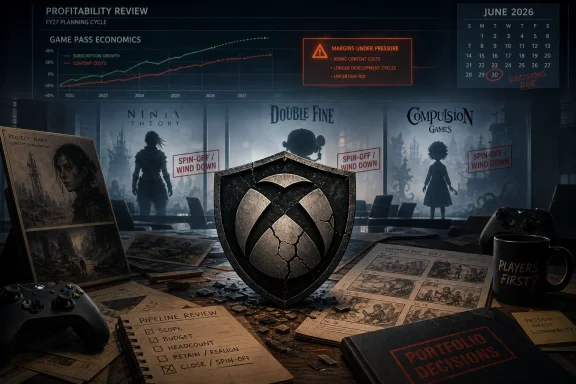 Xbox’s Reset Has Become a Studio Survival Test
The latest reporting around Xbox’s internal restructuring lands with an especially brutal kind of corporate timing. Ninja Theory had only recently shown the next Senua project, keeping alive one of Microsoft’s most distinctive first-party creative bets. Compulsion Games had just delivered South of Midnight, a stylized Southern Gothic adventure that looked nothing like the safe-service-game sludge shareholders usually imagine when they say “content pipeline.” Double Fine remains one of the few studios in the business whose name still suggests authorship rather than SKU output.That is precisely why the reported closures matter. These are not interchangeable support teams or satellite offices created to feed one annualized franchise. They are studios Microsoft once bought because they gave Xbox cultural texture: prestige, weirdness, craft, and the argument that Game Pass could be more than a buffet of sequels and shooters.
Now, according to multiple industry reports, those same studios are at risk because the math no longer supports the romance. The reported internal memo language is blunt: Microsoft has spent more than $20 billion on content, platform, and hardware subsidy outside Activision Blizzard King over five years, while annual revenue has declined by nearly half a billion dollars over that period. Even allowing for the usual fog around internal accounting, the message is obvious. Xbox’s old bargain — spend aggressively now, own the future later — has run into a wall.
This is the moment when consolidation stops being a headline about who bought whom and becomes a question of who gets to keep making games.
The Acquisition Era Was Always a Promise About Patience
For years, Microsoft’s pitch to developers and players was built around patience. Xbox would buy studios, fund them, leave them alone, and let Game Pass absorb the risk that traditional retail economics would punish. If a game was strange, short, niche, or artist-led, that was supposedly fine. The subscription needed variety, not just blockbusters.That pitch was powerful because it answered a real problem in the games business. Independent and mid-sized studios have long been trapped between underfunded autonomy and publisher dependency. Microsoft offered a third option: shelter inside one of the richest companies on Earth, with day-one distribution to millions of subscribers and the corporate muscle to weather a few commercially uneven releases.
Double Fine was almost the mascot for that idea. Psychonauts 2 arrived as the kind of game that rarely survives modern budget pressures: odd, funny, emotionally specific, and long in development. Ninja Theory’s Hellblade work represented another version of the same argument, using a smaller, highly focused production model to make something more psychologically intense than the usual action-adventure fare. Compulsion, with We Happy Few and later South of Midnight, fit the same pattern: imperfect, ambitious, visually specific, difficult to reduce to a quarterly spreadsheet.
But patience has a cost center. Once Xbox became not merely a console business but a subscription business, a cloud business, a PC storefront, a publisher, and the owner of Activision Blizzard King, every studio had to justify itself inside a more complicated machine. Microsoft could afford the experiment. That never meant Microsoft would tolerate the experiment indefinitely.
Game Pass Could Not Make Every Creative Bet Look Rational
Game Pass changed the way Xbox talked about games before it changed the underlying economics of making them. In retail, a studio can point to unit sales. In a subscription, the value of a game becomes diffuse: acquisition, retention, engagement, brand halo, regional appeal, catalog depth, and whatever internal metric leadership currently prefers. That makes a creative game harder to defend when the finance department asks what it contributed.A title like South of Midnight may strengthen Xbox’s identity even if it does not dominate playtime charts. A Double Fine release may justify itself by keeping the service artistically credible. A Ninja Theory project may give Microsoft awards-season prestige and a counterweight to the perception that Xbox only knows shooters, racers, and giant RPGs.
The problem is that those arguments are strongest when the broader business is growing. If subscriptions are rising, hardware is healthy, and third-party relations are stable, a platform holder can afford to keep the art-house wing open. If the business is shrinking or flat, the same studios begin to look exposed.
This is where the reported revenue decline matters. Microsoft’s gaming division has spent years asking observers to look past console sales and toward engagement, services, and ecosystem reach. That was plausible when the company seemed to be building a flywheel. It is harder to sustain when leadership is reportedly telling employees that five years of investment have not produced the necessary revenue trajectory.
The cruelest part is that the studios most likely to prove the artistic case for Game Pass may be among the least able to prove the spreadsheet case for survival.
Asha Sharma Inherits the Bill for Someone Else’s Empire
Asha Sharma’s reported reset has already been framed in some corners as a sudden betrayal, but that is too simple. New leaders do not create structural problems overnight. They decide which old assumptions to kill in public.Xbox spent the last decade expanding in every direction at once. It bought individual studios, then ZeniMax, then Activision Blizzard King. It pushed Game Pass across console, PC, and cloud. It promised day-one releases, broader device access, and eventually a world where Xbox was less a box under the TV than a service identity. That strategy made sense as a response to Sony’s first-party strength and Microsoft’s weak Xbox One generation. It also created a sprawling organization whose internal contradictions were easy to ignore while the money kept flowing.
Sharma’s early moves reportedly suggested a more consumer-friendly turn: pressure on Game Pass pricing, a more cautious posture toward AI branding, and an effort to simplify the story after years of confusing platform messaging. That made the studio closure reports feel sharper. Players heard “better value” and imagined lower prices or less corporate nonsense. Employees may have heard the other half of the sentence: better margins.
The internal logic is not hard to understand. If Game Pass pricing comes down or becomes more flexible, costs must come down somewhere else. If Microsoft wants less hardware subsidy, fewer bets can be justified by ecosystem theory alone. If Activision Blizzard King now provides the scale and recurring revenue that Wall Street understands, smaller narrative studios become less strategically essential.
That does not make the reported cuts wise. It only makes them legible.
The Departures Around Xbox Game Studios Signal More Than Personnel Churn
The reported exits of Craig Duncan and chief of staff Louise O’Connor add another layer to the story. Duncan, formerly associated with Rare, was not a distant finance executive parachuted into games as a spreadsheet enforcer. He represented, at least symbolically, the studio-culture side of Xbox’s internal leadership.When a studio head leaves during a wave of closure and spin-off reports, it is reasonable to read the timing as part of a broader handover. Even if the departures were planned or personally motivated, the optics are unavoidable. The people responsible for managing Microsoft’s first-party creative network are changing just as the network itself may be cut down.
That matters because studio stewardship is not only about budget approvals. It is about knowing which teams need runway, which projects are mismanaged, which ideas are worth saving, and which failures are signs of creative risk rather than organizational rot. A centralized reset can miss those distinctions if it treats every underperforming unit as a line item.
Xbox’s first-party portfolio has always been uneven. Some studios have struggled with long development cycles. Some have released critically admired games that did not become commercial monsters. Some have been too quiet for too long. But unevenness is not the same as uselessness, and a platform holder that cannot tell the difference will eventually optimize itself into blandness.
Microsoft’s danger is not merely that it may close the wrong studios. It is that it may teach the remaining ones the wrong lesson.
Ninja Theory Is the Most Symbolic Case Because It Was the Pitch
Ninja Theory’s reported position is the most jarring because the studio embodies the exact kind of creative bet Microsoft claimed it wanted. Hellblade: Senua’s Sacrifice was not a conventional blockbuster. It was a focused, psychologically intense project from a team trying to occupy the space between indie restraint and AAA polish. Microsoft’s acquisition of the studio seemed to validate that model.The subsequent years were more complicated. Senua’s Saga: Hellblade II became a showcase for visual fidelity and cinematic presentation, but it also arrived into a market increasingly skeptical of short, expensive, highly authored games. The louder the industry’s cost crisis became, the more vulnerable that model looked. A studio can win admiration and still fail to produce the kind of repeatable commercial engine large publishers now crave.
That is what makes the reported next Senua reveal so uncomfortable. Announcing a new game and then reportedly telling staff the studio may close unless a buyer emerges suggests a company trying to preserve optionality until the last possible moment. The brand may have value. The team may have value. But Microsoft may no longer believe owning the team is the best use of capital.
There is an argument that spin-off talks could be better than outright closure. If Ninja Theory, Double Fine, or Compulsion can regain independence with financing, staff continuity, and IP arrangements intact, the outcome could preserve some creative capacity. But spin-offs under duress are not romantic acts of liberation. They are emergency exits from a burning balance sheet.
The question is whether these studios would leave with enough oxygen to survive.
Double Fine Shows the Limits of Patronage
Double Fine’s reported risk cuts differently. Tim Schafer’s studio has always represented a very particular idea of game development: personal, comedic, exploratory, and stubbornly resistant to homogenization. In a healthier industry, that is an asset. In a consolidated industry, it can become a vulnerability.Microsoft did not buy Double Fine because it was the next Call of Duty. It bought Double Fine because Xbox needed credibility with players who care about creative range. The studio made Game Pass feel less algorithmic, less like a warehouse, and more like a place where the oddball stuff still had a home.
Yet the economics of that value are hard to defend in a downturn. Brand warmth is real, but it does not always survive a margin review. A subscription service can advertise breadth, but when costs tighten, breadth becomes a suspicious word. Executives begin asking which categories “move the needle,” and the history of media suggests what happens next: the middle gets squeezed, the strange gets cut, and the biggest franchises become even bigger.
If Double Fine is forced out or shut down, the message to other idiosyncratic teams will be unmistakable. Microsoft may still like creative prestige. It may no longer want to own the cost of producing it.
Compulsion’s Predicament Exposes the Industry’s Fear of Original Worlds
Compulsion Games is perhaps the least famous of the three names, but its reported uncertainty may be the clearest example of the industry’s current cowardice. South of Midnight was exactly the kind of game players often say they want from big publishers: visually distinctive, rooted in an underused cultural setting, and not obviously engineered around an endless monetization tail.That kind of game is risky. It asks marketing teams to explain a new world. It asks players to care about unfamiliar characters. It cannot rely on thirty years of brand memory. But without those risks, platform libraries become museums of familiar logos.
Microsoft’s own history should make this obvious. Xbox was built on a willingness to back identity-defining bets, from Halo to Gears of War to Xbox Live itself. Not all of those bets were safe at the time. The difference is that the modern games business has become much better at measuring risk and much worse at remembering why risk matters.
If Compulsion is closed or spun off because its work does not fit the new Xbox margin story, the loss is not only one studio. It is another signal that original, mid-budget, art-directed games are becoming structurally homeless. Too expensive to be indie, too unusual to be AAA, and too hard to quantify inside a subscription dashboard.
Activision Blizzard King Changes the Gravity of Xbox
The Activision Blizzard King acquisition was always going to reshape Xbox’s internal politics. A company that owns Call of Duty, World of Warcraft, Diablo, Candy Crush, and a massive mobile operation does not evaluate opportunity the same way it did when it was trying to patch holes in a thin first-party console lineup.Before ABK, Microsoft needed studios like Ninja Theory, Double Fine, and Compulsion to make Xbox feel culturally alive. After ABK, the center of gravity shifts toward franchises with enormous recurring audiences and proven monetization. That does not mean Microsoft no longer values smaller studios. It means those studios now compete for attention against assets that can move quarterly results in ways they cannot.
This is the trap of mega-acquisitions. They are justified as additive — more games, more teams, more options — but they often become gravitational. The biggest purchase changes what counts as success. It raises the internal bar for strategic relevance. A studio that once looked like a prized creative jewel can suddenly look like a rounding error.
Microsoft’s reported memo distinction between ABK and non-ABK investment is telling. If the company is measuring non-ABK spending against declining revenue, it is already separating the old Xbox studio strategy from the new empire’s financial engine. That is not just accounting. It is a map of power.
The post-ABK Xbox may still publish a wide range of games. But ownership is different from publishing, and the reported spin-off talks suggest Microsoft may prefer a future where it can buy or distribute creative variety without carrying all of it on the payroll.
The Console Business Is No Longer Enough Cover
The old platform-holder model gave first-party studios a kind of strategic protection. Even if a game did not sell enough copies on its own, it could help sell hardware, strengthen the brand, and keep users inside the ecosystem. That logic still exists for Nintendo and Sony, though even there the pressures are changing.Xbox has deliberately weakened that protection by redefining itself beyond the console. That may be strategically necessary, given Microsoft’s hardware position, but it also changes the internal defense for exclusive studios. If Xbox is everywhere, then a first-party game must justify itself across a wider and blurrier set of outcomes. It cannot simply be “good for the box.”
This is especially difficult when Microsoft is reportedly trying to reduce hardware subsidy. Subsidized hardware makes sense when it leads to software revenue, subscriptions, and platform fees. But if hardware is less central and margins are under pressure, the company has less reason to maintain a portfolio designed around traditional console identity.
The irony is that Xbox spent years telling players not to define the brand by console sales. Now the studios that gave Xbox a non-console identity may be vulnerable because the broader ecosystem has not produced enough financial clarity.
When a platform becomes a service, everything becomes content. And content, in Microsoft’s world, is always eligible for optimization.
Players Are Learning That “More Studios” Was Never the Same as More Security
There is a common fan reaction to acquisition waves: relief. A beloved studio is bought by a wealthy platform holder, and the immediate fear of closure or funding collapse fades. The team has backing. The next project can be bigger. The future looks safer.The last several years have demolished that assumption across the industry. Embracer’s collapse did it at one scale. Microsoft’s layoffs and closures did it at another. Sony’s retrenchment in live service has done its own version. Corporate ownership can save a studio from one kind of instability while exposing it to another: the sudden strategic reversal.
Inside a giant company, a studio’s fate can depend less on its own work than on a broader reorganization, a missed corporate target, a leadership change, or an acquisition made somewhere else. That is the uncomfortable lesson here. Ninja Theory, Double Fine, and Compulsion may not be facing risk simply because of individual failure. They may be facing risk because Xbox’s entire theory of growth is being revised.
For players, the result is a growing distrust of platform promises. When Microsoft says it values creative diversity, players can point to the studios reportedly fighting for survival. When it says Game Pass is good for discovery, players can ask whether discovery is enough to keep teams employed. When it says Xbox is a home for creators, creators can reasonably ask for how long.
This trust problem is not solved by a cheaper subscription tier or a better showcase. It is solved by demonstrating that the ecosystem can sustain more than the biggest franchises.
Developers Will Read the Signal More Carefully Than Fans
Fans experience studio closures as cultural loss. Developers experience them as labor-market data.If the reports are accurate, the message to independent studios considering acquisition is sobering. Microsoft can still offer resources, distribution, and technical infrastructure that few companies can match. But it can no longer plausibly offer insulation from corporate volatility. A studio that joins Xbox may gain reach and lose control over the conditions of its own survival.
That does not mean acquisitions will stop. Many studios will still choose the security of a large buyer over the brutal funding environment outside. But the negotiation changes when the buyer’s recent history includes layoffs, closures, and spin-off talks. Founders will ask harder questions about IP ownership, retention packages, project guarantees, and what happens if leadership changes.
The reports may also affect hiring inside Xbox itself. Top creative talent wants resources, but it also wants confidence that ambitious work will not be punished for being difficult to forecast. If Microsoft’s remaining studios conclude that only the safest bets survive, the creative culture will narrow even without more closures.
The most damaging layoffs are not always the ones that happen. Sometimes they are the projects never pitched afterward.
The AI Angle Is a Distraction, but Not an Irrelevant One
The source report frames part of Sharma’s early goodwill around a minimized reliance on AI branding such as Copilot. That detail may seem peripheral to studio closures, but it fits the broader pattern. Microsoft has spent the last few years pushing AI across nearly every product surface, sometimes in ways that felt more aligned with corporate strategy than user demand. Xbox fans have been wary of seeing that logic invade games.If Sharma really has cooled the most aggressive AI-facing parts of Xbox’s consumer pitch, that may be smart product politics. Players do not want a console that feels like a productivity suite with achievements. Developers do not want their craft reduced to prompt throughput. A less AI-saturated Xbox message would be welcome.
But no amount of restraint on Copilot changes the underlying economics. A company can talk less about AI and still behave like a company optimizing for margin above all else. In fact, the AI boom may intensify the pressure. Microsoft’s capital priorities are enormous, and gaming must compete internally with cloud, enterprise software, and infrastructure demands that promise clearer returns.
That is why the studio reports feel bigger than Xbox. Across tech, companies are trimming, reorganizing, and reallocating toward areas investors reward most. Games are culturally important, but within Microsoft they are still one division among giants. If gaming cannot show the right return profile, sentiment will not protect it.
The human cost of that logic lands on artists, designers, engineers, writers, producers, QA staff, and community teams whose work was once celebrated in trailers and is now being weighed against margin targets.
The Reported Spin-Off Talks Are the Least Bad Exit, Not a Happy Ending
There is a meaningful difference between closure and spin-off. Closure ends institutional knowledge, scatters teams, and often strands IP. A spin-off can preserve leadership, culture, and ongoing work if the departing studio secures funding and favorable terms. If Double Fine, Ninja Theory, or Compulsion can negotiate independence, many fans will understandably cheer.But independence after corporate triage is not the same as independence by choice. A studio leaving Microsoft under threat of closure would face a punishing funding market, rising development costs, and a publishing environment that is itself consolidating. It may also have to navigate complicated rights questions around existing franchises, technology, and unfinished projects.
The best-case scenario is that Microsoft lets these teams depart with dignity, enough capital or transition support to avoid immediate collapse, and reasonable access to the IP most associated with their identities. The worst-case scenario is a messy unwind in which names survive but teams shrink, projects die, and the creative promise that justified the acquisitions evaporates anyway.
Microsoft has a reputational interest in the best-case scenario. If it cannot keep every studio, it can at least avoid looking like a company that bought creative communities only to dissolve them when the metrics turned. For an ecosystem that still needs developer trust, the manner of exit matters.
The next few weeks may reveal whether “spin-off” is a genuine preservation strategy or merely a softer word used on the way to closure.
The Xbox Reset Is Really a Referendum on the Spencer Era
Phil Spencer’s Xbox was built on a humane public persona and an aggressive corporate strategy. The humane part mattered. Spencer talked like a player, acknowledged mistakes, and made Xbox feel less arrogant after the Xbox One launch debacle. The aggressive part mattered even more. Under his watch, Microsoft bought its way into a first-party position it had failed to build organically.Both things can be true. Spencer helped repair Xbox’s relationship with its audience, and the acquisition strategy he championed created obligations that his successors now must rationalize. The result is a legacy more complicated than either loyalists or critics tend to admit.
If Sharma’s Xbox is now pruning the portfolio, that does not erase why the buying spree happened. Microsoft really did need more games. It really did need more teams. It really did need a counterweight to Sony’s prestige machine and Nintendo’s evergreen franchises. But buying studios is easier than integrating them into a sustainable business model.
The reported closures suggest that Xbox may have mistaken ownership for strategy. Owning Double Fine did not answer how to measure Double Fine’s value. Owning Ninja Theory did not solve the economics of cinematic, high-end, mid-scale development. Owning Compulsion did not guarantee that original worlds would be protected when revenue missed expectations.
The Spencer era promised abundance. The Sharma era appears to be asking which parts of that abundance Xbox can actually afford.
The Cheapest Xbox Is Not Necessarily the Healthiest Xbox
A lower Game Pass price sounds like an obvious win for consumers, especially after years of subscription fatigue. But price cannot be separated from what the service is able to sustain. If cheaper Game Pass is funded by fewer creative bets, fewer internal studios, and a heavier reliance on mega-franchises, the value equation becomes more complicated.Consumers often want contradictory things from platform holders. They want low prices, day-one releases, technical polish, creative variety, no layoffs, no monetization creep, and no reduction in scope. Those desires are understandable. They are also difficult to reconcile in a market where development costs have ballooned and subscription economics remain opaque.
Microsoft encouraged some of those expectations. Game Pass was marketed as a radical deal, and for a time it was. The company trained players to expect abundance at a discount, then used acquisitions to make that abundance feel inevitable. Now, if the reports are accurate, Xbox is confronting the bill for that training.
The danger is a slow hollowing-out. Game Pass could remain attractive in raw volume while losing the very studios that gave it character. It could become cheaper and less interesting at the same time. It could win back some price-sensitive subscribers while signaling to creators that the safest path is franchise servicing.
A healthy Xbox needs more than a good monthly price. It needs a reason for players and developers to believe the ecosystem can support work that is not already guaranteed to scale.
The Names on the Chopping Block Tell Us What Xbox Values Now
The reported threat to Compulsion, Double Fine, and Ninja Theory does not mean Xbox has abandoned creativity wholesale. Microsoft still owns a vast network of studios, and some ambitious games will continue. But the specific names matter because they sit outside the easiest business cases.They are not primarily annualized content machines. They are not mobile monetization giants. They are not multiplayer service platforms with endless cosmetic revenue. They are studios whose value is partly cultural, partly artistic, partly reputational, and only sometimes directly commercial.
That kind of value is easy to praise in June showcases and hard to defend in June budget meetings. It is useful when a platform wants to look diverse, mature, and creator-friendly. It is vulnerable when the platform decides the next era is about accountability margins.
If Microsoft proceeds with closures, it will be choosing clarity over ambiguity. The company will be saying, implicitly if not explicitly, that the Xbox portfolio must become easier to justify in financial terms. That may please some investors. It may even be necessary for parts of the business. But it will make Xbox a narrower cultural force.
The old Xbox problem was that it did not have enough first-party identity. The new Xbox problem may be that it bought identity and then discovered identity is expensive to maintain.
The Practical Damage Will Reach Beyond Xbox Fans
For WindowsForum readers, this story is not only console drama. Microsoft’s gaming strategy touches PC gaming, Windows Store ambitions, Game Pass for PC, cloud streaming, controller ecosystems, cross-save infrastructure, and the broader way Microsoft thinks about consumer platforms. When Xbox contracts, the effects are felt beyond the living room.PC players may see fewer day-one oddities that make Game Pass feel worth keeping between blockbuster drops. Developers may become more cautious about pitching Windows-first or Game Pass-friendly projects if the internal appetite for variety weakens. Sysadmins and IT pros watching Microsoft’s broader consumer strategy may recognize a familiar pattern: bundling, expansion, complexity, then rationalization.
There is also a preservation angle. Studio closures can affect patches, PC optimization, accessibility updates, mod support, and long-tail availability. When teams vanish or shrink, games become harder to maintain. In an era when Windows compatibility, launcher fragmentation, and service dependencies already complicate preservation, losing the people who understand a game’s internals is not trivial.
The Xbox app on Windows has improved over time, but its value still depends on the catalog behind it. If Microsoft’s content strategy tilts further toward fewer, larger pillars, PC Game Pass risks becoming less of a discovery service and more of a waiting room between major releases. That may still be commercially viable. It is not the same promise.
The forum crowd should care because platform health is never just about the next device. It is about whether the ecosystem rewards experimentation or slowly routes everything toward the biggest denominator.
The June Reset Leaves Xbox With Fewer Ways to Sound Convincing
The concrete facts are still developing, and Microsoft has not publicly provided the full internal reasoning behind every reported studio decision. But the pattern is clear enough to judge the direction of travel. Xbox is reportedly moving from expansion to correction, and the correction is landing on studios that once helped justify the expansion.That leaves Microsoft with a messaging problem. It cannot easily claim to be the safest home for creative teams while those teams negotiate to escape closure. It cannot lean on Game Pass as a haven for variety if variety becomes a casualty of margin discipline. It cannot celebrate a Senua trailer and then treat the studio behind it as disposable without players noticing the contradiction.
The company can still reduce the damage. It can be transparent about which studios are affected. It can support spin-offs where possible. It can avoid burying layoffs under euphemisms. It can make credible commitments to the teams that remain. Most importantly, it can explain what kind of Xbox it is building now, because the old explanation no longer fits the evidence.
- Microsoft’s reported studio cuts are best understood as a correction to the acquisition-led Game Pass strategy, not as isolated bad luck for three developers.
- Ninja Theory, Double Fine, and Compulsion matter because each represents the kind of distinctive first-party work Xbox once said its ecosystem could protect.
- A cheaper or restructured Game Pass may help consumers in the short term, but it becomes a weaker bargain if it is funded by a thinner creative portfolio.
- Activision Blizzard King has changed Xbox’s internal gravity, making smaller prestige studios harder to defend against franchises with clearer recurring revenue.
- Spin-offs could preserve some teams, but only if Microsoft allows them to leave with enough funding, rights, and transition support to survive.
- The larger risk is cultural: remaining Xbox studios may learn that unusual, mid-sized, authored games are no longer worth pitching inside Microsoft.
References
- Primary source: mxdwn Games
Published: 2026-06-19T20:50:08.684637
Loading…
games.mxdwn.com - Related coverage: techradar.com
Loading…
www.techradar.com - Related coverage: gamesradar.com
Loading…
www.gamesradar.com - Related coverage: pcgamer.com
Double Fine, Ninja Theory, and other Xbox studios could close | PC Gamer
Microsoft's "Xbox reset" is starting to sound more like a bulldozing.www.pcgamer.com - Related coverage: windowscentral.com
Loading…
www.windowscentral.com - Related coverage: gematsu.com
Bloomberg: Several Xbox studios in negotiations to avoid closure - Gematsu
Several studios within Xbox are in active negotiations to spin off from the company in order to avoid closure, including Compulsion Games…www.gematsu.com
- Related coverage: techtimes.com
Loading…
www.techtimes.com - Related coverage: stevivor.com
Loading…
stevivor.com - Related coverage: engadget.com
Xbox Is Reportedly Closing Ninja Theory, Double Fine And Compulsion Games
Some well-known first-party Xbox studios are reportedly at risk of being closed down.www.engadget.com - Related coverage: videogameschronicle.com
Loading…
www.videogameschronicle.com - Related coverage: games.gg
Loading…
games.gg - Related coverage: dotesports.com
Xbox Game Pass price drop possible based on Microsoft Gaming CEO memo
New Microsoft Gaming CEO Asha Sharma acknowledges the Xbox Game Pass costs too much, and a change in price could be coming soon. dotesports.com
- Related coverage: gamespot.com
Xbox Closing We Happy Few, South Of Midnight Developer Compulsion Games - Report - GameSpot
Xbox CEO Asha Sharma recently discussed "hard truths."www.gamespot.com - Related coverage: geekwire.com
Microsoft’s new Xbox chief makes first major change, cutting Game Pass price, but with a catch
Microsoft is dropping Xbox Game Pass Ultimate from $29.99 to $22.99 a month, but future Call of Duty games will no longer be available at launch. It's the first significant move by new gaming CEO Asha Sharma. www.geekwire.com
- Related coverage: tweaktown.com
Xbox first-party studio closures target Compulsion Games, Double Fine and more, studios negotiating for independence
Microsoft is planning to shut down first-party Xbox Games Studios groups, but these developers are negotiating in a bid to secure independence from Xbox. www.tweaktown.com
- Related coverage: notebookcheck.org
Loading…
www.notebookcheck.org - Related coverage: as.com
Nuevo terremoto en Xbox: Ninja Theory, Compulsion Games y Double Fine negocian su salida ante el riesgo de cierre - Meristation
Xbox planea cerrar varios estudios, entre ellos Ninja Theory, Compulsion Games y Double Fine, pero las desarrolladoras negocian su independencia.as.com