

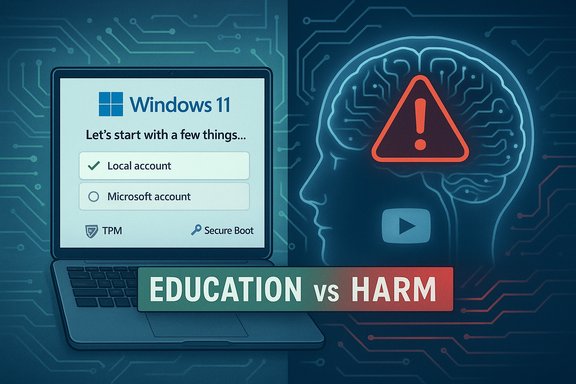
YouTube’s automated moderation has begun removing step‑by‑step Windows 11 installation guides — including videos that show how to install Windows 11 on unsupported PCs or how to complete setup with a local account — and labeling that content as “harmful or dangerous,” a decision that has pushed creators into confusion and prompted a wider debate about AI moderation, platform transparency, and the practical impact of Microsoft’s recent tightening of Windows 11 setup rules.
Windows 11’s stricter hardware and setup requirements — TPM 2.0, Secure Boot, and, more recently, enforced Microsoft‑account sign‑in during OOBE (Out‑Of‑Box Experience) in certain builds — have driven a large catalog of community‑created tutorials and workarounds. Those videos range from registry edits and unattended install methods to command‑prompt tricks that historically let users create a local account during setup or run the installer on machines that don’t meet Microsoft’s formal requirements. Many of those community workarounds were widely shared in forums, blogs, and on YouTube. In late October 2025, several creators reported sudden removals of Windows 11 walkthrough videos after receiving automated takedown notices claiming the content “encourages or promotes behavior that encourages dangerous or illegal activities that risk serious physical harm or death.” The first widely publicized report came from Rich White of the CyberCPU Tech channel, who said a local‑account setup tutorial was removed on October 26 and that an appeal was rejected in minutes — far too fast to suggest human review. Other Windows‑focused creators, including Britec09 and Hrutkay Mods, later reported similar removals.
A mature moderation strategy should protect people from instructions that cause bodily harm while preserving access to educational technical content that helps users repair, upgrade, and maintain their devices. Achieving that balance will require policy refinement, better classifier training on domain‑specific language, and reliable human escalation for edge cases.
Key takeaways
Source: Red Hot Cyber "If you install Windows 11, you can die!" YouTube blocks videos on unsupported PCs.
 Background
Windows 11’s stricter hardware and setup requirements — TPM 2.0, Secure Boot, and, more recently, enforced Microsoft‑account sign‑in during OOBE (Out‑Of‑Box Experience) in certain builds — have driven a large catalog of community‑created tutorials and workarounds. Those videos range from registry edits and unattended install methods to command‑prompt tricks that historically let users create a local account during setup or run the installer on machines that don’t meet Microsoft’s formal requirements. Many of those community workarounds were widely shared in forums, blogs, and on YouTube. In late October 2025, several creators reported sudden removals of Windows 11 walkthrough videos after receiving automated takedown notices claiming the content “encourages or promotes behavior that encourages dangerous or illegal activities that risk serious physical harm or death.” The first widely publicized report came from Rich White of the CyberCPU Tech channel, who said a local‑account setup tutorial was removed on October 26 and that an appeal was rejected in minutes — far too fast to suggest human review. Other Windows‑focused creators, including Britec09 and Hrutkay Mods, later reported similar removals. What happened — a clear timeline
October 26–27: Two videos removed from one channel
- CyberCPU Tech posted a video demonstrating how to complete Windows 11 25H2 setup with a local (offline) account; it was removed and flagged as “dangerous.” The appeal was denied within a short window, suggesting automated handling.
- The next day the same creator posted an installation on unsupported hardware guide for Windows 11 25H2; that too was removed with a similar “harmful” justification and a near‑instant appeal rejection.
Other creators report matching actions
- Britec09 and Hrutkay Mods published content on comparable subjects and reported takedowns or strikes with the same policy language and the same pattern of very fast, templated appeal responses. Creators noted that similar tutorials remain available elsewhere on YouTube, which raises questions about enforcement consistency.
The public reaction and speculation
- Some community members briefly speculated that Microsoft may have requested takedowns because the company recently neutralized several OOBE bypasses and publicly positioned those workarounds as problematic. Creators later acknowledged that direct corporate interference is unproven and that the problem likely lies with YouTube’s AI classifiers and opaque human‑review processes.
Why this matters: policy, automation, and mismatch
YouTube’s policy context
YouTube’s Community Guidelines explicitly forbid content that “encourages dangerous or illegal activities that risk serious physical harm or death.” The policy is intentionally broad and exists to stop content such as instructions for constructing weapons, hard‑drug synthesis, or life‑threatening stunts, but the guideline does allow educational or documentary context in some cases. The core of the dispute is that walkthroughs for installing or configuring an operating system are software procedures — not physical stunts — yet the moderation label treats them as if they pose imminent bodily danger.The limits of automated moderation
Creators’ reports point to an automated process: videos are taken down quickly and appeals are rejected within minutes. That pattern indicates classification and appeal adjudication are being performed primarily (if not solely) by machine learning models and templated systems with very little human escalation for borderline technical content. The consequence is a policy‑scope misclassification — an AI model trained to detect “dangerous instructions” can very plausibly confuse code, registry edits, or low‑level OS tweaks with instructions for dangerous physical acts or malicious device tampering.Inconsistency and enforcement opacity
Reports also highlight inconsistent enforcement: near‑identical videos on some channels remain online while others are removed. That arbitrary feel damages trust in the platform’s content moderation and leads creators to self‑censor. YouTube’s public reporting emphasizes machine detection at scale, but creators say the process lacks the necessary clarifying layers for technical content where context matters — whether a procedure is an educational debugging step, a legitimate repair workflow, or a malicious how‑to.The Microsoft angle — why the timing is sensitive
Microsoft closed popular bypasses in 2025
Throughout 2025 Microsoft progressively neutralized well‑known methods for bypassing the Microsoft‑account requirement in Windows 11 setup and also discouraged community workarounds for installing Windows 11 on unsupported hardware. Insider release notes and independent testing from October show code changes that removed or neutralized URIs and scripts (for example, the ms‑cxh:localonly flow and the bypassnro script) that had long been used by power users to create local accounts during OOBE. Microsoft’s stated rationale was to avoid incomplete or improperly configured devices after setup.Why creators linked Microsoft to takedowns
That product‑level tightening made speculation natural: if the vendor is actively closing loopholes, could it also be trying to limit public instructions that bypass its policies? The suggestion gained momentum because the removals coincided with Microsoft’s public changes. But evidence tying Microsoft to direct content takedown requests is absent; affected creators and independent reporting point instead to YouTube’s own moderation system as the proximate cause. In short, Microsoft’s product changes are contextually relevant but not proven to be the trigger for the removals.Technical assessment: do these tutorials actually pose physical danger?
Short answer: no — not in any ordinary meaning of the phrase “dangerous or life‑threatening.”- Installing an operating system, editing the registry, or circumventing a mandatory Microsoft account may cause data loss, system instability, or a need to reinstall the OS — but these are digital risks, not physical ones.
- The worst plausible harms from following a Windows 11 installation tutorial are bricked hardware (recoverable in many cases), data loss if a user neglects to back up, or exposure to malware if users obtain installers from untrusted sources. None of these equate to a real risk of serious bodily injury or death under normal circumstances.
The creators’ perspective and the emerging chilling effect
Creators forced to choose safe topics
Affected creators report shifting away from technical, troubleshooting, and deep‑dive content because the risk of automated strikes reduces views, jeopardizes monetization, and makes channels vulnerable to further enforcement actions. Several creators say they’ve pivoted to “safer” content to avoid subject matter that might trigger automated moderation. The result is a potential reduction in publicly available, high‑quality technical instruction.The appeal process and lack of human review
Creators uniformly point out the speed of appeal denials — often measured in minutes — as evidence that human reviewers are not assessing these cases. YouTube states it uses a mixture of human reviewers and AI, but when appeals are denied within a minute the practical reality is clear: an algorithm adjudicated the appeal. This undermines faith in the platform’s promises of nuanced human oversight for edge cases.Platform responsibility: what YouTube needs to fix
YouTube’s policy purpose is justified — stop content that causes real‑world harm — but execution requires better nuance for technical content. Recommended priorities:- Clarify policy language and create a dedicated technical content exception pathway that distinguishes digital risk from physical harm.
- Implement a human review queue for content flagged as “dangerous” when context indicates technical or educational intent (for example: registry edits, installer walkthroughs, developer tools). This queue must escalate within hours, not days or minutes.
- Publish public examples and a short checklist that creators can consult to avoid false positives: how to label educational intent, what disclaimers help, and what metadata signals acceptable technical context.
- Improve transparency for appeals: show which portion of a video triggered the automated flag and provide creators with the specific policy clause used in the takedown decision.
Practical advice for creators now
- Use clear educational framing: begin videos with an explicit educational‑only statement, discuss risks (data loss, warranty voids), and advise backups. That contextual metadata may reduce false positives.
- Avoid phrasing or thumbnails that could be misread as “how to damage” devices; emphasize restore options and safety measures.
- Provide alternate content channels or mirrors (own site, GitHub repos) for code and text steps so viewers can still access instructions if a video is taken down.
- Keep local archived copies and consider posting detailed steps in text form (which can be more robust against automated flags) while the video remains live.
Legal and business considerations
From a legal perspective, platforms are permitted to moderate content under their terms of service; creators have contractual recourse only insofar as YouTube’s own policies and appeals processes allow. What’s notable here is the reputational and economic damage to creators who depend on ad revenue and visibility. Arbitrary enforcement increases the platform’s operational risk: if creators migrate away from YouTube or self‑censor, YouTube loses specialist content that helps maintain its value for technical audiences. The business case for better, faster human review is therefore both ethical and commercial.Broader implications for digital literacy and community knowledge
Technical walkthroughs for operating systems, device repair, and software configuration are a critical component of digital literacy. When major platforms inadvertently suppress that content, it reduces consumer empowerment, increases reliance on less trustworthy sources, and pushes sensitive instructional content into smaller, less moderated corners of the internet where it can be republished without context or safety warnings.A mature moderation strategy should protect people from instructions that cause bodily harm while preserving access to educational technical content that helps users repair, upgrade, and maintain their devices. Achieving that balance will require policy refinement, better classifier training on domain‑specific language, and reliable human escalation for edge cases.
Conclusion
The removal of Windows 11 installation and local‑account walkthroughs under a “dangerous content” rubric has exposed a weak point in large‑scale AI moderation: context‑blind classifiers can mislabel legitimate technical tutorials as life‑threatening content. While Microsoft’s recent tightening of Windows 11 setup flows provides background and explains why these tutorials are popular, there is no evidence Microsoft directly requested YouTube takedowns. The proximate cause appears to be the platform’s automated moderation and appeals machinery, which currently lacks the nuance and human oversight necessary for complex technical material. Fixing this will require YouTube to build a clearer policy path for technical content, institute reliable rapid human review for contested cases, and publish practical guidance so creators can signal educational intent without fear. Until then, a chilling effect on valuable technical content is likely, and users looking to maintain or repair older hardware will suffer reduced access to trusted, community‑vetted guidance.Key takeaways
- YouTube’s AI moderation has removed Windows 11 setup and bypass tutorials, labeling them as “harmful or dangerous” and denying fast appeals.
- Microsoft recently neutralized common local‑account and installer bypasses in Insider builds, a contextual driver for the surge in tutorial postings.
- The real risk from these tutorials is digital (data loss, bricking), not immediate physical harm, making the “serious injury or death” label a categorical mismatch.
- Creators face a chilling effect and must adopt clearer educational framing, backup strategies, and multi‑channel publishing to mitigate takedown risk.
Source: Red Hot Cyber "If you install Windows 11, you can die!" YouTube blocks videos on unsupported PCs.
