

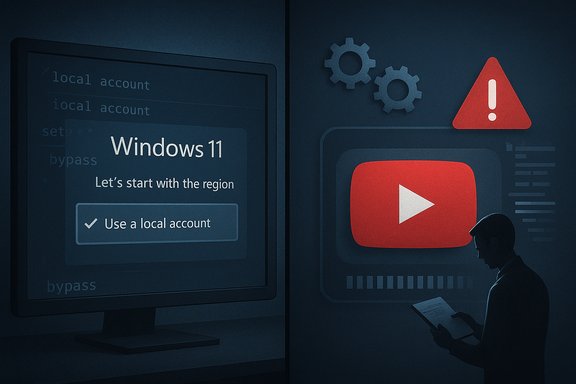
YouTube’s blunt takedown of step‑by‑step Windows 11 tutorials laid bare a modern moderation problem: automated systems built to stop life‑threatening content are misclassifying routine technical how‑tos as “dangerous,” sweeping away years of community knowledge and leaving creators exposed to strike‑based penalties that can kill a channel. The incident that put this tension on full display involved CyberCPU Tech — a mid‑sized Windows‑focused channel — whose videos showing how to create a local account during Windows 11 OOBE and how to install Windows 11 on unsupported hardware were removed with a single, startling justification: they “encourage dangerous or illegal activities that risk serious physical harm or death.”
The clash between creators and platforms did not happen in a vacuum. Microsoft has been steadily tightening the Windows 11 Out‑Of‑Box Experience (OOBE) and enforcement around hardware and account requirements — changes that prompted a long-standing ecosystem of repair channels, refurbishers, and privacy‑minded users to document workarounds. In October 2025 Microsoft’s Insider update (Dev channel Build 26220.6772) explicitly noted the company was “removing known mechanisms for creating a local account in the Windows Setup experience (OOBE),” a change that neutralized common in‑OOBE shortcuts such as the familiar oobe\bypassnro helper and the one‑line URI trick
That categorical mismatch matters for three reasons:
For creators (immediate, practical steps):
The restored videos and YouTube’s post‑hoc comment that initial actions “were not the result of automation” are welcome for the creators involved, but they leave unanswered questions that go beyond this single incident:
What the public and decision‑makers should press for is straightforward:
Fixing this requires a three‑way fix: smarter platform moderation with specialist review lanes; clearer vendor guidance and supported tooling for legitimate offline/repair workflows; and more disciplined creator practices to reduce false positives. Until those fixes are in place, expect more false alarms and the slow erosion of one of the internet’s most valuable public goods: practical, trustworthy technical instruction.
Source: It's FOSS News YouTube's Goes Bonkers, Removes Windows 11 Bypass Tutorials, Claims 'Risk of Physical Harm'
 Background / Overview
The clash between creators and platforms did not happen in a vacuum. Microsoft has been steadily tightening the Windows 11 Out‑Of‑Box Experience (OOBE) and enforcement around hardware and account requirements — changes that prompted a long-standing ecosystem of repair channels, refurbishers, and privacy‑minded users to document workarounds. In October 2025 Microsoft’s Insider update (Dev channel Build 26220.6772) explicitly noted the company was “removing known mechanisms for creating a local account in the Windows Setup experience (OOBE),” a change that neutralized common in‑OOBE shortcuts such as the familiar oobe\bypassnro helper and the one‑line URI trick start ms‑cxh:localonly. Those product changes created real demand for tutorials. For years, technicians and enthusiasts used a small toolbox of techniques for offline installs, refurbishing, or forcing an upgrade on older hardware:- OOBE Shift+F10 command prompt tricks (for example, invoking oobe\bypassnro).
- One‑line Cloud Experience Host URIs (start ms‑cxh:localonly).
- Preconfigured unattended installations using autounattend.xml or Rufus‑built media.
What happened on YouTube: timeline and immediate fallout
Late October 2025: CyberCPU Tech uploaded two videos in quick succession. The first demonstrated how to complete Windows 11 25H2 setup using a local offline account. The second walked through installing Windows 11 on unsupported hardware. Both videos were removed by YouTube and the channel received a community‑guidelines strike. The takedown notices invoked YouTube’s Harmful or Dangerous Content template, stating the material “encourages or promotes behavior that encourages dangerous or illegal activities that risk serious physical harm or death.” Appeals were filed and, according to the creator, rejected extremely quickly — one denial reported at roughly 45 minutes, the other in under five minutes — timelines that strongly suggested automated processing rather than thoughtful human review. The pattern was not limited to a single creator. Other Windows‑focused channels reported similar removals and strikes around the same period, even as similar tutorials remained available elsewhere on YouTube, creating the appearance of arbitrary, inconsistent enforcement. Creators publicly speculated about causes, with some suggesting platform‑side automation failures and others positing (without evidence) that vendor pressure may have contributed. Those latter claims remain unproven and should be treated cautiously. By early November the story evolved: after broader media coverage and community attention, YouTube re‑evaluated and restored the CyberCPU Tech videos, and the platform told the creator that the “initial actions” were not the result of automation. That reversal did not quiet concerns — it raised new questions about the opacity of enforcement and the mechanics behind takedowns and appeals.Why the policy label didn’t fit — and why that matters
YouTube’s “Harmful or Dangerous” policy exists to stop content that can directly lead to bodily harm or death: bomb‑making, lethal stunts, self‑harm instructions, and similar high‑risk guidance. Installing an operating system, editing a registry key, or using third‑party installer media are digital risks — loss of data, unsupported configurations, or potential security gaps if updates are blocked — but they are not the kind of immediate physical dangers the policy targets.That categorical mismatch matters for three reasons:
- False equivalence: Treating software walkthroughs as potentially life‑threatening conflates digital and physical risk categories, undermining policy clarity.
- Chilling effect on creators: A single strike can curtail monetization, reduce features, and — after three strikes in 90 days — lead to channel termination. Unpredictable enforcement drives creators to self‑censor, reducing the availability of high‑quality technical instruction.
- Knowledge fragmentation: When mainstream platforms remove legitimate how‑tos, users increasingly migrate to smaller, less‑moderated corners of the web where information quality and safety are uneven, potentially raising security risks.
The role of automation and opaque appeals
YouTube uses a mix of automated systems and human reviewers to manage the enormous volume of uploads. Automation is essential at scale, but classifiers lack context and domain expertise. The CyberCPU Tech case displays three technical shortcomings of a scale‑first moderation model:- Context blindness: Classifiers often operate on keywords, metadata, and short textual summaries; they struggle with long‑form, technical content where intent matters. A command like “bypass” or phrases such as “install on unsupported hardware” can trigger a worst‑case policy match even when the tutorial is clearly remedial or privacy‑preserving.
- Speed ≠ judgment: Ultra‑fast appeal denials (minutes) are evidence that appeals are sometimes handled automatically, or that human reviewers are given insufficient time and domain expertise to adjudicate. Creators received form‑letter rejections with little explanation, making remediation impossible.
- Inconsistent enforcement: Nearly identical videos remained on the platform, which suggests classifiers and takedown pipelines are uneven across channels. Inconsistent outcomes erode trust and leave creators guessing about safe content boundaries.
Verifiable technical facts and numbers
- Microsoft’s Insider release notes for Build 26220.6772 explicitly state Microsoft is “removing known mechanisms for creating a local account in the Windows Setup experience (OOBE).” That language and the associated neutralization of
oobe\bypassnroandstart ms‑cxh:localonlyhave been publicly documented. - Windows 10 reached end of support on October 14, 2025; Microsoft publicly advised users and organizations to migrate or enroll in Extended Security Updates. That timing increased pressure for upgrades and fueled the demand for how‑tos addressing older hardware.
- CyberCPU Tech’s channel size (reported in coverage) and the speed of appeal denials were cited by multiple outlets: the channel was characterized as a mid‑sized creator (roughly 300,000 subscribers in reporting), and the appeal denials were reported at ~45 minutes and under 5 minutes respectively. Those numbers come from creator statements and contemporaneous reporting. Readers should treat creator‑reported timelines as contemporaneous claims that were widely reported but cannot be independently timestamped within our article.
The human costs: creators, repairs, and the right‑to‑repair ecosystem
Technical how‑tos serve more than hobbyists. They are operational lifelines for:- Independent repair shops and refurbishers that rely on deterministic, offline install processes.
- Privacy‑conscious users who prefer local accounts to minimize cloud tie‑ins.
- Small businesses and labs that reuse older hardware rather than buy new devices during tight budgets or supply constraints.
Practical guidance — what creators, platforms, and vendors should do
This episode offers a constructive playbook for reducing false positives and protecting the public commons of technical education.For creators (immediate, practical steps):
- Use clear educational framing at the very start of videos: state the intent (repair/refurb/education), list risks (data loss, warranty implications), and advise backups. This may reduce misreading by automated classifiers.
- Publish textual guides or code in stable mirrors (own site, GitHub, archive) so readers can access steps even if a video is removed.
- Avoid incendiary thumbnails or sensational language; neutral, descriptive metadata may help avoid keyword triggers.
- Preserve local archives and transcripts to support appeals with granular timestamps.
- Create a fast human‑review lane for technical content that is flagged under broad “dangerous” categories, with reviewers who understand technical domain context and can adjudicate within hours, not days.
- Publish clearer takedown rationales: identify the specific clip, timestamp, or phrase that triggered action so creators can correct or reframe content.
- Build domain‑specific classifier signals that differentiate digital risk (data loss, bricking) from bodily‑harm risk (explosives, poison, stunts). Automated systems should default to escalation when ambiguous.
- Provide clearly documented, supported offline workflows for refurbishers and technicians or white‑list sanctioned tooling for imaging and provisioning. If a workflow is unsupported, publish a clear security and support rationale and provide alternatives for legitimate offline deployment scenarios.
Legal and reputational implications
Platforms enjoy broad latitude to enforce their Terms of Service, but enforcement must balance operational risk with reputation and the economic livelihoods of creators. The takedown‑and‑restore arc in this case shows how brittle that balance is: a single strike can have outsized consequences for a creator’s income and for viewers seeking legitimate guidance, and opaque enforcement risks regulatory scrutiny and public backlash.The restored videos and YouTube’s post‑hoc comment that initial actions “were not the result of automation” are welcome for the creators involved, but they leave unanswered questions that go beyond this single incident:
- Why did the initial enforcement action use language clearly intended for content with immediate physical risk?
- Which signals in the moderation pipeline caused the false positive?
- How many other legitimate videos were removed but not publicly tracked?
Risks and unanswered questions
This story surfaces several hard-to‑solve risks:- Scale versus subtlety trade‑off: Platforms must process millions of uploads, so automation is inevitable. But domain nuance is the only reliable defense against high‑impact false positives for educational content.
- Vendor influence perception: While there is no public evidence that Microsoft directly ordered specific takedowns in this case, the timing of Microsoft’s OOBE changes and the removals created credible suspicion among creators. That suspicion matters because perception influences creator behavior and public trust. Speculation here remains unproven and should be treated cautiously.
- Knowledge fragmentation: The long‑term outcome of consistent over‑moderation of technical content is a weaker public commons — fewer tutorials on mainstream platforms and more reliance on less‑regulated channels. That fragmentation reduces collective technical literacy and could increase security incidents as users follow lower‑quality instructions.
Where this leaves us
The CyberCPU Tech episode is not just a single creator’s quarrel with a platform; it is a case study in a broader governance problem at the intersection of product policy, platform moderation, and community knowledge. Microsoft’s product choices around OOBE and account enforcement are technical decisions with legitimate security and telemetry trade‑offs. YouTube’s takedowns — and the opaque, rapid appeal replies — are enforcement decisions with profound implications for creators and the public. Both sets of decisions deserve scrutiny, but the remedy must be cooperative rather than adversarial.What the public and decision‑makers should press for is straightforward:
- Platforms must invest in specialist human review for technical content, clear takedown rationales, and meaningful transparency.
- Vendors should publish supported alternatives or tooling for legitimate offline and bulk provisioning scenarios so the community has a documented, supported path to follow.
- Creators should adopt robust publishing practices (text mirrors, neutral metadata, explicit educational framing) to reduce false positives while platforms iterate on better moderation signals.
Conclusion
The removal and later restoration of CyberCPU Tech’s Windows 11 tutorials showcased a systemic failure of classification and process more than it revealed a deliberate policy choice to ban repair‑centric content. Automation misfires and opaque appeals have real economic and social consequences: creators face existential threats to their channels, users lose access to vetted guidance, and repair communities are pushed into shadowy corners of the web.Fixing this requires a three‑way fix: smarter platform moderation with specialist review lanes; clearer vendor guidance and supported tooling for legitimate offline/repair workflows; and more disciplined creator practices to reduce false positives. Until those fixes are in place, expect more false alarms and the slow erosion of one of the internet’s most valuable public goods: practical, trustworthy technical instruction.
Source: It's FOSS News YouTube's Goes Bonkers, Removes Windows 11 Bypass Tutorials, Claims 'Risk of Physical Harm'
