

The final day of Zero Trust World 2026 in Orlando offered a blunt, valuable lesson: even experts and celebrities can be undone by small mistakes — and the best security plans are those that assume people will fail at the worst possible moment.
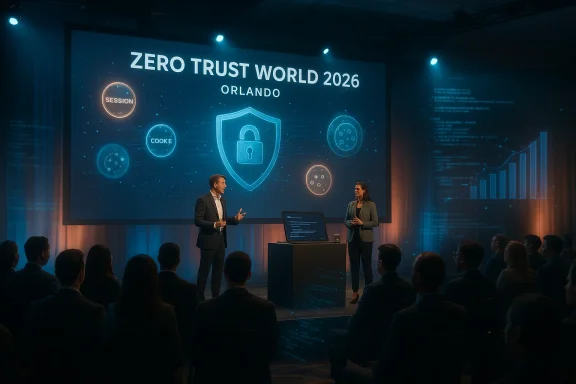
Zero Trust World, ThreatLocker’s annual conference, returned to Rosen Shingle Creek on March 4–6, 2026 as a three‑day, hands‑on gathering focused on practical hardening, identity security, and applied incident response. The show mixes mainstage keynotes with hacking labs and vendor briefings, and this year’s program included unexpected celebrity draws — from Linus Sebastian of Linus Tech Tips to Adam Savage of MythBusters — alongside deep technical training and live demonstrations.
That combination — accessible storytelling plus technical depth — is precisely why a relatively short anecdote about a single malicious PDF can travel from the mainstage and into boardrooms: real stories make abstract threats vivid, and vivid threats tend to create action. SC Media’s conference write‑up captured the arc of the day and the lessons speakers emphasized.
Why is that relevant to security leaders? In incidents where technical fixes are only part of the answer, the way leaders communicate determines reputational and legal exposure. Saying nothing or hiding material facts often amplifies damage; conversely, candid, fast remediation preserves relationships and reduces downstream escalation. The MythBusters example is a clear, memorable parable for modern incident response: fix the flaw, then fix the relationship.
What the lab at ZTW demonstrated — and what administrators should assume — is that physical access or even brief unattended presence near devices creates a high‑risk vector. Proper mitigations include blocking unauthorized USB devices, enforcing administrative policies that disallow PowerShell and scripting at non‑privileged levels, and maintaining restrictive endpoint controls that treat input devices with suspicion. The labs gave attendees both the demo and the reminder: simple hardware tricks still work in 2026 unless organizations explicitly block them.
Multiple analysis reports — from Proofpoint, Palo Alto Networks’ Unit 42, and wider vendor trackers — show threat actors and experiments using LLMs to draft PowerShell, HTML loaders, and other initial access tools. While LLM outputs often require human tuning to be fully functional, the combination of LLM‑produced scaffolding plus minor edits rapidly accelerates development for lower‑skilled actors. This trend means defenders should treat LLM‑enabled code generation as another supply chain risk.
Caveat and verification note: I searched for an immediate ThreatLocker press release or corporate post corroborating the exact $122,036 figure and did not find a dedicated press release at the time of reporting; the 2025 ThreatLocker press release documents a previous, separate donation. Because corporate PR channels can lag or post on social platforms, treat the specific number flagged by SC Media as reported by the conference coverage and likely accurate, but awaiting direct confirmation from ThreatLocker’s own 2026 news feed or a formal statement for absolute verification. In short: reported and plausible, but not yet duplicated by a ThreatLocker press release that I could locate.
Source: SC Media The importance of keeping calm in trying circumstances: Zero Trust World 2026
 Background / Overview
Zero Trust World, ThreatLocker’s annual conference, returned to Rosen Shingle Creek on March 4–6, 2026 as a three‑day, hands‑on gathering focused on practical hardening, identity security, and applied incident response. The show mixes mainstage keynotes with hacking labs and vendor briefings, and this year’s program included unexpected celebrity draws — from Linus Sebastian of Linus Tech Tips to Adam Savage of MythBusters — alongside deep technical training and live demonstrations.That combination — accessible storytelling plus technical depth — is precisely why a relatively short anecdote about a single malicious PDF can travel from the mainstage and into boardrooms: real stories make abstract threats vivid, and vivid threats tend to create action. SC Media’s conference write‑up captured the arc of the day and the lessons speakers emphasized.
Linus Tech Tips: When cookies and session tokens defeat MFA
What happened, in plain terms
Linus Media Group’s account takeover in March 2023 remains a useful case study. Their team opened an email PDF attachment that contained malware — an infostealer — which captured browser session data including cookies and screenshots, exfiltrated that data, and allowed attackers to re‑use session tokens to access logged‑in accounts without needing a password or an MFA code. The result: attackers pushed cryptocurrency scam videos across multiple channels before the team regained control. That recap was central to Linus’ Zero Trust World keynote.Why this matters technically
Attackers who steal session tokens or cookies can bypass typical multi‑factor authentication (MFA) models because the token functions as a bearer credential — possession proves the session is already authenticated. Modern guidance explicitly warns that cookies and other session secrets must be treated as short‑lived bearer tokens and protected accordingly; NIST’s authentication guidance recommends minimizing persistent session secrets and using cryptographic bindings where possible. In short: you can harden login flows, but if an attacker extracts a live session from an infected endpoint, many authentication defenses stop being effective.The human factor: context and cognitive load
Linus’ onstage anecdotes drove home the human side: distractions, social contexts, and fatigue increase the chance of misclicks. Sebastian described losing access to a Twitter account after answering a family pool‑party call; he said that when he’s busy or groggy his detection instincts lag. Security practitioners already know that social engineering is optimized for moments of distraction, but the conference highlighted a related truth: endpoint compromise turns a momentary human lapse into a long‑running identity theft.Verification and cross‑checks
Multiple industry write‑ups on the LTT incident confirm the PDF/infostealer/session token chain as the most plausible explanation reported by the victims themselves and by subsequent analysis. CyberArk’s recap and security commentary at the time reinforced the session‑token theft narrative; broader industry coverage later documented how cookie and token thefts rose as a high‑impact technique in 2023–2025. That alignment — first‑person recounting plus independent commentary — is the sort of cross‑validation we should demand before generalizing lessons to enterprise controls.MythBusters and the leadership lesson: transparency beats silence
Adam Savage’s keynote used television disaster stories — including a surprising fuselage test and a runaway cannonball — to make a central governance point: when experiments go wrong, transparency and rapid remediation buy public trust and reduce long‑term damage. Savage told the audience the MythBusters team visited damaged homeowners, explained what happened, and committed to making people whole. That outreach defused the story swiftly.Why is that relevant to security leaders? In incidents where technical fixes are only part of the answer, the way leaders communicate determines reputational and legal exposure. Saying nothing or hiding material facts often amplifies damage; conversely, candid, fast remediation preserves relationships and reduces downstream escalation. The MythBusters example is a clear, memorable parable for modern incident response: fix the flaw, then fix the relationship.
Hacking labs: Rubber Ducky, LLMs, and the double‑edged sword of training
Rubber Ducky: old trick, new context
Zero Trust World’s hands‑on labs included a session on the USB Rubber Ducky — the keystroke injection tool that operates like a keyboard and executes prewritten scripts when plugged in. The device remains a staple of red‑team toolkits because it bypasses many user‑level protections: the host sees a keyboard, not a suspicious payload, and keystroke injection can launch scripted PowerShell or other automation that defeats naive endpoint policies. The Hak5 community and the official Rubber Ducky payload repos document this technique and its DuckyScript syntax.What the lab at ZTW demonstrated — and what administrators should assume — is that physical access or even brief unattended presence near devices creates a high‑risk vector. Proper mitigations include blocking unauthorized USB devices, enforcing administrative policies that disallow PowerShell and scripting at non‑privileged levels, and maintaining restrictive endpoint controls that treat input devices with suspicion. The labs gave attendees both the demo and the reminder: simple hardware tricks still work in 2026 unless organizations explicitly block them.
LLMs and malware: a capability that’s now commodity
Perhaps the most unsettling lab showed large language models used to write infostealers and PowerShell scripts. According to SC Media, a custom model dubbed Gemma was prompted to produce malicious PowerShell for “educational” testing, and several infostealers produced by LLMs worked in a controlled VM testbed. That mirrors broader research and industry reporting: security vendors and research groups have repeatedly observed LLM‑generated code or LLM‑assisted code in malicious campaigns, and dedicated malicious LLMs (e.g., WormGPT and other underground offerings) have lowered the technical bar for developing payloads.Multiple analysis reports — from Proofpoint, Palo Alto Networks’ Unit 42, and wider vendor trackers — show threat actors and experiments using LLMs to draft PowerShell, HTML loaders, and other initial access tools. While LLM outputs often require human tuning to be fully functional, the combination of LLM‑produced scaffolding plus minor edits rapidly accelerates development for lower‑skilled actors. This trend means defenders should treat LLM‑enabled code generation as another supply chain risk.
Ethical and lab safety notes
Conferences that let attendees run malicious code in virtualized environments play an important role in training. Still, there are risk controls that must be enforced: isolated networks, immutable snapshots, and strict policies governing extraction and retention of test artifacts. SC Media’s report makes clear the ZTW lab used VMs; however, the creation and distribution of working infostealers — even for “educational” demos — should be disclosed and audited to avoid accidental leakage or downstream misuse. When conferences combine real kit (Surface laptops with large SSDs and RAM) and living code, organizers need airtight controls.Critical technical takeaways: what to do now
The conference’s speakers and lab experiences converge on a practical security checklist that maps to established guidance from NIST, CISA, and industry vendors. Below are distilled recommendations that combine the anecdotal lessons from Zero Trust World with proven technical controls.- Treat session tokens as sensitive secrets: design token lifetimes, HttpOnly and SameSite cookie settings, and session invalidation procedures according to NIST guidance. Rotate or rebind session secrets where possible.
- Assume endpoint compromise is possible: adopt “assume breach” posture — limit SaaS sessions to trusted IPs and device posture, use Conditional Access and device‑based authenticator checks. MITRE’s T1539 technique mapping reinforces that token theft is a real path to account takeover.
- Adopt phishing‑resistant MFA: prefer hardware or FIDO2 passkeys and token binding techniques that tie the authentication to a device or cryptographic proof, rather than solely relying on OTPs or SMS. These reduce the efficacy of AiTM and cookie‑reuse attacks.
- Harden endpoints against code injection and USB devices: enforce endpoint control policies that prevent unauthorized PowerShell or scripting by default, restrict USB device classes where practical, and use allowlisting rather than blocklists to limit arbitrary execution. The Rubber Ducky demo is a good reminder that physical vectors remain potent.
- Treat generative AI as an attacker tool: update playbooks to consider LLM‑assisted attack chains, run adversarial prompt tests against internal LLMs and Copilots, and enforce strict content and code review for any LLM outputs used in production. Research shows LLM outputs often contain telltale markers and may require post‑editing to be functional, but the barrier is falling.
- Inventory and segment devices that access sensitive SaaS or admin portals.
- Enforce short session lifetimes for high‑risk applications and require re‑authentication for sensitive operations.
- Deploy EDR/XDR with capabilities to detect exfiltration of browser artifacts and abnormal session reuse.
Organizational lessons: systems, not saints
Linus Sebastian’s repeated refrain — “we need systems that will protect us from our users and from ourselves” — captures the practical leadership shift required in modern operations. Security is not a training‑only problem; humans will click when distracted, be overwhelmed by context switching, or accept apparently legitimate cues during life’s messy moments. Because of that, leaders should:- Build automation that constrains human error (e.g., default‑deny posture, automated quarantine flows).
- Practice incident response with communications teams present, so the “MythBusters” response playbook — transparency, remediation, and direct outreach — becomes muscle memory.
- Fund and test sandboxed labs that expose engineers and SOC teams to real tactics in safe environments.
The donation, the optics, and a small verification flag
SC Media reported that ThreatLocker closed Zero Trust World 2026 by donating the proceeds from the conference swag store — $122,036 — to the Ronald McDonald House Charities of Central Florida, and included a photograph of CEO Danny Jenkins presenting the check onstage. That act of philanthropy mirrors ThreatLocker’s prior community contributions (for example, a $106,000 donation to RMHCCF in 2025), and it was a prominent closure to the event. SC Media published the report and photograph on March 8, 2026.Caveat and verification note: I searched for an immediate ThreatLocker press release or corporate post corroborating the exact $122,036 figure and did not find a dedicated press release at the time of reporting; the 2025 ThreatLocker press release documents a previous, separate donation. Because corporate PR channels can lag or post on social platforms, treat the specific number flagged by SC Media as reported by the conference coverage and likely accurate, but awaiting direct confirmation from ThreatLocker’s own 2026 news feed or a formal statement for absolute verification. In short: reported and plausible, but not yet duplicated by a ThreatLocker press release that I could locate.
Strengths, weaknesses, and the broader risk surface
Notable strengths demonstrated at Zero Trust World
- Practical training at scale: providing hundreds of fully outfitted lab machines gives practitioners the muscle memory to identify attack chains and test mitigations immediately. SC Media emphasized the quality of the lab environment and the hands‑on nature of the sessions.
- Narrative leverage: bringing recognizable speakers who share real failure stories (Linus, Adam Savage) made abstract risks tangible and actionable inside conference rooms and in C‑suite briefings alike.
- Zero Trust focus with behavioral controls: ThreatLocker’s live talk on ringfencing, closing SMB, and SaaS IP restrictions maps to well‑accepted controls and shows the vendor aligning product features to operational tactics. Those are realistic, measurable steps.
Potential risks and blind spots
- Operationalizing LLM safety: labs that demonstrate LLM‑crafted malware underscore an urgent risk: defenders need to assume code generated by LLMs will be used in criminal tooling. The trend is corroborated by vendor research and multiple incident reports in 2024–2026. Controlling internal assistant outputs, logging prompts, and ensuring rigorous code review are necessary but under‑deployed.
- Event demos that create artifacts: when conferences allow attendees to take home tools (physical Rubber Duckies) or run infostealers in VMs, organizers must enforce post‑event controls: no export of samples, mandatory wiping of lab images, and an audit trail of who performed which experiments. The risk is not theoretical; historically, well‑intentioned artifacts have escaped labs.
- Over‑reliance on a single vendor narrative: Linus publicly endorsing ThreatLocker after his channel compromise highlights a common reaction — rapid vendor adoption after a breach. Vendors often solve real problems, but organizations should validate controls against independent frameworks (NIST, MITRE, CISA) rather than accepting a single‑pane solution as complete.
Practical next steps for Windows admins and security teams
- Audit session and cookie lifetimes for all SaaS and internal applications. Implement short lifetimes and re‑authentication for sensitive operations.
- Enforce phishing‑resistant MFA (FIDO2/passkeys) where possible, and enable conditional access that binds sessions to device posture.
- Harden endpoints with allowlisting, PowerShell restrictions, and blocking of unauthorized USB device classes; treat HID‑like devices as untrusted by default.
- Update incident response plans to incorporate public communications and remediation playbooks, including early transparency with affected third parties. Use the MythBusters example as a template for triage + outreach.
- Test internal LLM use by running adversarial prompts and logging outputs; require human review before any LLM‑generated code runs in test or production.
Conclusion
Zero Trust World 2026 served a useful reminder: defenders need both sharp tooling and sober policy. The conference’s mix of human storytelling (Linus’ misclicks, Savage’s transparency lessons), hands‑on labs (Rubber Ducky, LLM demos), and practical vendor guidance (ThreatLocker’s ringfencing and SaaS restrictions) reinforced a single simple truth — people will err, tools will be abused, and organizations must design systems that fail safely. The best defenses now blend cryptographic authentication improvements, hardened endpoints, rigorous session management, and the cultural muscle to admit mistakes quickly and fix them publicly. In a world where session tokens can be stolen and LLMs can speed the creation of malware, calm, practiced response and layered controls are the most reliable forms of resilience.Source: SC Media The importance of keeping calm in trying circumstances: Zero Trust World 2026
