

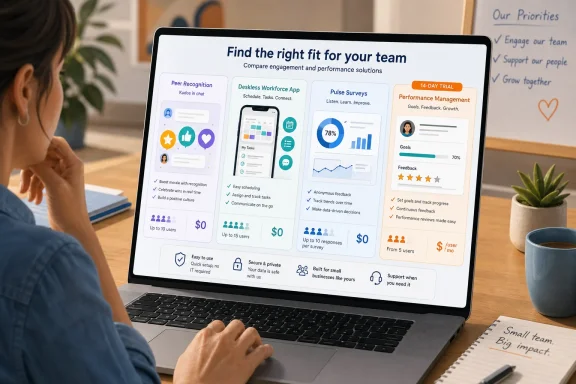
The central mismatch is 15Five. G2 includes it in a free-software roundup while clearly acknowledging that it has no permanent free plan, only a 14-day trial. That does not make 15Five a bad product; its $4-per-user-per-month Engage plan and $11-per-user-per-month Perform plan target different needs. But a trial is an evaluation period, not a free operating option, and small teams comparing recurring costs need to treat it accordingly.
The guide’s own inclusion test is also stricter than several choices can meet. It says products must support pulse surveys, custom survey distribution and reporting, plus employee recognition through internal communications. Matter’s free plan is centered on kudos, while its survey capability is an add-on. Jotform and SurveySparrow are capable feedback-collection tools, but neither is a native peer-recognition platform in the way Bonusly or Matter is. The list is best read as six adjacent tools for different pieces of engagement work.
The real free plans divide into three categories
The six products sort cleanly once the marketing language is removed.
Bonusly and Matter are recognition tools first. Both integrate with Slack and Microsoft Teams, which makes them potentially attractive for small organizations already standardized on Microsoft 365 and Teams. Their strongest feature is adoption: employees can recognize a colleague inside the communication channel they already have open, rather than being asked to remember a separate HR portal.
Connecteam is a mobile workforce-management product with engagement features. It is the outlier because scheduling, time clocks, task management, company communications, documents, PTO and forms sit alongside recognition. For a retail store, service company, construction crew or other deskless team, that concentration of operational functions matters more than an especially polished kudos feed.
Jotform and SurveySparrow are feedback collection products. They can run onboarding surveys, anonymous pulse checks, exit interviews and manager questionnaires. They do not, by themselves, create the continuous recognition and follow-through loop that most buyers mean when they say “employee engagement software.”
15Five is paid performance-management software. Its value lies in structured check-ins, one-on-ones, goals, performance reviews and engagement analysis—not in free access.
That distinction changes the recommended shortlist. A five-person office using Teams may reasonably choose Matter or Bonusly. A nine-person plumbing company should examine Connecteam first. A founder who simply needs a quarterly anonymous survey can start with Jotform or SurveySparrow. Those are different purchases even when each vendor appears in the same category.
Bonusly’s pricing and rewards details have moved
G2 presents Bonusly as a free-forever recognition option for up to eight users, with paid plans starting at $5 per user per month. Bonusly’s own current help documentation confirms the eight-user free cap, but lists its Team plan at $3 per user per month on monthly billing or $30 per user per year when billed annually.
More importantly, the boundary between “recognition” and “rewards” needs careful budgeting. Bonusly’s free plan includes peer recognition, company-value tags, Slack and Teams integrations, mobile apps, pulse checks and enhanced one-on-ones. Its current documentation also says custom rewards and Points Boost rewards are available without a subscription fee.
Paid rewards—gift cards, merchandise, charitable donations and cash-out options—are billed separately from the software subscription. Bonusly says its pay-as-you-go reward billing carries an 8% convenience fee, while prepaid Flex billing carries a 5% fee. That means the actual price of a recognition program is not just the seat price. A small business can run no-cost social recognition, but once managers fund gift cards, the recognition budget and billing fees become the larger recurring cost.
For teams of eight or fewer, Bonusly is now broader than G2’s description implies. For teams of nine or more, it ceases to be a free option immediately.
Connecteam has the most usable free operating tier
Connecteam’s Small Business Plan remains the strongest free offering in the guide if the organization has no more than 10 users. Connecteam says that plan includes all hubs and most advanced features at no cost: operations, communications, and HR and skills. Its own small-business documentation describes the offer as unrestricted for organizations below the limit.
That is unusually substantial, but the hard ceiling is operationally important. A company with 10 active employees that hires an 11th cannot just keep using the free tier with a reduced feature set; it needs to move to a paid subscription. Connecteam’s current pricing documentation places monthly Basic at $35 for the first 30 users, with per-user charges beyond that threshold. Annual billing reduces the effective monthly price to $29.
For a small field-based business, that jump can still be rational because it replaces several separate tools. A manager may otherwise pay for scheduling, time tracking, staff messaging, onboarding forms and document storage individually. But an office-based company looking only for employee recognition could be buying far more software than it needs.
Connecteam is therefore the clearest free choice for a genuine microbusiness with deskless workers, but it is not the universal winner the broader “engagement” label can imply.
Matter and Bonusly are better fits for Microsoft Teams than survey products
Matter’s free plan supplies unlimited peer-to-peer kudos, a kudos template library and Feedback Friday prompts inside Slack or Microsoft Teams. Its Basic tier costs $1 per user per month when billed annually and adds celebrations, company-value-based kudos, analytics and reporting. The $3-per-user Pro tier adds tangible rewards, including eGift cards and other redemption options.
The key limitation is that Matter’s free experience is deliberately lightweight. Its recognition works where Teams or Slack is already central to the workday; it is not a standalone engagement portal with the same utility for teams that communicate mainly through email, SMS or a line-of-business system. G2’s guide notes that Matter does not replicate the experience in a standalone web application, which makes platform choice a prerequisite rather than a minor integration detail.
For Microsoft Teams shops, that constraint may be a benefit. The lowest-friction engagement tools are usually the ones that do not ask employees to install, learn and routinely visit one more app. A weekly Teams prompt can establish a visible recognition habit, but it cannot diagnose why a worker is dissatisfied. Management still needs a mechanism to collect feedback and act on it.
That is why Matter or Bonusly can pair well with a basic survey process. Neither should be mistaken for a substitute for manager conversations, compensation review, scheduling fairness or career development—the issues that often determine whether people stay.
Jotform and SurveySparrow are feedback tools with sharply different limits
Jotform’s Starter plan is free forever, but it allows five forms, one account user and 100 submissions per month. The guide identifies a $39 monthly Bronze plan; Jotform’s current public pricing shows Bronze at $34 per month when billed annually. The difference is likely billing cadence, but it illustrates why buyers should verify whether a comparison is quoting annual or monthly pricing before treating it as a budget figure.
The 100-submission allowance is adequate for occasional pulse checks. It becomes restrictive surprisingly quickly: a 10-person weekly survey creates roughly 40 submissions in a month before onboarding, exit interviews, PTO forms or any other workflow touches the account. The one-user limit is equally consequential. A form owner can share results, but another manager cannot independently administer the account without moving to an Enterprise arrangement.
SurveySparrow offers a free plan with three active classic surveys, one active CX survey, 10 questions per survey and 75 responses per quarter. Its own pricing page confirms the quarterly response limit. For a 10-person team, one monthly pulse survey would consume 30 responses in a quarter; a weekly check-in would exhaust the allowance in less than two weeks.
SurveySparrow’s conversational format may improve completion willingness, but the free plan is best used to test that proposition rather than to establish an ongoing measurement program. Its Basic plan begins at $19 per month on annual billing and expands the response allowance to 2,500. G2’s framing is fair only if “free” means a low-volume pilot, not sustained employee listening.
15Five belongs on a paid shortlist, not a free one
15Five is the most substantial manager-effectiveness platform among the six, but it should be separated from the free-tier comparison. The vendor’s pricing page lists Engage at $4 per user per month billed annually, Perform at $11 and Total Platform at $16. The 14-day trial provides access to evaluate the system, but a business cannot continue using its engagement surveys, check-ins and performance workflow without a paid commitment.
The product is most relevant when a small business has already established the habit that free tools are designed to start: regular one-on-ones, feedback collection and manager accountability. Paying for 15Five before those behaviors exist can mean purchasing a more elaborate system than the company will use. Starting with a free recognition or feedback tool can make sense, but only if there is a named manager responsible for reviewing results and closing the loop.
The guide’s most useful takeaway is therefore not its six-product ranking. It is the upgrade trigger hidden in each vendor’s free plan: eight users for Bonusly, 10 for Connecteam, 100 monthly submissions for Jotform, and 75 quarterly responses for SurveySparrow. Small businesses should select the tool that matches today’s workflow, document the limit that will force a purchase, and set a review date before the team hits it.