
For Windows and enterprise security teams, the significance is not simply that another cybersecurity startup has created a partner portal and discount schedule. 7AI is making a broader bet: that agentic SOC platforms will be adopted most effectively when specialized partners redesign workflows, integrate existing security tools, establish governance rules, and package the technology into managed offerings. That is a more demanding proposition than reselling a point product—but it could also be more durable if customers see meaningful improvements in investigation speed, analyst capacity, and response consistency.
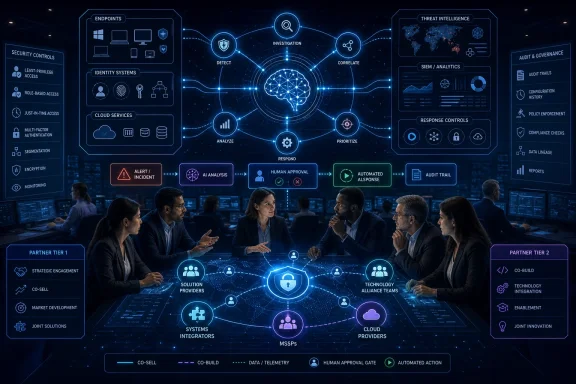 Overview: From Agentic Security Product to Partner-Led Operating Model
The new Alliance Partner Program brings five traditionally distinct channel constituencies into a common framework:
- Solution providers focused on advisory, technology selection, and professional services.
- Systems integrators tasked with redesigning security operations workflows.
- Service providers building recurring managed offerings on top of the platform.
- Technology alliance partners creating integrations and extensions.
- Cloud service providers expanding marketplace availability and co-sell reach.
That broad structure matters because agentic SOC adoption spans far more than a software procurement. An enterprise may need to connect endpoint detection and response data, identity platforms, cloud logs, security information and event management tools, ticketing systems, threat intelligence sources, and response actions. It may also need to decide which activities an AI agent can perform automatically, which require analyst approval, and which should remain entirely outside the agent’s authority.
7AI’s own platform positioning reflects that end-to-end scope. Its product is organized around incident cases, investigations, detection, response, threat hunting, and enterprise context, with AI agents intended to gather evidence, correlate activity across systems, produce investigation narratives, and in some cases initiate remediation workflows. 7AI’s platform overview describes a security operations stack that runs from alert ingestion to response, including human-in-the-loop options for high-impact actions.
That breadth makes a partner program strategically logical. A customer can buy a technology platform directly, but it often needs outside expertise to transform a legacy SOC built around queues, handoffs, manually maintained playbooks, and tiered analyst escalation. The alliance model is designed to make that expertise commercially repeatable.
Why 7AI Is Formalizing Its Channel Strategy Now
The timing is notable. 7AI is a relatively young company, founded in 2024 by Lior Div and Yonatan Striem-Amit, the cybersecurity executives also known for creating Cybereason. A 7AI announcement says its agents have autonomously investigated security alerts in production environments at Fortune 500 scale, while the company has expanded its product portfolio with Threat Hunt, Threat Intel Hunt, and Skills capabilities.
The company’s channel metrics, while self-reported, provide a concrete explanation for its move. Channel Insider reports a 6.5x expansion in channel pipeline over three quarters, a sevenfold quarter-over-quarter rise in partner-registered wins, and partner involvement in nearly 45% of pipeline. Those figures suggest that the ecosystem is already materially influencing sales activity, even before the formal program launch.
A second independent report adds useful context. CRN’s coverage describes the program as 7AI’s first formal channel initiative and notes that the company was already sourcing nearly half of its business through the channel. CRN also reports that the platform’s agents have overseen more than 7 million security investigations, according to 7AI.
The key caveat is straightforward: pipeline growth, investigation counts, false-positive reduction claims, and productivity measurements come from the vendor and should not be treated as independently audited performance benchmarks. Yet the operational thesis is credible: SOC modernization projects are usually difficult to close and deploy without partners that understand the customer’s existing technology estate, compliance obligations, incident procedures, and staffing model.
A leadership hire built for ecosystem scale
Kilpatrick’s appointment is as important as the program mechanics. According to CRN, he most recently served as vice president of global go-to-market partners at Cribl and previously spent six years at Okta, including as vice president of North America alliances.
That background fits 7AI’s present challenge. The company does not merely need resellers that can introduce it into accounts. It needs partners capable of producing repeatable service motions around agentic investigations, response automation, detection engineering, and proactive threat hunting. In a market crowded with AI security claims, a mature partner organization can help transform a promising platform into packaged outcomes a customer can understand, fund, deploy, and govern.
Kilpatrick’s public framing also appears intentionally practical. He told CRN that partners principally care about the value a solution creates, whether it will be profitable, and whether it can become “sticky” within customer accounts. That emphasis is more meaningful than generic channel rhetoric because agentic SOC technology creates opportunities for services revenue long after an initial software subscription is sold.
What the Alliance Partner Program Actually Provides
The 7AI Alliance Partner Program has Select and Premier tiers. Both are underpinned by commercial and operational components familiar to established security vendors, including value-based discounts, deal registration, renewal-incumbency protections, enablement, certifications, and dedicated alliance, sales, and technical resources. Channel Insider’s report identifies those elements as core pieces of the launch.
On the surface, this is conventional channel infrastructure. Deal registration reduces the risk that a partner creates demand only to have the vendor or another reseller take the transaction. Renewal protections provide incentives for a partner to invest in account relationships, training, deployment work, and customer success. Technical resources and certifications are essential when the technology being deployed can investigate security alerts, access multiple enterprise systems, and potentially trigger remediation activities.
But the deeper value proposition is the program’s stated focus on co-build, co-market, and co-sell motions. Instead of treating each partner as a separate reseller lane, 7AI is attempting to connect the players that collectively make an agentic SOC usable in the real world.
The five partner roles and where they fit
The roles are distinct, even if they will overlap in large enterprise accounts.
- Solution providers can introduce 7AI during technology assessments, help customers compare approaches, and attach advisory and deployment services. This is the most familiar value-added reseller motion.
- Systems integrators can do the harder architecture work: redesign incident management, define escalation paths, link agents to identity and endpoint controls, and map response procedures to the customer’s risk tolerance.
- Managed security service providers can build subscription-based services around the technology. This could include managed triage, investigation oversight, agent tuning, threat-hunting packages, and incident-response escalation.
- Technology alliance partners can improve the practical value of the platform by integrating data sources, controls, and operational tools. Integrations determine whether an AI agent has enough trusted context to reach useful conclusions and enough constrained access to act safely.
- Cloud providers can offer marketplace procurement and co-sell leverage, potentially simplifying buying processes for organizations that have committed cloud spending or standardized on cloud-native security operations.
This model is especially relevant to Windows-heavy environments. Microsoft Sentinel, Microsoft Defender XDR, Entra ID, Active Directory, Windows endpoints, and hybrid cloud workloads often generate a broad volume of telemetry and response decisions. The opportunity for an agentic SOC is not simply to read more logs; it is to correlate identity, endpoint, email, cloud, and network signals in a manner that can shorten the path from alert to defensible conclusion.
7AI says its platform can automatically populate incident cases, correlate alerts, preserve evidence, and maintain a complete audit trail. Its platform materials also say agents can gather data from multiple systems and produce conclusions with supporting evidence. For Windows security administrators, that potential is attractive because it can reduce the repeated manual work that typically consumes analysts during routine triage.
The Agentic SOC Opportunity: More Than Faster Alert Triage
“AI-powered SOC” has become an overloaded phrase. Many products use machine learning to score alerts, enrich incidents, or summarize case details. An agentic SOC makes a more ambitious claim: agents can plan and execute multistep investigative work, use enterprise context, and take—or recommend—actions based on conclusions.
7AI’s description of its response capability captures that distinction. The company says response actions can be driven by the conclusions of an investigation rather than by static, preconfigured rules alone, with options for automatic execution or one-click human approval. The platform page lists examples such as isolating endpoints, disabling accounts, blocking IP addresses, and triggering custom workflows.
The appeal is obvious. A conventional SOC often forces analysts to move among dashboards, lookup tools, endpoint consoles, identity portals, ticketing systems, and scripts. An investigation might involve checking whether a Windows device has an unusual process tree, confirming whether the user account recently authenticated from an unfamiliar location, reviewing prior endpoint activity, checking whether similar alerts occurred elsewhere, and deciding whether the account or device should be contained.
An agentic approach can compress portions of that repetitive work. 7AI says its investigation agents enrich alerts, query the environment, correlate signals across systems, and produce evidence-backed conclusions. Its stated platform workflow is aimed at reducing the time analysts spend collecting context rather than replacing the need for judgment in every security decision.
A real services opportunity for MSSPs and integrators
This is where the partner program becomes more than a sales vehicle. If 7AI’s agentic security platform becomes embedded in customer operations, a partner can create durable services around:
- SOC workflow design and operating-model transformation.
- Windows, identity, endpoint, cloud, and network telemetry integration.
- Detection logic review and false-positive reduction.
- Investigation-quality assurance.
- Threat-hunting services driven by organization-specific intelligence.
- Response automation design with approval gates.
- Governance, reporting, and audit support.
- Continuous agent tuning as the customer’s environment changes.
A prior 7AI partnership with DXC illustrates the potential model. DXC said it would integrate 7AI agents into managed security operations from alert ingestion through investigation and remediation, while also using the platform to optimize its internal SOC. The DXC and 7AI partnership announcement described the intended offering as a shift from manual operations to AI agents handling triage, investigation, and incident response.
DXC projected savings of 30 minutes to 2.5 hours per investigation in that deployment. That estimate should be read as a partner/vendor expectation rather than a universal benchmark. Still, it illustrates why managed security providers may find agentic SOC platforms commercially compelling: every repeatable reduction in manual analyst effort can improve service scale, margin, and the consistency of customer outcomes.
GuidePoint Security Signals Demand for Practical Adoption Help
The launch includes support from GuidePoint Security, whose Mark Thornberry emphasized that customers need partners that combine market perspective, technical depth, and practical guidance tailored to the environment. Channel Insider reports that GuidePoint sees the 7AI relationship as a way to collaborate on emerging security operations approaches without losing focus on practical outcomes.
That is an important qualification. The agentic SOC narrative can rapidly become abstract if it is framed only around autonomous reasoning and future potential. Customers ultimately need answers to much narrower questions:
- Which data sources will the agent use?
- What data leaves the organization, if any?
- Which tools can the agent query?
- Which actions can it execute?
- What requires analyst approval?
- How is each action logged and explained?
- How are incorrect conclusions corrected?
- Who owns the workflow after deployment?
- How is the platform measured against baseline investigation quality and response time?
GuidePoint’s own AI security practice emphasizes governance, inventorying AI tools and data use, and integrating policy and guardrail enforcement into AI adoption. GuidePoint’s AI security services page also identifies threat hunting, detection, response, remediation, endpoint security, cloud monitoring, and identity analysis as areas where AI can support defensive operations.
That alignment makes GuidePoint a relevant early partner voice. A partner that only knows how to resell licenses will struggle to answer governance and operating-model questions. A partner that can combine security architecture, managed services, and AI governance may be better positioned to make an agentic SOC useful without granting it excessive authority.
The Risks: Autonomy Does Not Remove Accountability
The most important critical point around the 7AI Alliance Partner Program is that it should not be evaluated like a conventional endpoint security reseller initiative. Agentic SOC systems have access to high-value telemetry and may be connected to high-impact response capabilities. Their success depends on governance as much as their ability to reduce alert fatigue.
NIST has made this distinction explicit. In January 2026, the agency’s Center for AI Standards and Innovation issued a request for information on securing AI agent systems, noting that such systems can plan and take autonomous actions that affect real-world systems and environments. NIST’s notice identifies risks including indirect prompt injection, insecure or poisoned models, and harmful actions taken even without adversarial inputs.
For security teams, these risks are not theoretical. A SOC agent may ingest threat intelligence, ticket descriptions, email content, endpoint evidence, cloud metadata, or web-derived intelligence. If untrusted content can influence the instructions or conclusions of an agent, safeguards must prevent that content from becoming a pathway to inappropriate data access or response actions.
The controls partners must operationalize
A capable partner program should make secure deployment practices a first-class service opportunity rather than an afterthought. Enterprises and MSSPs implementing agentic SOC capabilities should insist on at least the following controls:
- Least-privilege agent identities with narrowly scoped permissions for every connected system.
- Separation of read, recommend, and execute privileges, so investigation access does not automatically imply containment authority.
- Human approval requirements for consequential actions, particularly account disabling, endpoint isolation, data deletion, policy changes, and external communications.
- Immutable audit trails that capture the data considered, tools invoked, reasoning artifacts where available, actions proposed, approvals, and actions taken.
- Clear data-boundary rules for sensitive Windows telemetry, identity information, regulated data, and customer tenant data in managed environments.
- Validation and red-team testing for prompt injection, tool misuse, poisoned input, and incorrect escalation behavior.
- Rollback and break-glass procedures for automated changes that cause business disruption.
- Measurement against real operational baselines, including investigation time, escalation quality, missed detections, false positives, analyst overrides, and response error rates.
These requirements align with NIST’s larger AI Risk Management Framework, which is designed to help organizations incorporate trustworthiness into the design, development, use, and evaluation of AI systems. NIST’s AI RMF overview also points to a Generative AI Profile intended to help organizations identify risks that are unique to, or exacerbated by, generative AI.
The implication for 7AI partners is clear: certifications and sales enablement are valuable, but the differentiator will be the ability to operationalize trustworthy autonomy. The best services partners will not promise that AI makes human oversight unnecessary. They will define where AI can safely accelerate work, where analysts retain authority, and how customers can prove that the system stayed within those boundaries.
What Success Will Look Like for the Program
The Alliance Partner Program has several strengths from the start. It arrives with clear partner categories, a manageable two-tier structure, commercial protections that make investment more attractive, and a leadership appointment with substantial alliance experience. The strategy also matches the platform’s product direction: 7AI is positioning agents across investigations, detection, response, threat hunting, and operational knowledge—not as an isolated chatbot or alert-summary feature.
The market validation from partners is also meaningful. CRN reports that GuidePoint has collaborated with 7AI since the company was developing its initial technology and has since delivered the platform to numerous customer accounts. That account suggests that the ecosystem strategy is being built on existing field activity rather than launched entirely from scratch.
Still, partner program success cannot be measured only in sign-ups, pipeline, marketplace listings, or certification totals. The program will be strongest if it produces repeatable deployments where a Windows-centric enterprise can demonstrate:
- Fewer routine alerts requiring manual analyst handling.
- Faster, better-documented investigations.
- Consistent approvals for high-risk response actions.
- Reduced time between detection and containment.
- More analyst time available for complex incidents and proactive hunting.
- Clear auditability across agent activity and human decisions.
- A services model that gives customers expertise without creating opaque dependency.
That is a demanding standard, but it is the right one. The promise of the agentic SOC is not to eliminate security professionals. It is to remove the low-value, repetitive work that keeps skilled analysts trapped in alert queues and prevents them from focusing on adversaries, exposure reduction, and business-critical risk.
7AI’s Alliance Partner Program is therefore a consequential move because it acknowledges a central reality of enterprise cybersecurity: platforms do not transform SOCs on their own. If the company’s partners can pair agentic automation with integration discipline, operational design, and rigorous governance, the result could be a more scalable model for modern security operations. If they cannot, agentic SOC deployments risk becoming another layer of automation that creates new complexity faster than it removes the old.
