
The board supports Intel Core Ultra 200S “Arrow Lake-S” desktop processors through its LGA 1851 socket, with a listed CPU limit of 65W. AAEON’s product catalog confirms the Q870 chipset, dual DDR5-6400 SO-DIMM slots, and the board’s 0°C to 60°C operating-temperature range, positioning it more as an embedded and industrial platform than a conventional retail Mini-ITX gaming board.
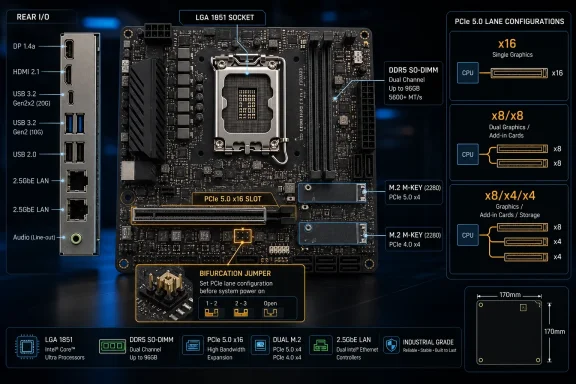 A Physical Answer to a Small-Form-Factor Constraint
PCIe bifurcation is familiar in workstation and server hardware, but it remains consequential on Mini-ITX because the format normally provides just one full-length slot. With a suitable passive riser or carrier card, the MIX-Q870A1’s x8/x8 mode could support two expansion cards, while x8/x4/x4 opens the door to a GPU or accelerator alongside multiple NVMe or network adapters.
The physical jumper is notable because it makes lane allocation explicit at the board level rather than leaving it dependent on an obscure firmware setting. System builders should still validate their riser, add-in cards, chassis clearance, and driver stack before committing to a design; splitting lanes does not itself create more physical expansion space.
Storage, Displays, and Networking Favor Embedded Deployments
According to AAEON’s specification material, the MIX-Q870A1 includes two M.2 M-key slots, two SATA 6Gbps ports, and an M.2 2230 E-key slot. The larger M.2 2280 socket uses PCIe x4 for NVMe SSDs, while the smaller M.2 2242 position supports SATA devices; the SATA ports support RAID 0 and RAID 1.
Its rear I/O is unusually dense for the form factor:
- Four display outputs—two HDMI 2.0 and two DisplayPort 1.4a connections—support multi-display installations.
- Eight USB 3.2 Gen 2 Type-A ports are available at the rear, with two additional USB 3.2 Gen 1 ports exposed internally.
- Intel I219-LM Gigabit Ethernet and Intel I226-LM 2.5GbE provide dual wired networking without consuming the PCIe slot.
AAEON also includes a 40-pin LVDS/eDP header for internal displays, an 8-bit digital I/O interface, watchdog support, TPM 2.0, and headers for a BMC module. Those details make the board a more natural fit for digital signage, machine vision, industrial control, and appliance-style Windows deployments than for consumer desktop builds.
Windows Support Is Listed, but Pricing Is Not
AAEON lists 64-bit Windows 10, Windows 11, and Ubuntu 24.04 support for the MIX-Q870A1. The Windows 10 entry will matter for organizations maintaining existing application images, though Windows 10’s general support deadline has already passed and should limit its appeal for new general-purpose deployments.
AAEON has not announced pricing, retail channels, or a broad availability date. The practical question is whether the board reaches distributors at a price that makes its PCIe lane-splitting feature compelling against larger Micro-ATX industrial platforms—the form factors that traditionally offer those expansion options without requiring risers.
