
The disclosure arrived alongside Absa Group’s interim results for the six months ended June 30, 2026. ITWeb reports that the chatbot uses natural-language interaction, asks follow-up questions and delivers personalised, data-driven answers. For Windows and enterprise IT teams, the more revealing part of the story is that Absa is pursuing customer-facing AI, employee Copilot adoption and developer coding assistants at the same time—three deployments with very different identity, data-governance and audit requirements.
Absa’s own interim results booklet, released August 18, confirms the bank is in the middle of a broad platform-modernisation programme across a 17-country footprint and has 13.4 million customers. Yet the booklet and accompanying investor presentation do not disclose the chatbot’s name, model provider, cloud architecture, supported channels, data boundaries or performance measures. The 1.6 million figure is therefore a scale signal, not enough evidence by itself that the system is delivering the quality, containment or cost savings that a production banking chatbot must prove.
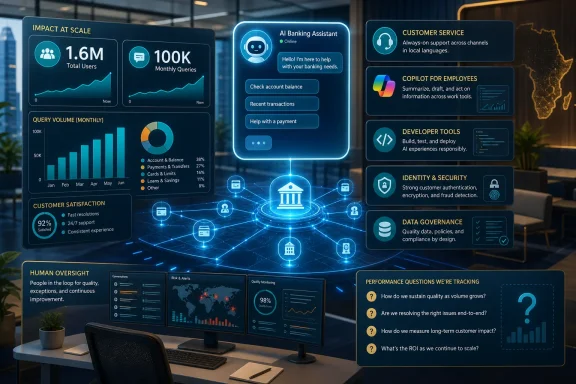 The 1.6 million figure needs a denominator
The arithmetic is the first issue. A chatbot handling more than 100,000 queries per month against a reported 1.6 million users works out to roughly one query per 16 users in a typical month, assuming both measures cover the same period and population. That could reflect a service that is available to a very large customer base but used only when needed; it could also mean the user count represents customers who are eligible for, registered for or have historically encountered the assistant rather than monthly active users.
Those are materially different measurements. A bank can accurately describe 1.6 million reachable or registered users while only a small proportion engage in a given month. It can also report large query volumes without showing whether a chatbot resolved a customer’s issue, handed it to an agent, or created a new call-centre interaction after giving an incomplete answer.
ITWeb’s report does not provide those definitions, and no equivalent KPI appears in Absa’s August 18 results materials. Neither source provides first-contact-resolution rates, escalation rates, customer-satisfaction changes, average response latency, hallucination or error rates, fraud-related false positives, or the categories of inquiry the system is allowed to answer. Those omissions are more important than the headline user count for an institution handling account, credit and payment questions.
A financial-services chatbot that answers FAQs is a different class of system from one that retrieves customer-specific account information or initiates a transaction. Absa says its assistant gives personalised answers, which implies access to customer context. The public reporting does not explain whether the system reads live banking data, uses a retrieval layer over approved knowledge sources, or exposes any agentic capability to take actions in connected systems. Until that is stated, “agentic” should be treated as a description of the bank’s ambition or implementation approach, not proof that the chatbot is independently executing financial workflows.
Absa is running three separate AI programmes
The chatbot is only one part of what Absa has disclosed. According to ITWeb, more than 30,000 employees use Microsoft Copilot every month. The same report says more than 4,400 staff with Copilot Pro access are building personal automation agents, with more than 3,800 agents live in production.
That is a substantial internal rollout by any measure. It is also a deployment that should not be conflated with the consumer chatbot. Microsoft 365 Copilot works in the productivity layer, where access decisions may draw on Microsoft 365 permissions across Outlook, Teams, SharePoint and OneDrive. Customer-service AI requires a separate control plane: customer authentication, data masking, transaction permissions, handoff rules, conversation retention and a reliable record of exactly what information the system used to form an answer.
The third programme is developer AI. ITWeb reports that more than 1,400 Absa developers are using AI-assisted coding tools, including GitHub Copilot and Anthropic’s Claude Code. That is a meaningful detail because code-generation use does not become low-risk merely because the tools are assigned to technology teams. In a regulated bank, generated code can enter repositories, pipelines, infrastructure definitions and customer-facing services rapidly. The control problem is therefore not just whether a developer’s prompt contains sensitive material; it is whether generated output is reviewed, tested, scanned and attributable before it reaches production.
Absa has not published its rules for any of those boundaries. There is no public detail on whether its Copilot users are governed through Microsoft Purview controls, whether agents can access sensitive internal repositories, whether staff-built automation agents are reviewed before publication, or how the bank separates customer information across markets. Those questions are routine production requirements, especially for an organisation operating in South Africa, Botswana, Ghana, Kenya, Mauritius, Mozambique, Seychelles, Tanzania, Uganda and Zambia, with additional operations and offices elsewhere.
“Production” is not a governance metric
The reported 3,800 live employee automation agents is perhaps the most striking number in the announcement. It indicates Absa has moved beyond a small pilot and is allowing business users to build workflows at scale. But “live in production” says little about the power of those workflows.
An agent that prepares a meeting summary from a user’s own documents has a vastly different risk profile from one that reads a shared mailbox, queries customer records, writes to a line-of-business application or triggers a financial decision. The useful metrics would be agent categories, approved connectors, data classifications, ownership, permission inheritance, exception handling, lifecycle controls and the number of agents that can make external changes.
Absa has not supplied those details publicly. That does not mean the controls do not exist; large financial institutions generally do not publish their full security architecture. It does mean readers should resist treating deployment totals as a proxy for governance maturity or realised business value.
Microsoft’s own enterprise Copilot reporting underscores the distinction between adoption and control. Microsoft has stressed that Microsoft 365 Copilot is grounded in an organisation’s existing permissions, which makes identity hygiene and over-shared content a prerequisite rather than an optional cleanup exercise. A bank rolling Copilot out to tens of thousands of workers needs to know not only who can use the assistant, but what the assistant can surface through existing access grants that may have been overly broad for years.
For Absa, the combination of Microsoft Copilot, personal automation agents, GitHub Copilot, Claude Code and a customer chatbot creates a practical need for separate inventories and monitoring. A single “AI dashboard” that counts users or prompts will not identify whether a customer-support tool exposed data, an employee agent gained an overbroad connector, or code-generated changes entered a sensitive service without the required review.
Faster contact-centre handling is the clearest outcome disclosed
Absa does provide outcome figures for a related customer-service platform. ITWeb reports that Amazon Connect has enabled contact-centre response times up to 21% faster, reduced handling time by 14% per call and cut call holding time by 44%.
Those are stronger operational measures than a chatbot’s broad user total because each has an identifiable baseline. They still need context: Absa did not disclose the affected contact centres, the dates used for comparison, call volumes, service-level targets, customer-satisfaction effects or whether changes in call mix affected the results. “Up to 21% faster,” in particular, describes a peak improvement rather than an average across the estate.
Even so, Amazon Connect and the chatbot should be considered part of the same customer-experience chain. If the chatbot answers routine requests accurately, it can reduce contact volume or prepare better escalations. If it gives ambiguous or incorrect answers, it can shift work downstream to call-centre agents and erase the headline efficiency gain. The missing measurement is containment with quality: how many customers completed an intended task without a human agent, and whether they remained satisfied with the outcome.
The same caution applies to Absa’s claim that small businesses can open accounts in minutes and that customers are receiving quicker credit decisions. The bank’s interim results establish that technology investment is central to its strategy, but they do not connect those outcomes directly to the chatbot, Microsoft Copilot, staff-built agents or coding assistants. Those may be related projects, but the public record does not establish causation.
What Absa should disclose next
The bank does not need to expose internal security designs to make this rollout more credible. Its next results update could answer the questions enterprise customers and regulators actually need answered:
- It should define whether the 1.6 million chatbot users are registered, eligible, lifetime, 90-day active or monthly active users.
- It should publish containment, escalation, correction and customer-satisfaction metrics alongside query volume.
- It should identify which customer tasks the chatbot can complete, which require human confirmation and which are blocked entirely.
- It should distinguish experimentation from production by showing how many employee agents can read sensitive data, call external services or write to business systems.
- It should explain the guardrails around Copilot, developer coding assistants and customer-service AI without disclosing defensive implementation details.
Absa’s H1 2026 results show a bank willing to deploy AI across customer service, office productivity and software delivery rather than keep it in an innovation lab. The immediate test is no longer whether the tools can attract users. It is whether Absa can demonstrate that high-volume AI activity produces safer, faster and more accurate banking outcomes—and disclose enough evidence for customers, employees and enterprise IT peers to assess that claim.