
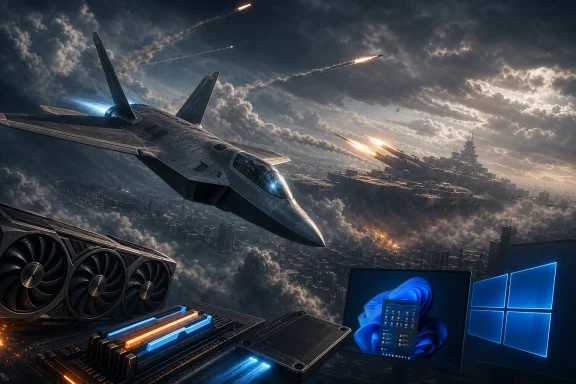
 A demanding takeoff for Ace Combat on PC
The published Ace Combat 8: Wings of Theve PC system requirements are striking because the game’s minimum profile is not a lightweight fallback configuration. Players meeting that bar should expect 1,920 × 1,080 with upscaling, low graphics settings, and a 30fps target, with Bandai Namco warning that frame rates can still fall in graphically intensive scenes. Steam’s PC requirements
That framing matters. “Minimum” is frequently interpreted as a promise of a broadly comfortable playable experience on older midrange PCs. Here, it instead describes an entry point that already assumes a modern operating system, a solid-state drive, DirectX 12, Shader Model 6.6, and dedicated graphics hardware capable of hardware-accelerated ray tracing. Steam’s PC requirements
The recommended tier is also unusually conservative in its visual goal. Bandai Namco lists 1080p upscaled at 60fps with medium settings, not native 1440p, 4K, ultra-quality rendering, or high-refresh-rate performance. That suggests Windows gamers should treat the official recommendation as a starting point for a stable console-like experience rather than evidence that an RTX 3070 or Radeon RX 6800 XT will automatically deliver uncompromised image quality at every higher resolution. Steam’s PC requirements
For a franchise built around immediacy—the rush of a missile warning, the speed of a close dogfight, the split-second decision to break through a cloud bank—performance expectations are not merely technical trivia. Input responsiveness and frame-time consistency can substantially affect how satisfying arcade-style aerial combat feels.
The official Ace Combat 8 PC requirements
Bandai Namco has published the following specifications on the game’s Steam product page.
Minimum requirements: low settings at 30fps
| Component | Official minimum requirement |
|---|---|
| Operating system | Windows 11 |
| CPU | Intel Core i7-10700K or AMD Ryzen 5 3600X |
| Memory | 16GB RAM |
| GPU | Nvidia GeForce RTX 2060 6GB or AMD Radeon RX 6600 XT 8GB |
| API | DirectX 12 |
| Storage | 125GB available SSD space |
| Target | 1080p upscaled, low settings, 30fps |
The minimum configuration also requires a hardware ray tracing-enabled graphics card and DirectX 12 with Shader Model 6.6 or newer. That explicitly excludes a range of otherwise capable older graphics cards that lack dedicated ray tracing support, even if their traditional rasterized-game performance might remain respectable. Steam’s PC requirements
Recommended requirements: medium settings at 60fps
| Component | Official recommended requirement |
|---|---|
| Operating system | Windows 11 |
| CPU | Intel Core i7-12700K or AMD Ryzen 5 5600X |
| Memory | 32GB RAM |
| GPU | Nvidia GeForce RTX 3070 8GB or AMD Radeon RX 6800 XT 16GB |
| API | DirectX 12 |
| Storage | 125GB available SSD space |
| Target | 1080p upscaled, medium settings, 60fps |
The recommendation maintains the same SSD, DirectX 12, Shader Model 6.6, and ray tracing-capable GPU requirements as the minimum tier. In other words, the primary distinction is not whether a system supports the game’s foundational rendering path, but how much CPU, memory, and graphics headroom it has once that baseline is met. Steam’s PC requirements
No official specification has yet been published for high or ultra settings, native-resolution 1080p, 1440p, 4K, ray tracing quality options, or 120fps and above. That leaves a substantial unanswered question for enthusiasts with high-refresh displays, ultrawide monitors, or premium GPUs: the published recommended requirements should not be read as a forecast for top-tier settings.
Why the ray tracing requirement is the most consequential detail
A requirement for an RTX 2060 or Radeon RX 6600 XT might initially look like a routine modern GPU cutoff. The more important line is the additional note requiring a hardware ray tracing-enabled graphics card.
This is a meaningful distinction. Plenty of graphics cards can run DirectX 12 games, and many can support recent shader features to varying degrees. Requiring hardware ray tracing narrows the eligible hardware pool around newer GPU architectures, including Nvidia RTX-class products and AMD’s RDNA 2-era Radeon cards or later.
Compatibility is not the same as visual settings
The Steam listing does not say that players must enable a selectable ray tracing visual preset. It says the game requires ray tracing-capable hardware as part of its technical baseline. Steam’s PC requirements
That wording raises the possibility that the title relies on features from a modern rendering stack even at lower presets, perhaps for elements such as lighting, reflections, shadows, geometry streaming, or scene-management workflows. It would be premature to declare exactly which rendering technologies are mandatory before Bandai Namco details its graphics settings, but the practical outcome is already clear: a card such as Nvidia’s GTX 10-series, despite being familiar to many PC players, falls outside the stated requirement because it lacks hardware ray tracing acceleration.
For Windows gamers, that is the central upgrade message. A PC that remains perfectly adequate for older DirectX 11 titles may be unable to launch Ace Combat 8 according to the official compatibility profile, regardless of its CPU or RAM capacity.
Upscaling is part of the baseline, not a luxury option
The performance targets are also explicitly marked as “1080p upscaled.” Steam’s PC requirements
Upscaling has become a normal component of PC game rendering, especially in visually ambitious releases. But it is revealing that the official figures assume it at both minimum and recommended levels. The RTX 3070 and Radeon RX 6800 XT are still substantial graphics cards, yet Bandai Namco’s published target for them is 60fps at 1080p upscaled and medium quality.
That could mean the final game is exceptionally ambitious visually. It could also mean the requirements are deliberately conservative, designed to leave room for the most punishing missions and effects-heavy scenes. The listing itself cautions that performance can decline during graphics-intensive moments, so players should regard the figures as estimated targets rather than hard guarantees. Steam’s PC requirements
Windows 11 is not optional on the Steam listing
The game’s operating-system requirement is simply Windows 11 for both minimum and recommended configurations. Steam’s PC requirements
That makes Ace Combat 8: Wings of Theve a clear compatibility problem for players who have elected to stay on Windows 10. The specification does not list Windows 10 as supported, and it does not present a Windows 10 compatibility tier with reduced visual options or lowered performance expectations.
For the Windows gaming community, this is the kind of requirement that deserves attention well before launch. A GPU or memory upgrade is an obvious hardware expense. An operating-system migration can carry its own practical work: verifying motherboard support, firmware settings, TPM and Secure Boot readiness where relevant, application compatibility, backup procedures, driver refreshes, and general system housekeeping.
A more modern PC platform assumption
The collective requirements point to a game designed around a recent PC platform:
- Windows 11
- A 64-bit processor and operating system
- DirectX 12
- Shader Model 6.6 or newer
- An SSD rather than a hard drive
- Hardware ray tracing support
- At least 16GB of system memory
None of those elements is extraordinary in isolation. Together, however, they draw a firm line between current-generation gaming PCs and systems that have remained capable by relying on older, well-optimized titles.
The potential upside is straightforward: designing around newer APIs and storage assumptions can allow developers to build denser scenes, more complex visual effects, and faster asset delivery without maintaining as many compromises for legacy configurations. The risk is equally straightforward: the number of players who can participate at launch may be smaller, especially when the minimum target is only 30fps at low settings with upscaling.
32GB of RAM has become the recommended reality
The shift from 16GB to 32GB of RAM at the recommended level may be less surprising than the ray tracing requirement, but it is arguably more relevant to the average Windows upgrade path.
For many years, 16GB was the comfortable mainstream recommendation for gaming. In Ace Combat 8, it is officially the minimum. The recommended specification doubles that allocation to 32GB, alongside a faster class of processor and GPU. Steam’s PC requirements
What 32GB may indicate
The system-memory requirement does not prove that the game alone will always consume nearly 32GB. Windows itself, background applications, browser tabs, game launchers, capture software, voice chat tools, overlays, and security software all share available memory.
Still, the recommendation signals that Bandai Namco expects the experience to benefit from greater memory headroom. That is plausible for a title centered on broad skies, detailed cityscapes, volatile weather, giant weapon encounters, cinematic sequences, and online modes. The publisher says the game is using Unreal Engine 5 alongside proprietary Cloudly technology to create its aerial environments. Bandai Namco’s launch announcement
For PC players with 16GB, this does not mean the game is automatically out of reach; 16GB remains the official minimum. It does mean that a system already prone to stutter when multitasking, streaming, recording, or maintaining a crowded browser session could face tighter margins than the raw “minimum supported” label suggests.
Upgrade guidance: prioritize the actual bottleneck
Gamers planning upgrades should avoid treating the requirements as a single shopping list. The right upgrade depends on where a particular PC fails the specification.
- Windows 10 users should first account for the Windows 11 requirement and verify that their hardware supports an orderly transition.
- Hard-drive installations need an SSD plan, because the game specifically requires one rather than merely recommending it.
- Owners of non-RTX Nvidia cards or pre-RDNA 2 Radeon GPUs should focus on graphics compatibility first, since the ray tracing-capable hardware condition is a gatekeeper.
- Systems with 16GB of RAM meet the listed minimum, but upgrading to 32GB could be sensible when chasing the published recommended experience or when running other software while playing.
- CPU upgrades should be weighed carefully. The official minimum starts at a Core i7-10700K or Ryzen 5 3600X, while the recommended list names a Core i7-12700K or Ryzen 5 5600X. Steam’s PC requirements
Laptop users in particular should be cautious about direct desktop-to-mobile comparisons. A notebook processor or GPU may share a family name with a listed desktop part while operating within a very different thermal and power envelope. Until final performance analysis arrives, the published desktop examples are best understood as useful reference points, not one-to-one laptop equivalencies.
125GB SSD storage is a substantial reservation
Both specifications require 125GB of available storage space, and the game must be installed on an SSD. Steam’s PC requirements
That is a considerable allocation even in an era of large PC releases. It can be especially problematic for players using 500GB SSDs already occupied by Windows, applications, restore capacity, and a handful of major games. The safe approach is not to aim for exactly 125GB free, but to leave additional working space for downloads, patches, shader caches, temporary installation files, saved captures, and future updates.
The high storage figure aligns with the presentation Bandai Namco is promising. The publisher describes dynamic multilayered cloudscapes, expansive landscapes and cities, fast-paced aerial combat, a cinematic campaign, and a substantial online component. Bandai Namco’s launch announcement None of that establishes a precise reason for the install size, but it does provide context for why storage planning is no longer an afterthought.
Unreal Engine 5 ambitions meet arcade flight combat
Ace Combat 8 is being developed by Bandai Namco Aces Inc., with Bandai Namco positioning it as the first mainline entry in seven years and confirming the use of Unreal Engine 5. Bandai Namco’s launch announcement
The technical direction fits the game’s visual ambitions. The Steam page promises dynamic, multilayered cloudscapes, cinematic first-person sequences, high-speed arcade flight action, and missions built around powerful weapons and battles across the sky. Steam’s product page
Large-scale battles have always been part of the appeal
The campaign returns to Strangereal, the series’ shared fictional setting. The story is set in July 2029, after the Federation of Central Usea is invaded by the neighboring Republic of Sotoa, leaving the FCU military scattered and its capital, Theve, occupied. PlayStation Blog’s campaign overview
Players take command of Joker Squadron and lead the fight back. Bandai Namco has emphasized squad relationships and command decisions as well as solo piloting, while the PlayStation presentation describes squadron composition and wingman commands as part of the mission structure. Bandai Namco’s launch announcement PlayStation Blog’s campaign overview
One of the showcased spectacle encounters is the Land Battleship, an enormous mobile weapon approximately 450 meters long that attacks Theve and must be confronted while pilots evade its main-gun fire. PlayStation Blog’s campaign overview TechSpot’s reporting identifies Land Battleship No. 1, Xanthos, as a centerpiece of Campaign Mission 9, “The Land Battleship Blockade,” though prospective players should note that mission naming and placement remain pre-release details that can change before launch. TechSpot’s system-requirements report
That blend of absurdly large boss weapons, real-world-inspired aircraft, melodramatic war fiction, and accessible flight handling is core to the identity of Ace Combat. The real question is whether the PC version can deliver its visual scale without making frame-rate compromises feel inseparable from the experience.
Denuvo and kernel-level Easy Anti-Cheat add another PC consideration
The Steam listing says the game incorporates Denuvo Anti-Tamper third-party DRM and includes a “five different systems within a day” machine activation limit. It also labels the game as using kernel-level anti-cheat and names Easy Anti-Cheat. Steam’s product page
Those disclosures deserve a separate discussion from the game’s graphics requirements.
What is confirmed
The available storefront information confirms:
- Denuvo Anti-Tamper DRM
- A limit of five different system activations per day
- Easy Anti-Cheat
- A kernel-level anti-cheat designation
- Online PvP, online co-op, and cross-platform multiplayer features Steam’s product page
The game’s online ambitions are significant. Steam describes Ace Combat Online as the series’ largest multiplayer offering, with an online lobby, air-base exploration through a customized avatar, co-op, and cross-platform play. Steam’s product page
Why this will concern some PC players
Denuvo and kernel-level anti-cheat tools have long been contentious in PC gaming. Concerns typically center on performance overhead, privacy, software compatibility, modding, Linux and Proton behavior, and the degree of system access involved in anti-cheat enforcement.
However, the inclusion of those technologies alone does not establish that Ace Combat 8 will have a specific performance penalty, security flaw, or compatibility issue. Those outcomes depend on the exact implementation and can only be evaluated responsibly through launch-period testing.
The strongest practical conclusion for now is narrower: Ace Combat 8 combines demanding official hardware requirements with DRM and anti-cheat layers that will likely receive close scrutiny once players can test the finished PC build. For gamers who prioritize offline play, modding, handheld-PC compatibility, or minimal background software, that is relevant purchase information—not an automatic verdict on the game’s quality.
Release timing requires a small calendar clarification
Bandai Namco’s announcement states that Ace Combat 8: Wings of Theve will launch for PlayStation 5, Xbox Series X|S, and PC on October 2, 2026, with Deluxe Edition early access beginning before the general launch. Bandai Namco’s launch announcement
Steam currently lists the PC release as October 1, 2026, while its Deluxe Edition page says advance access begins on September 28 at 3:00 PM PDT. Steam’s product page This is not necessarily a contradiction: Bandai Namco’s PlayStation announcement specifies regional unlock timing, including October 1 at 3:00 PM PT / 6:00 PM ET and October 2 at 12:00 AM CEST / 7:00 AM JST. PlayStation Blog’s campaign overview
For U.S. Windows players, the important expectation is that the standard edition may unlock on the evening of October 1, 2026, even though the global release date is commonly presented as October 2.
The bottom line for Windows gamers
Ace Combat 8: Wings of Theve is not merely another sequel with an updated aircraft roster and sharper clouds. Its PC specification makes a more aggressive statement: Bandai Namco is building around a modern Windows 11, DirectX 12, SSD, ray tracing-capable hardware baseline, and it expects 32GB of RAM for the recommended 60fps experience.
There are promising implications. Unreal Engine 5, dynamic cloud layers, cinematic storytelling, giant land-battleship encounters, and expanded multiplayer could give the series the visual and systemic leap fans have been waiting for. The campaign’s return to Strangereal and its focus on a desperate counteroffensive also suggest the kind of heightened military drama that has helped make Ace Combat distinctive. Bandai Namco’s launch announcement PlayStation Blog’s campaign overview
But the risks are clear as well. A 30fps low-settings minimum at 1080p upscaled, coupled with a strict hardware ray tracing requirement, means a sizeable portion of older gaming PCs will need more than a settings adjustment. The 125GB SSD demand, Windows 11 requirement, and Denuvo-plus-Easy Anti-Cheat stack further increase the preparation required for a smooth day-one experience.
For PC pilots, the sensible response is to assess compatibility early rather than wait for launch day. Ace Combat 8 may promise the fantasy of effortless flight, but its official system requirements make clear that getting into the cockpit will demand a notably current Windows gaming rig.
